Bitcoin Institutional Demand Overtakes BTC Mining Output – Here Are The Figures

bitcoinistPublished on 2026-04-04Last updated on 2026-04-04

Abstract

A recent report highlights a significant shift in the Bitcoin market: institutional demand for BTC is now substantially outpacing the supply of newly mined coins. Despite ongoing macroeconomic uncertainty, public companies acquired over 47,000 BTC in March alone—valued at approximately $3.14 billion—nearly doubling the previous month's accumulation. In contrast, only 13,950 BTC were mined during the same period, intensifying Bitcoin’s scarcity narrative. Leading the institutional charge is Michael Saylor’s MicroStrategy, which accounted for 44,377 of the net acquired BTC. This growing demand is further reflected in declining exchange balances, with BTC supply on exchanges dropping to a multi-year low of 14.6% by April 2026. A similar trend is observed in Ethereum, suggesting a broader institutional accumulation pattern. This supply-demand imbalance may serve as a catalyst for Bitcoin’s future price movement.

Bitcoin demand is taking a crucial turn in a market hampered by ongoing negative macroeconomic and political events across the globe. A recent report has outlined an increasing interest and demand for the leading cryptocurrency asset among large companies, which has now significantly exceeded those produced by miners in the market.

More Bitcoin Is Absorbed Than Being Mined

While price direction has been uncertain and unstable for the past few weeks, a growing imbalance is starting to take shape in the Bitcoin market. This imbalance focuses on institutions’ interests in BTC compared to new coins being mined.

On the X platform, a crypto investor known as AltCryptoGems has shared that institutional demand for BTC is rising at a substantial rate despite current unfavorable market conditions. Currently, public companies are scooping up more BTC faster than the rate at which miners are producing new coins.

As it continues to expand, this dynamic is strengthening the scarcity narrative of the flagship asset and reducing the amount of liquidity that is available. Such an imbalance could play a crucial role or act as a catalyst for the asset’s next price move. When large institutions accumulate, it is typically a clear sign of conviction in the asset’s long-term prospects.
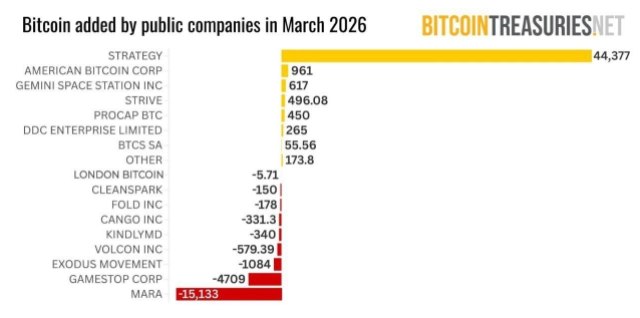
Source: Chart from AltCryptoGems on X

The recently concluded month of March saw a wave of accumulation from these big public firms. In the month alone, the expert revealed that these companies collectively added over 47,000 BTC valued at approximately $3.14 billion at current price levels, to their balance sheets. Leading the charge is Michael Saylor’s Strategy, amassing over 44,377 BTC out of the net acquisition.

When compared to the prior month, this is significantly higher, as it saw over 29,590 BTC being scooped up by public institutions. This shows that institutional interest and demand in BTC nearly doubled within a monthly period. As for Bitcoin mining, only 13,950 BTC were mined during the same period, indicating that demand is currently clouding new supply into the market.

BTC Exchange Balance Is Drying Up Pretty Fast

Despite persistent sideways price action and ongoing volatility, the underlying sentiment toward Bitcoin is turning quite bullish. Investors on cryptocurrency exchanges are steadily taking out their BTC from these platforms. Market expert Leon Waidmann reported that BTC balance on cryptocurrency exchanges is not sitting at its lowest level since 2018.

After a period of steady withdrawals, the total supply of BTC left on exchanges is only 14.6%. From 2019 to 2022, the balance dropped to the 16% to 18% range, and then gradually continued bleeding throughout 2022. Now, 8 years later, the percentage has dropped to 14.6% as of April 2026.

Ethereum, the second-largest cryptocurrency asset, has also witnessed a similar trend, with balances on exchanges now sitting at 11%, its lowest level in years. Both leading assets are at historic lows at the same time, making this period a crucial one for the market as it could notably shift sentiment.

BTC trading at $67,159 on the 1D chart | Source: BTCUSDT on Tradingview.com

Related Questions

QAccording to the article, how much Bitcoin did public companies collectively add to their balance sheets in March, and what was its approximate value?

AIn March, public companies collectively added over 47,000 BTC to their balance sheets, valued at approximately $3.14 billion at current price levels.

QWhat does the article state is the significance of large institutions accumulating Bitcoin?

AWhen large institutions accumulate Bitcoin, it is typically a clear sign of conviction in the asset's long-term prospects and can act as a catalyst for its next price move.

QHow does the institutional demand for Bitcoin compare to the new supply from mining, as reported for March?

AInstitutional demand significantly exceeded mining output. While public companies acquired over 47,000 BTC, only 13,950 BTC were mined during the same period.

QWhat trend is reported regarding the balance of Bitcoin on cryptocurrency exchanges?

AThe balance of Bitcoin on cryptocurrency exchanges is at its lowest level since 2018, with only 14.6% of the total supply remaining on exchanges as of April 2026.

QWhich company was highlighted as the largest accumulator of Bitcoin in the recent wave of institutional buying?

AMichael Saylor's company, MicroStrategy, led the charge by amassing over 44,377 BTC out of the net acquisition.

Related Reads

Solana Price Forecast for August 2026: Can $19 Million from Morgan Stanley and 330,000 Korean Merchants Break SOL's Triangle?

**Solana Price Forecast for August 2026: Key Catalysts and Technical Setup** As of July 31, Solana (SOL) trades at $73.59, consolidating within a triangle pattern formed between its May peak (~$98) and June low (~$60.29). A decisive breakout from this pattern is anticipated. Key resistance levels are clustered around $74.79 (0.382 Fib), $75.33 (20-day EMA), $76.01 (50-day EMA), and a critical zone near $79 (0.5 Fib & 100-day EMA). Support lies at $73.42, $69.25 (0.236 Fib), and the June low of $60.29. Two major institutional catalysts emerged recently: 1. **Morgan Stanley's MSOL ETF:** Launched July 28, it saw $19.06 million in inflows on its second day—the largest single-day inflow for any US SOL ETF since mid-May. 2. **KSNET Partnership:** The Solana Foundation signed an MoU with South Korean payment processor KSNET (serving 330,000 merchants) to explore integrating Solana Pay for domestic and AI-powered transactions. Historically, August has been volatile for SOL, marked by extreme gains in 2020 and 2021 but otherwise weak performance. The forecast for August 2026 is bifurcated: * **Bullish Case:** An upside triangle breakout, sustained MSOL inflows, and positive momentum from the KSNET news could propel SOL toward the $79 resistance cluster, especially if the CLARITY Act is passed by August 8. * **Bearish Case:** A downside break below $73.42, fading excitement around the new ETF, and stalled regulatory progress could see SOL retest support near $69.25, exacerbated by macro risks.

cryptonews.ru10m ago

Solana Price Forecast for August 2026: Can $19 Million from Morgan Stanley and 330,000 Korean Merchants Break SOL's Triangle?

cryptonews.ru10m ago

AFX Trade Promises to Present "Goodwill Plan" on August 3 Following $24 Million Loss Incident

AFX Trade, a cryptocurrency platform, announced it will present a "goodwill plan" on August 3rd, following a security incident on July 22nd that resulted in a loss of $24.15 million. The company's brief update offered no specific details on compensation for affected users, investors, and employees, only urging calm while the team formulates next steps. The theft occurred from a USDC custody account on Arbitrum, with the stolen funds converted to Ethereum. Blockchain analysts traced the funds to a single wallet. AFX Trade and Arbitrum clarified the exploit targeted a third-party bridge, not Arbitrum's native bridge. An investigation revealed the attack began on July 9th with a social engineering scheme targeting a developer. The attacker then deployed malicious code within AFX's internal JFrog repository and infrastructure, eventually compromising bridge validators to authorize the fraudulent withdrawal. The company stated the exploit leveraged a "trust vulnerability," not a smart contract bug. AFX Trade's head of business development made an offer to the attacker, proposing they keep 30% of the funds as a white hat bounty if 70% is returned. The incident fits a 2026 trend identified by TRM Labs: while the number of crypto hacks hit a record, total losses decreased. However, infrastructure and operational breaches, though fewer, accounted for the majority of financial losses. The AFX breach is classified as an infrastructure incident involving private key compromise.

cryptonews.ru21m ago

AFX Trade Promises to Present "Goodwill Plan" on August 3 Following $24 Million Loss Incident

cryptonews.ru21m ago

Trading

Spot
活动图片