Bitcoin Inflection Point Forms At $70k As Institutional Demand Offsets Whale Sell-Off

bitcoinistPublished on 2026-03-15Last updated on 2026-03-15

Abstract

Bitcoin's price is consolidating around $70,000 as a battle between investor cohorts unfolds. On-chain analysis reveals long-term holders are defending their cost basis, selling at near break-even levels (LTH-SOPR at 1.01). While miner exhaustion is signaled by a declining Puell Multiple, potentially hinting at a bearish move to $54,000, significant whale distribution was absorbed by other large holders and relentless institutional demand. Spot ETFs recorded over $763 million in net inflows, buffering the market. This institutional conviction validates $70k as a key support floor, with 'Smart Money' positioned for the next major price move.

Over the last day, the Bitcoin price has displayed sideways movement, without any apparent intent of a breakout. While this is a typical weekend price action, there has been an interesting update on the underlying dynamics keeping the flagship cryptocurrency grounded around $70,000.

Bitcoin LTH-SOPR Falls To 1.01 — What This Means

In a recent QuickTake post on CryptoQuant, on-chain analyst GugaOnChain reveals that a battle between different cohorts of Bitcoin investors is currently unfolding.

GugaOnChain cites the Long-Term Holder SOPR (Spent Output Profit Ratio) metric, which tracks whether long-term investors (who have held Bitcoin for at least 155 days) are selling their tokens profitably, or at a loss. Readings above 1 suggest that these investors are accumulating profits, while readings under 1 reveal otherwise.

According to GugaOnChain, the LTH-SOPR currently stands at 1.01, reflecting that Bitcoin’s long-term investors are exiting the markets at break-even, or with minimal profits. The analyst further explains that this means the “veterans are once again aggressively defending their acquisition cost at $70,675.”

At the same time, the Puell Multiple reflects a reading of 0.60, which GugaOnChain describes as a typical sign that the market is undervalued and that Bitcoin’s miners are starting to experience exhaustion. Usually, when the Puell Multiple falls to 0.5, it marks capitulation among miners.

It is worth noting that if the Puell Multiple should continue on its approach towards the 0.5 mark, the Bitcoin price could follow on such a bearish move, until its Realized Price at $54,000 is retested.

Institutional Demand Buffers Whale Distribution

Notably, GugaOnChain explains that the most significant development is still largely dependent on the dynamics between whale cohorts. As of March 13, there was a massive distribution of about 16,100 BTC among the whales holding between 1,000 and 10,000 BTC. Normally, such a large sell-off should trigger a sudden downturn in the Bitcoin price, but prices only retraced by about 0.33%. GugaOnChain points out that this is due to the absorption of supply by differing whale cohorts, and even institutional investors.

Specifically, the ‘Mega Whales,’ who have custody of more than 10,000 BTC, alongside the ‘Dolphins’ (holding between 100 and 1,000 BTC), both countered what should have been a devastating price drop. At the same time, institutional demand has been unrelenting over the week. During this period, spot ETFs have recorded a total of $763.4 million in net inflows, with $180.4 million coming in on March 13 alone.

While the Puell Multiple reflects the possibility of $54,000 being visited, GugaOnChain insists that ‘Smart Money currently validates $70k as the “inflection floor”’. As such, if the LTH-SOPR continues to prevail above 1.0, it would reflect that the current Bitcoin cost has been successfully defended. Interestingly, ETF’s conviction capital is already positioned for the next big move. As of this writing, Bitcoin trades for $71,000, reflecting a 0.5% gain in 24 hours.

BTC trading at $71,470 on the daily chart | Source: BTCUSDT chart on Tradingview.com

Trending Cryptos

Related Questions

QWhat does the Long-Term Holder SOPR (LTH-SOPR) reading of 1.01 indicate about Bitcoin investors?

AA reading of 1.01 for the Long-Term Holder SOPR indicates that Bitcoin's long-term investors (those holding for at least 155 days) are exiting the markets at break-even or with minimal profits. It suggests they are aggressively defending their acquisition cost around $70,675.

QAccording to the analyst, what is the significance of the Puell Multiple reading of 0.60?

AA Puell Multiple reading of 0.60 is a typical sign that the Bitcoin market is undervalued and that miners are starting to experience exhaustion. If it falls further to 0.5, it would mark capitulation among miners and could lead the price to retest its Realized Price at $54,000.

QWhy did the massive whale distribution of 16,100 BTC on March 13 not cause a significant price drop?

AThe massive whale sell-off did not cause a significant price drop because the supply was absorbed by other whale cohorts, specifically 'Mega Whales' (holding over 10,000 BTC) and 'Dolphins' (100-1,000 BTC), as well as strong institutional demand from spot ETFs, which recorded substantial net inflows.

QWhat role did institutional demand play in stabilizing the Bitcoin price around $70,000?

AInstitutional demand, particularly through spot Bitcoin ETFs, provided a strong buffer against whale sell-offs. ETFs recorded $763.4 million in net inflows over the week, with $180.4 million on March 13 alone, helping to absorb selling pressure and validate $70,000 as an 'inflection floor'.

QWhat is the current analyst's view on Bitcoin's price floor and the potential for a major move?

AThe analyst, GugaOnChain, states that 'Smart Money' currently validates $70,000 as the 'inflection floor.' If the LTH-SOPR remains above 1.0, it would indicate successful defense of this cost basis. Additionally, ETF conviction capital is already positioned for the next big move.

Related Reads

Goldman Sachs: July Smashes Through Crowded Trades, U.S. Stock Bull Market Not Broken but Harder to Navigate

Goldman Sachs: July Sees Crowded Trades Unwound, U.S. Bull Market Intact but Getting Tougher. The U.S. stock market in July did not see an index-level crash, but rather a significant unwinding of speculative positions. While the S&P 500 remained stable—trading within a narrow 3.5% range and staying within 2% of its high—underlying market dynamics were volatile. Heavily crowded trades, particularly in high-momentum tech, AI-linked stocks, and Asian strategies, faced severe pressure and forced deleveraging. Data indicates this was a meaningful cleanse, not a minor adjustment. Global tech exposure saw its largest sell-off in over five years, leverage in Korean equity ETFs plummeted, and Goldman's prime brokerage recorded the largest gross exposure reduction since late 2022. Leverage on momentum factors among fundamental long/short clients fell to the 28th percentile of its one-year range. The AI trade narrative shifted from pure potential to a focus on tangible returns. While Meta failed to show clear AI monetization, Microsoft and Amazon provided evidence that massive capital expenditure is translating into scalable revenue and product growth, preventing a blanket sell-off of the AI sector. The Federal Reserve's more opaque communication style and volatility in long-end Treasury yields have introduced new friction, particularly for rate-sensitive growth and tech stocks. The broader outlook for U.S. equities remains favorable, supported by a strong economy, robust earnings, and substantial AI capital expenditure. However, risk/reward is no longer cheap, and the market's upward elasticity has weakened. The Nasdaq 100's trajectory—up 12% year-to-date despite significant pullbacks—illustrates that the bull trend persists but the path is becoming more difficult. The key lesson from July is that the market no longer rewards crowded, highly leveraged trades, requiring more disciplined and liquid portfolio approaches.

marsbit1h ago

Goldman Sachs: July Smashes Through Crowded Trades, U.S. Stock Bull Market Not Broken but Harder to Navigate

marsbit1h ago

Interview with Robinhood Executive: Meme + Tokenized US Stocks as "Barbell" Customer Acquisition Strategy, All Business Lines Achieve Hundreds of Millions in Revenue

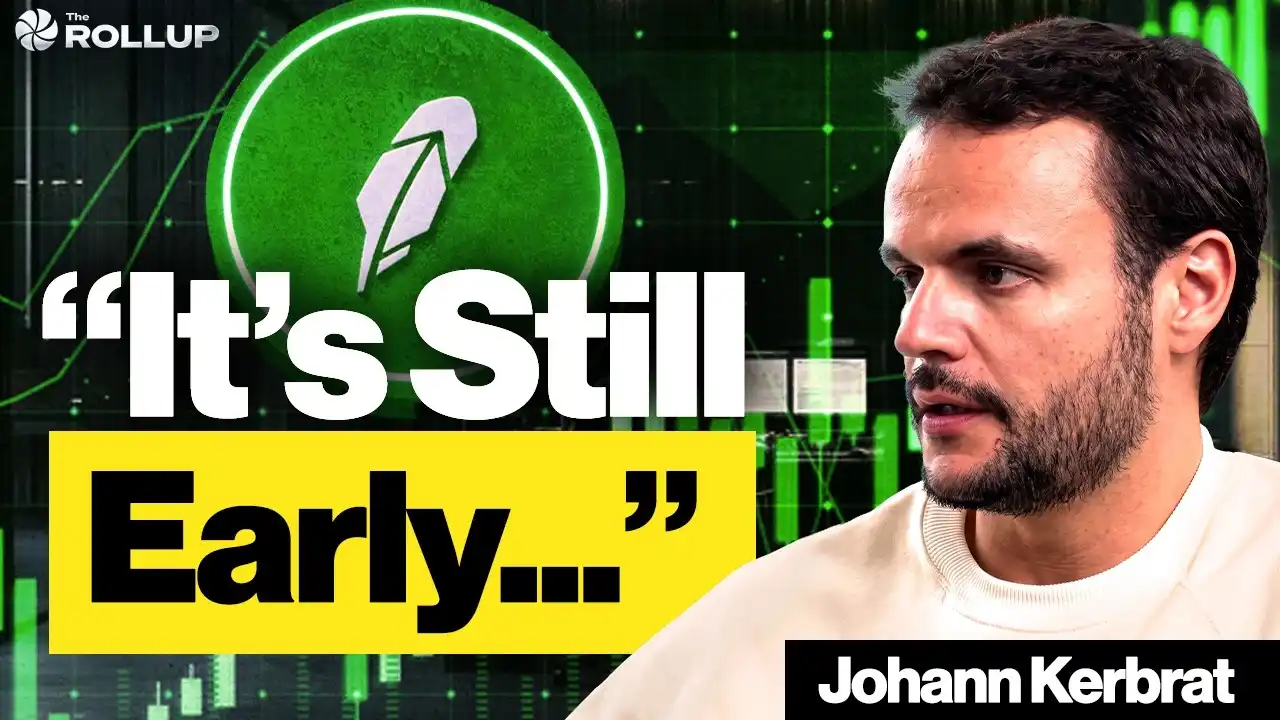
Interview with Robinhood executive Johann Kerbrat reveals the company's "barbell" customer acquisition strategy for its new Robinhood Chain, combining meme tokens with tokenized stocks. Three weeks after mainnet launch, the chain has seen over $3B in weekly DEX volume and 105M transactions. Kerbrat explains the logic behind the permissionless chain: meme tokens attract DeFi users, while tokenized real-world assets (RWA), currently over 90 US stocks and ETFs accessible in 120+ countries, serve global users. The goal is to bring Robinhood's 27 million funded accounts on-chain by simplifying DeFi with a user-friendly interface, exemplified by features like Robinhood Earn which offers yield without requiring wallet management. Built on Arbitrum's technology stack for its speed, low cost, and Ethereum's security, the chain focuses on financial products like Earn, spot trading, and perpetuals. Kerbrat downplays direct competition with platforms like Base, emphasizing the goal of expanding the overall market for on-chain assets. He details selective partnerships (e.g., Morpho, Lighter) based on compliance, unique UX, and differentiation. While regulatory clarity is pending for US perpetuals, the expansion continues via Bitstamp in Europe. Finally, Kerbrat positions Robinhood as a "super app" integrating stocks, options, crypto, banking, and AI trading, with all major business lines generating hundreds of millions in revenue. For the chain, current priority is driving adoption over maximizing gas fee revenue.

marsbit3h ago

Interview with Robinhood Executive: Meme + Tokenized US Stocks as "Barbell" Customer Acquisition Strategy, All Business Lines Achieve Hundreds of Millions in Revenue

marsbit3h ago

Trading

Spot

Hot Articles

What is $BITCOIN

DIGITAL GOLD ($BITCOIN): A Comprehensive Analysis Introduction to DIGITAL GOLD ($BITCOIN) DIGITAL GOLD ($BITCOIN) is a blockchain-based project operating on the Solana network, which aims to combine the characteristics of traditional precious metals with the innovation of decentralized technologies. While it shares a name with Bitcoin, often referred to as “digital gold” due to its perception as a store of value, DIGITAL GOLD is a separate token designed to create a unique ecosystem within the Web3 landscape. Its goal is to position itself as a viable alternative digital asset, although specifics regarding its applications and functionalities are still developing. What is DIGITAL GOLD ($BITCOIN)? DIGITAL GOLD ($BITCOIN) is a cryptocurrency token explicitly designed for use on the Solana blockchain. In contrast to Bitcoin, which provides a widely recognized value storage role, this token appears to focus on broader applications and characteristics. Notable aspects include: Blockchain Infrastructure: The token is built on the Solana blockchain, known for its capacity to handle high-speed and low-cost transactions. Supply Dynamics: DIGITAL GOLD has a maximum supply capped at 100 quadrillion tokens (100P $BITCOIN), although details regarding its circulating supply are currently undisclosed. Utility: While precise functionalities are not explicitly outlined, there are indications that the token could be utilized for various applications, potentially involving decentralized applications (dApps) or asset tokenization strategies. Who is the Creator of DIGITAL GOLD ($BITCOIN)? At present, the identity of the creators and development team behind DIGITAL GOLD ($BITCOIN) remains unknown. This situation is typical among many innovative projects within the blockchain space, particularly those aligning with decentralized finance and meme coin phenomena. While such anonymity may foster a community-driven culture, it intensifies concerns about governance and accountability. Who are the Investors of DIGITAL GOLD ($BITCOIN)? The available information indicates that DIGITAL GOLD ($BITCOIN) does not have any known institutional backers or prominent venture capital investments. The project seems to operate on a peer-to-peer model focused on community support and adoption rather than traditional funding routes. Its activity and liquidity are primarily situated on decentralized exchanges (DEXs), such as PumpSwap, rather than established centralized trading platforms, further highlighting its grassroots approach. How DIGITAL GOLD ($BITCOIN) Works The operational mechanics of DIGITAL GOLD ($BITCOIN) can be elaborated on based on its blockchain design and network attributes: Consensus Mechanism: By leveraging Solana’s unique proof-of-history (PoH) combined with a proof-of-stake (PoS) model, the project ensures efficient transaction validation contributing to the network's high performance. Tokenomics: While specific deflationary mechanisms have not been extensively detailed, the vast maximum token supply implies that it may cater to microtransactions or niche use cases that are still to be defined. Interoperability: There exists the potential for integration with Solana’s broader ecosystem, including various decentralized finance (DeFi) platforms. However, the details regarding specific integrations remain unspecified. Timeline of Key Events Here is a timeline that highlights significant milestones concerning DIGITAL GOLD ($BITCOIN): 2023: The initial deployment of the token occurs on the Solana blockchain, marked by its contract address. 2024: DIGITAL GOLD gains visibility as it becomes available for trading on decentralized exchanges like PumpSwap, allowing users to trade it against SOL. 2025: The project witnesses sporadic trading activity and potential interest in community-led engagements, although no noteworthy partnerships or technical advancements have been documented as of yet. Critical Analysis Strengths Scalability: The underlying Solana infrastructure supports high transaction volumes, which could enhance the utility of $BITCOIN in various transaction scenarios. Accessibility: The potential low trading price per token could attract retail investors, facilitating wider participation due to fractional ownership opportunities. Risks Lack of Transparency: The absence of publicly known backers, developers, or an audit process may yield skepticism regarding the project's sustainability and trustworthiness. Market Volatility: The trading activity is heavily reliant on speculative behavior, which can result in significant price volatility and uncertainty for investors. Conclusion DIGITAL GOLD ($BITCOIN) emerges as an intriguing yet ambiguous project within the rapidly evolving Solana ecosystem. While it attempts to leverage the “digital gold” narrative, its departure from Bitcoin's established role as a store of value underscores the need for a clearer differentiation of its intended utility and governance structure. Future acceptance and adoption will likely depend on addressing the current opacity and defining its operational and economic strategies more explicitly. Note: This report encompasses synthesised information available as of October 2023, and developments may have transpired beyond the research period.

1.3k Total ViewsPublished 2025.05.13Updated 2025.05.13

What is $BITCOIN

Discussions

Welcome to the HTX Community. Here, you can stay informed about the latest platform developments and gain access to professional market insights. Users' opinions on the price of BTC (BTC) are presented below.

活动图片