Bitcoin Hyper Could Conquer 2026 if Bitcoin Regains Lost Ground

bitcoinistPublished on 2026-02-10Last updated on 2026-02-10

Abstract

Bitcoin Hyper ($HYPER) is positioned as a potential market leader in 2026 by addressing Bitcoin's scalability and programmability limitations. It combines Bitcoin's security with the high-speed Solana Virtual Machine (SVM) to create a Layer 2 solution, enabling fast, low-cost decentralized finance (DeFi) applications. The project has raised $31.3 million in its presale, with significant whale activity, including a single $500,000 purchase, indicating strong institutional interest. By solving Bitcoin's "programmability gap," Bitcoin Hyper aims to recapture capital that has migrated to ecosystems like Ethereum and Solana, potentially unlocking trillions in dormant Bitcoin liquidity for DeFi, NFTs, and gaming.

Trusted Editorial content, reviewed by leading industry experts and seasoned editors. Ad Disclosure

Quick Facts:

  • ➡️ Bitcoin Hyper combines Bitcoin’s security with the speed of the Solana Virtual Machine (SVM), addressing the critical need for scalable Bitcoin DeFi.
  • ➡️ The project has demonstrated massive market interest, raising $31.3M in its ongoing presale with tokens priced at $0.0136754.
  • ➡️ On-chain data highlights significant whale accumulation, including a single $500K purchase on Jan 15, 2026, signaling institutional confidence.
  • ➡️ By solving the “programmability gap,” Bitcoin Hyper aims to recapture capital that has historically migrated to Ethereum and Solana.

Bitcoin is fighting a multi-front war. While institutional flows via ETFs have stabilized the asset class, the battle for dominance in 2026 is being fought on entirely different terrain: utility.

As of late 2025, Bitcoin is struggling to reclaim the critical $98,000 level after a sharp correction, leaving traders questioning if the cycle has peaked. But price action only tells half the story.

The real ‘lost ground’ isn’t just market cap. It’s the hundreds of billions in decentralized finance (DeFi) activity that has migrated to Ethereum and Solana because of Bitcoin’s inherent programmability limits.

This matters (a lot) because history suggests capital rotation follows innovation. When Bitcoin stagnates, liquidity hunts for yield in high-performance ecosystems. But a new infrastructure layer is emerging to challenge that dynamic. By bringing smart contract capabilities directly to the world’s most secure blockchain, Layer 2 solutions are attempting to unify Bitcoin’s liquidity with Solana’s speed.

Leading this charge is Bitcoin Hyper ($HYPER). By integrating the Solana Virtual Machine (SVM) as a Layer 2 on Bitcoin, the project aims to recapture the market share Bitcoin has historically ceded to faster chains. With over $31.3M raised in its presale, the market is signaling a serious appetite for this hybrid approach.

Read more about $HYPER here.

The SVM Advantage: Why Smart Money is Watching

The core value proposition of Bitcoin Hyper lies in a specific architectural choice: utilizing the Solana Virtual Machine (SVM) for execution while relying on Bitcoin Layer 1 for settlement. This isn’t just a technical upgrade; it’s a fundamental shift in how capital can be deployed on Bitcoin.

Traditional Bitcoin transactions are secure but notoriously slow and expensive, often costing upwards of $5–$10 during congestion. In contrast, the SVM architecture allows for sub-second finality and transaction costs that are fractions of a cent.

For developers, this solves the ‘scalability trilemma’ without abandoning Bitcoin’s security guarantees. The project features a Decentralized Canonical Bridge, allowing users to transfer $BTC seamlessly into a high-speed environment for DeFi protocols, NFT platforms, and gaming dApps.
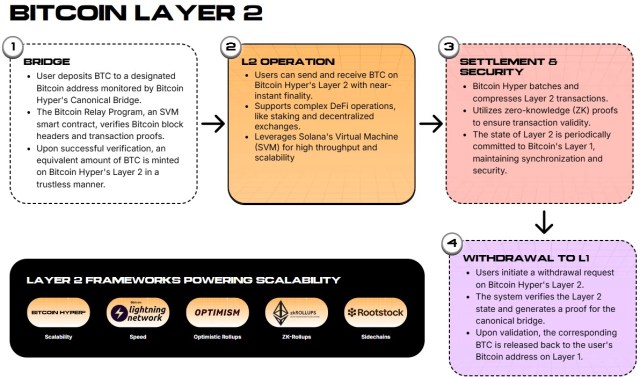
Unlike previous attempts to scale Bitcoin that relied on complex sidechains, Bitcoin Hyper offers a developer experience compatible with Rust, the language powering Solana’s thriving ecosystem.

The risk? Execution. Bridging assets between a Turing-incomplete chain like Bitcoin and a high-performance environment is technically demanding. However, if the team pulls it off, this modular blockchain approach, separating execution (L2) from settlement (L1), could unlock trillions in dormant Bitcoin capital.

As technical analysts have noted, this infrastructure is critical for Bitcoin to move beyond a ‘store of value’ and become a productive asset in the 2026 economy.

Check the $HYPER presale.

Whale Activity Signals Confidence in the $HYPER Presale

While the broader market remains cautious, specific smart money actors are taking aggressive positions in infrastructure plays. On-chain data reveals significant accumulation for Bitcoin Hyper (view whale transaction).

According to recent records, two whale wallets have accumulated a total of $1M+ in $HYPER tokens. The biggest splash came on Jan 15, 2026, when a single wallet executed a purchase of $500K. This suggests high-net-worth individuals are positioning themselves ahead of the token generation event (TGE), likely anticipating the demand for a functional Bitcoin L2.

The financial metrics back up this bullish outlook. The project has raised an impressive $31.3M to date, a figure that stands out even in a crowded market. With the current token price set at $0.0136754, the valuation remains accessible compared to established L2s like Stacks or Optimism.
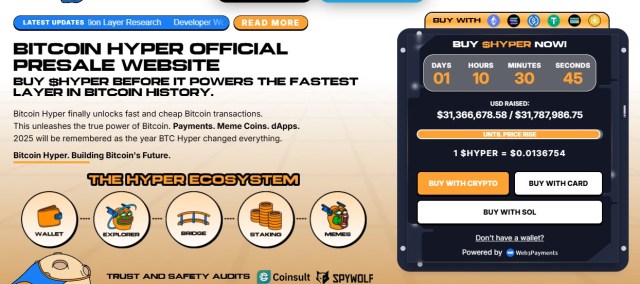
For retail investors, the staking incentives offer an additional layer of yield. Although the specific APY fluctuates, the protocol offers immediate staking after TGE with a short 7-day vesting period for presale participants. This structure encourages long-term holding rather than quick flips.

Investors should watch the timing here. As Bitcoin attempts to regain its lost ground above key resistance levels, the narrative is shifting toward ‘Bitcoin DeFi.’ Projects that can successfully deploy high-speed applications on Bitcoin are poised to capture the overflow of liquidity.

Bitcoin Hyper is positioning itself not just as a participant in this trend, but as the primary infrastructure layer enabling it. Join the $HYPER presale here.

Buy $HYPER here.

The content provided in this article is for informational purposes only and does not constitute financial advice. Cryptocurrency investments carry inherent risks, including market volatility and regulatory uncertainty. Always conduct your own research before investing.

Editorial Process for bitcoinist is centered on delivering thoroughly researched, accurate, and unbiased content. We uphold strict sourcing standards, and each page undergoes diligent review by our team of top technology experts and seasoned editors. This process ensures the integrity, relevance, and value of our content for our readers.

patrubogdan

Follow

Full Profile

Related Posts

Cathie Wood’s Ark Invest Buys More Bullish Assets Just Days After Last Purchase, While LiquidChain Turns Heads

Polymarket Sues Massachusetts Over Prediction Market Regulation – SUBBD Token Takes Advantage

Tether Pushes for $1 Despite Market Crash, While Maxi Doge Reaches New Heights

Ethereum Holds Strong Above $2K, While $LIQUID Starts Turning Heads: Price Analysis & Outlook

Convicted FTX CEO SBF Cries ‘Biden Lawfare’ In Trump Pardon Pitch

Bitcoin Hovers Below $70K – Breakout Soon or is $HYPER a Safer Bet?

Related Questions

QWhat is the core technological innovation that Bitcoin Hyper ($HYPER) brings to the Bitcoin ecosystem?

ABitcoin Hyper combines Bitcoin's security with the speed of the Solana Virtual Machine (SVM) as a Layer 2 solution, addressing Bitcoin's programmability and scalability limitations for DeFi.

QHow much funding has the Bitcoin Hyper project raised in its presale, and what does this indicate?

AThe project has raised $31.3 million in its ongoing presale, signaling massive market interest and institutional confidence in its hybrid Bitcoin-Solana infrastructure approach.

QWhat specific on-chain activity suggests 'whale' or institutional interest in the $HYPER token?

AOn-chain data shows significant whale accumulation, including a single purchase of $500,000 on January 15, 2026, with two wallets accumulating over $1 million in total.

QWhat problem does Bitcoin Hyper aim to solve that has historically caused capital to migrate from Bitcoin to other chains?

AIt aims to solve Bitcoin's 'programmability gap' and scalability issues, which have historically caused hundreds of billions in DeFi activity to migrate to faster chains like Ethereum and Solana.

QWhat are the key benefits for developers building on the Bitcoin Hyper platform?

ADevelopers benefit from sub-second transaction finality, extremely low fees, and compatibility with the Solana ecosystem's Rust programming language, all while settling transactions on Bitcoin's secure Layer 1.

Related Reads

You Bet on the News, the Pros Read the Rules: The True Cognitive Gap in Losing Money on Polymarket

The article explains that the key to profiting on Polymarket, a prediction market platform, lies not just predicting real-world events correctly, but in meticulously understanding the specific rules that govern how each market will be resolved. It illustrates this with examples, such as a market on Venezuela's 2026 leader, where the official rules defining "officially holds" the office overruled the intuitive answer of who was in practical control. Other examples include debates over the definition of a "token" or what constitutes an "agreement." The core argument is that a "reality vs. rules" gap creates pricing discrepancies that savvy traders ("车头" or "whales") exploit. The platform has a formal dispute resolution process managed by UMA token holders to settle ambiguous outcomes. This process involves proposal submission, a challenge window, a discussion period, and a final vote. However, the article highlights a critical flaw in this system compared to a traditional court: the lack of separation between the arbiters (UMA voters) and the interested parties (traders with financial stakes in the outcome). This conflict of interest undermines the discussion phase, leads to herd mentality, and results in opaque final decisions without explanatory rulings. Consequently, the system lacks a body of precedent, making it difficult for users to learn from past disputes. The ultimate takeaway is that success on Polymarket requires a lawyer-like scrutiny of the rules to identify and capitalize on the cognitive gap between how events appear and how they are contractually defined for settlement.

marsbit1h ago

You Bet on the News, the Pros Read the Rules: The True Cognitive Gap in Losing Money on Polymarket

marsbit1h ago

Trading

Spot
Futures

Hot Articles

What is $BITCOIN

DIGITAL GOLD ($BITCOIN): A Comprehensive Analysis Introduction to DIGITAL GOLD ($BITCOIN) DIGITAL GOLD ($BITCOIN) is a blockchain-based project operating on the Solana network, which aims to combine the characteristics of traditional precious metals with the innovation of decentralized technologies. While it shares a name with Bitcoin, often referred to as “digital gold” due to its perception as a store of value, DIGITAL GOLD is a separate token designed to create a unique ecosystem within the Web3 landscape. Its goal is to position itself as a viable alternative digital asset, although specifics regarding its applications and functionalities are still developing. What is DIGITAL GOLD ($BITCOIN)? DIGITAL GOLD ($BITCOIN) is a cryptocurrency token explicitly designed for use on the Solana blockchain. In contrast to Bitcoin, which provides a widely recognized value storage role, this token appears to focus on broader applications and characteristics. Notable aspects include: Blockchain Infrastructure: The token is built on the Solana blockchain, known for its capacity to handle high-speed and low-cost transactions. Supply Dynamics: DIGITAL GOLD has a maximum supply capped at 100 quadrillion tokens (100P $BITCOIN), although details regarding its circulating supply are currently undisclosed. Utility: While precise functionalities are not explicitly outlined, there are indications that the token could be utilized for various applications, potentially involving decentralized applications (dApps) or asset tokenization strategies. Who is the Creator of DIGITAL GOLD ($BITCOIN)? At present, the identity of the creators and development team behind DIGITAL GOLD ($BITCOIN) remains unknown. This situation is typical among many innovative projects within the blockchain space, particularly those aligning with decentralized finance and meme coin phenomena. While such anonymity may foster a community-driven culture, it intensifies concerns about governance and accountability. Who are the Investors of DIGITAL GOLD ($BITCOIN)? The available information indicates that DIGITAL GOLD ($BITCOIN) does not have any known institutional backers or prominent venture capital investments. The project seems to operate on a peer-to-peer model focused on community support and adoption rather than traditional funding routes. Its activity and liquidity are primarily situated on decentralized exchanges (DEXs), such as PumpSwap, rather than established centralized trading platforms, further highlighting its grassroots approach. How DIGITAL GOLD ($BITCOIN) Works The operational mechanics of DIGITAL GOLD ($BITCOIN) can be elaborated on based on its blockchain design and network attributes: Consensus Mechanism: By leveraging Solana’s unique proof-of-history (PoH) combined with a proof-of-stake (PoS) model, the project ensures efficient transaction validation contributing to the network's high performance. Tokenomics: While specific deflationary mechanisms have not been extensively detailed, the vast maximum token supply implies that it may cater to microtransactions or niche use cases that are still to be defined. Interoperability: There exists the potential for integration with Solana’s broader ecosystem, including various decentralized finance (DeFi) platforms. However, the details regarding specific integrations remain unspecified. Timeline of Key Events Here is a timeline that highlights significant milestones concerning DIGITAL GOLD ($BITCOIN): 2023: The initial deployment of the token occurs on the Solana blockchain, marked by its contract address. 2024: DIGITAL GOLD gains visibility as it becomes available for trading on decentralized exchanges like PumpSwap, allowing users to trade it against SOL. 2025: The project witnesses sporadic trading activity and potential interest in community-led engagements, although no noteworthy partnerships or technical advancements have been documented as of yet. Critical Analysis Strengths Scalability: The underlying Solana infrastructure supports high transaction volumes, which could enhance the utility of $BITCOIN in various transaction scenarios. Accessibility: The potential low trading price per token could attract retail investors, facilitating wider participation due to fractional ownership opportunities. Risks Lack of Transparency: The absence of publicly known backers, developers, or an audit process may yield skepticism regarding the project's sustainability and trustworthiness. Market Volatility: The trading activity is heavily reliant on speculative behavior, which can result in significant price volatility and uncertainty for investors. Conclusion DIGITAL GOLD ($BITCOIN) emerges as an intriguing yet ambiguous project within the rapidly evolving Solana ecosystem. While it attempts to leverage the “digital gold” narrative, its departure from Bitcoin's established role as a store of value underscores the need for a clearer differentiation of its intended utility and governance structure. Future acceptance and adoption will likely depend on addressing the current opacity and defining its operational and economic strategies more explicitly. Note: This report encompasses synthesised information available as of October 2023, and developments may have transpired beyond the research period.

363 Total ViewsPublished 2025.05.13Updated 2025.05.13

What is $BITCOIN

Discussions

Welcome to the HTX Community. Here, you can stay informed about the latest platform developments and gain access to professional market insights. Users' opinions on the price of BTC (BTC) are presented below.

活动图片