Bitcoin Faces Quantum Risk — New Proposal Could Lock Vulnerable Coins

bitcoinistPublished on 2026-04-15Last updated on 2026-04-15

Abstract

A new Bitcoin security proposal, BIP-361, introduces a three-phase plan to protect the network from the future threat of quantum computers. It specifically addresses the vulnerability of approximately 1.7 million BTC, including Satoshi Nakamoto's fortune, held in old-style P2PK addresses whose public keys are exposed. The proposal would eventually freeze any coins not moved to a new quantum-resistant format after a multi-year grace period. A controversial "rescue window" would allow users who miss the deadline to reclaim funds by proving ownership of their seed phrase. The plan has faced significant community backlash, with critics labeling it authoritarian and confiscatory for rendering old Bitcoin unspendable. Its adoption depends on achieving network consensus.

Buried inside a new Bitcoin security proposal is a provision that could save stragglers from losing everything.

Anyone who misses the upgrade deadline but still holds their seed phrase would have a path to recovery through zero-knowledge proof technology — a last-resort mechanism built into the final phase of BIP-361, a draft posted to GitHub on Tuesday by cypherpunk Jameson Lopp and five co-authors.

The full proposal is a three-phase plan designed to protect Bitcoin from a threat that has quietly grown more serious: the eventual ability of quantum computers to crack the cryptographic keys protecting early Bitcoin addresses.

Satoshi’s Fortune At The Center Of It All

About 1.7 million BTC sits in old-style addresses known as P2PK — the kind used in Bitcoin’s earliest days. Those addresses expose public keys directly, making them vulnerable once quantum computing reaches sufficient power.

Satoshi Nakamoto’s stash alone is valued at roughly $74 billion at current prices. According to the proposal’s authors, if a bad actor gained quantum access to those coins, the damage to Bitcoin’s value and credibility could be severe.
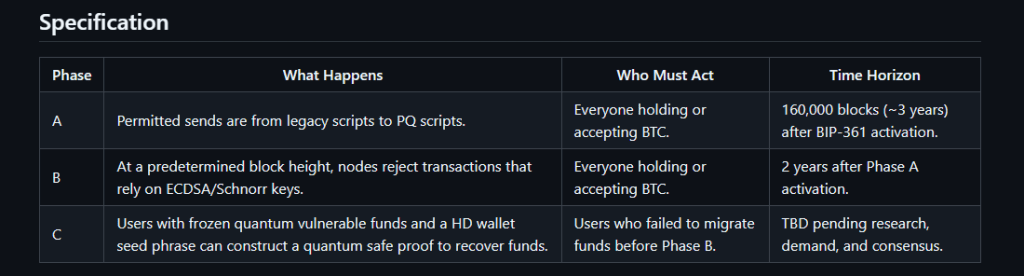
New 3-step strategy targets quantum risk. Source: Github

BIP-361 builds on BIP-360, released in February, which introduced a new quantum-resistant address format called pay-to-Merkle-root, or P2MR. That earlier proposal protects new coins. BIP-361 tackles what BIP-360 left unresolved — the roughly 34% of Bitcoin’s total supply still sitting in vulnerable addresses.

The plan unfolds in stages. Three years after activation, sending BTC to old-style addresses would no longer be allowed. Two years after that, old-format signatures would be invalidated entirely.

Any coins that haven’t been moved by then would be frozen. The third phase — the rescue window — gives late movers a technical route to reclaim funds using proof of seed ownership.

BTCUSD trading at $73,722 on the 24-hour chart: TradingView

The Community Response Has Been Blunt

The proposal landed hard among Bitcoin’s most vocal voices. Bitcoin Magazine’s editor rejected it outright. TFTC founder Marty Bent called it “laughable.” Metaplanet’s head of business development put the contradiction plainly: “We have to steal people’s money to prevent their money from being stolen.”

The authors anticipated the backlash. Based on their own framing, the freeze isn’t meant as punishment — it’s described as a defense against a worse outcome. Frozen coins, they argue, slightly increase the value of everyone else’s holdings. Quantum-stolen coins do the opposite.

Protocol developer Mark Erhardt shared the proposal on X, where pushback came quickly. Critics called it “highly authoritarian and confiscatory” and questioned whether any deadline could justify making existing Bitcoin unspendable by its rightful owners. Lopp had not responded to requests for comment at the time of publication.

Whether BIP-361 moves forward depends on a consensus process that has historically resisted changes this significant. For now, it remains a draft — and a flashpoint.

Featured image from PostQuantum, chart from TradingView

Related Questions

QWhat is the main purpose of the BIP-361 proposal?

AThe main purpose of BIP-361 is to protect the Bitcoin stored in old, quantum-vulnerable addresses (P2PK) by implementing a three-phase plan that eventually freezes unupgraded coins and provides a last-resort recovery mechanism for their owners.

QWhich specific type of Bitcoin addresses are most at risk from quantum computing, and approximately how much BTC is in them?

AThe most at-risk addresses are the old-style P2PK (Pay-to-Public-Key) addresses used in Bitcoin's earliest days. Approximately 1.7 million BTC, including Satoshi Nakamoto's presumed stash, is stored in them.

QWhat is the new quantum-resistant address format introduced in the related BIP-360 proposal?

AThe new quantum-resistant address format introduced in BIP-360 is called pay-to-Merkle-root, or P2MR.

QWhat is the community's general reaction to the BIP-361 proposal, as described in the article?

AThe community reaction has been largely negative and critical. Prominent figures have rejected it as 'laughable' and 'highly authoritarian and confiscatory,' arguing that it forces an upgrade and could make existing Bitcoin unspendable by its rightful owners.

QWhat is the final 'rescue window' phase of the BIP-361 plan designed to do?

AThe final 'rescue window' phase is designed to provide a technical path for late movers to reclaim their frozen funds by using a zero-knowledge proof to demonstrate ownership of their seed phrase.

Related Reads

Trading

Spot
Futures

Hot Articles

What is $BITCOIN

DIGITAL GOLD ($BITCOIN): A Comprehensive Analysis Introduction to DIGITAL GOLD ($BITCOIN) DIGITAL GOLD ($BITCOIN) is a blockchain-based project operating on the Solana network, which aims to combine the characteristics of traditional precious metals with the innovation of decentralized technologies. While it shares a name with Bitcoin, often referred to as “digital gold” due to its perception as a store of value, DIGITAL GOLD is a separate token designed to create a unique ecosystem within the Web3 landscape. Its goal is to position itself as a viable alternative digital asset, although specifics regarding its applications and functionalities are still developing. What is DIGITAL GOLD ($BITCOIN)? DIGITAL GOLD ($BITCOIN) is a cryptocurrency token explicitly designed for use on the Solana blockchain. In contrast to Bitcoin, which provides a widely recognized value storage role, this token appears to focus on broader applications and characteristics. Notable aspects include: Blockchain Infrastructure: The token is built on the Solana blockchain, known for its capacity to handle high-speed and low-cost transactions. Supply Dynamics: DIGITAL GOLD has a maximum supply capped at 100 quadrillion tokens (100P $BITCOIN), although details regarding its circulating supply are currently undisclosed. Utility: While precise functionalities are not explicitly outlined, there are indications that the token could be utilized for various applications, potentially involving decentralized applications (dApps) or asset tokenization strategies. Who is the Creator of DIGITAL GOLD ($BITCOIN)? At present, the identity of the creators and development team behind DIGITAL GOLD ($BITCOIN) remains unknown. This situation is typical among many innovative projects within the blockchain space, particularly those aligning with decentralized finance and meme coin phenomena. While such anonymity may foster a community-driven culture, it intensifies concerns about governance and accountability. Who are the Investors of DIGITAL GOLD ($BITCOIN)? The available information indicates that DIGITAL GOLD ($BITCOIN) does not have any known institutional backers or prominent venture capital investments. The project seems to operate on a peer-to-peer model focused on community support and adoption rather than traditional funding routes. Its activity and liquidity are primarily situated on decentralized exchanges (DEXs), such as PumpSwap, rather than established centralized trading platforms, further highlighting its grassroots approach. How DIGITAL GOLD ($BITCOIN) Works The operational mechanics of DIGITAL GOLD ($BITCOIN) can be elaborated on based on its blockchain design and network attributes: Consensus Mechanism: By leveraging Solana’s unique proof-of-history (PoH) combined with a proof-of-stake (PoS) model, the project ensures efficient transaction validation contributing to the network's high performance. Tokenomics: While specific deflationary mechanisms have not been extensively detailed, the vast maximum token supply implies that it may cater to microtransactions or niche use cases that are still to be defined. Interoperability: There exists the potential for integration with Solana’s broader ecosystem, including various decentralized finance (DeFi) platforms. However, the details regarding specific integrations remain unspecified. Timeline of Key Events Here is a timeline that highlights significant milestones concerning DIGITAL GOLD ($BITCOIN): 2023: The initial deployment of the token occurs on the Solana blockchain, marked by its contract address. 2024: DIGITAL GOLD gains visibility as it becomes available for trading on decentralized exchanges like PumpSwap, allowing users to trade it against SOL. 2025: The project witnesses sporadic trading activity and potential interest in community-led engagements, although no noteworthy partnerships or technical advancements have been documented as of yet. Critical Analysis Strengths Scalability: The underlying Solana infrastructure supports high transaction volumes, which could enhance the utility of $BITCOIN in various transaction scenarios. Accessibility: The potential low trading price per token could attract retail investors, facilitating wider participation due to fractional ownership opportunities. Risks Lack of Transparency: The absence of publicly known backers, developers, or an audit process may yield skepticism regarding the project's sustainability and trustworthiness. Market Volatility: The trading activity is heavily reliant on speculative behavior, which can result in significant price volatility and uncertainty for investors. Conclusion DIGITAL GOLD ($BITCOIN) emerges as an intriguing yet ambiguous project within the rapidly evolving Solana ecosystem. While it attempts to leverage the “digital gold” narrative, its departure from Bitcoin's established role as a store of value underscores the need for a clearer differentiation of its intended utility and governance structure. Future acceptance and adoption will likely depend on addressing the current opacity and defining its operational and economic strategies more explicitly. Note: This report encompasses synthesised information available as of October 2023, and developments may have transpired beyond the research period.

363 Total ViewsPublished 2025.05.13Updated 2025.05.13

What is $BITCOIN

Discussions

Welcome to the HTX Community. Here, you can stay informed about the latest platform developments and gain access to professional market insights. Users' opinions on the price of BTC (BTC) are presented below.

活动图片