Bitcoin Enters Risk-Off Regime: Sentiment and On-Chain Data Align

BitcoinistPublished on 2025-12-24Last updated on 2026-04-24

Abstract

Bitcoin continues to trade below the psychologically important $90,000 level.

Bitcoin continues to trade below the psychologically important $90,000 level, reinforcing a cautious tone across the market as more analysts begin to warn that the current cycle could be transitioning toward a broader bear phase in 2026. Despite several attempts to regain upside momentum, price action has remained fragile, with volatility picking up and confidence fading among short-term participants.

Recent on-chain insights from analyst Axel Adler add weight to the growing risk-off narrative. Market sentiment, which reached euphoric levels earlier this month, has undergone a notable reversal. After peaking in early December, optimism quickly faded as prices failed to sustain higher levels, triggering a steady deterioration in sentiment indicators. The latest readings now place sentiment firmly below neutral, reflecting a clear cooling in trader conviction.

This shift is particularly notable because it follows a failed seasonal rebound attempt, often referred to as the “Santa rally,” which historically tends to support prices. Instead, the market’s inability to capitalize on that window has reinforced the view that short-term conditions have deteriorated. The downward turn in sentiment metrics suggests that traders are increasingly defensive, with reduced risk appetite and lower willingness to add exposure at current levels.

As Bitcoin remains capped below key resistance, sentiment dynamics point to a market that is no longer driven by momentum but by caution, uncertainty, and a reassessment of the medium-term outlook.

Bitcoin Trades Below Key Cost Bases as Recovery Signals Remain Elusive

Bitcoin continues to trade under pressure, with price hovering near the $87,400 level, a zone that analysts view as structurally weak in the short term. According to insights shared by Axel Adler, Bitcoin is currently trading below all major short-term holder realized price benchmarks, highlighting the fragility of recent demand. The closest overhead barrier is the short-term holder, 1-week to 1-month realized price around $90,300, a level now acting as immediate resistance rather than support.
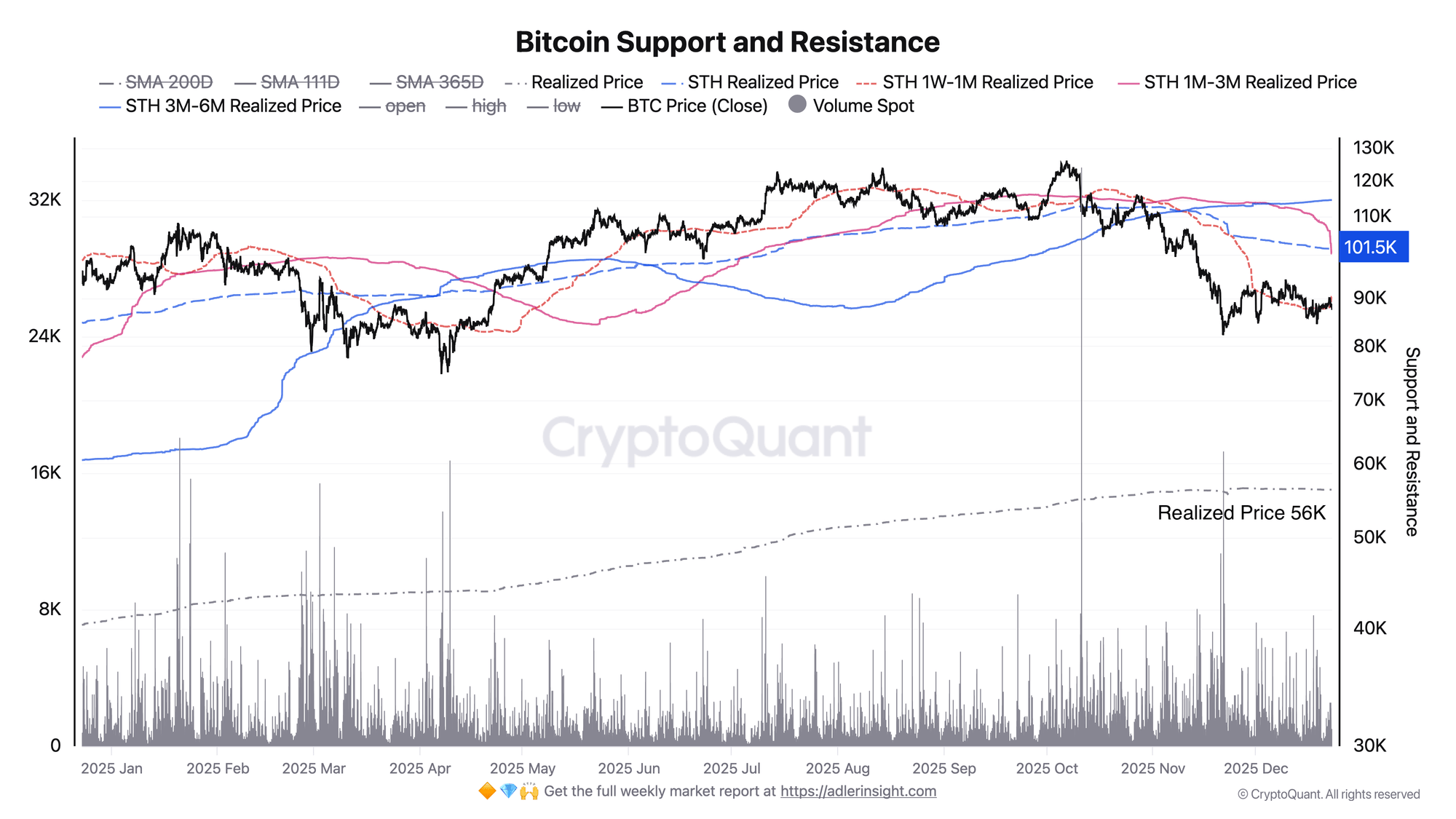
Bitcoin Support and Resistance | Source: CryptoQuant

Above that, resistance intensifies sharply. A dense supply cluster emerges between $100,400 and $101,500, where the 1-month to 3-month short-term holder realized price converges with the aggregate short-term holder realized price. This zone also aligns closely with the 365-day simple moving average near $101,800, reinforcing its importance as a longer-term inflection area. Additional moving average resistance is positioned even higher, with the 111-day and 200-day SMAs near $104,300 and $107,900, respectively.

Trading below short-term holder cost bases implies that the most recent buyers are sitting on unrealized losses. As a result, relief rallies toward breakeven levels risk triggering renewed selling. For market conditions to improve meaningfully, Bitcoin would need to reclaim and hold above the $90,000 area. Until then, the absence of strong spot demand leaves the market exposed to further downside, despite long-term support anchored near the aggregate realized price at $56,300.


Related Questions

QWhat is the current psychological price level that Bitcoin is struggling to reclaim, according to the article?

A$90,000

QWhich analyst is cited in the article for providing on-chain insights that support the risk-off narrative?

AAxel Adler

QWhat historically supportive seasonal price event did the market fail to capitalize on, reinforcing the view of deteriorating conditions?

AThe Santa rally

QWhat is the immediate resistance level formed by the short-term holder (1-week to 1-month) realized price?

A$90,300

QAccording to the article, what is the longer-term support level anchored near the aggregate realized price?

A$56,300

Related Reads

Why Hasn't the U.S. Seen the Rise of 'Huabei' or 'Jiebei'?

The article explores why the U.S. lacks large-scale consumer credit products like China's "Huabei" and "Jiebei," despite having a developed financial sector. Key reasons include: 1. **Structural Barriers**: A fragmented federal and state regulatory system, reinforced by post-2008 reforms like the Dodd-Frank Act, raises compliance costs and protects traditional banks, stifling fintech innovation. 2. **Credit Card Dominance**: Credit cards, used by 70-80% of adults, form a $1.28 trillion debt market with high APRs (avg. 22.3%). This system cross-subsidizes users who pay in full with those carrying balances, creating a predatory yet entrenched ecosystem. 3. **Data Privacy Laws**: Strict regulations (e.g., FCRA, CCPA) prevent tech giants from leveraging behavioral data for credit scoring, unlike in China where such data fuels fintech models. 4. **Capital Market Disincentives**: Wall Street penalizes tech firms entering finance due to lower valuations associated with heavy regulation and risk, as seen in Apple’s failure with Apple Card. 5. **Banking Oligopoly**: Major banks control consumer lending, leveraging lobbying power and consumer habits to maintain high-cost credit, while alternatives like payday loans (400% APR) or "unbanked" services remain niche or exploitative. Ultimately, regulatory, structural, and corporate interests collectively block the emergence of accessible, low-cost digital lending in the U.S.

Odaily星球日报1h ago

Why Hasn't the U.S. Seen the Rise of 'Huabei' or 'Jiebei'?

Odaily星球日报1h ago

Trading

Spot
Futures

Hot Articles

What is $BITCOIN

DIGITAL GOLD ($BITCOIN): A Comprehensive Analysis Introduction to DIGITAL GOLD ($BITCOIN) DIGITAL GOLD ($BITCOIN) is a blockchain-based project operating on the Solana network, which aims to combine the characteristics of traditional precious metals with the innovation of decentralized technologies. While it shares a name with Bitcoin, often referred to as “digital gold” due to its perception as a store of value, DIGITAL GOLD is a separate token designed to create a unique ecosystem within the Web3 landscape. Its goal is to position itself as a viable alternative digital asset, although specifics regarding its applications and functionalities are still developing. What is DIGITAL GOLD ($BITCOIN)? DIGITAL GOLD ($BITCOIN) is a cryptocurrency token explicitly designed for use on the Solana blockchain. In contrast to Bitcoin, which provides a widely recognized value storage role, this token appears to focus on broader applications and characteristics. Notable aspects include: Blockchain Infrastructure: The token is built on the Solana blockchain, known for its capacity to handle high-speed and low-cost transactions. Supply Dynamics: DIGITAL GOLD has a maximum supply capped at 100 quadrillion tokens (100P $BITCOIN), although details regarding its circulating supply are currently undisclosed. Utility: While precise functionalities are not explicitly outlined, there are indications that the token could be utilized for various applications, potentially involving decentralized applications (dApps) or asset tokenization strategies. Who is the Creator of DIGITAL GOLD ($BITCOIN)? At present, the identity of the creators and development team behind DIGITAL GOLD ($BITCOIN) remains unknown. This situation is typical among many innovative projects within the blockchain space, particularly those aligning with decentralized finance and meme coin phenomena. While such anonymity may foster a community-driven culture, it intensifies concerns about governance and accountability. Who are the Investors of DIGITAL GOLD ($BITCOIN)? The available information indicates that DIGITAL GOLD ($BITCOIN) does not have any known institutional backers or prominent venture capital investments. The project seems to operate on a peer-to-peer model focused on community support and adoption rather than traditional funding routes. Its activity and liquidity are primarily situated on decentralized exchanges (DEXs), such as PumpSwap, rather than established centralized trading platforms, further highlighting its grassroots approach. How DIGITAL GOLD ($BITCOIN) Works The operational mechanics of DIGITAL GOLD ($BITCOIN) can be elaborated on based on its blockchain design and network attributes: Consensus Mechanism: By leveraging Solana’s unique proof-of-history (PoH) combined with a proof-of-stake (PoS) model, the project ensures efficient transaction validation contributing to the network's high performance. Tokenomics: While specific deflationary mechanisms have not been extensively detailed, the vast maximum token supply implies that it may cater to microtransactions or niche use cases that are still to be defined. Interoperability: There exists the potential for integration with Solana’s broader ecosystem, including various decentralized finance (DeFi) platforms. However, the details regarding specific integrations remain unspecified. Timeline of Key Events Here is a timeline that highlights significant milestones concerning DIGITAL GOLD ($BITCOIN): 2023: The initial deployment of the token occurs on the Solana blockchain, marked by its contract address. 2024: DIGITAL GOLD gains visibility as it becomes available for trading on decentralized exchanges like PumpSwap, allowing users to trade it against SOL. 2025: The project witnesses sporadic trading activity and potential interest in community-led engagements, although no noteworthy partnerships or technical advancements have been documented as of yet. Critical Analysis Strengths Scalability: The underlying Solana infrastructure supports high transaction volumes, which could enhance the utility of $BITCOIN in various transaction scenarios. Accessibility: The potential low trading price per token could attract retail investors, facilitating wider participation due to fractional ownership opportunities. Risks Lack of Transparency: The absence of publicly known backers, developers, or an audit process may yield skepticism regarding the project's sustainability and trustworthiness. Market Volatility: The trading activity is heavily reliant on speculative behavior, which can result in significant price volatility and uncertainty for investors. Conclusion DIGITAL GOLD ($BITCOIN) emerges as an intriguing yet ambiguous project within the rapidly evolving Solana ecosystem. While it attempts to leverage the “digital gold” narrative, its departure from Bitcoin's established role as a store of value underscores the need for a clearer differentiation of its intended utility and governance structure. Future acceptance and adoption will likely depend on addressing the current opacity and defining its operational and economic strategies more explicitly. Note: This report encompasses synthesised information available as of October 2023, and developments may have transpired beyond the research period.

363 Total ViewsPublished 2025.05.13Updated 2025.05.13

What is $BITCOIN

Discussions

Welcome to the HTX Community. Here, you can stay informed about the latest platform developments and gain access to professional market insights. Users' opinions on the price of BTC (BTC) are presented below.

活动图片














