Bitcoin enters make or break zone after liquidation flush – What does this mean for you?

ambcryptoPublished on 2026-03-28Last updated on 2026-03-28

Abstract

Bitcoin (BTC) dropped to $65.5K on March 27, triggering significant long liquidations totaling $172 million in BTC and nearly $400 million across the crypto market. Analysis indicates a long squeeze occurred as Open Interest rose while price and CVD fell. The 30-day liquidation map suggests further downside risk toward $64K. On-chain metrics show accumulation continues despite distribution pressure, placing Bitcoin in a transitional state. Long-term holders (LTHs) have been net buyers since January 2026, yet the LTH Spent Output Profit Ratio (SOPR) fell below 1 in late February, indicating some are selling at a loss. This selling appears localized rather than broad capitulation. Market sentiment remains pessimistic. A shift to net selling by LTHs would signal full distribution, while a SOPR recovery above 1 could indicate reduced selling pressure.

Bitcoin [BTC] fell to a low of $65.5K on Friday, 27 March. This was the same low that it rallied off of earlier in the month to reach $76K. The losses on Friday forced nearly $400 million in long liquidations in the crypto market, and $172 million for Bitcoin.
Source: CoinGlass on X

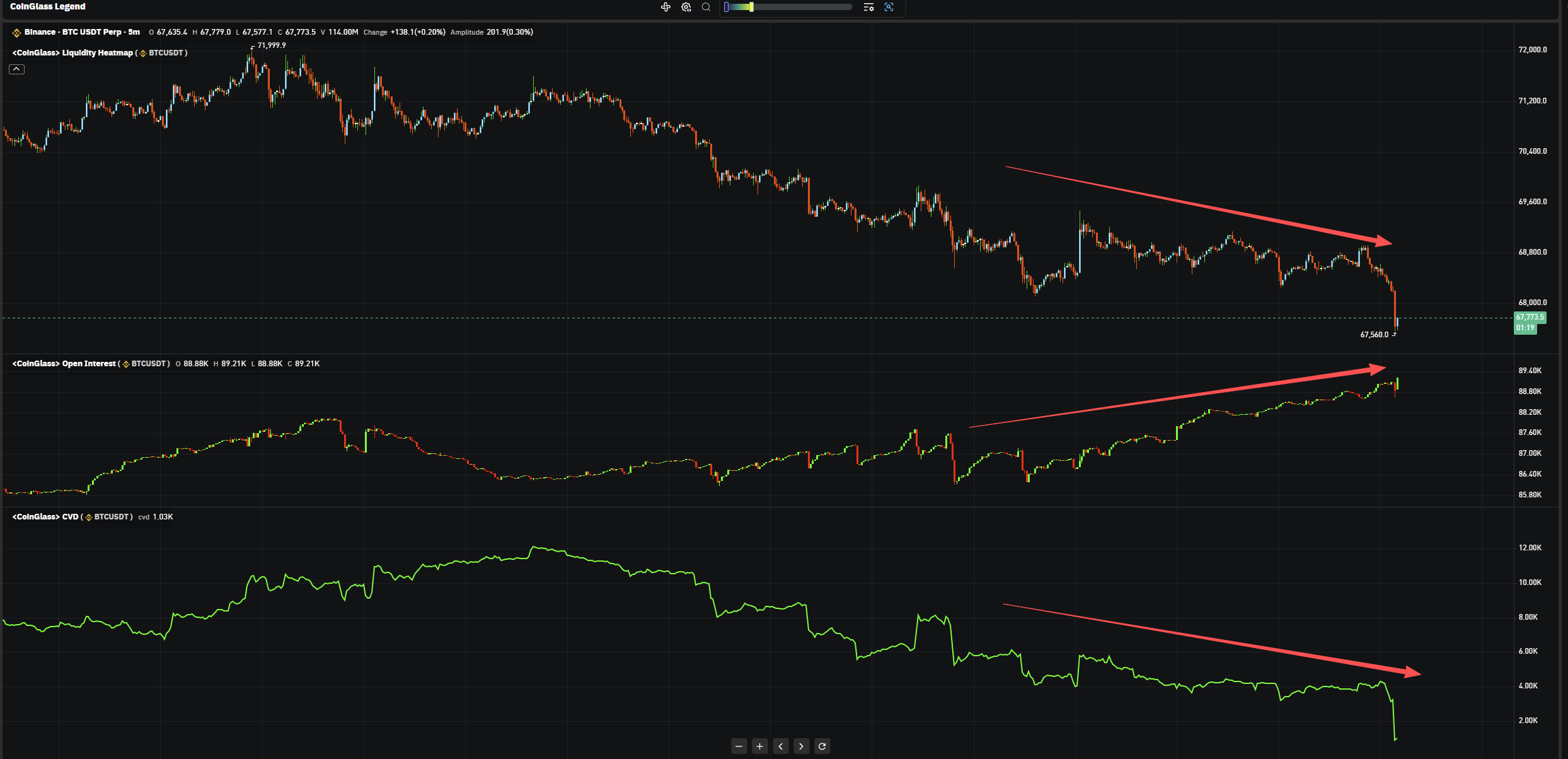
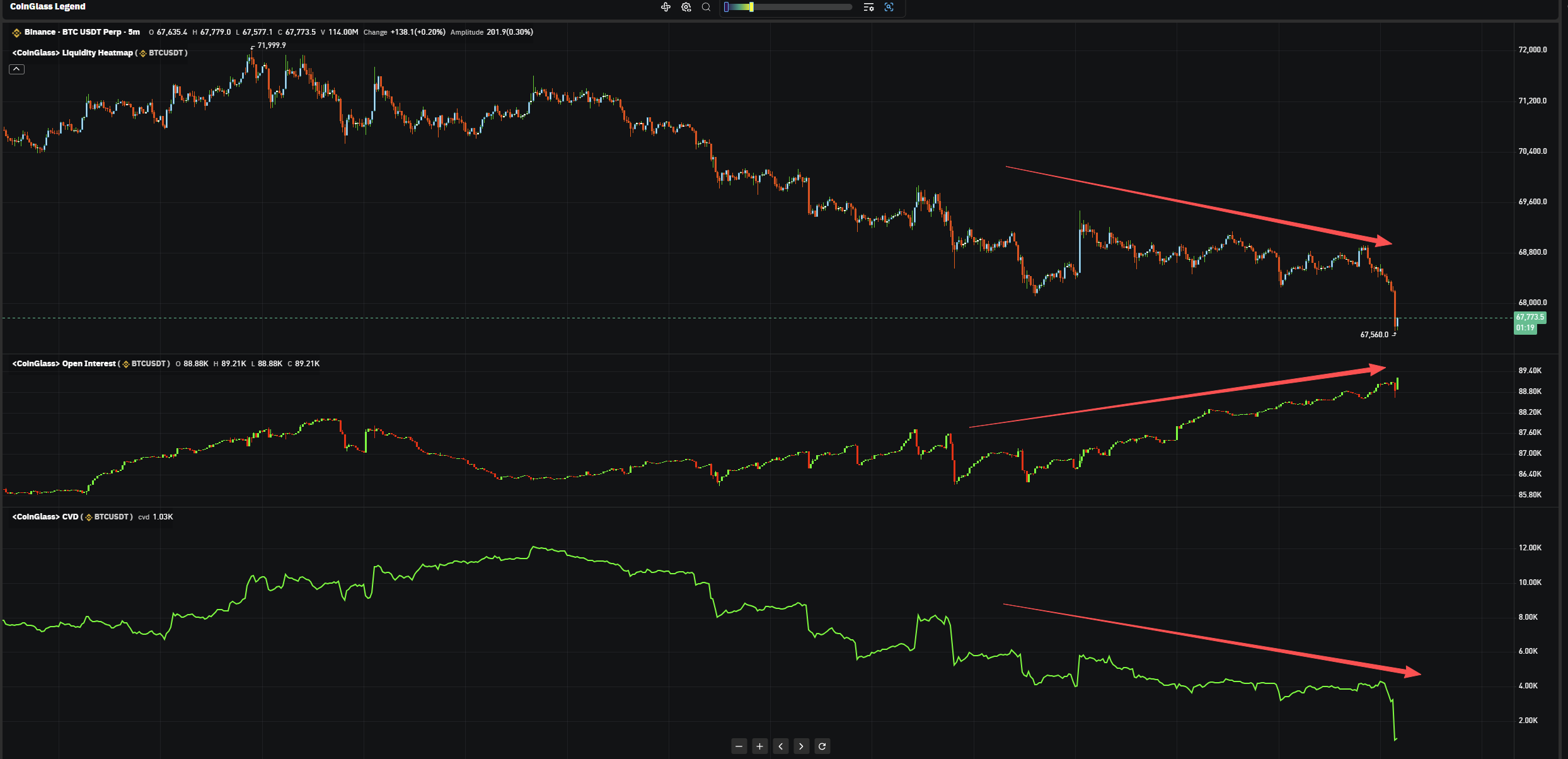
In a post on X, CoinGlass pointed out that the Open Interest was rising, while the price and the CVD were falling. Together, they pointed to a long squeeze. In fact, the sell-off over the past week and the recent long squeeze have effectively flushed most long positions out of the market.

The 30-day liquidation map showed there was another cluster of high leverage long levels up to the $64K-mark that could be hunted next.

Analysis of on-chain metrics found that accumulation was still fighting against distribution pressure. The market seemed to be in a stressed, transitional state, with full-on distribution not commencing yet.

In other words, it may be, once again, decision time for Bitcoin.

Bitcoin’s internal tug-of-war has not yet been resolved
Source: Axel Adler Jr Insights

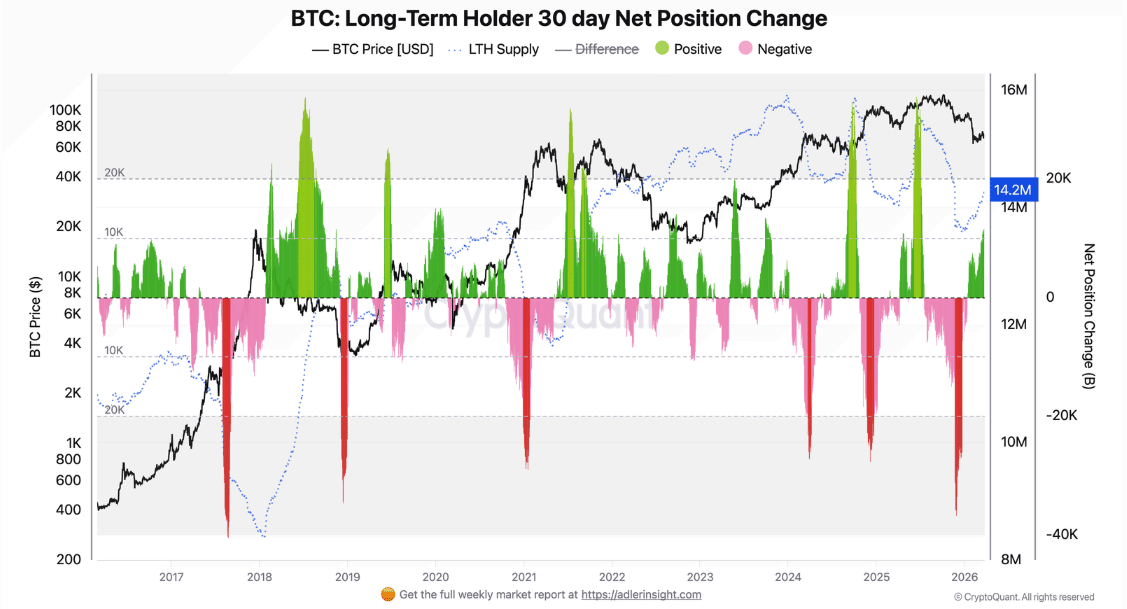
Crypto analyst Axel Adler Jr observed that the 30-day net position change for long-term holders has been positive since January 2026. The LTH supply measured 14.2 million BTC at press time and despite the recent correction, they continued to accumulate.

A transition to selling was not yet underway. The last time this cohort transitioned to overall selling was in July 2025, with prices around the $120K-level.
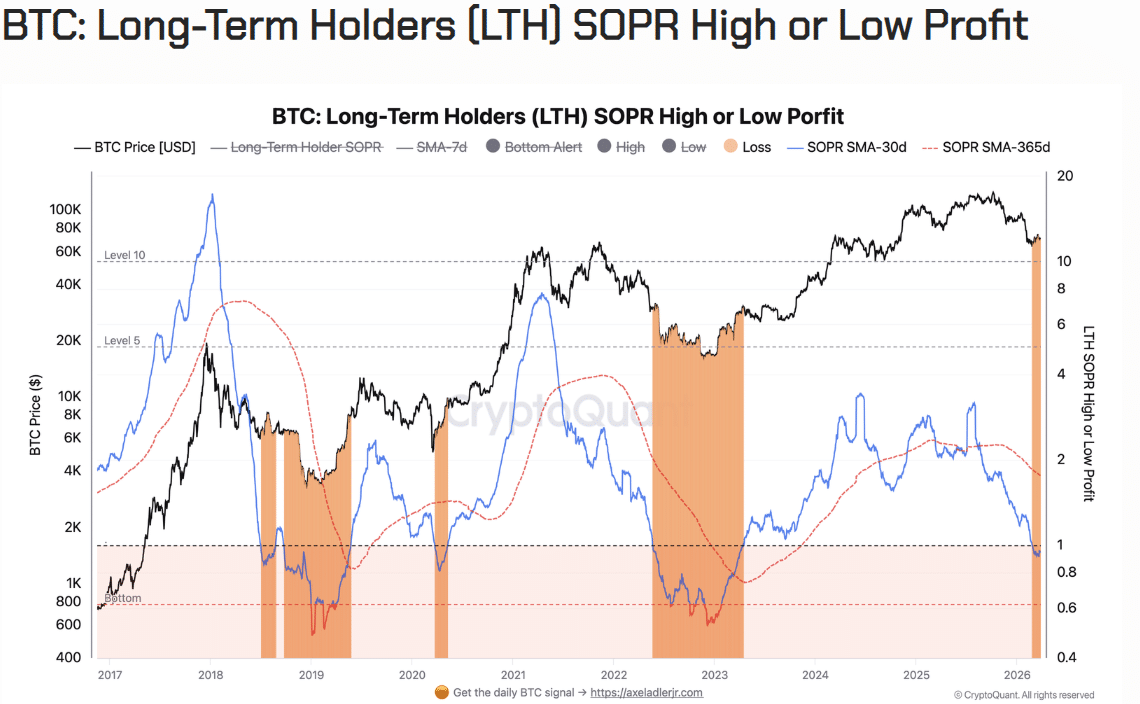
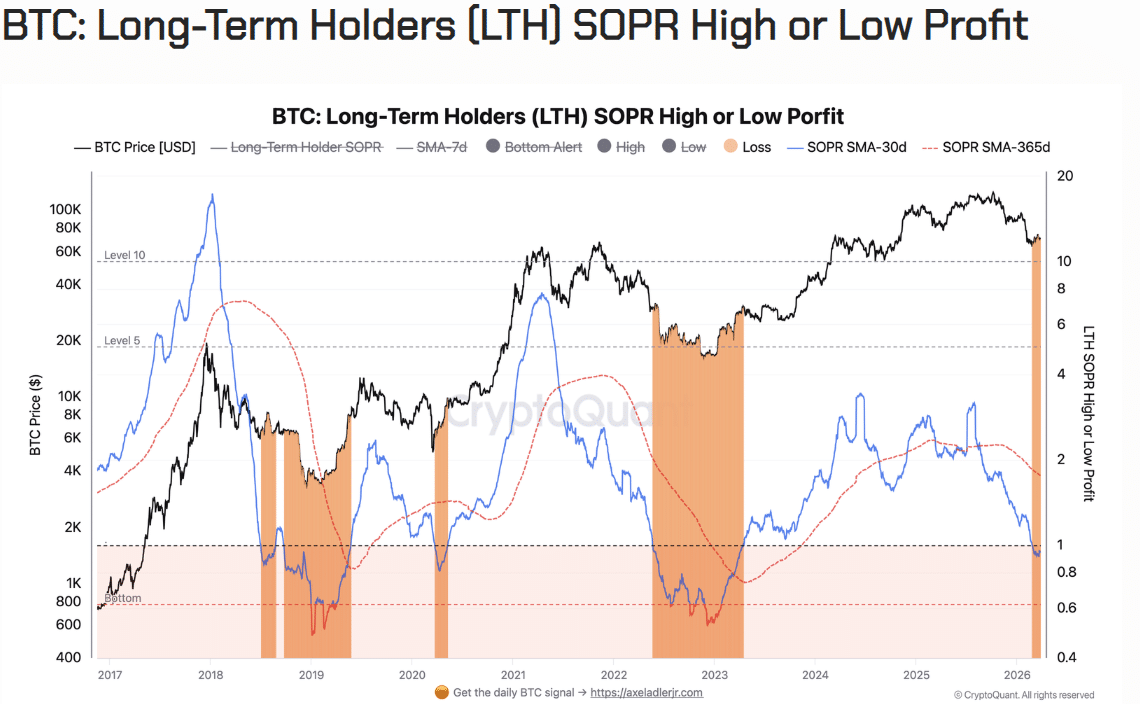
Source: Axel Adler Jr Insights

At the same time, the LTH Spent Output Profit Ratio fell below 1 in late February. This meant that the long-term holders were realizing a loss, on average, when selling. The analyst pointed out that the “loss zone” was active on the chart, which has historically come during prolonged stress periods.

One difference between the previous stressed market conditions and this one was that BTC’s price was significantly higher than in previous LTH loss phases. This meant that the selling was not indicative of a broad LTH cohort capitulation, but from localized stress from those who bought near the 2025 peak.

The two metrics showed a divergence – Long-term holders continued to accumulate, but a section of the LTHs were selling at a loss.

If the 30-day net position change turns negative, it would be indicative of a shift towards a full distribution.

It remains to be seen if the loss-realizing sellers intensify as prices fall, or if their capitulation ends. If the LTH SOPR can climb back above 1, it would indicate that the current forced selling might be easing.


Final Summary

  • Bitcoin’s market sentiment appeared to be extremely pessimistic as prices revisited the $65.6K local lows.
  • Long-term holder behavior has not yet shown a transition to a full distribution regime.

Related Questions

QWhat was the significance of Bitcoin's drop to $65.5K on March 27th?

AIt was the same low that Bitcoin rallied from earlier in the month to reach $76K, and it triggered nearly $400 million in long liquidations across the crypto market, with $172 million of that being Bitcoin positions.

QAccording to the on-chain analysis, what is the current state of the market between accumulation and distribution?

AThe market is in a stressed, transitional state where accumulation is still fighting against distribution pressure, but a full-on distribution has not yet commenced.

QWhat two conflicting behaviors are long-term holders (LTHs) exhibiting, creating a divergence?

AThe 30-day net position change shows that LTHs as a whole are still accumulating (positive since January 2026), while the LTH Spent Output Profit Ratio (SOPR) falling below 1 indicates that a section of them are selling at a loss.

QWhat would a negative 30-day net position change for long-term holders indicate?

AIt would be indicative of a shift towards a full distribution regime, meaning long-term holders have transitioned from net accumulation to net selling.

QWhat key metric would signal that the current period of forced selling by long-term holders might be easing?

AIf the Long-term Holder Spent Output Profit Ratio (LTH SOPR) climbs back above 1, it would indicate that sellers are no longer realizing losses on average, suggesting the forced selling pressure could be easing.

Related Reads

a16z: AI's 'Amnesia', Can Continuous Learning Cure It?

The article "a16z: AI's 'Amnesia' – Can Continual Learning Cure It?" explores the limitations of current large language models (LLMs), which, like the protagonist in the film *Memento*, are trapped in a perpetual present—unable to form new memories after training. While methods like in-context learning (ICL), retrieval-augmented generation (RAG), and external scaffolding (e.g., chat history, prompts) provide temporary solutions, they fail to enable true internalization of new knowledge. The authors argue that compression—the core of learning during training—is halted at deployment, preventing models from generalizing, discovering novel solutions (e.g., mathematical proofs), or handling adversarial scenarios. The piece introduces *continual learning* as a critical research direction to address this, categorizing approaches into three paths: 1. **Context**: Scaling external memory via longer context windows, multi-agent systems, and smarter retrieval. 2. **Modules**: Using pluggable adapters or external memory layers for specialization without full retraining. 3. **Weights**: Enabling parameter updates through sparse training, test-time training, meta-learning, distillation, and reinforcement learning from feedback. Challenges include catastrophic forgetting, safety risks, and auditability, but overcoming these could unlock models that learn iteratively from experience. The conclusion emphasizes that while context-based methods are effective, true breakthroughs require models to compress new information into weights post-deployment, moving from mere retrieval to genuine learning.

marsbit2h ago

a16z: AI's 'Amnesia', Can Continuous Learning Cure It?

marsbit2h ago

Can a Hair Dryer Earn $34,000? Deciphering the Reflexivity Paradox in Prediction Markets

An individual manipulated a weather sensor at Paris Charles de Gaulle Airport with a portable heat source, causing a Polymarket weather market to settle at 22°C and earning $34,000. This incident highlights a fundamental issue in prediction markets: when a market aims to reflect reality, it also incentivizes participants to influence that reality. Prediction markets operate on two layers: platform rules (what outcome counts as a win) and data sources (what actually happened). While most focus on rules, the real vulnerability lies in the data source. If reality is recorded through a specific source, influencing that source directly affects market settlement. The article categorizes markets by their vulnerability: 1. **Single-point physical data sources** (e.g., weather stations): Easily manipulated through physical interference. 2. **Insider information markets** (e.g., MrBeast video details): Insiders like team members use non-public information to trade. Kalshi fined a剪辑师 $20,000 for insider trading. 3. **Actor-manipulated markets** (e.g., Andrew Tate’s tweet counts): The subject of the market can control the outcome. Evidence suggests Tate’sociated accounts coordinated to profit. 4. **Individual-action markets** (e.g., WNBA disruptions): A single person can execute an event to profit from their pre-placed bets. Kalshi and Polymarket handle these issues differently. Kalshi enforces strict KYC, publicly penalizes insider trading, and reports to regulators. Polymarket, with its anonymous wallet-based system, has historically been more permissive, arguing that insider information improves market accuracy. However, it cooperated with authorities in the "Van Dyke case," where a user traded on classified government information. The core paradox is reflexivity: prediction markets are designed to discover truth, but their financial incentives can distort reality. The more valuable a prediction becomes, the more likely participants are to influence the event itself. The market ceases to be a mirror of reality and instead shapes it.

marsbit3h ago

Can a Hair Dryer Earn $34,000? Deciphering the Reflexivity Paradox in Prediction Markets

marsbit3h ago

Trading

Spot
Futures

Hot Articles

What is $BITCOIN

DIGITAL GOLD ($BITCOIN): A Comprehensive Analysis Introduction to DIGITAL GOLD ($BITCOIN) DIGITAL GOLD ($BITCOIN) is a blockchain-based project operating on the Solana network, which aims to combine the characteristics of traditional precious metals with the innovation of decentralized technologies. While it shares a name with Bitcoin, often referred to as “digital gold” due to its perception as a store of value, DIGITAL GOLD is a separate token designed to create a unique ecosystem within the Web3 landscape. Its goal is to position itself as a viable alternative digital asset, although specifics regarding its applications and functionalities are still developing. What is DIGITAL GOLD ($BITCOIN)? DIGITAL GOLD ($BITCOIN) is a cryptocurrency token explicitly designed for use on the Solana blockchain. In contrast to Bitcoin, which provides a widely recognized value storage role, this token appears to focus on broader applications and characteristics. Notable aspects include: Blockchain Infrastructure: The token is built on the Solana blockchain, known for its capacity to handle high-speed and low-cost transactions. Supply Dynamics: DIGITAL GOLD has a maximum supply capped at 100 quadrillion tokens (100P $BITCOIN), although details regarding its circulating supply are currently undisclosed. Utility: While precise functionalities are not explicitly outlined, there are indications that the token could be utilized for various applications, potentially involving decentralized applications (dApps) or asset tokenization strategies. Who is the Creator of DIGITAL GOLD ($BITCOIN)? At present, the identity of the creators and development team behind DIGITAL GOLD ($BITCOIN) remains unknown. This situation is typical among many innovative projects within the blockchain space, particularly those aligning with decentralized finance and meme coin phenomena. While such anonymity may foster a community-driven culture, it intensifies concerns about governance and accountability. Who are the Investors of DIGITAL GOLD ($BITCOIN)? The available information indicates that DIGITAL GOLD ($BITCOIN) does not have any known institutional backers or prominent venture capital investments. The project seems to operate on a peer-to-peer model focused on community support and adoption rather than traditional funding routes. Its activity and liquidity are primarily situated on decentralized exchanges (DEXs), such as PumpSwap, rather than established centralized trading platforms, further highlighting its grassroots approach. How DIGITAL GOLD ($BITCOIN) Works The operational mechanics of DIGITAL GOLD ($BITCOIN) can be elaborated on based on its blockchain design and network attributes: Consensus Mechanism: By leveraging Solana’s unique proof-of-history (PoH) combined with a proof-of-stake (PoS) model, the project ensures efficient transaction validation contributing to the network's high performance. Tokenomics: While specific deflationary mechanisms have not been extensively detailed, the vast maximum token supply implies that it may cater to microtransactions or niche use cases that are still to be defined. Interoperability: There exists the potential for integration with Solana’s broader ecosystem, including various decentralized finance (DeFi) platforms. However, the details regarding specific integrations remain unspecified. Timeline of Key Events Here is a timeline that highlights significant milestones concerning DIGITAL GOLD ($BITCOIN): 2023: The initial deployment of the token occurs on the Solana blockchain, marked by its contract address. 2024: DIGITAL GOLD gains visibility as it becomes available for trading on decentralized exchanges like PumpSwap, allowing users to trade it against SOL. 2025: The project witnesses sporadic trading activity and potential interest in community-led engagements, although no noteworthy partnerships or technical advancements have been documented as of yet. Critical Analysis Strengths Scalability: The underlying Solana infrastructure supports high transaction volumes, which could enhance the utility of $BITCOIN in various transaction scenarios. Accessibility: The potential low trading price per token could attract retail investors, facilitating wider participation due to fractional ownership opportunities. Risks Lack of Transparency: The absence of publicly known backers, developers, or an audit process may yield skepticism regarding the project's sustainability and trustworthiness. Market Volatility: The trading activity is heavily reliant on speculative behavior, which can result in significant price volatility and uncertainty for investors. Conclusion DIGITAL GOLD ($BITCOIN) emerges as an intriguing yet ambiguous project within the rapidly evolving Solana ecosystem. While it attempts to leverage the “digital gold” narrative, its departure from Bitcoin's established role as a store of value underscores the need for a clearer differentiation of its intended utility and governance structure. Future acceptance and adoption will likely depend on addressing the current opacity and defining its operational and economic strategies more explicitly. Note: This report encompasses synthesised information available as of October 2023, and developments may have transpired beyond the research period.

363 Total ViewsPublished 2025.05.13Updated 2025.05.13

What is $BITCOIN

Discussions

Welcome to the HTX Community. Here, you can stay informed about the latest platform developments and gain access to professional market insights. Users' opinions on the price of BTC (BTC) are presented below.

活动图片