Bitcoin Demand Remains Weak: Setting The Stage For Long-Term Accumulation

bitcoinistPublished on 2026-01-13Last updated on 2026-01-13

Abstract

Bitcoin is attempting to stabilize above $90,000 amid renewed macro uncertainty following comments from Fed Chair Jerome Powell. On-chain data indicates weak underlying demand, with the "apparent demand" metric remaining negative at approximately -106,000 BTC. This suggests more dormant supply is entering the market than new demand is absorbing, signaling net selling pressure. However, the weakness reflects cautious and defensive behavior rather than panic or capitulation. Historically, such periods of low demand can create long-term accumulation opportunities, though current conditions favor disciplined, patient strategies over short-term speculation. The market awaits clearer signals from macro conditions or on-chain metrics before committing fresh capital.

Bitcoin is attempting to stabilize above the $90,000 level as markets digest fresh comments from Jerome Powell, which briefly reintroduced macro uncertainty into an already fragile environment. Powell’s remarks reinforced the Federal Reserve’s commitment to policy independence and data-driven decisions, a message that rattled risk assets after weeks of consolidation.

Bitcoin reacted with a short burst of volatility, slipping from local highs before finding tentative support near the $90K zone. While the move was not structurally destructive, it underscored how sensitive BTC remains to shifts in macro narratives.

Beyond the headline-driven reaction, on-chain data suggests that underlying demand remains subdued. According to an analysis by Darkfost, current conditions do not yet resemble the extreme weakness typically seen at the early stages of a full bear market.

However, demand has clearly softened compared to prior expansion phases. The focus is on a metric that compares new Bitcoin issuance with supply that has remained inactive for more than one year, a framework used to estimate so-called “apparent demand.”

When this ratio falls below zero, it indicates that long-term dormant supply entering the market outweighs new demand, signaling net selling pressure. When it moves above zero, demand is considered positive and absorption is occurring.

At present, the indicator remains weak, suggesting that while panic is absent, conviction from buyers is still limited. As Bitcoin hovers above $90,000, the balance between macro uncertainty and on-chain demand will likely define the next decisive move.

Demand Weakness Signals Caution, Not Capitulation

Currently, Bitcoin’s apparent demand remains firmly negative, with roughly −106,000 BTC on a 30-day cumulative basis. This reading confirms that more supply is entering the market than is being absorbed by new buyers, a dynamic typically associated with cautious positioning rather than aggressive accumulation. Investors appear risk-averse, gradually reducing exposure as Bitcoin continues to be treated as a high-beta asset sensitive to macro uncertainty and policy signals.
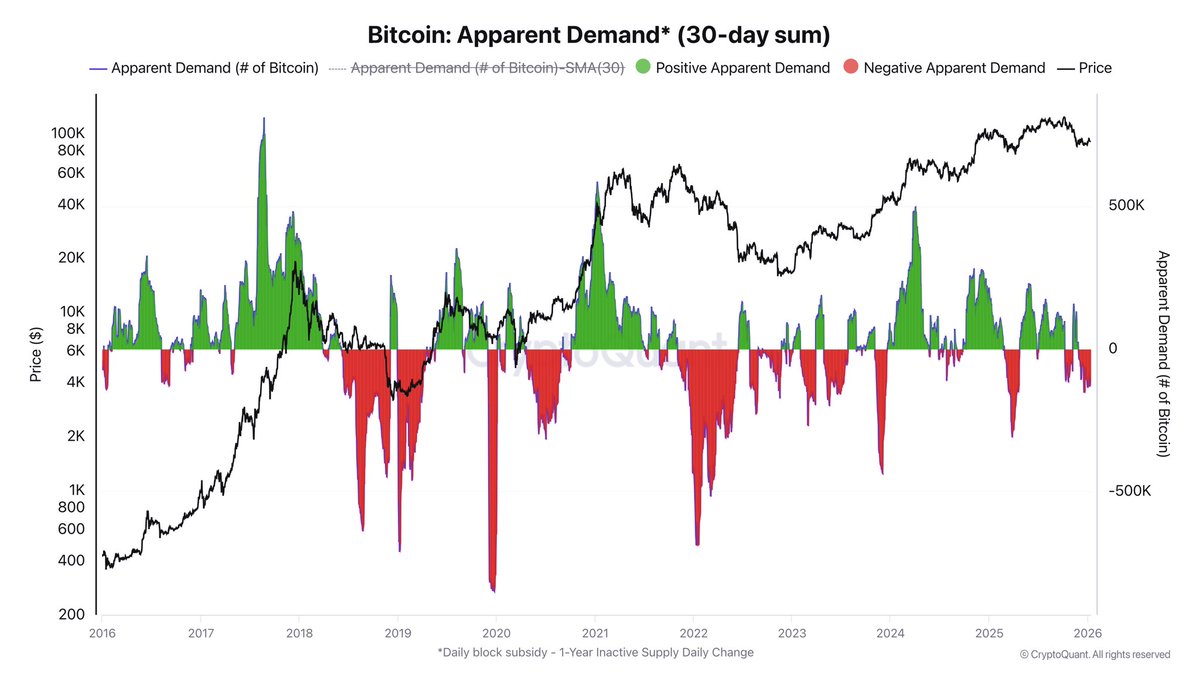
Bitcoin Apparent Demand | Source: CryptoQuant

This negative demand environment reflects a market that is defensive but not panicked. There is no evidence of forced liquidation or broad capitulation; instead, the data points to controlled distribution and a lack of urgency from buyers. In practical terms, participants are waiting for clearer confirmation—either from macro conditions, price structure, or on-chain metrics—before committing fresh capital.

Importantly, history shows that periods of weak or negative demand often coincide with zones where long-term opportunities begin to form. When interest is low and sentiment is muted, prices tend to stabilize rather than trend aggressively, allowing patient investors to build positions with reduced competition. However, these conditions favor long-term, risk-managed strategies, not short-term speculation.

Betting aggressively against the prevailing demand trend remains risky. As long as apparent demand stays negative, upside moves are more likely to be corrective rather than impulsive. For now, Bitcoin sits in a phase where discipline matters more than conviction, and time—not momentum—becomes the primary ally.


Related Questions

QWhat is the current state of Bitcoin's apparent demand according to the on-chain analysis?

ABitcoin's apparent demand remains firmly negative, with approximately -106,000 BTC on a 30-day cumulative basis, indicating that more supply is entering the market than is being absorbed by new buyers.

QHow did Bitcoin's price react to Jerome Powell's recent comments?

ABitcoin reacted with a short burst of volatility, slipping from local highs before finding tentative support near the $90,000 level.

QWhat does it mean when the 'apparent demand' ratio falls below zero?

AWhen the ratio falls below zero, it indicates that long-term dormant supply entering the market outweighs new demand, signaling net selling pressure.

QWhat type of market environment does the current negative demand reflect?

AIt reflects a defensive but not panicked market, with no evidence of forced liquidation, pointing instead to controlled distribution and a lack of urgency from buyers.

QAccording to the article, what do periods of weak demand often coincide with in Bitcoin's history?

APeriods of weak or negative demand often coincide with zones where long-term opportunities begin to form, allowing patient investors to build positions with reduced competition.

Related Reads

DeepSeek Funding: Liang Wenfeng's 'Realist' Pivot

DeepSeek, a leading Chinese AI company, has initiated its first external funding round, aiming to raise at least $300 million at a valuation of no less than $10 billion. This move marks a significant shift from its founder Liang Wenfeng’s previous idealistic stance of rejecting external capital to maintain independence. Despite strong financial backing from its parent company, quantitative trading firm幻方量化 (Huanfang Quant), which provided an estimated $700 million in revenue in 2025 alone, DeepSeek faces mounting challenges. Key issues include a 15-month gap in major model updates, delays in its flagship V4 release, and the loss of several core researchers to competitors offering significantly higher compensation. The company is also undergoing a strategic pivot by migrating its infrastructure from NVIDIA’s CUDA to Huawei’s Ascend platform, a move aligned with China’s push for technological self-reliance amid U.S. export controls. However, DeepSeek lags behind rivals like智谱AI and MiniMax—both now publicly listed—in areas such as product ecosystem, multimodal capabilities, and commercialization. The funding round, though relatively small in scale, is seen as a way to establish a market-validated valuation anchor, making employee stock options more competitive and facilitating talent retention. It also signals DeepSeek’s transition from a pure research-oriented organization to a commercially-driven player in the global AI ecosystem.

marsbit33m ago

DeepSeek Funding: Liang Wenfeng's 'Realist' Pivot

marsbit33m ago

Solana Q1 Report: Revenue Plunges 68% Year-on-Year, Developers Decrease by 30%

Solana Q1 2026 Report: Key Metrics Show Significant Decline Amid Market Reset Solana experienced a substantial downturn in Q1 2026, with key performance indicators reflecting a broader market cooling. Total network revenue (REV) fell to $89.9 million, down 68% year-over-year (YoY) and 1.4% quarter-over-quarter (QoQ). This decline was driven by reduced speculative activity, which had previously fueled the network during the 2024/2025 bull market. Key revenue components saw mixed results: base fees dropped 8.7% QoQ, Jito tips (MEV) fell 19.7%, priority fees rose 23%, and vote fees declined 44.5%. The annualized real yield for stakers was just 0.17%, down 67% YoY. Network GDP, generated by top applications, fell 7% QoQ to $451 million. Pump Fun emerged as a standout, generating $103 million (up 3% QoQ), surpassing Solana's L1 revenue. However, daily active addresses averaged 2.4 million, down 4.8% YoY. Stablecoin supply on Solana reached $15.9 billion, down 2.7% QoQ but up 18% YoY. USDC and USDT remained dominant. DEX volumes averaged $3.2 billion daily, with private DEXs now accounting for 60% of all volume. The network's net dilution rate was 4.38%, while the cost to produce $1 of REV was $8.10, up 93% YoY. The number of new tokens created on launchpads grew 42% QoQ to 3 million, with Pump Fun dominating 85% of this market. Despite the downturn, Solana's core strengths remain: its position as a hub for retail trading apps, potential in perpetual markets, and growing use in stablecoin-based fintech applications, particularly in Latin America. However, developer activity declined 32% YoY, slightly worse than Ethereum's 29% drop. The network must now focus on attracting traditional finance, competing in perpetual markets, and sustaining developer ecosystem growth to drive the next expansion cycle.

marsbit1h ago

Solana Q1 Report: Revenue Plunges 68% Year-on-Year, Developers Decrease by 30%

marsbit1h ago

Trading

Spot
Futures

Hot Articles

What is $BITCOIN

DIGITAL GOLD ($BITCOIN): A Comprehensive Analysis Introduction to DIGITAL GOLD ($BITCOIN) DIGITAL GOLD ($BITCOIN) is a blockchain-based project operating on the Solana network, which aims to combine the characteristics of traditional precious metals with the innovation of decentralized technologies. While it shares a name with Bitcoin, often referred to as “digital gold” due to its perception as a store of value, DIGITAL GOLD is a separate token designed to create a unique ecosystem within the Web3 landscape. Its goal is to position itself as a viable alternative digital asset, although specifics regarding its applications and functionalities are still developing. What is DIGITAL GOLD ($BITCOIN)? DIGITAL GOLD ($BITCOIN) is a cryptocurrency token explicitly designed for use on the Solana blockchain. In contrast to Bitcoin, which provides a widely recognized value storage role, this token appears to focus on broader applications and characteristics. Notable aspects include: Blockchain Infrastructure: The token is built on the Solana blockchain, known for its capacity to handle high-speed and low-cost transactions. Supply Dynamics: DIGITAL GOLD has a maximum supply capped at 100 quadrillion tokens (100P $BITCOIN), although details regarding its circulating supply are currently undisclosed. Utility: While precise functionalities are not explicitly outlined, there are indications that the token could be utilized for various applications, potentially involving decentralized applications (dApps) or asset tokenization strategies. Who is the Creator of DIGITAL GOLD ($BITCOIN)? At present, the identity of the creators and development team behind DIGITAL GOLD ($BITCOIN) remains unknown. This situation is typical among many innovative projects within the blockchain space, particularly those aligning with decentralized finance and meme coin phenomena. While such anonymity may foster a community-driven culture, it intensifies concerns about governance and accountability. Who are the Investors of DIGITAL GOLD ($BITCOIN)? The available information indicates that DIGITAL GOLD ($BITCOIN) does not have any known institutional backers or prominent venture capital investments. The project seems to operate on a peer-to-peer model focused on community support and adoption rather than traditional funding routes. Its activity and liquidity are primarily situated on decentralized exchanges (DEXs), such as PumpSwap, rather than established centralized trading platforms, further highlighting its grassroots approach. How DIGITAL GOLD ($BITCOIN) Works The operational mechanics of DIGITAL GOLD ($BITCOIN) can be elaborated on based on its blockchain design and network attributes: Consensus Mechanism: By leveraging Solana’s unique proof-of-history (PoH) combined with a proof-of-stake (PoS) model, the project ensures efficient transaction validation contributing to the network's high performance. Tokenomics: While specific deflationary mechanisms have not been extensively detailed, the vast maximum token supply implies that it may cater to microtransactions or niche use cases that are still to be defined. Interoperability: There exists the potential for integration with Solana’s broader ecosystem, including various decentralized finance (DeFi) platforms. However, the details regarding specific integrations remain unspecified. Timeline of Key Events Here is a timeline that highlights significant milestones concerning DIGITAL GOLD ($BITCOIN): 2023: The initial deployment of the token occurs on the Solana blockchain, marked by its contract address. 2024: DIGITAL GOLD gains visibility as it becomes available for trading on decentralized exchanges like PumpSwap, allowing users to trade it against SOL. 2025: The project witnesses sporadic trading activity and potential interest in community-led engagements, although no noteworthy partnerships or technical advancements have been documented as of yet. Critical Analysis Strengths Scalability: The underlying Solana infrastructure supports high transaction volumes, which could enhance the utility of $BITCOIN in various transaction scenarios. Accessibility: The potential low trading price per token could attract retail investors, facilitating wider participation due to fractional ownership opportunities. Risks Lack of Transparency: The absence of publicly known backers, developers, or an audit process may yield skepticism regarding the project's sustainability and trustworthiness. Market Volatility: The trading activity is heavily reliant on speculative behavior, which can result in significant price volatility and uncertainty for investors. Conclusion DIGITAL GOLD ($BITCOIN) emerges as an intriguing yet ambiguous project within the rapidly evolving Solana ecosystem. While it attempts to leverage the “digital gold” narrative, its departure from Bitcoin's established role as a store of value underscores the need for a clearer differentiation of its intended utility and governance structure. Future acceptance and adoption will likely depend on addressing the current opacity and defining its operational and economic strategies more explicitly. Note: This report encompasses synthesised information available as of October 2023, and developments may have transpired beyond the research period.

363 Total ViewsPublished 2025.05.13Updated 2025.05.13

What is $BITCOIN

Discussions

Welcome to the HTX Community. Here, you can stay informed about the latest platform developments and gain access to professional market insights. Users' opinions on the price of BTC (BTC) are presented below.

活动图片