Bitcoin Current Cycle Breaks Pattern As LTH-To-STH Supply Transfer Fails To Materialize

bitcoinistPublished on 2026-03-16Last updated on 2026-03-16

Abstract

Bitcoin's current market cycle is breaking historical patterns as the typical large-scale supply transfer from Long-Term Holders (LTHs) to Short-Term Holders (STHs) has not materialized. Despite the price rebounding above $73,000, on-chain data shows LTHs still control about 79% of the supply, unlike previous cycles where their dominance decreased significantly during bull markets. Analyst Darkfost notes that supply shifts occurred in six waves, with sufficient liquidity allowing LTHs to find counterparties without drastic selling pressure. Additionally, increased speculation and institutional inflows via ETFs and Digital Asset Treasuries are reshaping market dynamics, indicating stronger long-term confidence and a structural shift in Bitcoin’s holder composition.

The cryptocurrency market is turning bullish again, and Bitcoin has experienced a bounce, triggering optimism among investors. While Bitcoin’s price is holding firm above the $73,000 mark, its market dynamics are undergoing a major shift that could shape the flagship asset’s direction in the short term.

A Key Change In Bitcoin’s Market Structure?

Bitcoin’s price is showing bullish strength once again, recovering above the $73,000 level during the weekend. However, on-chain market data reveals that the way supply is shifting between long-term BTC holders (LTHs) and short-term BTC holders (STHs) throughout the current cycle is clearly changing.

Darkfost, in a post on X, highlighted that this transfer of supply between the two groups has not occurred in the ongoing cycle the same way it did in previous cycles. As prices rise, long-term investors have historically transferred their holdings to more recent market players during significant bull market periods.

This trend suggests a major reset in the initial market structure of Bitcoin, where supply is equally controlled by short-term and long-term holders. Moving on, the expert stated that the first key thing to remember in the current cycle is that long-term holders still hold the majority of the BTC supply.
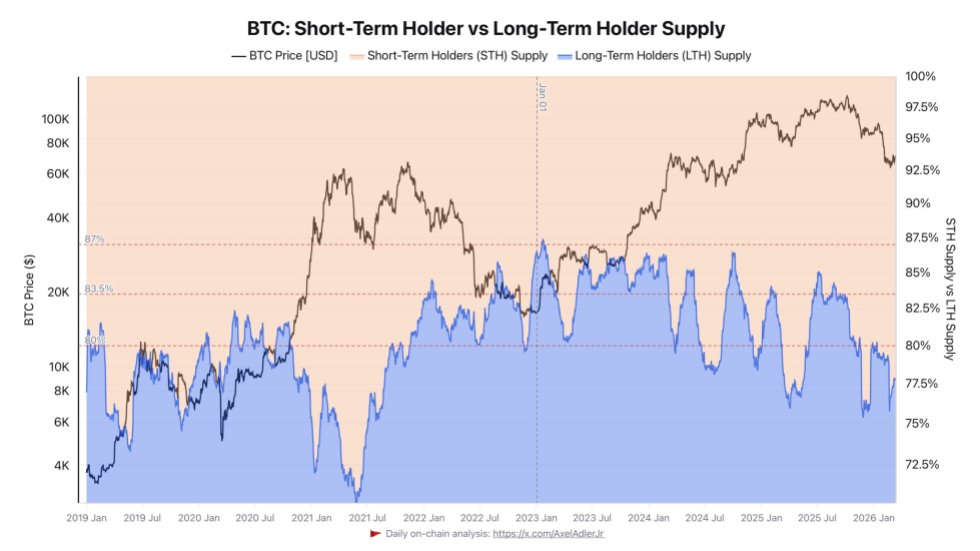
A shift in supply transfer between Bitcoin STHs and LTHs | Source: Chart from Darkfost on X

Rather than witnessing a rapid decline in LTH-held supply as Bitcoin nears the conclusion of its cycle, this time the process took a different turn. As of Sunday, these key investors represent roughly 79% of the total BTC supply.

The development is similar to that of the 2021 cycle, where the share of supply held by long-term holders fell from 82% to 70% in a space of 6 months. A major trigger is the insufficient liquidity from short-term holders to absorb the selling pressure from long-term investors.

The Movement Of BTC In 6 Separate Waves

During the current cycle, Darkfost reports that this transfer occurred in 6 waves. Meanwhile, STHs were observed swooping in to absorb the supply at every stage. These investors eventually turned into LTHs over time. After examining the coin movement within the 6 waves, Darkfost has underscored two major observations.

One is that liquidity appears to have been substantial during this cycle, and this allowed LTHs to steadily discover counterparties while Bitcoin’s price action extends. Secondly, speculation seems to have been stronger than before, with some short-term holders offloading their stash shortly after holding their BTC for more than 6 months in order to quickly realize profits.

Another key development observed in the market is the arrival of new participants via the Exchange-Traded Funds (ETFs) and Digital Asset Treasuries (DATs). Such a trend points to renewed capital and demand for the flagship asset from institutional investors who are confident about its long-term prospects. According to Darkfost, all of these factors are adding to a changing market structure for Bitcoin.

At the time of trading, Bitcoin’s price was trading at $73,815, following a more than 3% bounce over the last 24 hours. Its trading volume has followed suit, spiking by over 77% within the past day.

BTC trading at $73,807 on the 1D chart | Source: BTCUSDT on Tradingview.com

Related Questions

QWhat is the main difference in Bitcoin's supply transfer pattern between long-term holders (LTHs) and short-term holders (STHs) in the current cycle compared to previous cycles?

AIn the current cycle, the transfer of supply from long-term holders to short-term holders has not occurred in the same way as in previous cycles. Long-term holders still hold the majority of the supply (roughly 79%), and the process has been more gradual, occurring in 6 distinct waves, rather than a rapid decline in LTH-held supply.

QWhat percentage of the total Bitcoin supply do long-term holders (LTHs) currently control, according to the article?

AAs of the time of the article, long-term holders (LTHs) represent roughly 79% of the total Bitcoin supply.

QWhat are the two major observations made by Darkfost after examining the coin movement within the 6 waves of supply transfer?

AThe two major observations are: 1) Liquidity has been substantial, allowing LTHs to steadily find counterparties as Bitcoin's price extends. 2) Speculation has been stronger, with some STHs selling their BTC shortly after holding for more than 6 months to realize profits quickly.

QWhat new participants are cited as a key development contributing to Bitcoin's changing market structure?

AThe arrival of new participants via Exchange-Traded Funds (ETFs) and Digital Asset Treasuries (DATs) is a key development, pointing to renewed capital and demand from institutional investors confident in Bitcoin's long-term prospects.

QWhat was Bitcoin's price and 24-hour performance at the time the article was written?

AAt the time of writing, Bitcoin's price was $73,815, following a more than 3% bounce over the last 24 hours.

Related Reads

First Batch of Keynote Speakers and Partners Announced! Web2+3 Summit: Defining the Next Generation of Digital Economy

Web2+3 Summit: Defining the Next Generation of Digital Economy The 6th BEYOND International Technology Innovation Expo (BEYOND Expo 2026), Asia's largest tech and ecosystem exhibition, is launching a dedicated Web2+3 stage for the first time. Co-hosted by BEYOND Expo and ChainNeXT Group, the Web3 Summit will take place from May 28–30, 2026. Against the backdrop of accelerating global tech integration, the boundaries between Web2 and Web3 are rapidly blurring. With clearer global regulations for blockchain-driven internet (Web3) and the special issuance of a Hong Kong dollar stable币 license by the Hong Kong SAR government on April 10, 2026, Web3's decentralized principles are quickly merging with traditional industries (Web2) such as e-commerce, finance, and artificial intelligence. Focused on blockchain-driven digital economy elements, the summit will center on three core principles—implementability, commercial viability, and compliance. It will bring together top Web3 experts to discuss key integration areas like stablecoin payment finance (PayFi), real-world asset tokenization (RWA), and decentralized AI (DeAI), unveiling new opportunities for industrial innovation. The first wave of confirmed speakers includes Jack Kong (Director of Hong Kong Cyberport, Chairman of Nano Labs), Yat Siu (Chairman of Animoca Brands), Michael Wu (Co-founder & CEO of Amber Group), Michael Heinrich (Co-founder & CEO of 0G), and Art Abal (Co-founder of Vana). More Web3 ecosystem pioneers, AI, and fintech experts will be announced soon. Core forum topics include: - Web2+DeAI: New AI Paradigms Driven by Decentralized Infrastructure - Web2+RWA: Real-World Asset Tokenization and Global Liquidity - Web2+PayFi: Cross-Border Payments and Financial Innovation Powered by Crypto Infrastructure - Web2+3 AI: Autonomous Agents and the Crypto Economy - Web2+3 Wealth: On-Chain and Off-Chain Integrated Investment Ecosystems - Web2+3 Commerce: A New Landscape for Global Trade Driven by Stablecoins Additional agenda details will be released in the near future.

marsbit2h ago

First Batch of Keynote Speakers and Partners Announced! Web2+3 Summit: Defining the Next Generation of Digital Economy

marsbit2h ago

Trading

Spot
Futures

Hot Articles

What is $BITCOIN

DIGITAL GOLD ($BITCOIN): A Comprehensive Analysis Introduction to DIGITAL GOLD ($BITCOIN) DIGITAL GOLD ($BITCOIN) is a blockchain-based project operating on the Solana network, which aims to combine the characteristics of traditional precious metals with the innovation of decentralized technologies. While it shares a name with Bitcoin, often referred to as “digital gold” due to its perception as a store of value, DIGITAL GOLD is a separate token designed to create a unique ecosystem within the Web3 landscape. Its goal is to position itself as a viable alternative digital asset, although specifics regarding its applications and functionalities are still developing. What is DIGITAL GOLD ($BITCOIN)? DIGITAL GOLD ($BITCOIN) is a cryptocurrency token explicitly designed for use on the Solana blockchain. In contrast to Bitcoin, which provides a widely recognized value storage role, this token appears to focus on broader applications and characteristics. Notable aspects include: Blockchain Infrastructure: The token is built on the Solana blockchain, known for its capacity to handle high-speed and low-cost transactions. Supply Dynamics: DIGITAL GOLD has a maximum supply capped at 100 quadrillion tokens (100P $BITCOIN), although details regarding its circulating supply are currently undisclosed. Utility: While precise functionalities are not explicitly outlined, there are indications that the token could be utilized for various applications, potentially involving decentralized applications (dApps) or asset tokenization strategies. Who is the Creator of DIGITAL GOLD ($BITCOIN)? At present, the identity of the creators and development team behind DIGITAL GOLD ($BITCOIN) remains unknown. This situation is typical among many innovative projects within the blockchain space, particularly those aligning with decentralized finance and meme coin phenomena. While such anonymity may foster a community-driven culture, it intensifies concerns about governance and accountability. Who are the Investors of DIGITAL GOLD ($BITCOIN)? The available information indicates that DIGITAL GOLD ($BITCOIN) does not have any known institutional backers or prominent venture capital investments. The project seems to operate on a peer-to-peer model focused on community support and adoption rather than traditional funding routes. Its activity and liquidity are primarily situated on decentralized exchanges (DEXs), such as PumpSwap, rather than established centralized trading platforms, further highlighting its grassroots approach. How DIGITAL GOLD ($BITCOIN) Works The operational mechanics of DIGITAL GOLD ($BITCOIN) can be elaborated on based on its blockchain design and network attributes: Consensus Mechanism: By leveraging Solana’s unique proof-of-history (PoH) combined with a proof-of-stake (PoS) model, the project ensures efficient transaction validation contributing to the network's high performance. Tokenomics: While specific deflationary mechanisms have not been extensively detailed, the vast maximum token supply implies that it may cater to microtransactions or niche use cases that are still to be defined. Interoperability: There exists the potential for integration with Solana’s broader ecosystem, including various decentralized finance (DeFi) platforms. However, the details regarding specific integrations remain unspecified. Timeline of Key Events Here is a timeline that highlights significant milestones concerning DIGITAL GOLD ($BITCOIN): 2023: The initial deployment of the token occurs on the Solana blockchain, marked by its contract address. 2024: DIGITAL GOLD gains visibility as it becomes available for trading on decentralized exchanges like PumpSwap, allowing users to trade it against SOL. 2025: The project witnesses sporadic trading activity and potential interest in community-led engagements, although no noteworthy partnerships or technical advancements have been documented as of yet. Critical Analysis Strengths Scalability: The underlying Solana infrastructure supports high transaction volumes, which could enhance the utility of $BITCOIN in various transaction scenarios. Accessibility: The potential low trading price per token could attract retail investors, facilitating wider participation due to fractional ownership opportunities. Risks Lack of Transparency: The absence of publicly known backers, developers, or an audit process may yield skepticism regarding the project's sustainability and trustworthiness. Market Volatility: The trading activity is heavily reliant on speculative behavior, which can result in significant price volatility and uncertainty for investors. Conclusion DIGITAL GOLD ($BITCOIN) emerges as an intriguing yet ambiguous project within the rapidly evolving Solana ecosystem. While it attempts to leverage the “digital gold” narrative, its departure from Bitcoin's established role as a store of value underscores the need for a clearer differentiation of its intended utility and governance structure. Future acceptance and adoption will likely depend on addressing the current opacity and defining its operational and economic strategies more explicitly. Note: This report encompasses synthesised information available as of October 2023, and developments may have transpired beyond the research period.

363 Total ViewsPublished 2025.05.13Updated 2025.05.13

What is $BITCOIN

Discussions

Welcome to the HTX Community. Here, you can stay informed about the latest platform developments and gain access to professional market insights. Users' opinions on the price of BTC (BTC) are presented below.

活动图片