Bitcoin braces for $14B Options expiry – Will BTC’s $75K ceiling crack?

ambcryptoPublished on 2026-03-26Last updated on 2026-03-26

Abstract

Bitcoin is holding steady around $70,000 despite geopolitical tensions, but faces a major test with $14 billion in BTC options set to expire on March 27th. This event accounts for nearly 40% of Deribit’s total open interest. The put/call ratio of 0.62 and max pain price at $75,000 indicate bullish sentiment among traders, though the $75k level has repeatedly acted as a strong resistance. Market sentiment, as shown by the Fear and Greed Index, has dipped into fear territory, reflecting hesitation among buyers. The expiry may amplify volatility, and breaking above $75k remains challenging due to persistent selling pressure and lack of strong bullish momentum.

Bitcoin [BTC] has been holding up pretty well despite ongoing geopolitical tension. It has been hovering around $70k for over three weeks straight. That said, on the daily chart, BTC would need to break above $75k to set a second higher high and start eyeing the $80k zone.

The environment is extremely volatile right now. With such a huge Options expiry on the horizon, price swings could get amplified.

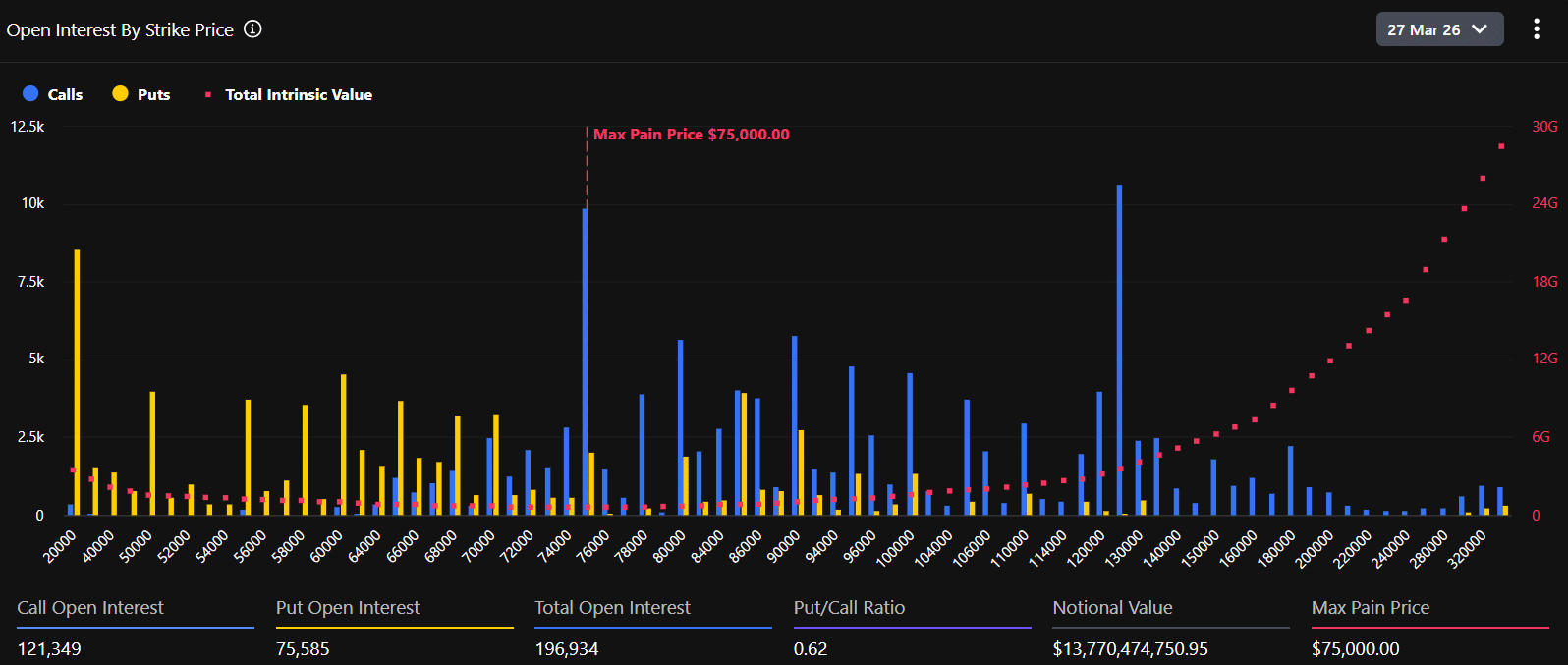
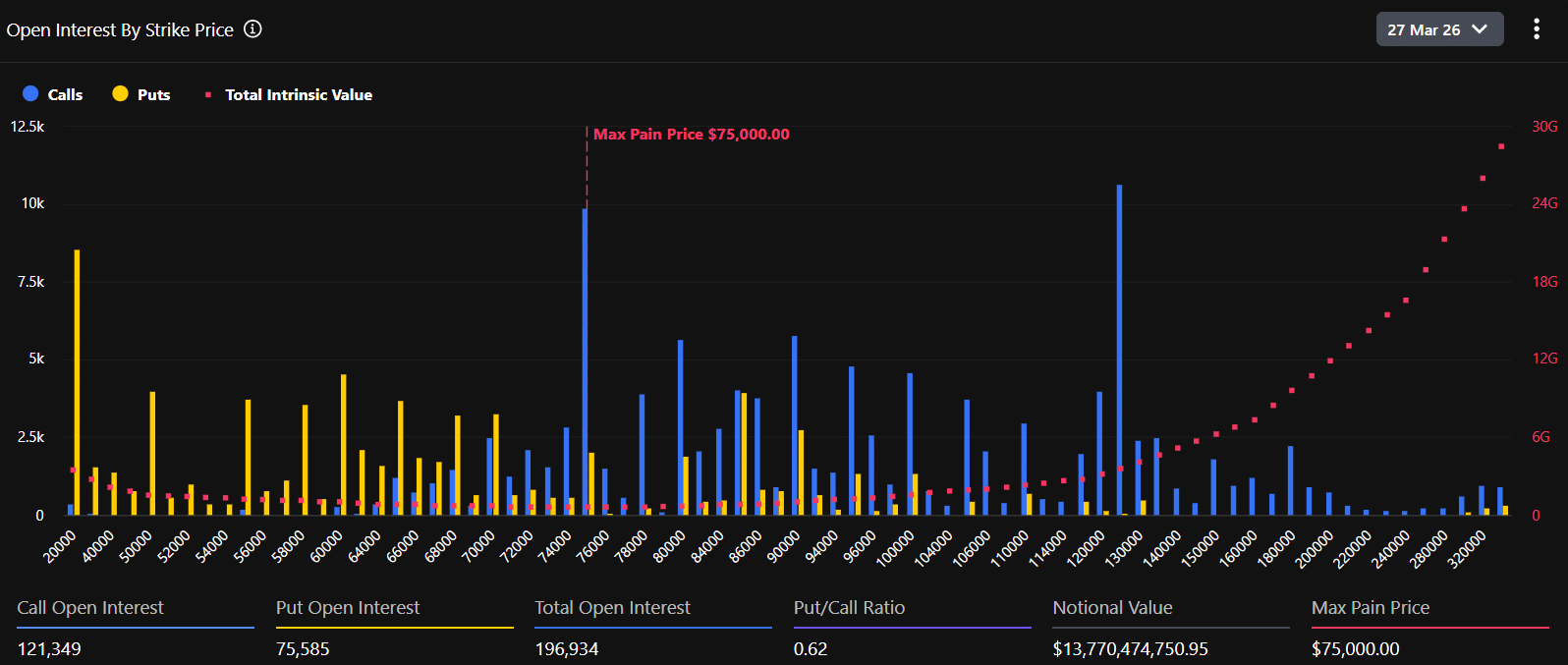
According to Deribit data, nearly $14 billion in Bitcoin Options are set to expire on the 27th of March. In fact, this expiry accounts for almost 40% of Deribit’s total open positions.
Source: Deribit

Now, to get a sense of how this might play out, it helps to look at a few key metrics.

For instance, Bitcoin’s put/call ratio is currently at 0.62, which means that calls are dominating. From a technical standpoint, out of a total Open Interest of 196k contracts, around 121k are call options, so traders are leaning bullish heading into the expiry.

Moreover, the max pain level is coming in at $75k. Basically, this level represents the sweet spot where option sellers stand to benefit the most. According to AMBCrypto, this creates an interesting setup.

On the technical side, Bitcoin has been chopping around $70k for weeks, showing resilience, but the $75k mark has acted as a strong ceiling.

The sheer size of the Options expiry has traders on high alert, watching to see whether BTC can finally push past $75k or if sellers will cap it near max pain.

Looking at sentiment, though, it feels like traders have already made up their minds.

This Friday could put Bitcoin’s resilience to the ultimate test

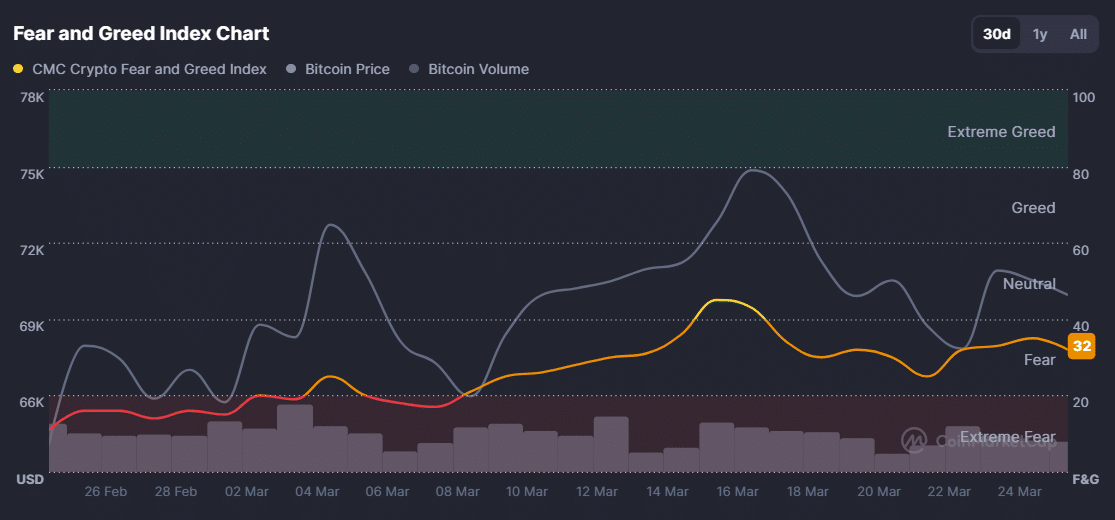
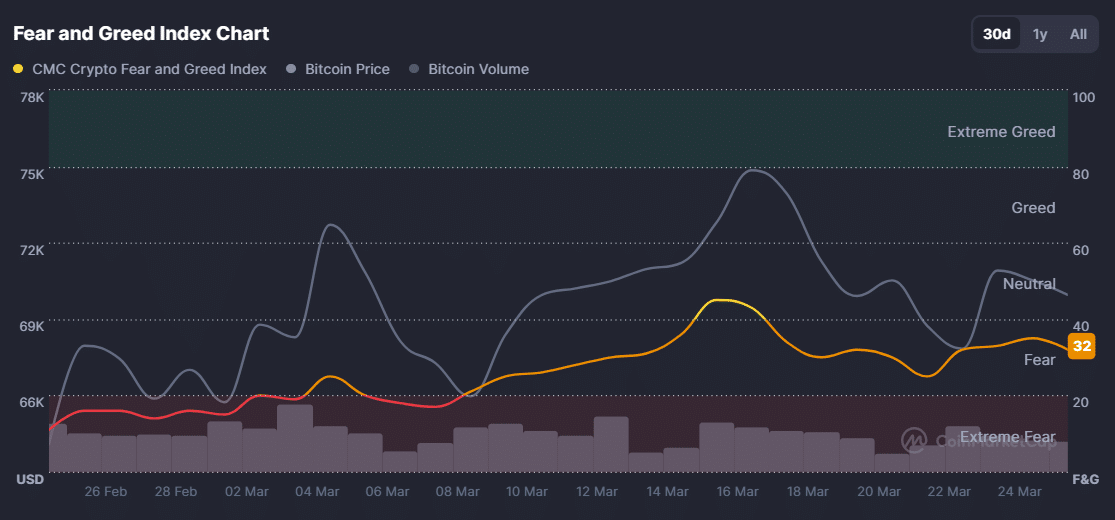
The Crypto Fear and Greed Index shows that since Bitcoin hit resistance around $75k in mid-March, the index has slid back into the fear zone.

The fascinating part is that when BTC topped in this range, it wasn’t accompanied by greed, which tells you traders weren’t fully confident in pushing the market higher.
Source: CoinMarketCap

Put simply, Bitcoin ran into resistance because bulls didn’t have enough follow-through.

Add consistent selling pressure to the mix, and it’s clear the market is still hitting friction before any meaningful upside. Every rally has stalled, and buyers aren’t stepping up aggressively, keeping BTC pinned below key levels.

Against this backdrop, the $14 billion Options expiry on Friday adds another layer of uncertainty. With so much of the market’s open positions coming off the table, pushing past $75k looks tough, especially since sentiment is still cautious and traders are hesitant to take on risk.


Final Summary

  • Bitcoin faces a critical test this Friday as the $14 billion Options expiry could keep it pinned below $75k.
  • Resistance and selling pressure remain key hurdles, making BTC’s ability to hold $70k support the main focus for short-term market direction.


Related Questions

QWhat is the significance of the $14 billion Bitcoin Options expiry on March 27th mentioned in the article?

AThe $14 billion Bitcoin Options expiry is significant because it accounts for almost 40% of Deribit's total open positions. This massive expiry could amplify price swings and is a key test for Bitcoin's price, as it may determine whether BTC can break above the $75,000 resistance level or remain capped near that point.

QWhat is the current put/call ratio for Bitcoin options, and what does it indicate about trader sentiment?

AThe current put/call ratio for Bitcoin options is 0.62. This indicates that call options are dominating, meaning traders are leaning bullish heading into the expiry, as there are more open call contracts (121k) than put contracts.

QWhat is the 'max pain' level for the upcoming options expiry, and why is it important?

AThe 'max pain' level for the upcoming options expiry is $75,000. This is the price at which option sellers would benefit the most, as it represents the strike price where the largest number of options (both calls and puts) would expire worthless, minimizing the payout from the option writers.

QAccording to the article, what does the Crypto Fear and Greed Index reveal about market sentiment when Bitcoin recently faced resistance at $75k?

AThe Crypto Fear and Greed Index shows that when Bitcoin faced resistance around $75,000 in mid-March, the index slid back into the 'fear' zone. This indicates that traders were not fully confident in pushing the market higher, and the resistance was met with a lack of bullish follow-through rather than extreme greed.

QWhat are the two main hurdles preventing Bitcoin from achieving a meaningful upside move, as outlined in the article's summary?

AThe two main hurdles preventing Bitcoin from achieving a meaningful upside move are resistance at the $75,000 level and consistent selling pressure. These factors have kept BTC pinned below key levels, with every rally stalling due to a lack of aggressive buying.

Related Reads

Google TPU Shipments Revised Up by 50%

Recent industry research indicates a significant upward revision in the shipments of Google's TPU (Tensor Processing Unit) chips. Previous expectations for 2027 were set at around 10 million units, but new estimates now point to 15 million units, a 50% increase. This substantial boost directly translates to higher demand across the entire supporting supply chain. Google's TPU clusters utilize a standardized all-optical interconnect architecture. Consequently, key hardware components are deeply integrated and scaled in fixed ratios with the chips. The 15 million TPU target will drive corresponding demand increases for NPO optical engines (roughly a 1:1 match), 1.6T optical modules, OCS optical switches, high-end server power supplies, fiber optics & MPO connectors, and liquid cooling solutions. Among these, liquid cooling is highlighted as the sector experiencing the most significant transformation and offering the most stable potential for excess returns. As next-generation TPU chips reach power levels where traditional air cooling is insufficient, liquid cooling becomes essential. 2026 is forecasted as the first year of substantial adoption for Google's liquid cooling solutions. This shift, coupled with delivery and capacity bottlenecks faced by incumbent overseas manufacturers, is creating a prime window for domestic Chinese suppliers to enter and secure Google's core supply chain. The market size for Google-specific liquid cooling is projected to potentially triple from a baseline of hundreds of billions to around 300 billion units by 2028. The logic for the fiber optic sector is also being rewritten. Once considered a cyclical commodity tied to telecom operator procurement, fiber is now a strategic and scarce resource for AI Data Centers (AIDC). A severe supply-demand imbalance, driven by the long lead time for preform production (18-24 months) and surging demand from cloud giants, is supporting strong performance. Chinese fiber manufacturers are well-positioned to capture a significant share of global AIDC demand, with exports potentially reaching 200-300 million core kilometers in 2026. Overall, the investment focus within the AI computing industry is shifting from pure "chip performance speculation" towards the more certain incremental growth in computing infrastructure and its supporting ecosystem. The upward revision in Google TPU shipments, along with the potential for further doubling by 2028, is seen as solidifying performance visibility for the entire supporting supply chain over the next two years.

marsbit30m ago

Google TPU Shipments Revised Up by 50%

marsbit30m ago

What Wall Street Really Wants After the Crypto Story Recedes

The tide of speculative crypto narratives has receded, revealing Wall Street's true objective: building a controlled, yield-generating, and compliant financial pipeline on distributed ledgers. They are migrating core functions onto blockchains, not for decentralization, but for efficiency and new revenue streams. Key developments include BlackRock's BUIDL fund, a tokenized treasury fund acting as a foundational reserve asset, and the rise of Securitize, which is going public and partnering with the NYSE to build a 24/7 digital securities trading and settlement system. This signals a major shift of securities clearing to blockchain technology. To make volatile assets like Bitcoin palatable for institutional investors, firms like BlackRock and Goldman Sachs are creating "covered call" ETFs (e.g., BITA). These products systematically sell options on Bitcoin holdings, transforming price volatility into stable monthly income, effectively repackaging crypto as a yield-bearing asset. Stablecoins are being positioned not as speculative tools but as efficient payment rails. Companies like Stripe and Mastercard are integrating them for instant, low-cost merchant settlements and cross-border card payments, respectively. Critically, new legislation like the GENIUS Act shapes them as non-interest-bearing, heavily regulated extensions of the US dollar system. In summary, Wall Street is quietly constructing a parallel, blockchain-based financial infrastructure featuring tokenized traditional assets, structured crypto yields, and programmable dollar pipelines—all under its control and fully integrated with existing regulatory and credit frameworks.

marsbit47m ago

What Wall Street Really Wants After the Crypto Story Recedes

marsbit47m ago

Tying Itself to SpaceX: Cursor's $60 Billion Rise

This article recounts the rapid rise of AI-powered coding startup Cursor and its 25-year-old MIT graduate CEO, Michael Truell. Launched in 2023, Cursor achieved explosive growth, reaching over 10 billion USD in revenue by late 2025. However, its journey highlights a central dilemma for AI application companies: dependence on foundational model providers. Cursor initially relied heavily on Anthropic's models but faced an existential threat when Anthropic launched its own competing coding tool, Claude Code. In response, Cursor declared an internal emergency in early 2026 and accelerated development of its own model, Composer. To secure the immense computing power needed, Truell struck a pivotal deal with Elon Musk's SpaceX in April 2026. The collaboration grants Cursor access to SpaceX's supercomputing resources for Composer, while SpaceX's Grok model benefits from Cursor's programming data. The agreement includes a potential 600 billion USD acquisition of Cursor by SpaceX later in the year, though a substantial termination fee is in place if the deal falls through. The story explores Cursor's intense, sometimes controversial hiring practices involving lengthy unpaid "work trials," its complex partnership-turned-rivalry with Anthropic, and its high-stakes gamble to ensure independence through the SpaceX alliance. The core question remains: will Cursor evolve into a defining, independent "generational" software company, or become a key piece in a tech giant's AI arsenal?

marsbit52m ago

Tying Itself to SpaceX: Cursor's $60 Billion Rise

marsbit52m ago

Warsh's Debut: Will the FED Chair Who Knows Crypto Best Bring Surprises or Shocks to the Market?

Kevin Warsh, the new Federal Reserve Chairman, prepares for his inaugural press conference amidst a challenging macroeconomic landscape: resurgent inflation, a bond market sell-off, and political pressure from President Trump for rate cuts. Uniquely, Warsh holds indirect investments in over 20 crypto and Web3 entities (e.g., Solana, dYdX), making him the first Fed Chair with disclosed crypto exposure. His stance may combine a hawkish, inflation-focused monetary policy with a crypto-friendly regulatory philosophy that shifts from Powell’s “same risk, same rule” approach toward a framework acknowledging blockchain’s productivity value. Warsh’s leadership could impact crypto markets across three dimensions: a paradigm shift in regulation (potentially accelerating pro-innovation legislation and stable币 rules), a re-pricing of risk premiums based on clearer communication and his view of AI as a structural disinflationary force, and a long-term reallocation of global institutional capital driven by increased legitimacy. Two potential scenarios for the press conference are outlined. A “positive surprise” would involve a dovish-leaning tone on rates coupled with signals of regulatory openness, potentially boosting crypto asset valuations. Conversely, a “negative shock” would see a more hawkish-than-expected stance on inflation and rates, triggering a broad risk-asset selloff that crypto markets would not escape. While ethics rules required Warsh to divest his crypto holdings upon confirmation, his deep understanding of the technology may fundamentally lower policy uncertainty and build a more receptive long-term foundation for digital assets’ integration into the mainstream financial system.

marsbit11h ago

Warsh's Debut: Will the FED Chair Who Knows Crypto Best Bring Surprises or Shocks to the Market?

marsbit11h ago

Trading

Spot
Futures

Hot Articles

What is $BITCOIN

DIGITAL GOLD ($BITCOIN): A Comprehensive Analysis Introduction to DIGITAL GOLD ($BITCOIN) DIGITAL GOLD ($BITCOIN) is a blockchain-based project operating on the Solana network, which aims to combine the characteristics of traditional precious metals with the innovation of decentralized technologies. While it shares a name with Bitcoin, often referred to as “digital gold” due to its perception as a store of value, DIGITAL GOLD is a separate token designed to create a unique ecosystem within the Web3 landscape. Its goal is to position itself as a viable alternative digital asset, although specifics regarding its applications and functionalities are still developing. What is DIGITAL GOLD ($BITCOIN)? DIGITAL GOLD ($BITCOIN) is a cryptocurrency token explicitly designed for use on the Solana blockchain. In contrast to Bitcoin, which provides a widely recognized value storage role, this token appears to focus on broader applications and characteristics. Notable aspects include: Blockchain Infrastructure: The token is built on the Solana blockchain, known for its capacity to handle high-speed and low-cost transactions. Supply Dynamics: DIGITAL GOLD has a maximum supply capped at 100 quadrillion tokens (100P $BITCOIN), although details regarding its circulating supply are currently undisclosed. Utility: While precise functionalities are not explicitly outlined, there are indications that the token could be utilized for various applications, potentially involving decentralized applications (dApps) or asset tokenization strategies. Who is the Creator of DIGITAL GOLD ($BITCOIN)? At present, the identity of the creators and development team behind DIGITAL GOLD ($BITCOIN) remains unknown. This situation is typical among many innovative projects within the blockchain space, particularly those aligning with decentralized finance and meme coin phenomena. While such anonymity may foster a community-driven culture, it intensifies concerns about governance and accountability. Who are the Investors of DIGITAL GOLD ($BITCOIN)? The available information indicates that DIGITAL GOLD ($BITCOIN) does not have any known institutional backers or prominent venture capital investments. The project seems to operate on a peer-to-peer model focused on community support and adoption rather than traditional funding routes. Its activity and liquidity are primarily situated on decentralized exchanges (DEXs), such as PumpSwap, rather than established centralized trading platforms, further highlighting its grassroots approach. How DIGITAL GOLD ($BITCOIN) Works The operational mechanics of DIGITAL GOLD ($BITCOIN) can be elaborated on based on its blockchain design and network attributes: Consensus Mechanism: By leveraging Solana’s unique proof-of-history (PoH) combined with a proof-of-stake (PoS) model, the project ensures efficient transaction validation contributing to the network's high performance. Tokenomics: While specific deflationary mechanisms have not been extensively detailed, the vast maximum token supply implies that it may cater to microtransactions or niche use cases that are still to be defined. Interoperability: There exists the potential for integration with Solana’s broader ecosystem, including various decentralized finance (DeFi) platforms. However, the details regarding specific integrations remain unspecified. Timeline of Key Events Here is a timeline that highlights significant milestones concerning DIGITAL GOLD ($BITCOIN): 2023: The initial deployment of the token occurs on the Solana blockchain, marked by its contract address. 2024: DIGITAL GOLD gains visibility as it becomes available for trading on decentralized exchanges like PumpSwap, allowing users to trade it against SOL. 2025: The project witnesses sporadic trading activity and potential interest in community-led engagements, although no noteworthy partnerships or technical advancements have been documented as of yet. Critical Analysis Strengths Scalability: The underlying Solana infrastructure supports high transaction volumes, which could enhance the utility of $BITCOIN in various transaction scenarios. Accessibility: The potential low trading price per token could attract retail investors, facilitating wider participation due to fractional ownership opportunities. Risks Lack of Transparency: The absence of publicly known backers, developers, or an audit process may yield skepticism regarding the project's sustainability and trustworthiness. Market Volatility: The trading activity is heavily reliant on speculative behavior, which can result in significant price volatility and uncertainty for investors. Conclusion DIGITAL GOLD ($BITCOIN) emerges as an intriguing yet ambiguous project within the rapidly evolving Solana ecosystem. While it attempts to leverage the “digital gold” narrative, its departure from Bitcoin's established role as a store of value underscores the need for a clearer differentiation of its intended utility and governance structure. Future acceptance and adoption will likely depend on addressing the current opacity and defining its operational and economic strategies more explicitly. Note: This report encompasses synthesised information available as of October 2023, and developments may have transpired beyond the research period.

376 Total ViewsPublished 2025.05.13Updated 2025.05.13

What is $BITCOIN

Discussions

Welcome to the HTX Community. Here, you can stay informed about the latest platform developments and gain access to professional market insights. Users' opinions on the price of BTC (BTC) are presented below.

活动图片