Bitcoin Bear Market Would Be Record Shallow If $60,000 Was The Low: Glassnode

bitcoinistPublished on 2026-05-15Last updated on 2026-05-15

Abstract

Glassnode's analysis indicates the current Bitcoin bear market may be record shallow if the low was $60,000. The firm notes the Relative Unrealized Loss metric, tracking investor paper losses as a percentage of market cap, peaked at only 25% during February's sell-off, significantly lower than historical cycle highs. This level has since declined to around 8%, suggesting a shift from fear to uncertainty rather than the broad capitulation typical of major bottoms. Concurrently, the 30-day change in Bitcoin's Realized Cap has turned positive, signaling renewed capital inflows, though Glassnode cautions this inflow lacks the conviction seen at similar past inflection points. Bitcoin's price has recently consolidated around the $81,300 level.

Glassnode has pointed out how this Bitcoin bear market has so far seen a peak Unrealized Loss significantly lower than previous cycles.

Bitcoin Relative Unrealized Loss Has Dropped To Just 8%

In its latest report, on-chain analytics firm Glassnode has discussed the latest trend in the Relative Unrealized Loss of Bitcoin. This indicator keeps track of the total amount of unrealized loss held by the BTC investors as a percentage of the market cap.

Below is the chart shared by Glassnode that shows the trend in the metric for BTC over the last few cycles.
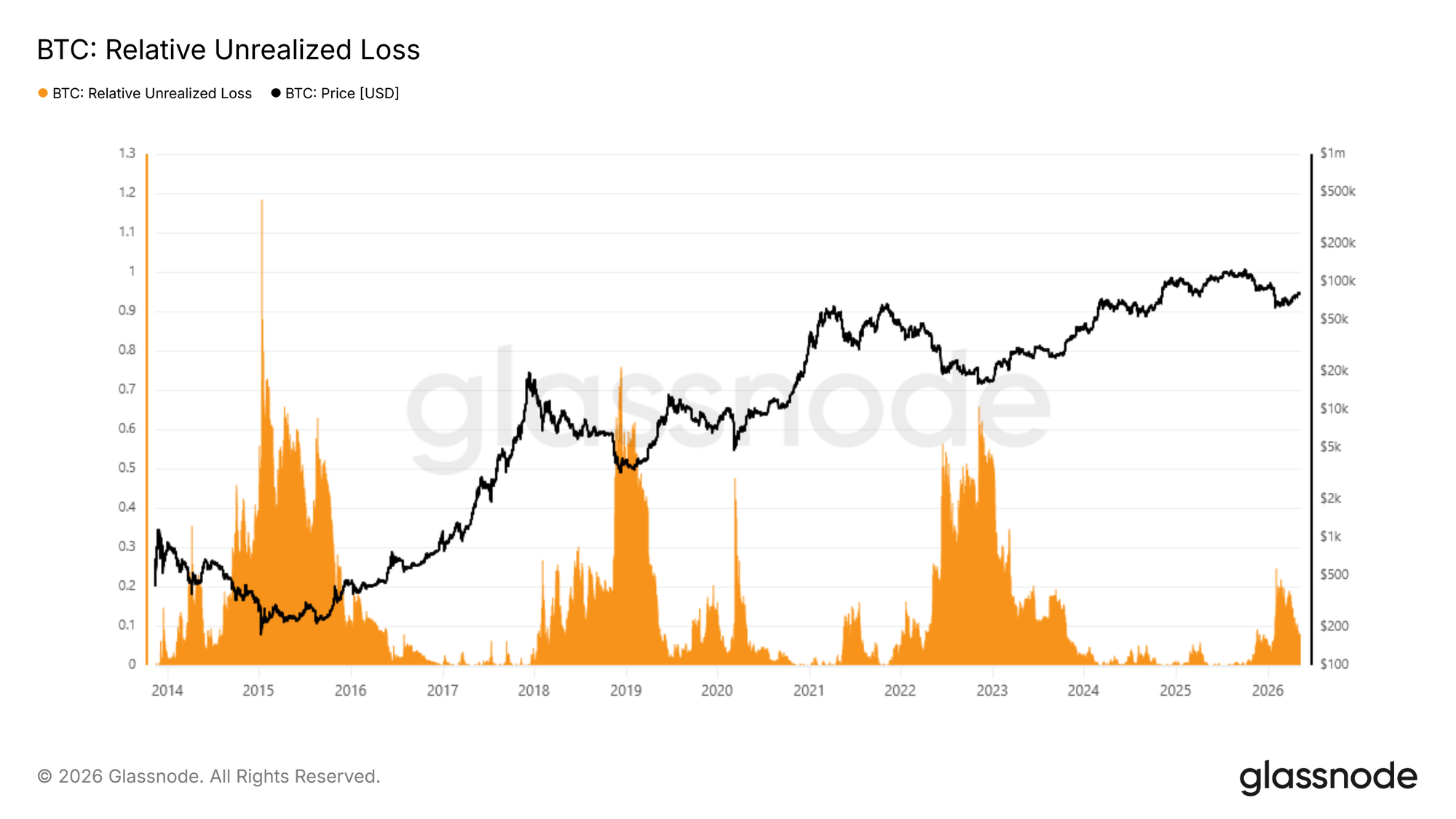
Looks like the value of the metric has declined in recent days | Source: Glassnode's The Week Onchain - Week 19, 2026

As is visible in the graph, the Bitcoin Relative Unrealized Loss shot up to a notable level alongside the price plunge in early February, indicating that pain among investors saw a sharp uptick. With the recovery that has followed since then, however, the indicator’s value has gone down.

Today, the Relative Unrealized Loss for the network stands at approximately 8%. The report described this decline in the metric as “a transition that shifts the prevailing sentiment from fear toward uncertainty rather than capitulation.”

Earlier, when the indicator had spiked, its value reached a high of 25%. This means that the February crash had meant that investor losses ballooned to 25% of the entire market cap of the cryptocurrency. This is a notable amount on its own, but a quick look at the chart shows that the level is in fact significantly lower than highs seen during previous bear markets.

At present, it’s unclear which stage the current bear market is inside right now. It’s possible that the fact that the Relative Unrealized Loss hasn’t touched prior peaks yet points to the drawdown not being over. It’s also a possibility, though, that the current cycle is simply going to be different from the previous ones. Glassnode noted:

If $60k proves to have been the cycle low, this bear market would stand as the shallowest on record, one that registered fear but stopped well short of the broad capitulation that has historically marked durable cycle bottoms.

Another on-chain indicator that suggests improvement in market conditions is the Realized Cap, which basically measures the total amount of capital that the investors as a whole have put into Bitcoin.

As the below chart shared by the analytics firm in the same report shows, the 30-day change in the BTC Realized Cap had plunged deep into the negative zone earlier, indicating that capital was leaving the network.
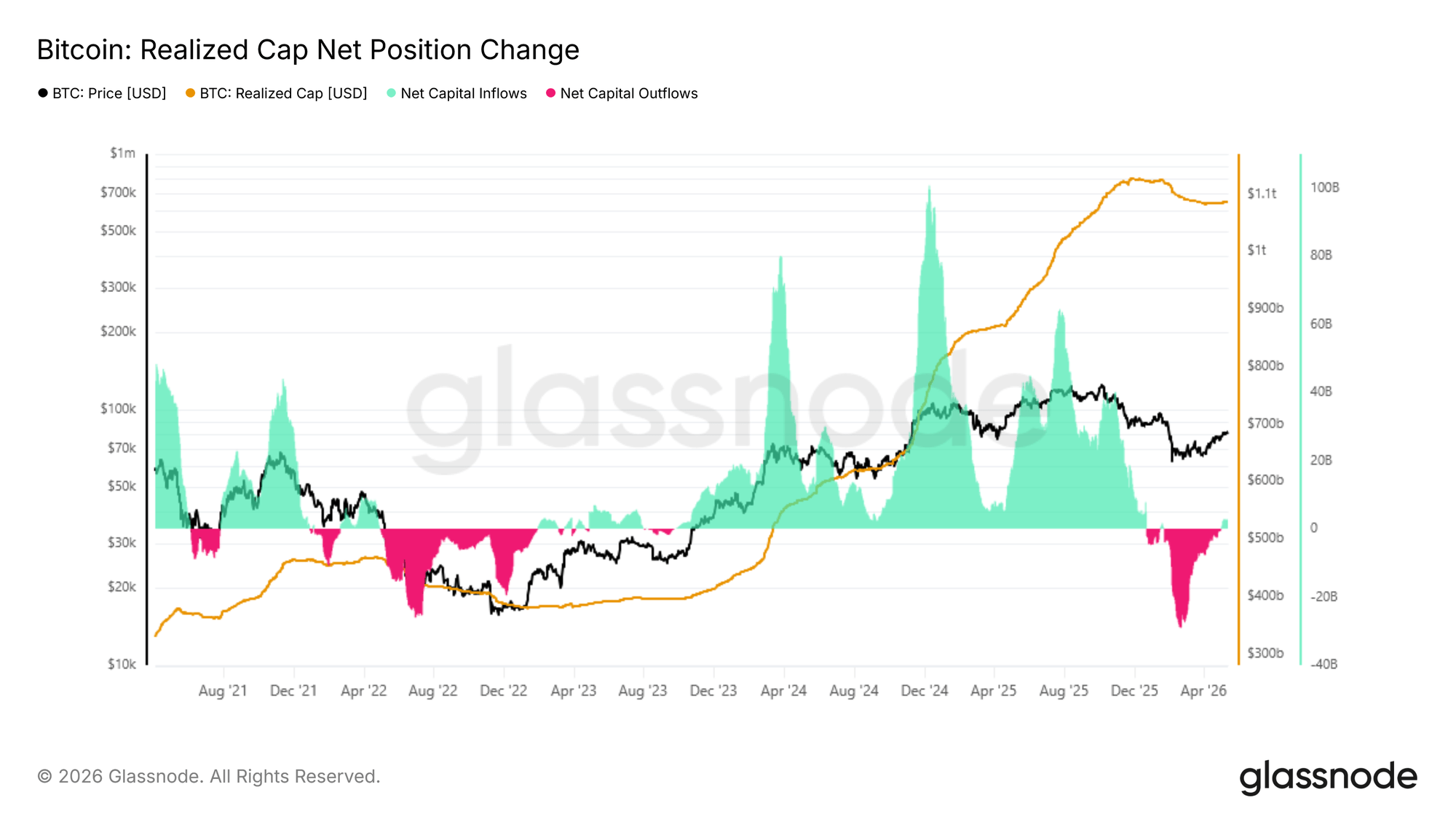
How the capital netflow of the asset has fluctuated over the years | Source: Glassnode's The Week Onchain - Week 19, 2026

Recently, however, the indicator has recovered back into the green zone, implying capital is once again flowing into Bitcoin. Glassnode explained, though:

The current reading, while encouraging, remains significantly below that threshold, suggesting the capital inflow underpinning this recovery lacks the conviction seen at comparable inflection points in the prior cycle.

BTC Price

Bitcoin has been stuck in sideways movement recently as its price is still trading around $81,300.

The trend in the price of the coin over the last five days | Source: BTCUSDT on TradingView


Related Questions

QAccording to Glassnode, what is the current level of Bitcoin's Relative Unrealized Loss, and what sentiment does this value indicate?

AAccording to Glassnode, Bitcoin's Relative Unrealized Loss currently stands at approximately 8%. This decline is described as indicating a transition in market sentiment 'from fear toward uncertainty rather than capitulation.'

QWhat is the significance of the 25% Relative Unrealized Loss peak seen during the February crash, according to the article?

AThe 25% Relative Unrealized Loss peak during the February crash meant that investor losses ballooned to a quarter of Bitcoin's entire market cap. However, the article notes this level is significantly lower than the highs seen in previous bear market cycles.

QWhat would it imply if the $60,000 price level proves to have been the cycle low for Bitcoin?

AIf the $60,000 price level proves to have been the cycle low, this bear market would stand as the shallowest on record. It would be one that registered fear but stopped well short of the broad capitulation that has historically marked durable cycle bottoms.

QWhat recent trend does the article highlight regarding the 30-day change in Bitcoin's Realized Cap?

AThe article highlights that the 30-day change in Bitcoin's Realized Cap, which had plunged deep into negative territory earlier, has recently recovered back into the green zone. This implies capital is once again flowing into the Bitcoin network.

QWhat is Bitcoin's approximate price at the time of the article, and what is its recent price behavior?

AAt the time of the article, Bitcoin's price is trading around $81,300. It has been stuck in sideways movement recently.

Related Reads

Breaking: OpenAI Undergoes Major Reorganization, President Brockman Assumes Command

OpenAI has announced a major internal reorganization just months before its anticipated IPO. The company is merging its three flagship product lines—ChatGPT, Codex, and the API platform—into a single, unified product organization. The most significant leadership change involves co-founder and President Greg Brockman moving from a background technical role to take full, permanent control over all product strategy. This follows the indefinite medical leave of AGI Deployment CEO Fidji Simo. Additionally, ChatGPT's longtime lead, Nick Turley, has been reassigned to enterprise products, with former Instagram executive Ashley Alexander taking over consumer offerings. The consolidation, internally framed as a strategic move towards an "Agentic Future," aims to break down internal silos and create a cohesive "Super App." This planned desktop application would integrate ChatGPT's conversational abilities, Codex's coding power, and a rumored internal web browser named "Atlas" to autonomously perform complex user tasks. The reorganization occurs amid significant internal and external pressures. OpenAI has recently seen a wave of high-profile departures, including Sora co-lead Bill Peebles and other senior technical leaders, leading to concerns about a thinning executive bench. Externally, rival Anthropic recently secured funding at a staggering $900 billion valuation, surpassing OpenAI's own. Google's upcoming I/O developer conference also poses a competitive threat. Analysts suggest the dramatic restructure is a pre-IPO move to present a clearer, more focused narrative to Wall Street—streamlining operations and demonstrating decisive leadership under Brockman to counter internal turbulence and intense market competition.

marsbit2h ago

Breaking: OpenAI Undergoes Major Reorganization, President Brockman Assumes Command

marsbit2h ago

Two Survival Structures of Market Makers and Arbitrageurs

Market makers and arbitrageurs represent two distinct survival structures in high-frequency trading. Market makers primarily use limit orders (makers) to profit from the bid-ask spread, enjoying high capital efficiency (nominally 100%) but bearing inventory risk. This "inventory risk" arises from passive, fragmented, and discontinuous order fills in the limit order book (LOB). This risk, while a potential cost, can also contribute to excess profit if managed within control boundaries, allowing for mean reversion. Market makers essentially sell "time" (uncertainty over execution timing) to the market for price control and low fees. In contrast, cross-exchange arbitrageurs typically use market orders (takers) to exploit price differences or funding rates, resulting in lower nominal capital efficiency (requiring capital on both exchanges) and higher transaction costs. Their risk exposure stems from asymmetries in exchange rules (e.g., minimum order sizes), execution latency, and infrastructure risks (e.g., ADL, oracle drift). These exposures are active, exogenous gaps that primarily erode profits rather than contribute to them. Arbitrageurs essentially sell "space" (capital sunk across venues) for localized, immediate certainty. Both strategies engage in a trade-off between execution friction and residual risk. Optimal systems allow for temporary, controlled risk exposure rather than enforcing zero exposure at all costs. Their evolution converges towards hybrid models: arbitrageurs may use maker orders to reduce costs, while market makers may use taker orders or hedges for risk management. Ultimately, both use different forms of risk exposure—market makers exposing inventory, arbitrageurs immobilizing capital—to extract marginal, hard-won certainty from the market.

链捕手2h ago

Two Survival Structures of Market Makers and Arbitrageurs

链捕手2h ago

Who Will Define the Rules of the AI Era? Anthropic Discusses the 2028 US-China AI Landscape

This article, based on Anthropic's analysis, outlines the intensifying systemic competition between the U.S./allies and China for AI leadership by 2028. It argues that access to advanced computing power ("compute") is the critical bottleneck, where the U.S. currently holds a significant advantage through chip export controls and allied innovation. However, China's AI labs remain competitive by exploiting policy loopholes—via chip smuggling, overseas data center access, and "model distillation" attacks to copy U.S. model capabilities—keeping them close to the frontier. The piece presents two contrasting scenarios for 2028. In the first, decisive U.S. action to tighten compute controls and curb distillation locks in a 12-24 month AI capability lead, cementing democratic influence over global AI norms, security, and economic infrastructure. In the second, policy inaction allows China to achieve near-parity through continued access to U.S. technology, enabling Beijing to promote its AI stack globally and integrate advanced AI into its military and governance systems, altering the strategic balance. Anthropic contends that maintaining a decisive U.S. lead is essential for shaping safe AI development and governance. The core recommendation is for U.S. policymakers to urgently close compute and model access loopholes while promoting global adoption of the U.S. AI technology stack to secure a lasting strategic advantage.

marsbit4h ago

Who Will Define the Rules of the AI Era? Anthropic Discusses the 2028 US-China AI Landscape

marsbit4h ago

Trading

Spot
Futures

Hot Articles

What is $BITCOIN

DIGITAL GOLD ($BITCOIN): A Comprehensive Analysis Introduction to DIGITAL GOLD ($BITCOIN) DIGITAL GOLD ($BITCOIN) is a blockchain-based project operating on the Solana network, which aims to combine the characteristics of traditional precious metals with the innovation of decentralized technologies. While it shares a name with Bitcoin, often referred to as “digital gold” due to its perception as a store of value, DIGITAL GOLD is a separate token designed to create a unique ecosystem within the Web3 landscape. Its goal is to position itself as a viable alternative digital asset, although specifics regarding its applications and functionalities are still developing. What is DIGITAL GOLD ($BITCOIN)? DIGITAL GOLD ($BITCOIN) is a cryptocurrency token explicitly designed for use on the Solana blockchain. In contrast to Bitcoin, which provides a widely recognized value storage role, this token appears to focus on broader applications and characteristics. Notable aspects include: Blockchain Infrastructure: The token is built on the Solana blockchain, known for its capacity to handle high-speed and low-cost transactions. Supply Dynamics: DIGITAL GOLD has a maximum supply capped at 100 quadrillion tokens (100P $BITCOIN), although details regarding its circulating supply are currently undisclosed. Utility: While precise functionalities are not explicitly outlined, there are indications that the token could be utilized for various applications, potentially involving decentralized applications (dApps) or asset tokenization strategies. Who is the Creator of DIGITAL GOLD ($BITCOIN)? At present, the identity of the creators and development team behind DIGITAL GOLD ($BITCOIN) remains unknown. This situation is typical among many innovative projects within the blockchain space, particularly those aligning with decentralized finance and meme coin phenomena. While such anonymity may foster a community-driven culture, it intensifies concerns about governance and accountability. Who are the Investors of DIGITAL GOLD ($BITCOIN)? The available information indicates that DIGITAL GOLD ($BITCOIN) does not have any known institutional backers or prominent venture capital investments. The project seems to operate on a peer-to-peer model focused on community support and adoption rather than traditional funding routes. Its activity and liquidity are primarily situated on decentralized exchanges (DEXs), such as PumpSwap, rather than established centralized trading platforms, further highlighting its grassroots approach. How DIGITAL GOLD ($BITCOIN) Works The operational mechanics of DIGITAL GOLD ($BITCOIN) can be elaborated on based on its blockchain design and network attributes: Consensus Mechanism: By leveraging Solana’s unique proof-of-history (PoH) combined with a proof-of-stake (PoS) model, the project ensures efficient transaction validation contributing to the network's high performance. Tokenomics: While specific deflationary mechanisms have not been extensively detailed, the vast maximum token supply implies that it may cater to microtransactions or niche use cases that are still to be defined. Interoperability: There exists the potential for integration with Solana’s broader ecosystem, including various decentralized finance (DeFi) platforms. However, the details regarding specific integrations remain unspecified. Timeline of Key Events Here is a timeline that highlights significant milestones concerning DIGITAL GOLD ($BITCOIN): 2023: The initial deployment of the token occurs on the Solana blockchain, marked by its contract address. 2024: DIGITAL GOLD gains visibility as it becomes available for trading on decentralized exchanges like PumpSwap, allowing users to trade it against SOL. 2025: The project witnesses sporadic trading activity and potential interest in community-led engagements, although no noteworthy partnerships or technical advancements have been documented as of yet. Critical Analysis Strengths Scalability: The underlying Solana infrastructure supports high transaction volumes, which could enhance the utility of $BITCOIN in various transaction scenarios. Accessibility: The potential low trading price per token could attract retail investors, facilitating wider participation due to fractional ownership opportunities. Risks Lack of Transparency: The absence of publicly known backers, developers, or an audit process may yield skepticism regarding the project's sustainability and trustworthiness. Market Volatility: The trading activity is heavily reliant on speculative behavior, which can result in significant price volatility and uncertainty for investors. Conclusion DIGITAL GOLD ($BITCOIN) emerges as an intriguing yet ambiguous project within the rapidly evolving Solana ecosystem. While it attempts to leverage the “digital gold” narrative, its departure from Bitcoin's established role as a store of value underscores the need for a clearer differentiation of its intended utility and governance structure. Future acceptance and adoption will likely depend on addressing the current opacity and defining its operational and economic strategies more explicitly. Note: This report encompasses synthesised information available as of October 2023, and developments may have transpired beyond the research period.

363 Total ViewsPublished 2025.05.13Updated 2025.05.13

What is $BITCOIN

Discussions

Welcome to the HTX Community. Here, you can stay informed about the latest platform developments and gain access to professional market insights. Users' opinions on the price of BTC (BTC) are presented below.

活动图片














