Best Crypto Presales 2026: Analysts Flag Early Projects Worth Tracking

bitcoinistPublished on 2026-02-06Last updated on 2026-02-06

Abstract

Crypto markets face a risk-off environment in early 2026, with BTC near $66,805 and ETH at $1,895, alongside significant Bitcoin ETF outflows. In this climate, capital is focusing on infrastructure and distribution. A key trend is Bitcoin Layer-2 solutions, where execution moves off-chain while Bitcoin remains the settlement layer. Bitcoin Hyper emerges as a notable presale, positioning itself as the first Bitcoin L2 with Solana Virtual Machine integration for high-speed, low-cost transactions. It has raised over $31 million, with early whale activity, and aims to enable DeFi, NFTs, and payments on Bitcoin. Key questions remain about its bridge security and developer adoption.

Crypto is kicking off February 2026 with a distinct chill in the air. The tape is doing exactly what it always does during drawdowns: punishing leverage first, then forcing narratives to prove they have actual demand.

At the time of writing, $BTC hovers around $66,805 and $ETH struggles near $1,895, per CoinGecko, following a sharp multi-month retrace from late-2025 highs. (coingecko.com) But price is just the headline. The real signal is positioning. When the market de-risks this aggressively, liquidity fragments, spreads widen, and “beta” plays (memecoins, small caps) stop being forgiving.

ETF flows tell a similar story. Data tracked by SoSoValue indicates U.S. spot Bitcoin ETFs recently endured a $1.33B net outflow week—the worst bleed since February 2025—even though flows managed a notable one-day rebound early this month. (fastbull.com) Meanwhile, mainstream coverage notes that the post-2025 euphoria has given way to deleveraging and renewed regulatory friction. It’s the classic cocktail that squeezes speculative excess out of the system. (apnews.com)

Why does this matter for the “best crypto presales 2026” conversation?

Because presales don’t exist in a vacuum. Gravity applies here too. However, capital tends to concentrate around two specific themes that survive risk-off regimes: infrastructure and distribution. If smart money is going to take early-stage risk right now, it wants a defensible thesis—scaling, settlement, and credible user demand. Which raises the uncomfortable question: where is crypto’s next useful throughput coming from—especially on Bitcoin?

Bitcoin L2s Take Center Stage As Execution Moves Off L1

The most actionable presale theme in 2026 is simple: Bitcoin remains the settlement layer, but the actual work is moving elsewhere.

Lightning continues to anchor the payments narrative. Capacity metrics hit records around 5,637 BTC in late 2025, suggesting that “Bitcoin as a medium of exchange” is compounding quietly even while price sentiment sours. (bitcoinmagazine.com) In the same vein, Stacks has pushed the “programmable Bitcoin” thesis forward via its Nakamoto upgrade milestones. (stacks.co)

But here’s what most coverage misses: when markets draw down, builders don’t stop. They consolidate. Payments networks (Lightning) and execution environments (Bitcoin L2s) are currently fighting for the same prize—Bitcoin liquidity that actually does something.

That’s where Bitcoin Hyper enters the fray.

The project pitches itself as “THE FIRST EVER BITCOIN LAYER 2” with Solana Virtual Machine (SVM) integration. The goal? Deliver extremely low-latency L2 processing and fast smart contract execution while relying on Bitcoin L1 for final settlement. The architecture is modular—Bitcoin settles, the SVM executes—with a decentralized canonical bridge for BTC transfers. (Yes, combining Bitcoin security with Solana speed is an ambitious play).

The risk? Execution speed narratives can be intoxicating. Bridging design and sequencer assumptions—Bitcoin Hyper utilizes a single trusted sequencer with periodic L1 state anchoring—are where serious investors will focus their due diligence. Fast is easy to market; resilient is hard to ship.

Review Bitcoin Hyper’s L2 thesis.

Bitcoin Hyper ($HYPER) Presale Metrics: Big Raise, Clear Narrative

In this environment, metrics speak louder than whitepapers. Presales that survive 2026 typically show sustained fundraising and a narrative that aligns with the market’s “infrastructure-first” bias.

On the fundraising front, Bitcoin Hyper’s numbers aren’t small. According to the official presale page, the project has raised $31,257,822.88, with tokens priced at $0.0136751. In a market actively repricing risk, these figures suggest the bid isn’t purely momentum—there’s conviction behind the theme.
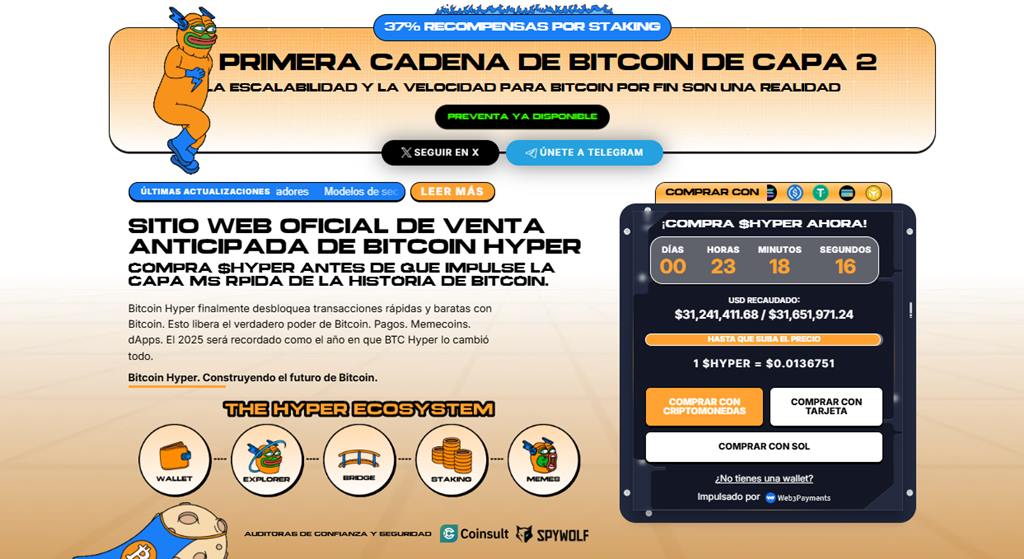
We’re also seeing early “smart money” movement. Etherscan records show 2 whale wallets have accumulated $116K, with the largest single transaction of $63K occurring on Jan 15, 2026. (Etherscan) While whale buys aren’t a guarantee of future performance, in a skittish tape, they often function as a sentiment catalyst.

Utility-wise, Bitcoin Hyper is targeting:

  • High-speed payments in wrapped BTC with negligible fees.
  • DeFi primitives (swaps, lending, staking protocols).
  • NFT and gaming dApps, supported by a developer SDK/API in Rust.

On the incentive side, staking is advertised with high APY (rate not disclosed), featuring immediate staking after TGE and a 7-day vesting period for presale stakers, plus rewards tied to governance participation.

For traders building a 2026 watchlist, here are the key questions: 1) Can the bridge model earn trust under stress? 2) Will developers actually deploy SVM apps, or will it remain theoretical? 3) Does Bitcoin liquidity migrate into on-chain apps as ETF flows stabilize?

If the macro clouds part and Bitcoin’s ecosystem narrative rotates from “hold” to “use,” Bitcoin Hyper is positioned squarely in that slipstream.

Visit the official Bitcoin Hyper site.

This article is not financial advice; crypto is volatile, presales are high risk, and smart-contract/bridge designs can fail. Always do your own research.

Key Takeaways

  • $BTC (~$66,805) and $ETH (~$1,895) signal a risk-off market where leverage unwinds faster than narratives can rebuild.
  • ETF flow whiplash (heavy outflows followed by rebounds) suggests institutional positioning is tactical, not a blind “up only” bet.
  • Bitcoin scaling is fragmenting into payments (Lightning) and execution layers (L2s), putting “productive BTC” back in focus.
  • Bitcoin Hyper targets this shift by bringing fast SVM execution to a Bitcoin-settled L2 environment.


Related Questions

QWhat are the two main themes that capital tends to concentrate around during risk-off regimes in the crypto market, according to the article?

AInfrastructure and distribution.

QWhat is the name of the Bitcoin Layer 2 project featured in the article and what key technology does it integrate?

AThe project is called Bitcoin Hyper ($HYPER) and it integrates the Solana Virtual Machine (SVM).

QHow much had the Bitcoin Hyper presale raised at the time of writing, and what was the token price?

AThe presale had raised $31,257,822.88, with tokens priced at $0.0136751.

QWhat was the approximate price of Bitcoin ($BTC) and Ethereum ($ETH) mentioned at the beginning of the article?

ABitcoin was around $66,805 and Ethereum was near $1,895.

QWhat does the article cite as the risk associated with Bitcoin Hyper's design?

AThe risk is in its bridging design and sequencer assumptions, which utilize a single trusted sequencer with periodic L1 state anchoring, making resilience hard to ship.

Related Reads

The Verdict in Choi Tae-won's Divorce Case: Revealing the Inheritance Undercurrent Behind SK Hynix's Trillion-Won Empire

SK Group Chairman Chey Tae-won's high-profile divorce case, involving a record 1.38 trillion won settlement, has drawn attention to the succession plans for Korea's second-largest conglomerate, especially its crown jewel, SK hynix. Unlike traditional chaebol scripts centered on the eldest son, Chey's three children from his marriage to former President Roh Tae-woo's daughter, Roh Soh-yeong, are carving distinct, non-traditional paths. Eldest daughter Chey Yun-jung (b. 1989) is seen as the most evident successor. With a scientific and consulting background, she holds executive roles at SK bioscience and SK Inc.'s growth support department, focusing on future strategy and biopharma. Her marriage is to an AI infrastructure entrepreneur, not a traditional business alliance. Second daughter Chey Min-jung (b. 1991) took a unique route, voluntarily serving as a South Korean naval officer, including an anti-piracy deployment. She later worked on policy and strategy for SK hynix in Washington D.C. before co-founding an AI-driven healthcare startup. She married a former U.S. Marine Corps officer, connecting her to U.S. defense and policy circles—networks crucial for a global semiconductor giant. The only son, Chey In-geun (b. 1995), who studied physics like his father, worked briefly at SK E&S before joining McKinsey. Despite fitting the traditional "heir" profile as the eldest son, he remains silent and holds no public position or shares in SK, suggesting the old succession playbook is obsolete. As SK hynix's valuation soars, becoming a geopolitical asset in the AI era, the heirs' legitimacy is no longer automatic. They must prove themselves in fields like AI biotech, global policy, and strategic consulting. Their marriages also reflect new elite networks in tech and defense, not old political alliances. Their inheritance is the complex challenge of navigating a globalized, tech-driven world, not just a corporate throne.

marsbit6h ago

The Verdict in Choi Tae-won's Divorce Case: Revealing the Inheritance Undercurrent Behind SK Hynix's Trillion-Won Empire

marsbit6h ago

From OpenSea to OpenRouter: Is Alex Atallah Repeating His 'Exit at the Peak' Playbook?

From OpenSea to OpenRouter: Is Alex Atallah Repeating His "Exit at the Peak" Playbook? According to the Wall Street Journal, payments giant Stripe is in talks to acquire the AI model aggregation platform OpenRouter in a potential deal valuing the company near $100 billion. This would mark founder Alex Atallah's second creation of a company reaching a $100 billion valuation, following his co-founding of NFT marketplace OpenSea. OpenRouter, founded just over three years ago, has grown rapidly by acting as a unified gateway for developers to access over 400 AI models. It currently has about 10 million users and processes over 200 trillion tokens monthly. While the platform's annualized revenue is around $50 million, its valuation has skyrocketed from $1.3 billion in March 2026. The potential acquisition by Stripe, a company OpenRouter's founder once likened it to, represents a major expansion into AI infrastructure for the payments leader. This move echoes Atallah's previous timing with OpenSea, where he departed before the NFT market's significant downturn. For OpenRouter, selling now may be strategic. Despite its scale, its business model—charging a 5-5.5% fee on AI inference calls—faces pressure from competition, open-source models, and potential price wars among model providers, limiting its profitability narrative for an IPO. A key asset for potential acquirers like Stripe is OpenRouter's vast repository of real-world AI usage data, which offers unique insights into model performance and developer preferences that are difficult to replicate. Whether this potential deal signifies a new valuation benchmark for AI infrastructure or another market peak signal remains to be seen.

链捕手7h ago

From OpenSea to OpenRouter: Is Alex Atallah Repeating His 'Exit at the Peak' Playbook?

链捕手7h ago

Trading

Spot
活动图片




