Best Crypto Presales 2026: Analysts Flag Early Projects Worth Tracking

bitcoinistPublished on 2026-02-06Last updated on 2026-02-06

Abstract

Crypto markets face a risk-off environment in early 2026, with BTC near $66,805 and ETH at $1,895, alongside significant Bitcoin ETF outflows. In this climate, capital is focusing on infrastructure and distribution. A key trend is Bitcoin Layer-2 solutions, where execution moves off-chain while Bitcoin remains the settlement layer. Bitcoin Hyper emerges as a notable presale, positioning itself as the first Bitcoin L2 with Solana Virtual Machine integration for high-speed, low-cost transactions. It has raised over $31 million, with early whale activity, and aims to enable DeFi, NFTs, and payments on Bitcoin. Key questions remain about its bridge security and developer adoption.

Crypto is kicking off February 2026 with a distinct chill in the air. The tape is doing exactly what it always does during drawdowns: punishing leverage first, then forcing narratives to prove they have actual demand.

At the time of writing, $BTC hovers around $66,805 and $ETH struggles near $1,895, per CoinGecko, following a sharp multi-month retrace from late-2025 highs. (coingecko.com) But price is just the headline. The real signal is positioning. When the market de-risks this aggressively, liquidity fragments, spreads widen, and “beta” plays (memecoins, small caps) stop being forgiving.

ETF flows tell a similar story. Data tracked by SoSoValue indicates U.S. spot Bitcoin ETFs recently endured a $1.33B net outflow week—the worst bleed since February 2025—even though flows managed a notable one-day rebound early this month. (fastbull.com) Meanwhile, mainstream coverage notes that the post-2025 euphoria has given way to deleveraging and renewed regulatory friction. It’s the classic cocktail that squeezes speculative excess out of the system. (apnews.com)

Why does this matter for the “best crypto presales 2026” conversation?

Because presales don’t exist in a vacuum. Gravity applies here too. However, capital tends to concentrate around two specific themes that survive risk-off regimes: infrastructure and distribution. If smart money is going to take early-stage risk right now, it wants a defensible thesis—scaling, settlement, and credible user demand. Which raises the uncomfortable question: where is crypto’s next useful throughput coming from—especially on Bitcoin?

Bitcoin L2s Take Center Stage As Execution Moves Off L1

The most actionable presale theme in 2026 is simple: Bitcoin remains the settlement layer, but the actual work is moving elsewhere.

Lightning continues to anchor the payments narrative. Capacity metrics hit records around 5,637 BTC in late 2025, suggesting that “Bitcoin as a medium of exchange” is compounding quietly even while price sentiment sours. (bitcoinmagazine.com) In the same vein, Stacks has pushed the “programmable Bitcoin” thesis forward via its Nakamoto upgrade milestones. (stacks.co)

But here’s what most coverage misses: when markets draw down, builders don’t stop. They consolidate. Payments networks (Lightning) and execution environments (Bitcoin L2s) are currently fighting for the same prize—Bitcoin liquidity that actually does something.

That’s where Bitcoin Hyper enters the fray.

The project pitches itself as “THE FIRST EVER BITCOIN LAYER 2” with Solana Virtual Machine (SVM) integration. The goal? Deliver extremely low-latency L2 processing and fast smart contract execution while relying on Bitcoin L1 for final settlement. The architecture is modular—Bitcoin settles, the SVM executes—with a decentralized canonical bridge for BTC transfers. (Yes, combining Bitcoin security with Solana speed is an ambitious play).

The risk? Execution speed narratives can be intoxicating. Bridging design and sequencer assumptions—Bitcoin Hyper utilizes a single trusted sequencer with periodic L1 state anchoring—are where serious investors will focus their due diligence. Fast is easy to market; resilient is hard to ship.

Review Bitcoin Hyper’s L2 thesis.

Bitcoin Hyper ($HYPER) Presale Metrics: Big Raise, Clear Narrative

In this environment, metrics speak louder than whitepapers. Presales that survive 2026 typically show sustained fundraising and a narrative that aligns with the market’s “infrastructure-first” bias.

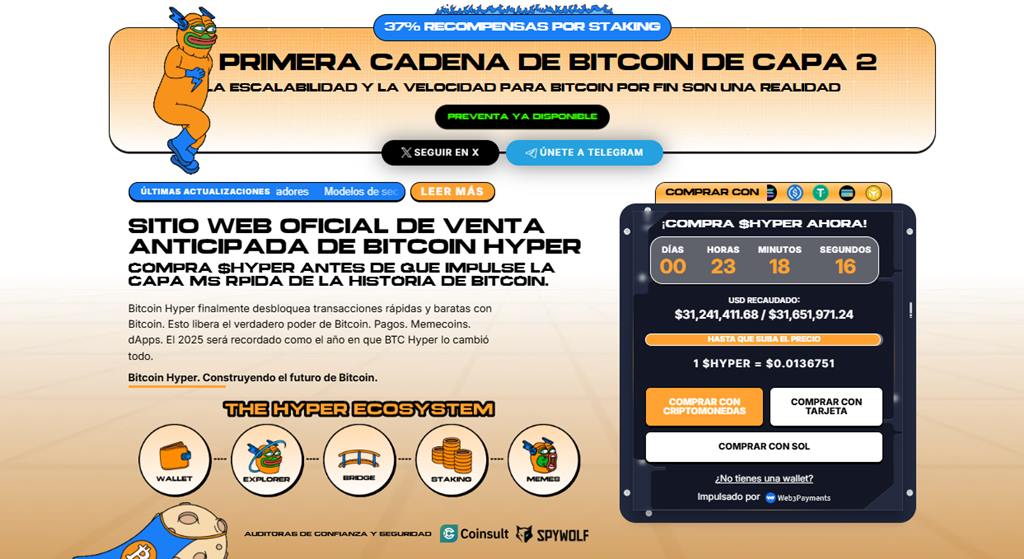
On the fundraising front, Bitcoin Hyper’s numbers aren’t small. According to the official presale page, the project has raised $31,257,822.88, with tokens priced at $0.0136751. In a market actively repricing risk, these figures suggest the bid isn’t purely momentum—there’s conviction behind the theme.
We’re also seeing early “smart money” movement. Etherscan records show 2 whale wallets have accumulated $116K, with the largest single transaction of $63K occurring on Jan 15, 2026. (Etherscan) While whale buys aren’t a guarantee of future performance, in a skittish tape, they often function as a sentiment catalyst.

Utility-wise, Bitcoin Hyper is targeting:

  • High-speed payments in wrapped BTC with negligible fees.
  • DeFi primitives (swaps, lending, staking protocols).
  • NFT and gaming dApps, supported by a developer SDK/API in Rust.

On the incentive side, staking is advertised with high APY (rate not disclosed), featuring immediate staking after TGE and a 7-day vesting period for presale stakers, plus rewards tied to governance participation.

For traders building a 2026 watchlist, here are the key questions: 1) Can the bridge model earn trust under stress? 2) Will developers actually deploy SVM apps, or will it remain theoretical? 3) Does Bitcoin liquidity migrate into on-chain apps as ETF flows stabilize?

If the macro clouds part and Bitcoin’s ecosystem narrative rotates from “hold” to “use,” Bitcoin Hyper is positioned squarely in that slipstream.

Visit the official Bitcoin Hyper site.

This article is not financial advice; crypto is volatile, presales are high risk, and smart-contract/bridge designs can fail. Always do your own research.

Key Takeaways

  • $BTC (~$66,805) and $ETH (~$1,895) signal a risk-off market where leverage unwinds faster than narratives can rebuild.
  • ETF flow whiplash (heavy outflows followed by rebounds) suggests institutional positioning is tactical, not a blind “up only” bet.
  • Bitcoin scaling is fragmenting into payments (Lightning) and execution layers (L2s), putting “productive BTC” back in focus.
  • Bitcoin Hyper targets this shift by bringing fast SVM execution to a Bitcoin-settled L2 environment.


Related Questions

QWhat are the two main themes that capital tends to concentrate around during risk-off regimes in the crypto market, according to the article?

AInfrastructure and distribution.

QWhat is the name of the Bitcoin Layer 2 project featured in the article and what key technology does it integrate?

AThe project is called Bitcoin Hyper ($HYPER) and it integrates the Solana Virtual Machine (SVM).

QHow much had the Bitcoin Hyper presale raised at the time of writing, and what was the token price?

AThe presale had raised $31,257,822.88, with tokens priced at $0.0136751.

QWhat was the approximate price of Bitcoin ($BTC) and Ethereum ($ETH) mentioned at the beginning of the article?

ABitcoin was around $66,805 and Ethereum was near $1,895.

QWhat does the article cite as the risk associated with Bitcoin Hyper's design?

AThe risk is in its bridging design and sequencer assumptions, which utilize a single trusted sequencer with periodic L1 state anchoring, making resilience hard to ship.

Related Reads

In Jinjiang, Fujian, a Storage Super Unicorn Lies Quiet

In Fujian's Jinjiang, a city known for sportswear, lies a quiet semiconductor giant: Fujian Jinhua Integrated Circuit Co. (JHICC). Once a promising domestic DRAM manufacturer alongside Yangtze Memory and ChangXin Memory Technologies (CXMT), its journey was derailed in 2018 when the U.S. placed it on an Entity List and filed criminal charges for alleged trade secret theft. This halted production for years. A turning point came in February 2024 when a U.S. federal court found JHICC not guilty. However, it had lost crucial time. While CXMT soared to become a top-valued A-share company in 2024, JHICC, with an estimated valuation of 80 billion RMB, was just restarting. Its current output is primarily customized DDR4 chips, not the advanced DDR5/HBM demanded for AI, but it still benefits from the broader memory chip upcycle. JHICC's story is tied to Chen Zhengkun, a veteran engineer who left Micron to lead the venture. Founded in 2016 with state-backed funding, JHICC partnered with Taiwan's UMC to develop DRAM technology. Rapid progress was cut short by the U.S. actions, which Micron initiated, partly due to its heavy reliance on the Chinese market. Post-sanctions, Chen's team worked to rebuild the production line with reduced reliance on U.S. technology. According to its records, JHICC achieved small-scale production and revenue growth under immense pressure. It now focuses on the stable "niche" DRAM market (e.g., TVs, routers) with a monthly capacity of ~40,000 wafers, aiming for 60,000 by 2026. It holds over 1,000 patents but remains on the Entity List. For Jinjiang, investing in JHICC was a bold industrial leap. The local government provided unwavering financial and logistical support during the crisis, helping the company survive. JHICC has become the anchor for a growing local semiconductor cluster. Though its scale lags behind domestic peers, JHICC's persistence symbolizes a hard-won foothold in a global market long dominated by Samsung, SK Hynix, and Micron. Having missed one boom, it seeks a place in the new AI-driven memory supercycle.

marsbit18m ago

In Jinjiang, Fujian, a Storage Super Unicorn Lies Quiet

marsbit18m ago

Must-Watch Events Next Week|CLARITY Act Could Face Senate Vote; SpaceX, Circle to Report Earnings (8.3-8.9)

**Summary: Key Events and Developments to Watch (August 3-9)** The upcoming week is marked by significant financial disclosures, key legislative deadlines, and notable product updates. **Major Financial Events:** Several companies are scheduled to release their Q2 2026 earnings. American Bitcoin (ABTC) will report on August 3, followed by SpaceX and Hut 8 Mining Corp. on August 4, and Circle on August 5. Notably, a significant portion of SpaceX shares (up to 12% of total shares) will be unlocked on August 6 following their earnings release. **Key Legislative Deadline:** The U.S. Senate faces an August 7 deadline to secure 60 votes for the CLARITY Act, a bipartisan bill aiming to establish a federal regulatory framework for cryptocurrencies. The Senate may hold a full vote on the bill during the week. **Economic Data:** The U.S. July Non-Farm Payrolls report will be released on August 7, providing crucial labor market data. **Technology & Product Updates:** * **Shutdowns:** DeFi portfolio tracker Zapper and wallet app Ctrl Wallet will cease operations on August 3. * **Upgrades:** LayerZero will deprecate its v1 relayers on August 3. XRP Ledger's new version 3.3.0, featuring five new functions, is expected next week. * **AI:** Elon Musk announced that the advanced Grok 4.6 AI model is set for release around August 7. * **Bitcoin:** The BIP-110 forced signaling for a potential Bitcoin network change is scheduled to begin around August 8. **Other Notable Events:** Chinese robotics firm Unitree Tech has set its preliminary price inquiry for its IPO for August 5. South Korean exchange Upbit will delist AQT and AERGO tokens on August 3.

marsbit2h ago

Must-Watch Events Next Week|CLARITY Act Could Face Senate Vote; SpaceX, Circle to Report Earnings (8.3-8.9)

marsbit2h ago

Trading

Spot
活动图片




