Behind NEAR's Doubling: Three Major Trends Fueling Its Price Surge

链捕手Published on 2026-05-26Last updated on 2026-05-26

Abstract

NEAR's price has recently doubled, driven by three key catalysts. First, its strong AI narrative: co-founder Illia Polosukhin co-authored the foundational Transformer paper, and NEAR has integrated AI into its super-app, positioning it as decentralized AI infrastructure. Second, it has evolved into a privacy-focused chain, launching features like Confidential Payments to enable private cross-chain transfers, balancing privacy with usability for institutional and DeFi users. Third, its tokenomics are bolstered by a buyback mechanism: with full circulation achieved and inflation halved, fees from the NEAR Intents layer are used to repurchase NEAR tokens, reducing sell pressure. Combined with a recovering TVL exceeding $80 million, these factors are fueling NEAR's current market outperformance.

Author: Ma He, Foresight News

On May 25, the price of NEAR, the native token of the NEAR protocol, stands at $2.37. Since early May, NEAR has surged from a low of $1.24 to a high of $2.5, with its market capitalization returning above $3 billion. While mainstream crypto assets like Bitcoin have been fluctuating, NEAR has charted its own independent upward trajectory, emerging as one of the brightest performing tokens alongside others like ZEC, ONDO, and HYPE. What are the underlying reasons for this breakout?

The AI Narrative

NEAR co-founder Illia Polosukhin is a seasoned professional in the AI field. Illia is one of the eight co-authors of the seminal Transformer paper, alongside others like Ashish Vaswani and Noam Shazeer from Google Brain / Google Research. This paper introduced the Transformer architecture, which relies entirely on attention mechanisms, significantly improving parallel training efficiency and model scale. It is the foundational framework for all major contemporary large models like ChatGPT, Claude, and Gemini.

NEAR has made AI a core strategy from its early days. In February of this year, NEAR officially launched the Near.com super-app, integrating cross-chain swaps, privacy tools, and smart contract management into one platform with built-in AI capabilities, supporting autonomous agent application scenarios. In November 2023, Illia also formally assumed the role of NEAR Foundation CEO, focusing the strategy primarily around the AI narrative.

In May, Nvidia's earnings report spurred a broader recovery in the AI sector, with NEAR being viewed as a representative of decentralized AI infrastructure, alongside tokens like TAO.
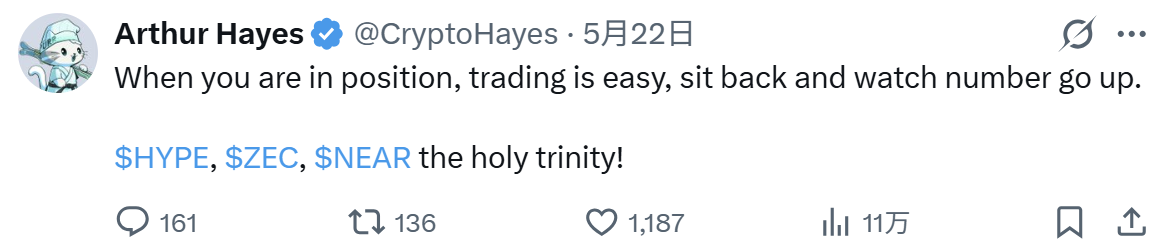
On May 22, BitMEX co-founder Arthur Hayes, in an article, grouped NEAR with HYPE and ZEC in a call for attention, directly igniting market sentiment.

Privacy-Focused Blockchain

Blockchain has long faced the privacy dilemma where 'transparency equals publicity.' The sharp rise of privacy coins like ZEC and XMR has refocused the industry's attention on the privacy sector, leading various protocols, including public blockchains, to start incorporating privacy features.

NEAR was founded in 2018. Its initial core positioning was not AI, but scalability. Its earliest progress primarily revolved around continuously optimizing sharding technology, making it one of the hot 'Ethereum killer' public blockchains at the time.
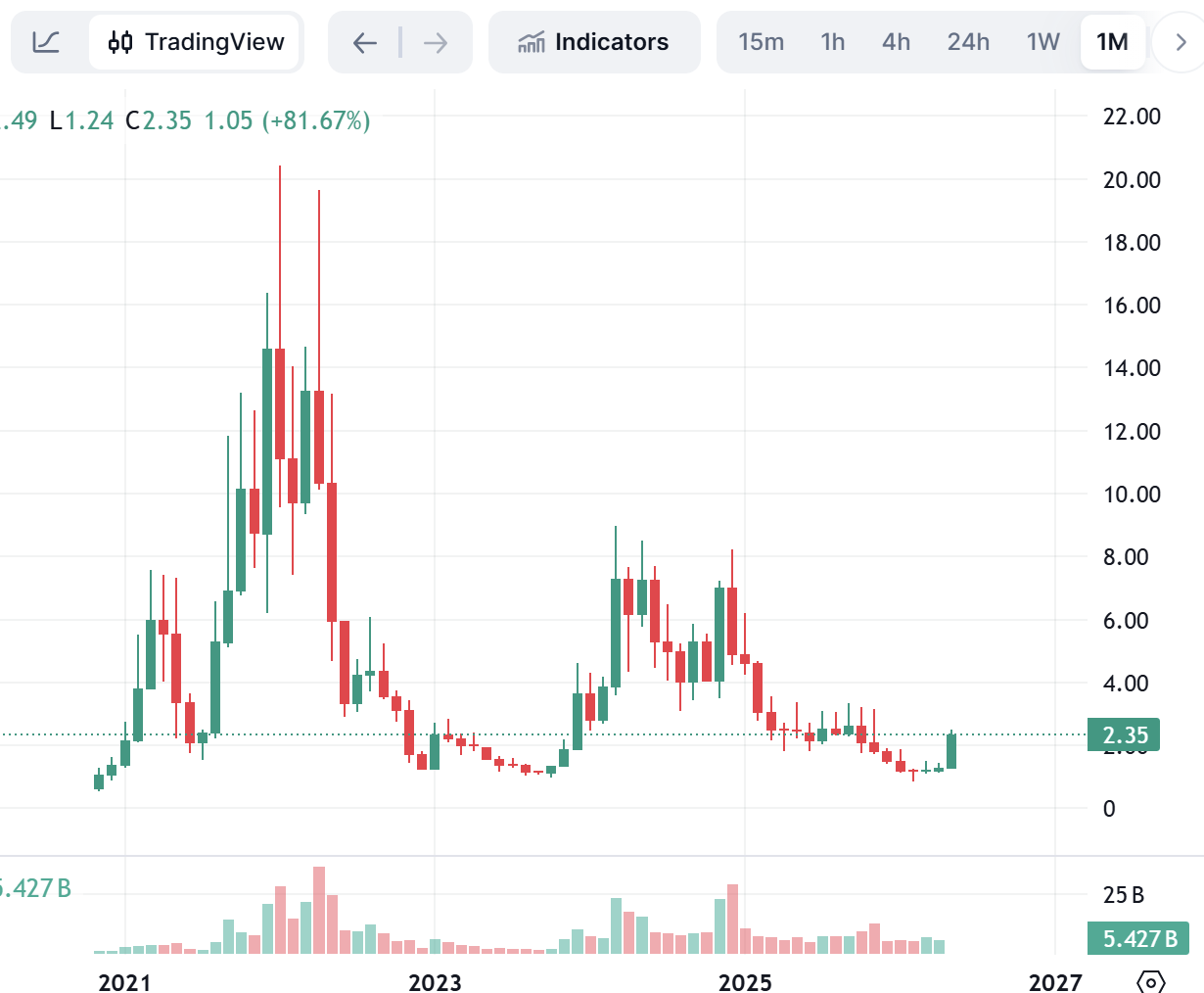
Because of this, NEAR's public sale on CoinList once crashed the latter's website. During the 2020-2021 bull cycle, NEAR soared from $0.5 to a peak of $20.59, becoming one of the most watched star tokens that year.

However, fast-forwarding to this cycle, the vast majority of older tokens and new VC-backed tokens have been shunned by the market. Therefore, even in this bull cycle, NEAR only reached a high of around $9 in 2024 before declining steadily, hitting a low of $0.84 in 2026.

With the official launch of NEAR Intents, privacy requirements have become critically important. Intents are core to cross-chain transactions, allowing users to execute actions simply by expressing intent. However, large on-chain transactions are vulnerable to MEV (Maximal Extractable Value) attacks when public, a significant drawback for institutions, large holders, and ordinary DeFi users alike.

The NEAR team began planning privacy as a crucial complement to Intents. In late May this year, the NEAR Intents team launched Confidential Payments and Confidential Intents features, supporting private cross-chain transfers for assets like ETH, BTC, SOL, and USDC across 35+ chains. The sender, amount, and path are all hidden, with only the result visible on the target chain, utilizing a private shard + TEE (Trusted Execution Environment) bridge at the underlying layer.
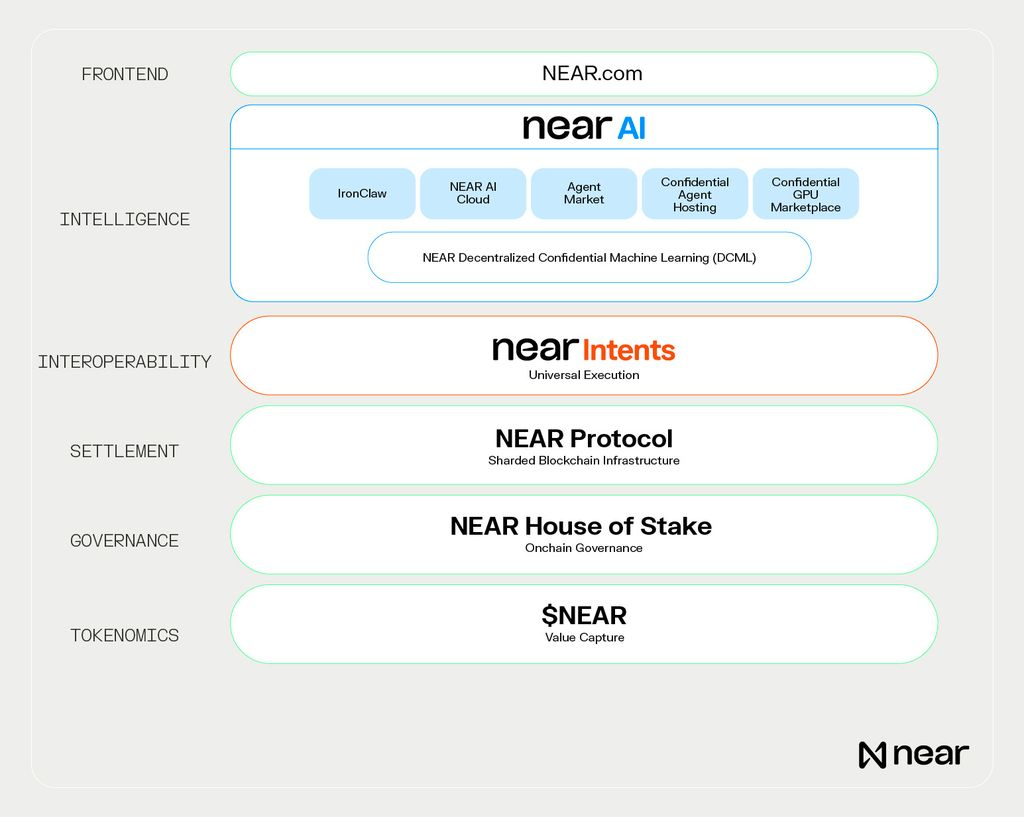
NEAR also opened a privacy mode, where user balances, transfers, and transaction activities are private by default. Whether for ordinary users, enterprise users, or AI agents executing complex strategies, this prevents data leakage. The Confidential Treasuries (Trezu) launched around the same time further supports private multi-signature wallets, payroll, and cross-chain payments, having already processed $68 million in confidential transactions.

Compared to pure privacy coins like Zcash, NEAR's balance between privacy, usability, and cross-chain functionality is more practical, directly addressing enterprise-level demand and driving a recovery in TVL and developer activity.

NEAR Intents Fee Buyback

In October 2025, NEAR completed the unlocking of its final batch of initial supply, bringing its circulating supply close to 100%.
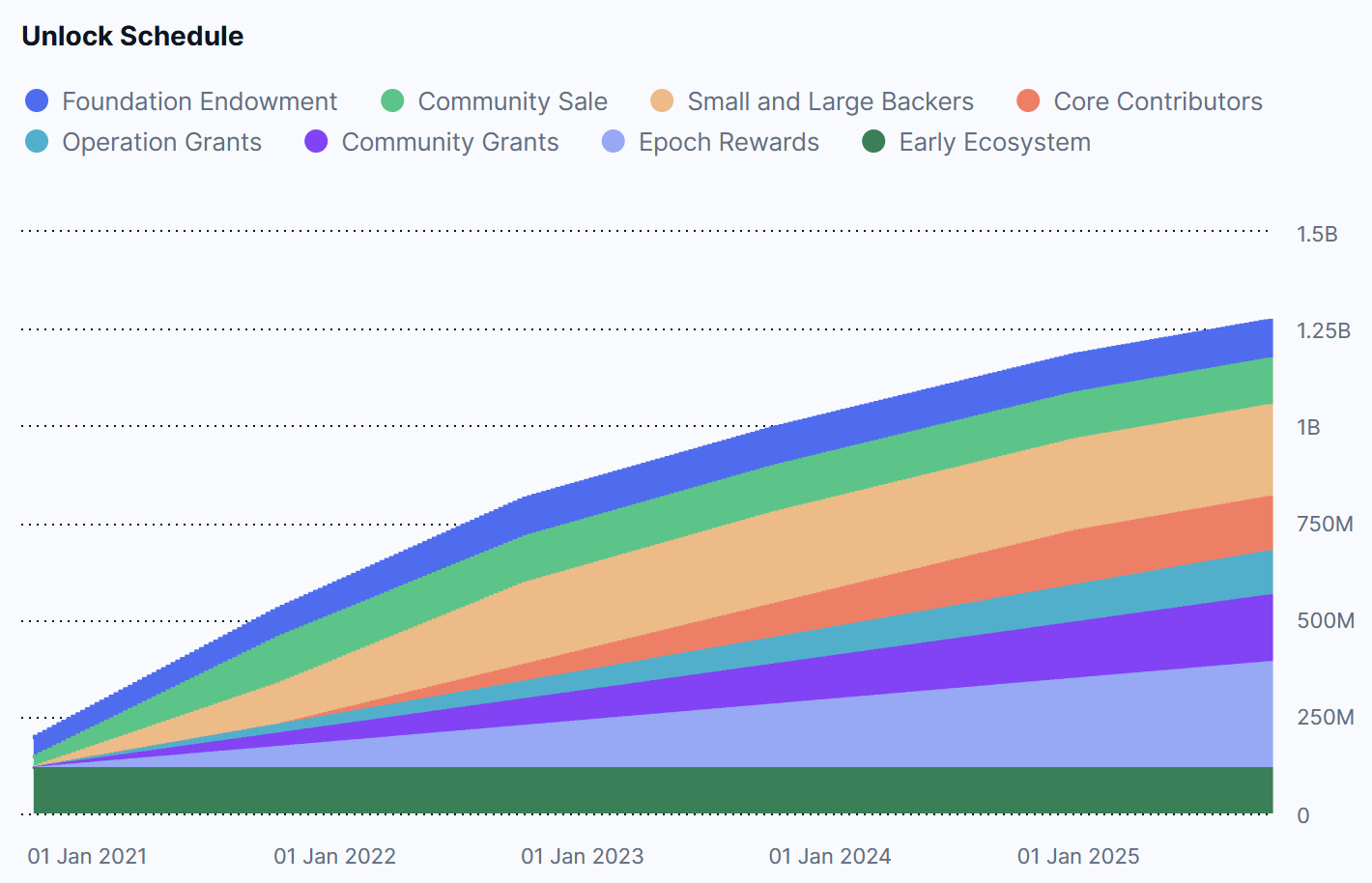
NEAR designed a dual mechanism of inflation + burning from its mainnet's early days: a maximum annual inflation of 5% (permanently halved to 2.5% via an upgrade in October 2025), with 90% going to validators as rewards and 10% entering the protocol treasury. Entering 2026, the project has no major unlock events or linear unlocks remaining, only the regular epoch reward emissions (approximately 5.4 million NEAR released in the last 30 days, about 0.4% of total supply).

In addition, the fee revenue generated by NEAR Intents is used to directly buy back NEAR tokens on the market, also creating significant buying pressure.

NEAR's intent-driven cross-chain transaction layer on the protocol allows users to simply express their desired outcome (e.g., swapping BTC for SOL), and it provides the optimal execution path, supporting multiple chains without the need for bridging/wrapped assets and featuring low fees.

NEAR Intents previously had two fee components: protocol fees and distribution fees (shared with third-party integrators). However, protocol fees now entirely go into the buyback path. The repurchased NEAR isn't necessarily burned immediately; instead, after being bought back, it is staked, locked, or removed from liquidity. It still counts towards the total supply but reduces circulating supply pressure while also earning staking rewards.
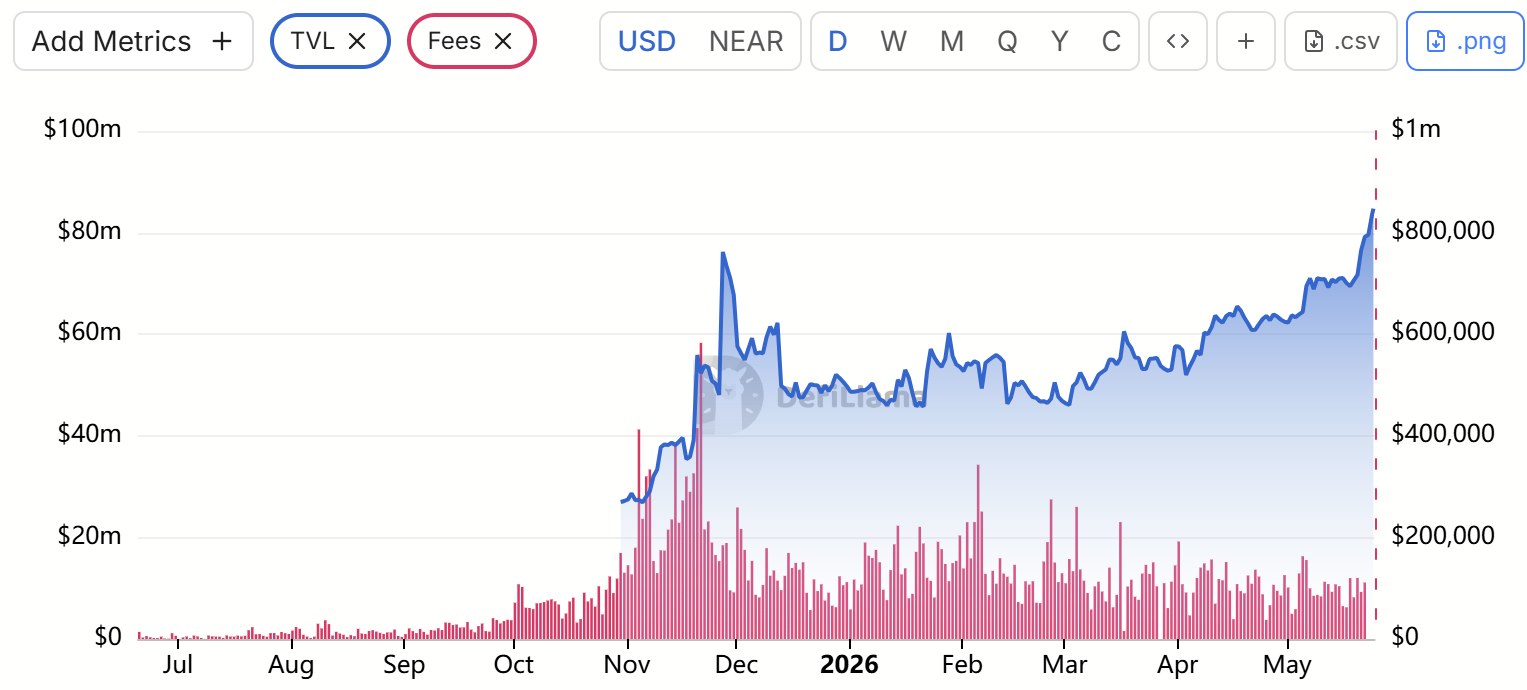
According to the latest data from defiLlama, the TVL of NEAR Intents has exceeded $80 million, with its daily generated fees fluctuating around $100,000, translating to a monthly buyback amount of approximately $3 million.

At the end of this month, its core development team, Near One, also announced the latest technical progress. The team plans to release dynamic resharding by the end of Q2 2026 to significantly enhance scalability. Additionally, the team will introduce NEAR's post-quantum secure signature scheme and perform upgrades in June this year, improving its resistance to quantum computing.


Related Questions

QWhat are the three main catalysts driving NEAR's recent price surge according to the article?

AThe three main catalysts are: 1) AI Narrative, due to co-founder Illia Polosukhin's AI background and NEAR's strategic focus. 2) Privacy Public Chain, through features like Confidential Payments and Intents. 3) NEAR Intents fee buybacks, which reduce circulating supply.

QWho is Illia Polosukhin and what is his significance in the AI field?

AIllia Polosukhin is a co-founder of NEAR. He is one of the eight co-authors of the seminal Transformer paper, which introduced the Transformer architecture that forms the foundation of modern large language models like ChatGPT, Claude, and Gemini.

QWhat specific privacy features did NEAR Intents launch in May, and what problem do they solve?

AIn May, NEAR Intents launched Confidential Payments and Confidential Intents features. They solve the privacy problem for cross-chain transfers by hiding the sender, amount, and transaction path across 35+ chains, protecting users from MEV attacks and data leaks during large or complex transactions.

QHow does the NEAR Intents fee buyback mechanism work and what is its impact?

AFees generated by the NEAR Intents protocol are used to buy back NEAR tokens from the market. These bought-back tokens are then staked, locked, or removed from liquidity. This reduces selling pressure on the circulating supply and creates consistent buy-side demand, with current monthly buybacks estimated around $3 million.

QWhat are the key upcoming technical upgrades mentioned for NEAR in the article?

AThe key upcoming upgrades are: 1) Dynamic Resharding, to be released at the end of Q2 2026, which will significantly improve scalability. 2) A post-quantum secure signature scheme, planned for introduction and upgrade in June of this year, to enhance its resistance to quantum computing attacks.

Related Reads

Bloomberg Uncovered: How Do China's Wealthy Circumvent the Annual $50,000 Limit to Transfer Assets?

**Summary: How Wealthy Chinese Circumvent $50,000 Annual Foreign Exchange Limits** Despite China's strict capital controls, including an annual $50,000 per person foreign exchange quota, an estimated $150 billion in funds still leaves the country annually via various gray and underground channels. This report outlines the evolution of China's "capital wall" and the methods used to bypass it. **The Evolving Capital Controls:** * **Foundation (1994):** The system of "current account convertibility with strict capital account controls" was established. * **Quota Set (2007):** The $50,000 individual annual forex purchase limit was formalized. * **Crackdown Begins (2015-2017):** Following market volatility, enforcement tightened. Banks were required to scrutinize transactions, and channels like using UnionPay cards for Hong Kong insurance premiums or buying overseas property were blocked. * **Digital & Legal Upgrades (2024-2026):** Enhanced algorithms now flag suspicious patterns (e.g., "smurfing"). The Common Reporting Standard (CRS) provides Chinese tax authorities with data on citizens' offshore accounts. Unlicensed cross-border brokers have been targeted. **Five Primary Methods for Moving Capital:** 1. **Underground Banking / "Hawala" (Duiqiao):** The largest-scale method. No money crosses borders. Clients pay RMB to a domestic account; an overseas associate deposits equivalent foreign currency into the client's offshore account. Risks include high fees, account freezes, and legal penalties. 2. **"Smurfing" or "Ant Moving":** Using multiple individuals' $50,000 quotas to pool funds for one offshore recipient. Increasingly detected by anti-money laundering algorithms. 3. **Trade Invoice Manipulation:** Businesses over-invoice imports or under-invoice exports via offshore shell companies, creating a pretext to transfer excess funds abroad under the guise of trade. 4. **Channel Migration:** After a crackdown on internet brokers, funds flow toward more compliant but costly channels like major banks' cross-border wealth management services or Qualified Domestic Institutional Investor (QDII) quotas. 5. **Structural Arrangements:** High-net-worth individuals use complex, high-cost legal structures involving offshore trusts, insurance, and investment migration programs to transfer asset ownership. **Regulatory Response: Focusing on People, Not Just Money** The current strategy extends oversight from enterprises to **individual residents**. Tools like CRS allow retroactive visibility into offshore assets. Cryptocurrencies, once seen as a potential loophole, are now actively monitored and prosecuted as an illegal channel. The underlying driver remains: with significant wealth concentrated among millions of affluent households seeking diversification amid domestic economic shifts, the incentive to move assets offshore persists despite regulatory barriers.

marsbit21m ago

Bloomberg Uncovered: How Do China's Wealthy Circumvent the Annual $50,000 Limit to Transfer Assets?

marsbit21m ago

Ethereum's Ballmer Moment: As Everyone Is Bearish, the Circulating Supply Is Disappearing

"Ethereum's Ballmer Moment: Circulation Shrinks Amid Bearish Sentiment" Amid widespread bearish sentiment, with prominent figures like Bankless founder David Hoffman selling ETH and young developers flocking to Solana, some argue Ethereum is entering its "Ballmer era"—akin to Microsoft's perceived stagnation under Steve Ballmer. While surface-level criticisms about slow protocol development, cautious leadership, and competitive pressure are valid, underlying fundamentals tell a different story. Approximately 30% of ETH is staked, major holders like BitMine are accumulating, and spot ETFs continue to absorb supply. Regulatory clarity, including the SEC/CFTC's March ruling on staking rewards and the potential passage of the CLARITY Act, is transforming crypto from a regulatory threat into a legitimized framework. This institutionalization, alongside a shrinking circulating supply (with net issuance around 0.23% annually), creates significant buy-side pressure independent of fee-based value capture. The broader crypto total addressable market is expanding through regulated stablecoins, tokenized assets, and institutional adoption. While public chains face competition from permissioned alternatives, the winning model appears to be permissioned assets settling on public chains like Ethereum and Solana. The author advocates a non-maximalist, barbell strategy: holding ETH for its institutional role and supply squeeze, SOL for consumer/throughput trends, BTC as a macro hedge, and a basket of next-gen L1s. Key bullish drivers for ETH include rapid circulation shrinkage, potential Q2 staked ETF approvals, regulatory tailwinds solidifying its role as a default settlement layer, and the optionality of an eventual "Satya moment" leadership shift. Despite bearish consensus, the current setup—where crypto is "not hot" and regulatory groundwork is being laid—presents a compelling investment opportunity. The crypto cycle's focus may have shifted to AI, but blockchain infrastructure is gaining a legal and institutional foothold precisely while attention is elsewhere.

marsbit21m ago

Ethereum's Ballmer Moment: As Everyone Is Bearish, the Circulating Supply Is Disappearing

marsbit21m ago

Claude Code Introduces Dynamic Workflows: Enabling AI to Form Teams and Collaborate

Claude Code introduces dynamic workflows, enabling AI to coordinate teams of specialized agents for complex tasks. This transforms Claude from a code assistant into a programmable workbench. Workflows address key limitations of single-agent systems: agentic laziness (premature task completion), self-preferential bias (favoring own outputs), and goal drift (losing sight of original objectives). The system allows Claude to dynamically create execution frameworks using JavaScript. It can split tasks, dispatch parallel agents for isolated work (e.g., in separate worktrees), implement adversarial validation, run tournaments, and synthesize results. This multi-agent approach is valuable for tasks requiring deep research, factual verification, code migration, root cause analysis, large-scale triage, and qualitative sorting. Key patterns include: classify-and-route, fan-out-and-synthesize, adversarial verification, generate-and-filter, tournaments, and loop-until-done. While token usage is higher, workflows excel where tasks resemble programming—needing problem decomposition, isolated context, hypothesis testing, and handling many details. They extend Claude Code's utility beyond technical work to areas like business plan review, resume screening, and naming brainstorm. The feature is not a universal solution but points to a future where AI tool competitiveness depends on organizing reliable, reusable, and auditable execution flows for complex goals.

marsbit1h ago

Claude Code Introduces Dynamic Workflows: Enabling AI to Form Teams and Collaborate

marsbit1h ago

Trading

Spot
Futures
活动图片