Behind NEAR's Doubling: Three Major Trends Fueling Its Price Surge

链捕手Published on 2026-05-26Last updated on 2026-05-26

Abstract

NEAR's price has recently doubled, driven by three key catalysts. First, its strong AI narrative: co-founder Illia Polosukhin co-authored the foundational Transformer paper, and NEAR has integrated AI into its super-app, positioning it as decentralized AI infrastructure. Second, it has evolved into a privacy-focused chain, launching features like Confidential Payments to enable private cross-chain transfers, balancing privacy with usability for institutional and DeFi users. Third, its tokenomics are bolstered by a buyback mechanism: with full circulation achieved and inflation halved, fees from the NEAR Intents layer are used to repurchase NEAR tokens, reducing sell pressure. Combined with a recovering TVL exceeding $80 million, these factors are fueling NEAR's current market outperformance.

Author: Ma He, Foresight News

On May 25, the price of NEAR, the native token of the NEAR protocol, stands at $2.37. Since early May, NEAR has surged from a low of $1.24 to a high of $2.5, with its market capitalization returning above $3 billion. While mainstream crypto assets like Bitcoin have been fluctuating, NEAR has charted its own independent upward trajectory, emerging as one of the brightest performing tokens alongside others like ZEC, ONDO, and HYPE. What are the underlying reasons for this breakout?

The AI Narrative

NEAR co-founder Illia Polosukhin is a seasoned professional in the AI field. Illia is one of the eight co-authors of the seminal Transformer paper, alongside others like Ashish Vaswani and Noam Shazeer from Google Brain / Google Research. This paper introduced the Transformer architecture, which relies entirely on attention mechanisms, significantly improving parallel training efficiency and model scale. It is the foundational framework for all major contemporary large models like ChatGPT, Claude, and Gemini.

NEAR has made AI a core strategy from its early days. In February of this year, NEAR officially launched the Near.com super-app, integrating cross-chain swaps, privacy tools, and smart contract management into one platform with built-in AI capabilities, supporting autonomous agent application scenarios. In November 2023, Illia also formally assumed the role of NEAR Foundation CEO, focusing the strategy primarily around the AI narrative.

In May, Nvidia's earnings report spurred a broader recovery in the AI sector, with NEAR being viewed as a representative of decentralized AI infrastructure, alongside tokens like TAO.
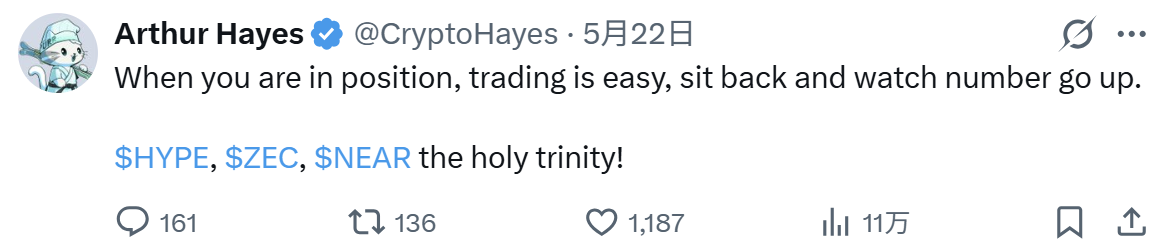
On May 22, BitMEX co-founder Arthur Hayes, in an article, grouped NEAR with HYPE and ZEC in a call for attention, directly igniting market sentiment.

Privacy-Focused Blockchain

Blockchain has long faced the privacy dilemma where 'transparency equals publicity.' The sharp rise of privacy coins like ZEC and XMR has refocused the industry's attention on the privacy sector, leading various protocols, including public blockchains, to start incorporating privacy features.

NEAR was founded in 2018. Its initial core positioning was not AI, but scalability. Its earliest progress primarily revolved around continuously optimizing sharding technology, making it one of the hot 'Ethereum killer' public blockchains at the time.
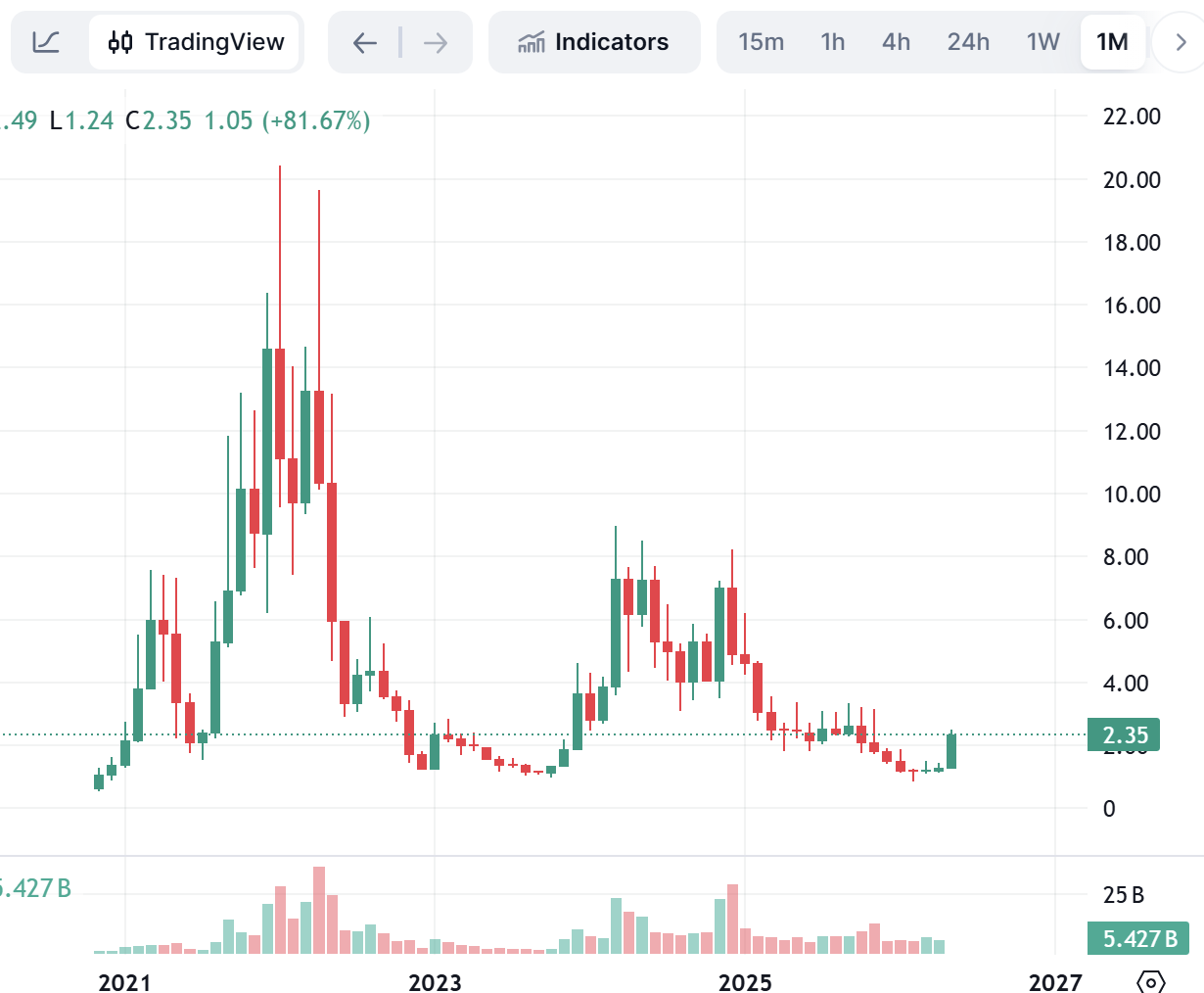
Because of this, NEAR's public sale on CoinList once crashed the latter's website. During the 2020-2021 bull cycle, NEAR soared from $0.5 to a peak of $20.59, becoming one of the most watched star tokens that year.

However, fast-forwarding to this cycle, the vast majority of older tokens and new VC-backed tokens have been shunned by the market. Therefore, even in this bull cycle, NEAR only reached a high of around $9 in 2024 before declining steadily, hitting a low of $0.84 in 2026.

With the official launch of NEAR Intents, privacy requirements have become critically important. Intents are core to cross-chain transactions, allowing users to execute actions simply by expressing intent. However, large on-chain transactions are vulnerable to MEV (Maximal Extractable Value) attacks when public, a significant drawback for institutions, large holders, and ordinary DeFi users alike.

The NEAR team began planning privacy as a crucial complement to Intents. In late May this year, the NEAR Intents team launched Confidential Payments and Confidential Intents features, supporting private cross-chain transfers for assets like ETH, BTC, SOL, and USDC across 35+ chains. The sender, amount, and path are all hidden, with only the result visible on the target chain, utilizing a private shard + TEE (Trusted Execution Environment) bridge at the underlying layer.
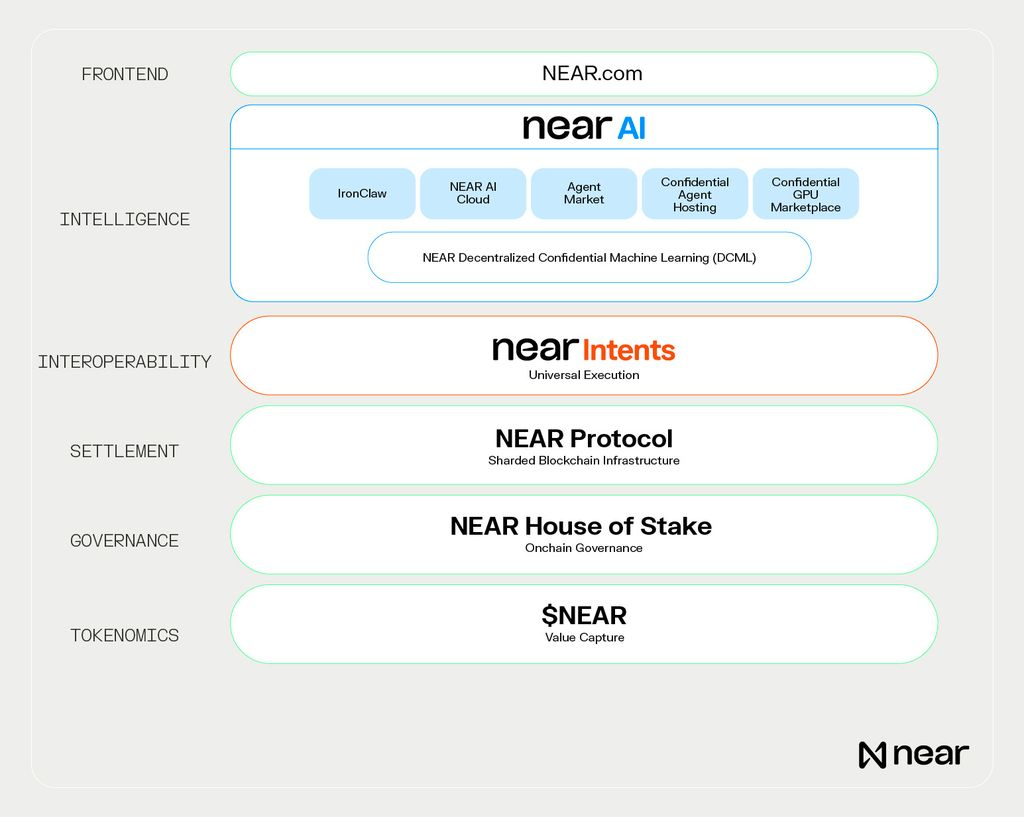
NEAR also opened a privacy mode, where user balances, transfers, and transaction activities are private by default. Whether for ordinary users, enterprise users, or AI agents executing complex strategies, this prevents data leakage. The Confidential Treasuries (Trezu) launched around the same time further supports private multi-signature wallets, payroll, and cross-chain payments, having already processed $68 million in confidential transactions.

Compared to pure privacy coins like Zcash, NEAR's balance between privacy, usability, and cross-chain functionality is more practical, directly addressing enterprise-level demand and driving a recovery in TVL and developer activity.

NEAR Intents Fee Buyback

In October 2025, NEAR completed the unlocking of its final batch of initial supply, bringing its circulating supply close to 100%.
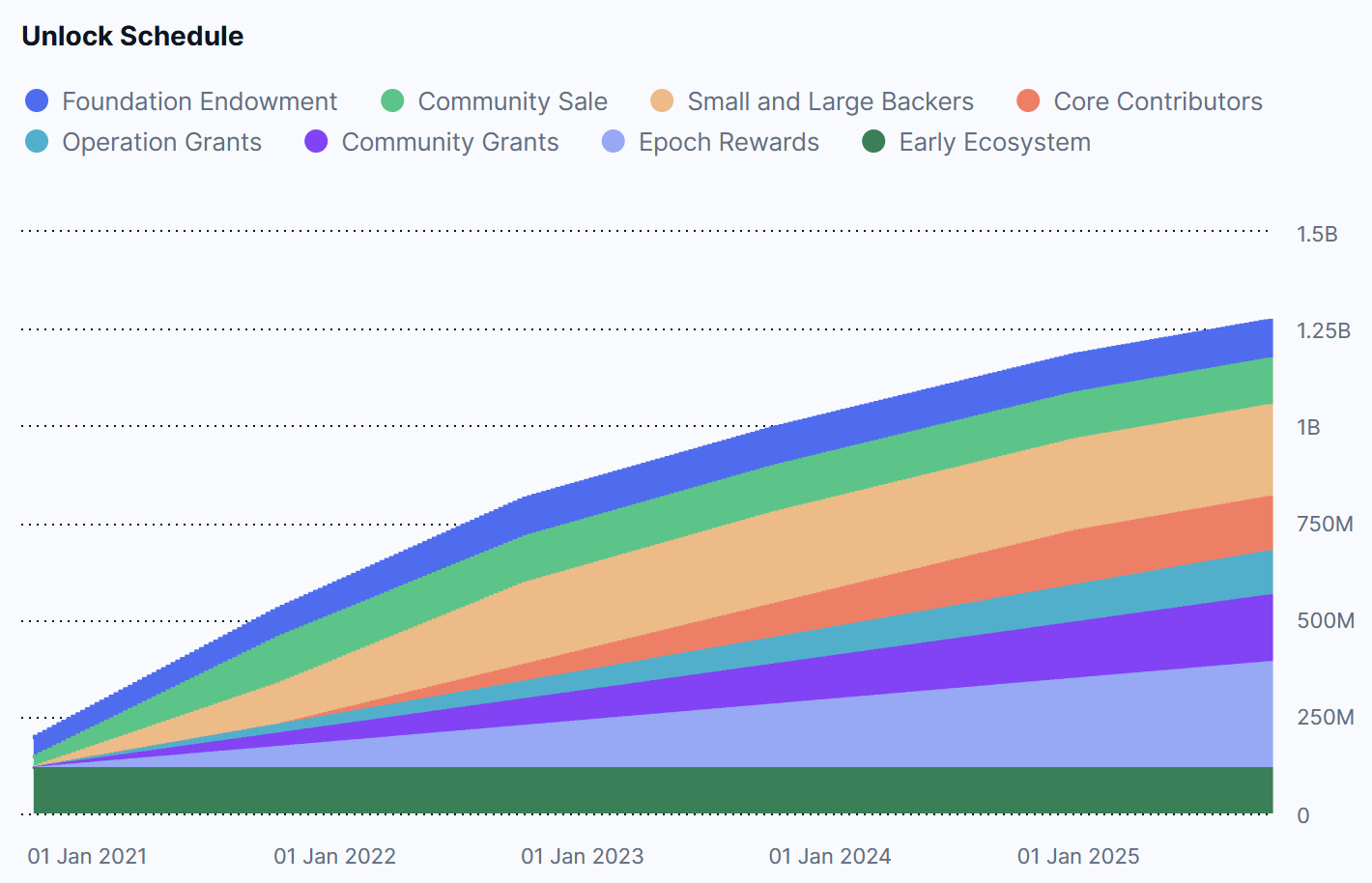
NEAR designed a dual mechanism of inflation + burning from its mainnet's early days: a maximum annual inflation of 5% (permanently halved to 2.5% via an upgrade in October 2025), with 90% going to validators as rewards and 10% entering the protocol treasury. Entering 2026, the project has no major unlock events or linear unlocks remaining, only the regular epoch reward emissions (approximately 5.4 million NEAR released in the last 30 days, about 0.4% of total supply).

In addition, the fee revenue generated by NEAR Intents is used to directly buy back NEAR tokens on the market, also creating significant buying pressure.

NEAR's intent-driven cross-chain transaction layer on the protocol allows users to simply express their desired outcome (e.g., swapping BTC for SOL), and it provides the optimal execution path, supporting multiple chains without the need for bridging/wrapped assets and featuring low fees.

NEAR Intents previously had two fee components: protocol fees and distribution fees (shared with third-party integrators). However, protocol fees now entirely go into the buyback path. The repurchased NEAR isn't necessarily burned immediately; instead, after being bought back, it is staked, locked, or removed from liquidity. It still counts towards the total supply but reduces circulating supply pressure while also earning staking rewards.
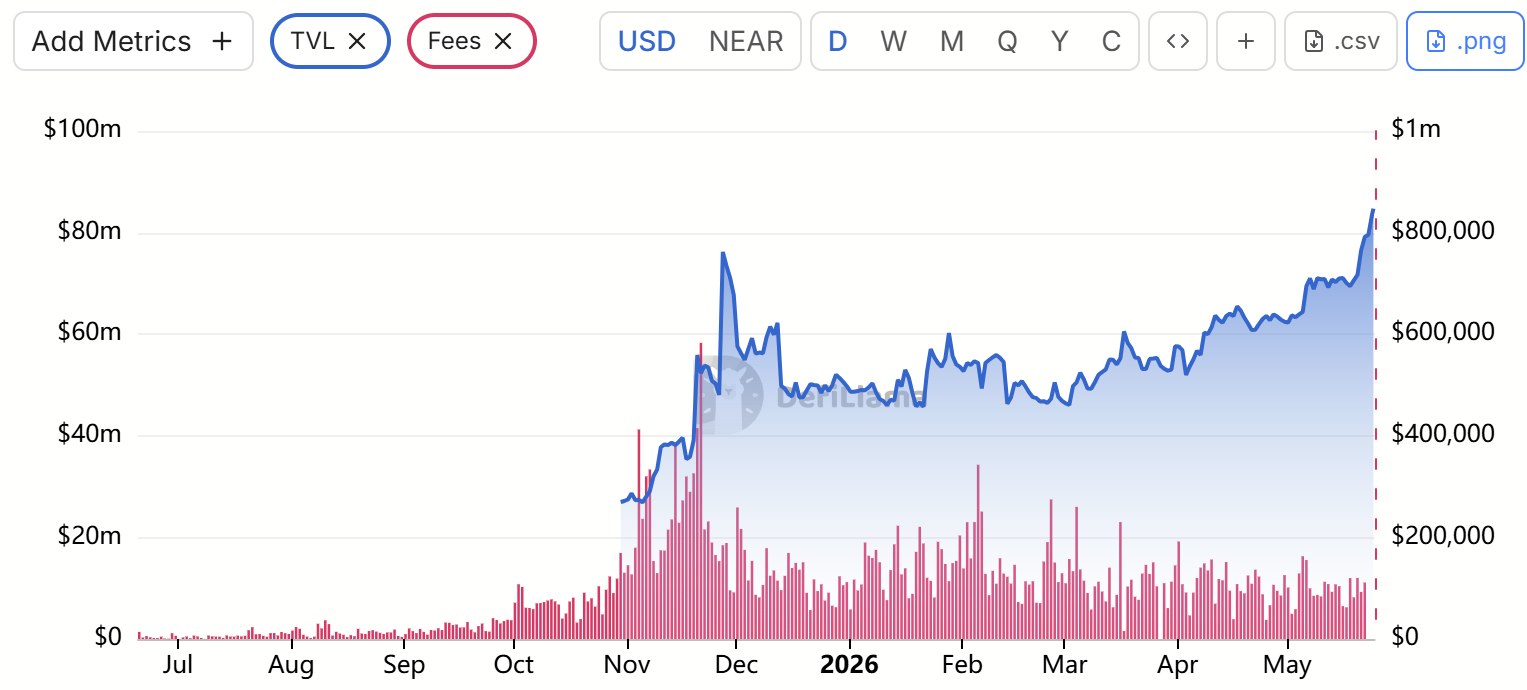
According to the latest data from defiLlama, the TVL of NEAR Intents has exceeded $80 million, with its daily generated fees fluctuating around $100,000, translating to a monthly buyback amount of approximately $3 million.

At the end of this month, its core development team, Near One, also announced the latest technical progress. The team plans to release dynamic resharding by the end of Q2 2026 to significantly enhance scalability. Additionally, the team will introduce NEAR's post-quantum secure signature scheme and perform upgrades in June this year, improving its resistance to quantum computing.


Related Questions

QWhat are the three main catalysts driving NEAR's recent price surge according to the article?

AThe three main catalysts are: 1) AI Narrative, due to co-founder Illia Polosukhin's AI background and NEAR's strategic focus. 2) Privacy Public Chain, through features like Confidential Payments and Intents. 3) NEAR Intents fee buybacks, which reduce circulating supply.

QWho is Illia Polosukhin and what is his significance in the AI field?

AIllia Polosukhin is a co-founder of NEAR. He is one of the eight co-authors of the seminal Transformer paper, which introduced the Transformer architecture that forms the foundation of modern large language models like ChatGPT, Claude, and Gemini.

QWhat specific privacy features did NEAR Intents launch in May, and what problem do they solve?

AIn May, NEAR Intents launched Confidential Payments and Confidential Intents features. They solve the privacy problem for cross-chain transfers by hiding the sender, amount, and transaction path across 35+ chains, protecting users from MEV attacks and data leaks during large or complex transactions.

QHow does the NEAR Intents fee buyback mechanism work and what is its impact?

AFees generated by the NEAR Intents protocol are used to buy back NEAR tokens from the market. These bought-back tokens are then staked, locked, or removed from liquidity. This reduces selling pressure on the circulating supply and creates consistent buy-side demand, with current monthly buybacks estimated around $3 million.

QWhat are the key upcoming technical upgrades mentioned for NEAR in the article?

AThe key upcoming upgrades are: 1) Dynamic Resharding, to be released at the end of Q2 2026, which will significantly improve scalability. 2) A post-quantum secure signature scheme, planned for introduction and upgrade in June of this year, to enhance its resistance to quantum computing attacks.

Related Reads

A Nation Blocks Chips, a Giant Buys a Nuclear Power Plant: Why It's Time to Seriously Consider DeAI

**Title: Great Powers Blockade Chips, Giants Buy Nuclear Plants: Why It's Time to Seriously Consider DeAI** In May 2026, the US closed loopholes for Chinese firms to acquire advanced NVIDIA chips via overseas subsidiaries. That same month, Kenya halted a $1B geothermal data center project involving Microsoft, fearing its immense energy consumption. Meanwhile, Huawei announced mass production of its Ascend AI chip. These disparate events underscore a new reality: the competition for computing power ("compute") has escalated beyond the tech industry, becoming a geopolitical and infrastructural battleground. A new era of oligopoly is forming, with control over the AI stack—from GPU chips (NVIDIA) and cloud platforms (AWS, Azure, Google Cloud) to foundational models (OpenAI, Anthropic)—concentrating in a few Western "AI Octopus" corporations. This centralization creates systemic risks: pricing power and platform lock-in for users, infrastructure fragility, and a widening "compute divide" that threatens to marginalize nations without independent AI capacity. An "AI Iron Curtain" is deepening through export controls. In response, some nations like Saudi Arabia and the UAE are investing heavily to buy compute power, aiming to transition from oil to AI economies. The EU seeks to triple its compute capacity by 2030 to reduce dependency. However, the spending gap is vast, with four US tech giants alone planning ~$750B in AI capex for 2026. The race is increasingly constrained by energy, with AI tasks consuming up to 1000x more power than web searches, pushing firms to even acquire nuclear plants. This landscape is fueling interest in Decentralized AI (DeAI). It proposes a third way: using open protocols to coordinate a global network of idle GPUs, independent developers, and data centers, creating an AI infrastructure without a single controlling entity. Leveraging blockchain and cryptographic verification, DeAI aims to break market concentration, disperse energy demands, reduce geopolitical dependencies, and enhance transparency. While still nascent in performance and stability, DeAI's core promise is not immediate superiority but providing a crucial alternative architecture to resist monopoly, censorship, and centralized power. As specialized AI hardware costs fall and open-source models flourish, the window to build this foundation is open. The very existence of such competition serves as a vital check against the inevitable abuse of concentrated power.

marsbit12m ago

A Nation Blocks Chips, a Giant Buys a Nuclear Power Plant: Why It's Time to Seriously Consider DeAI

marsbit12m ago

Outpoll Review: A Prediction Market Platform Built for Active Traders

Outpoll Review: A Prediction Market Platform Built for Active Traders In recent years, prediction markets have grown from a niche sector to a mainstream arena, attracting billions in trading volume and institutional capital. However, the user experience and tools for traders have not kept pace. Outpoll, a new global prediction market platform, aims to fill this gap by providing enhanced trading infrastructure for active and professional traders. Built on standard prediction market principles, Outpoll allows users to trade on the outcome of specific events. It uses fully collateralized contracts with USDC settlement, charges a competitive 0.1% fee per trade, and provides clear settlement rules upfront to minimize disputes. A key focus for Outpoll is its professional-grade trading tools. The platform supports limit and market orders, as well as take-profit and stop-loss orders for open positions—features uncommon in prediction markets. For automated trading, Outpoll offers comprehensive REST and WebSocket APIs, enabling portfolio management, price arbitrage, and integration with existing tools. The platform also features a creator-led market model, where approved experts and community leaders can create and manage markets for niche topics under platform supervision. Its integrated interface combines news feeds directly with trading functions, allowing users to monitor events and manage positions seamlessly. Outpoll launched with a native Android app (available on Google Play) and plans an iOS version later this year. In summary, Outpoll distinguishes itself with trader-focused tools, practical APIs, transparent and collateralized markets, integrated news, and an expanding creator program. For active traders, its advanced order types and API access alone make it a platform worth watching. Outpoll is now globally accessible via outpoll.com and Google Play.

marsbit20m ago

Outpoll Review: A Prediction Market Platform Built for Active Traders

marsbit20m ago

Bitwise: Crypto Becomes a Contrarian Investment, Three Logics to Understand the Current Market

**Summary** Matt Hougan, Bitwise's CIO, analyzes the current crypto market through three key lenses, arguing it has shifted from a momentum-driven to a contrarian investment. **1) Crypto Becomes a Contrarian Play:** The market is weak, with major assets like Bitcoin and Ethereum down significantly. Capital has moved to hot sectors like AI, leaving crypto as an "unloved" asset class. This transforms crypto investing from trend-following to a test of patience and fundamental analysis. Investors now favor projects with solid fundamentals (e.g., Hyperliquid) over speculative ones. **2) Regulatory Overhang:** The uncertain fate of the U.S. CLARITY Act, a major crypto regulatory framework, is a key headwind. With its passage in 2024 seen as far from guaranteed (estimates range from 30-55%), institutional capital remains on the sidelines, choosing less risky alternatives like AI stocks. The market needs clarity—whether the bill passes or fails—more than any specific outcome to move decisively. **3) Capital Rotates to New Fundamentals:** This cycle differs from past bear markets where money fled to Bitcoin. Now, capital seeks smaller assets with strong use cases. While major cryptos fell in May 2024, tokens like Hyperliquid (+72%), Zcash (+50%), and XLM (+44%) rallied on their specific fundamentals. This rotation confirms the new contrarian, fundamentals-driven logic and signals the bear market may be in its later stages. **Conclusion:** Short-term pressure persists due to regulatory uncertainty and competition from AI narratives. Investing in crypto now requires a contrarian mindset—acting against the crowd and focusing on fundamental value. Patience and targeting high-quality projects based on their merits are essential for capturing long-term gains.

marsbit1h ago

Bitwise: Crypto Becomes a Contrarian Investment, Three Logics to Understand the Current Market

marsbit1h ago

ChatGPT Might Be Disappearing Soon

OpenAI announced at its "Intelligence at Work" event that its coding assistant, Codex, will be fully integrated into the ChatGPT app within weeks. This move marks a strategic shift from a conversational AI (Chat) towards a unified "agentic" platform capable of execution. Codex, originally launched to compete with Anthropic's Claude Code, has grown rapidly to 5 million weekly active users, with 20% being non-developers like analysts and designers. Its enterprise revenue now constitutes 40% of OpenAI's total. The integration is the first step in creating a super-app combining ChatGPT (interface), Codex (execution engine), and the Atlas browser (web access). OpenAI also unveiled new Codex features: specialized Agent plugins for six professional roles, an "Annotations" tool for direct document editing, and a "Sites" function to turn work into shareable web apps. Internally, this reflects a power shift; the Codex team now leads core product strategy. While the ChatGPT brand remains for its vast user base, the platform's future is focused on autonomous agents that perform tasks, not just chat. The article notes that competition with Claude Code pushed OpenAI's development, with Codex competing on cost-effectiveness and accessibility rather than raw coding quality. It concludes that the essence of "ChatGPT" is evolving from a chatbot into an AI agent platform, with the name potentially becoming a legacy symbol of its original function.

marsbit1h ago

ChatGPT Might Be Disappearing Soon

marsbit1h ago

Trading

Spot
Futures
活动图片




