Before Musk Gave Him $1 Million, He Made $600,000 by Launching Coins

marsbitPublished on 2026-02-12Last updated on 2026-02-12

Abstract

On February 4th, X awarded user @beaverd $1 million for winning an article competition with a piece criticizing Deloitte. Beaver, a well-known meme coin trader, was later accused by Bubblemaps of being a "serial rugger" who allegedly made $600,000 by deploying and manipulating the price of a token called $SIAS on pump.fun, which rapidly rose to a $6 million market cap before crashing to zero. Bubblemaps claimed Beaver used multiple wallets to snipe and profit from the token. In response, Beaver gave a defiant reply, garnering significant support from parts of the crypto community. Supporters argued that since he did not promote the token on his social media, his actions weren’t fraudulent—just a high-risk bet that others lost. Some even criticized Bubblemaps’ own token $BMT as a worse offender. Beaver is also known for Somaliscan, a data site tracking U.S. government spending and exposing corruption, which earned him admiration, particularly among right-leaning audiences. The incident reignites the ongoing debate in crypto over whether launching and manipulating tokens without promotion constitutes unethical behavior or simply reflects the risky nature of meme coin trading.

On February 4th, X announced the winner of its million-dollar article competition. @beaverd, with his piece "Deloitte, a $74 billion cancer metastasized across America," became the ultimate winner, receiving a $1 million reward.
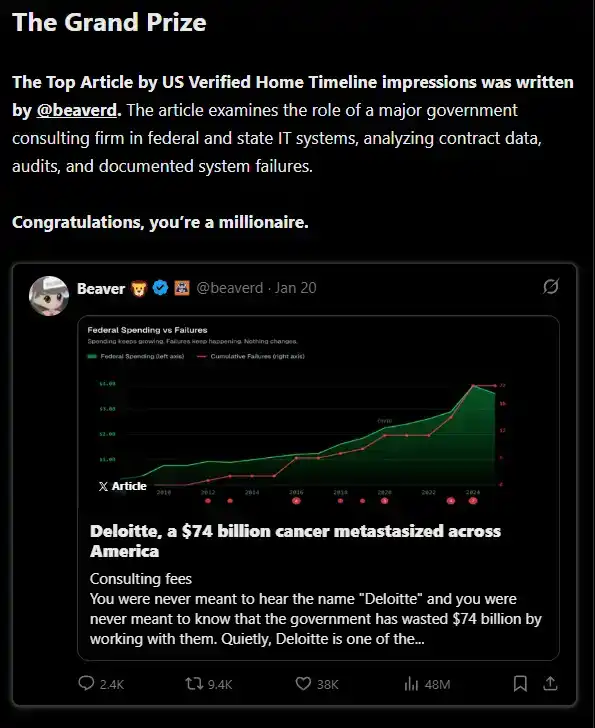
In the English-speaking crypto community, Beaver is a relatively well-known meme coin player, so his win excited the crypto circle. However, the day before yesterday, Bubblemaps posted a tweet accusing him of being a "serial rugger," alleging that he manipulated coin prices to profit $600,000.

Bubblemaps stated that based on Beaver's public Solana address, they discovered an associated address "2mQB8o," which launched the token $SIAS on pump.fun. $SIAS quickly reached a market cap of $6 million within 7 minutes of deployment, but then rapidly plummeted to zero in the next 10 minutes due to large sell-offs by the dev.
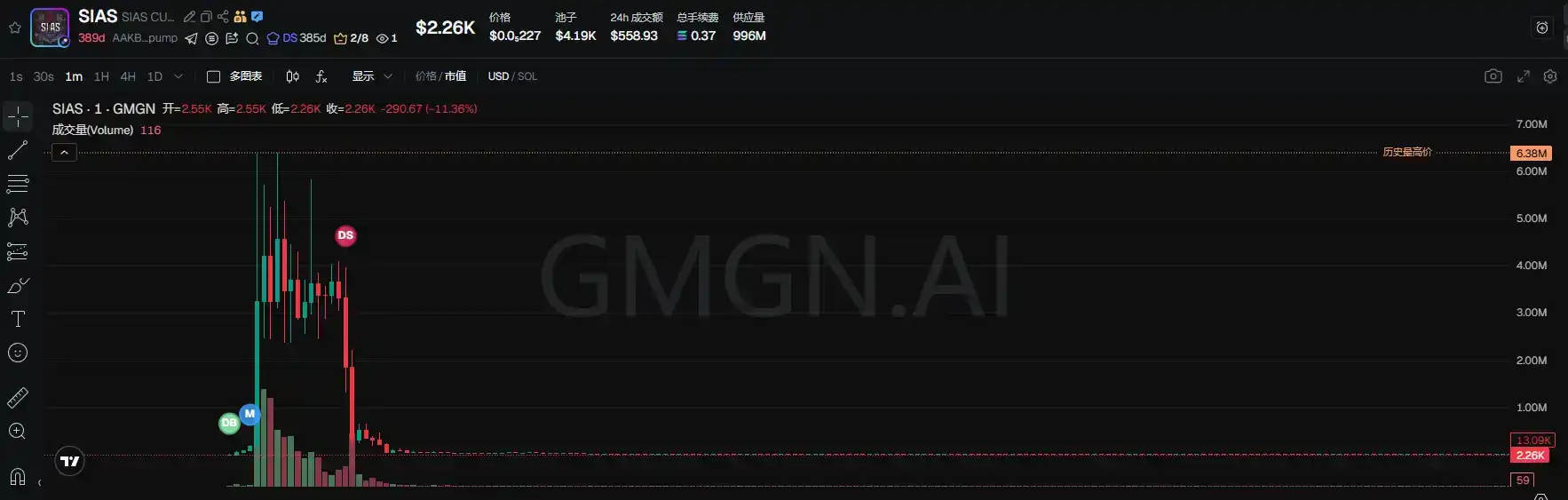
After the token crashed to zero, its X account was also deleted.

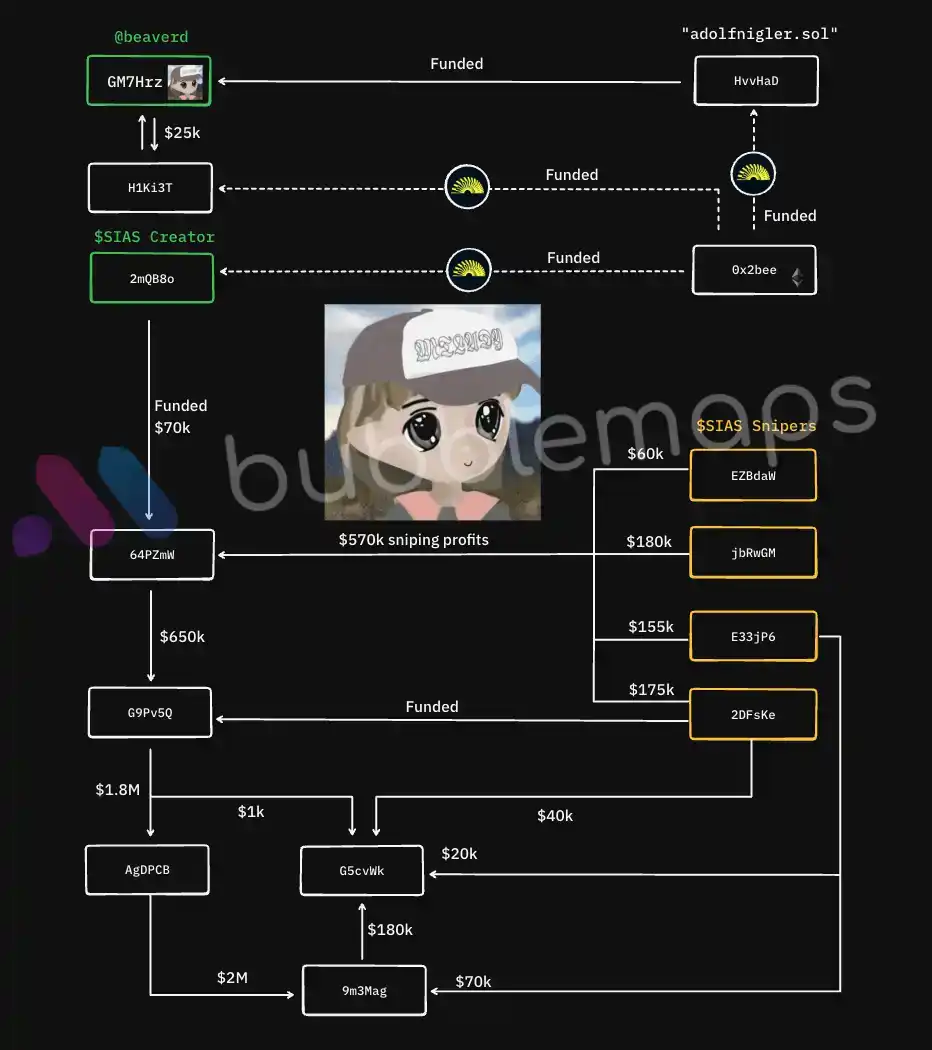
Through further on-chain analysis, Bubblemaps pointed out that Beaver was not only the dev but also used four other addresses to snipe the token, totaling a profit of $600,000.
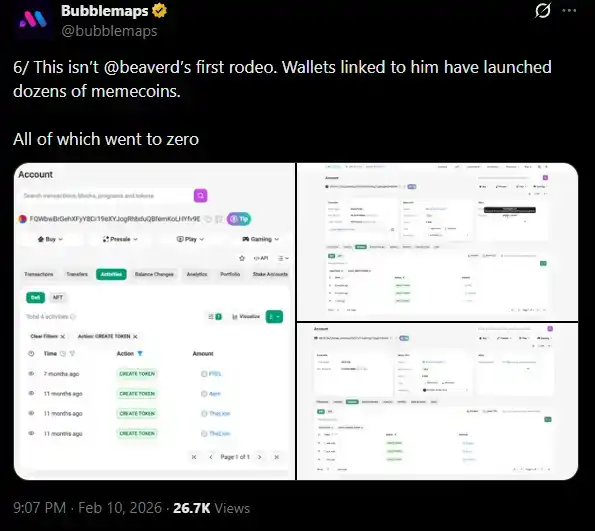
Finally, Bubblemaps also noted that all tracked addresses related to Beaver did not just launch this one token but many others, all of which crashed to zero.
In response to Bubblemaps' accusations, Beaver's reply was as wild as his Milady avatar:

Precisely because of Beaver's response, he gained considerable support. In the English-speaking community, Beaver is popular for being "fun," similar to figures like Bob Lax and mitch. To make an imperfect analogy, it's somewhat like Liang Xi in the Chinese circle.

This is an interesting manifestation of the crypto subculture. Whether in the Chinese or English-speaking circles, a significant portion of players hold the view of "you win some, you lose some"—meme coins are essentially a gamble, and if devs can make money through clever means, that's their skill. Since you gambled, you should take responsibility for yourself.
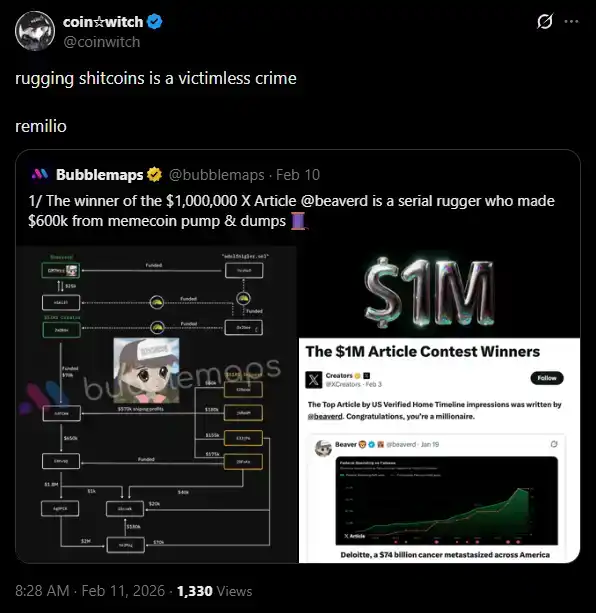
There is also the view that Beaver did not promote $SIAS through his X account (Bubblemaps' accusation also acknowledged this but pointed out that Beaver even profited from the token using his public address, which is an act of audacity). Therefore, Beaver is not guilty of "fraud"; rather, those who bet against him lost to him.

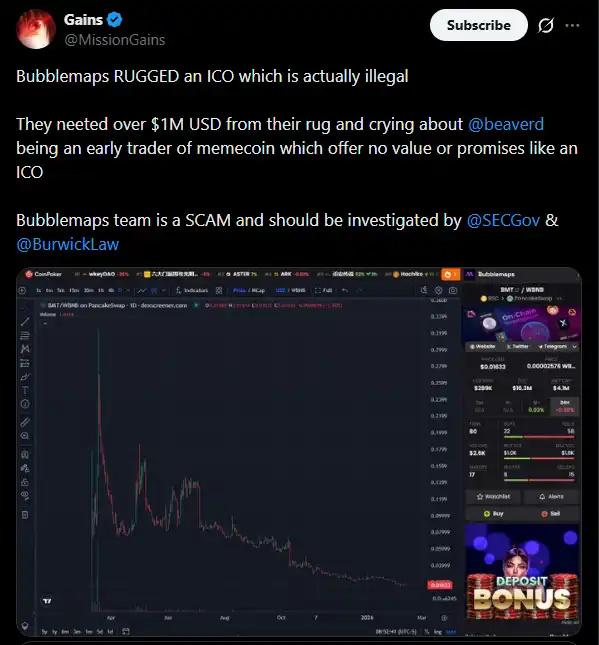
Players siding with Beaver even mocked the market performance of Bubblemaps' token $BMT, arguing that compared to Beaver, Bubblemaps—which conducted an ICO and made promises—is the illegal scam that should be held accountable:
Besides the有趣的 subculture of the crypto world, another reason for Beaver's popularity is his project Somaliscan. Somaliscan is an open-source data website that tracks over $55 trillion in U.S. government fiscal expenditures, exposing massive corruption in the U.S. government's refugee resettlement programs, particularly aid to Somalia. The data on this website covers U.S. government spending, political donations to officials, healthcare system fund allocations, federal loans, and summaries of individuals linked to the Epstein files. Beaver's million-dollar-winning article exposed the massive corruption of Deloitte, which received a $40 billion contract from the U.S. government but caused an estimated $34 billion in losses—a discovery he made while building the database for Somaliscan.

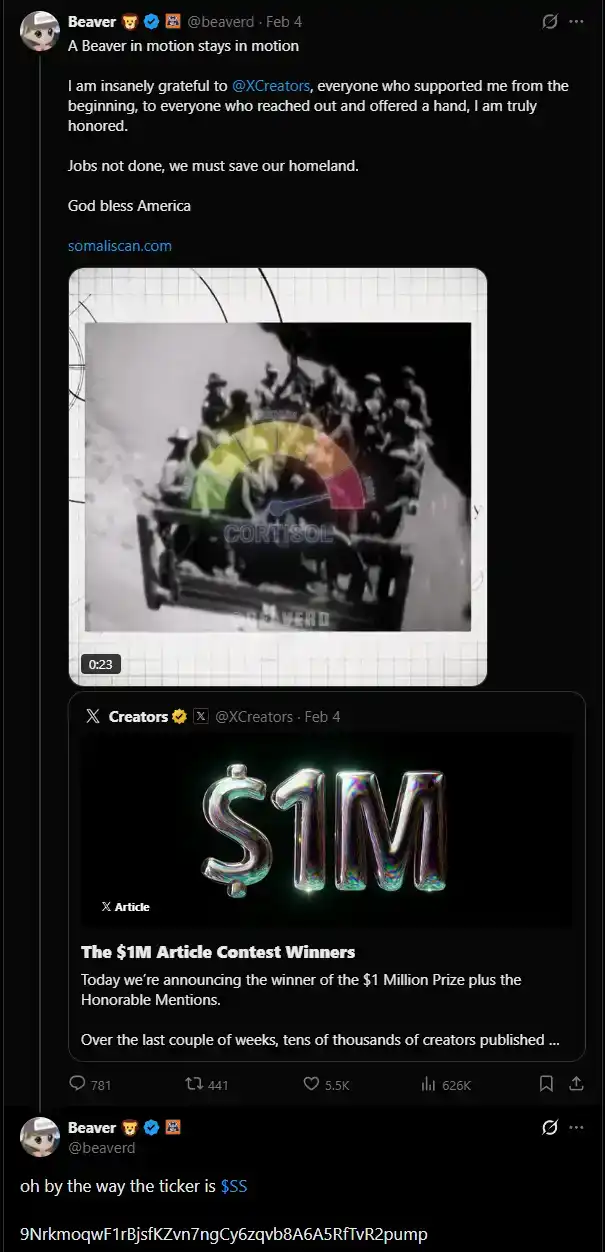
As a result, Beaver is seen as a hero by right-leaning players in the English-speaking community (especially in the U.S.). After X announced his million-dollar article prize, he immediately promoted Somaliscan and included the CA in the tweet's comments:
Setting aside emotional factors, this incident has indeed reignited a long-standing debate in the crypto community—if someone launches a token and manipulates its price but does not promote it, should they be criticized?

This debate will not cease unless the market ceases to be残酷.

Related Questions

QWho won the $1 million article competition on X and what was the title of their winning article?

AThe winner was @beaverd with the article titled 'Deloitte, a $74 billion cancer metastasized across America'.

QWhat accusation did Bubblemaps make against Beaver regarding his activities in the crypto space?

ABubblemaps accused Beaver of being a 'serial rugger' who manipulated the price of a token called $SIAS on pump.fun, making a profit of $600,000 by quickly selling off his holdings and causing the token's value to plummet to zero.

QHow did Beaver respond to the allegations made by Bubblemaps?

ABeaver responded defiantly and with a wild attitude, which actually garnered him significant support from parts of the crypto community who view meme coin trading as a form of gambling where participants are responsible for their own risks.

QWhat is Somaliscan, and how is it related to Beaver's public image?

ASomaliscan is an open-source data website created by Beaver that tracks over $55 trillion in U.S. government spending, exposing corruption in programs like refugee安置 (especially aid to Somalia). It enhanced his reputation, particularly among right-leaning circles, who see him as a hero for uncovering government waste and corruption.

QWhat ongoing debate in the crypto community does the article highlight through Beaver's story?

AThe article highlights the debate over whether creating a token and manipulating its price without promoting it should be considered fraudulent or simply a risky bet that participants enter into willingly, reflecting the community's divided views on responsibility and ethics in meme coin trading.

Related Reads

Gensyn AI: Don't Let AI Repeat the Mistakes of the Internet

In recent months, the rapid growth of the AI industry has attracted significant talent from the crypto sector. A persistent question among researchers intersecting both fields is whether blockchain can become a foundational part of AI infrastructure. While many previous AI and Crypto projects focused on application layers (like AI Agents, on-chain reasoning, data markets, and compute rentals), few achieved viable commercial models. Gensyn differentiates itself by targeting the most critical and expensive layer of AI: model training. Gensyn aims to organize globally distributed GPU resources into an open AI training network. Developers can submit training tasks, nodes provide computational power, and the network verifies results while distributing incentives. The core issue addressed is not decentralization for its own sake, but the increasing centralization of compute power among tech giants. In the era of large models, access to GPUs (like the H100) has become a decisive bottleneck, dictating the pace of AI development. Major AI companies are heavily dependent on large cloud providers for compute resources. Gensyn's approach is significant for several reasons: 1) It operates at the core infrastructure layer (model training), the most resource-intensive and technically demanding part of the AI value chain. 2) It proposes a more open, collaborative model for compute, potentially increasing resource utilization by dynamically pooling idle GPUs, similar to early cloud computing logic. 3) Its technical moat lies in solving complex challenges like verifying training results, ensuring node honesty, and maintaining reliability in a distributed environment—making it more of a deep-tech infrastructure company. 4) It targets a validated, high-growth market with genuine demand, rather than pursuing blockchain integration without purpose. Ultimately, the boundaries between Crypto and AI are blurring. AI requires global resource coordination, incentive mechanisms, and collaborative systems—areas where crypto-native solutions excel. Gensyn represents a step toward making advanced training capabilities more accessible and collaborative, moving beyond a niche controlled by a few giants. If successful, it could evolve into a fundamental piece of AI infrastructure, where the most enduring value in the AI era is often created.

marsbit9h ago

Gensyn AI: Don't Let AI Repeat the Mistakes of the Internet

marsbit9h ago

Why is China's AI Developing So Fast? The Answer Lies Inside the Labs

A US researcher's visit to China's top AI labs reveals distinct cultural and organizational factors driving China's rapid AI development. While talent, data, and compute are similar to the West, Chinese labs excel through a pragmatic, execution-focused culture: less emphasis on individual stardom and conceptual debate, and more on teamwork, engineering optimization, and mastering the full tech stack. A key advantage is the integration of young students and researchers who approach model-building with fresh perspectives and low ego, prioritizing collective progress over personal credit. This contrasts with the US culture of self-promotion and "star scientist" narratives. Chinese labs also exhibit a strong "build, don't buy" mentality, preferring to develop core capabilities—like data pipelines and environments—in-house rather than relying on external services. The ecosystem feels more collaborative than tribal, with mutual respect among labs. While government support exists, its scale is unclear, and technical decisions appear driven by labs, not state mandates. Chinese companies across sectors, from platforms to consumer tech, are building their own foundational models to control their tech destiny, reflecting a broader cultural drive for technological sovereignty. Demand for AI is emerging, with spending patterns potentially mirroring cloud infrastructure more than traditional SaaS. Despite challenges like a less mature data industry and GPU shortages, Chinese labs are propelled by vast talent, rapid iteration, and deep integration with the open-source community. The competition is evolving beyond a pure model race into a contest of organizational execution, developer ecosystems, and industrial pragmatism.

marsbit11h ago

Why is China's AI Developing So Fast? The Answer Lies Inside the Labs

marsbit11h ago

3 Years, 5 Times: The Rebirth of a Century-Old Glass Factory

Corning, a 175-year-old glass company, is experiencing a dramatic revival as a key player in AI infrastructure, driven by surging demand for high-performance optical fiber in data centers. AI data centers require vastly more fiber than traditional ones—5 to 10 times as much per rack—to handle high-speed data transmission between GPUs. This structural demand shift, coupled with supply constraints from the lengthy expansion cycle for fiber preforms, has created a significant supply-demand gap. Nvidia has invested in Corning, along with Lumentum and Coherent, in a $4.5 billion total commitment to secure the optical supply chain for AI. Corning's competitive edge lies in its expertise in producing ultra-low-loss, high-density, and bend-resistant specialty fiber, which is critical for 800G+ and future 1.6T data rates. Its deep involvement in co-packaged optics (CPO) with partners like Nvidia further solidifies its position. While not the largest fiber manufacturer globally, Corning's revenue from enterprise/data center clients now exceeds 40% of its optical communications sales, and it has secured multi-year supply agreements with major hyperscalers including Meta and Nvidia. Financially, Corning's optical communications revenue has surged, doubling from $1.3 billion in 2023 to over $3 billion in 2025. Its stock price has risen nearly 6-fold since late 2023. Key future catalysts include the rollout of Nvidia's CPO products and the scale of undisclosed customer agreements. However, risks include high current valuations and potential disruption from next-generation technologies like hollow-core fiber. The company's long-term bet on light over electricity, maintained even through the telecom bubble crash, is now being validated by the AI boom.

marsbit11h ago

3 Years, 5 Times: The Rebirth of a Century-Old Glass Factory

marsbit11h ago

Trading

Spot
Futures
活动图片





