Bear Market Signal Triggers 70%! BofA Advises Taking Profits, Current U.S. Stocks Resemble '1 Month Before the 2000 Bubble Burst'

marsbitPublished on 2026-06-09Last updated on 2026-06-09

Abstract

US Bank of America issues a stark warning, triggering 70% of its bear market signals and suggesting investors take profits, drawing parallels to the market peak one month before the 2000 dot-com bubble burst. The warning follows a sharp sell-off in tech stocks, with the Philadelphia Semiconductor Index posting its worst day since March 2020. BofA's quantitative chief notes excessive speculation, with high-P/E stocks outperforming and stretched valuations. The tech sector's internal dispersion, with a ~120 percentage point median return gap between top and bottom performers, mirrors levels seen in February 2000. However, Morgan Stanley and Citi remain bullish, citing strong earnings revisions and macroeconomic data, advising clients to buy the dip. While BofA acknowledges current tech fundamentals are stronger than in 2000, it highlights deteriorating trends like plateauing cash flow conversion and rising capital intensity among cloud giants.

Source: Wall Street News

A clear divergence has emerged on Wall Street following the sharp decline in U.S. tech stocks. Bank of America issued a warning, stating there are "too many danger signals" in the market and advising investors to take profits; while institutions such as Morgan Stanley and Citigroup remain bullish, recommending buying on dips.

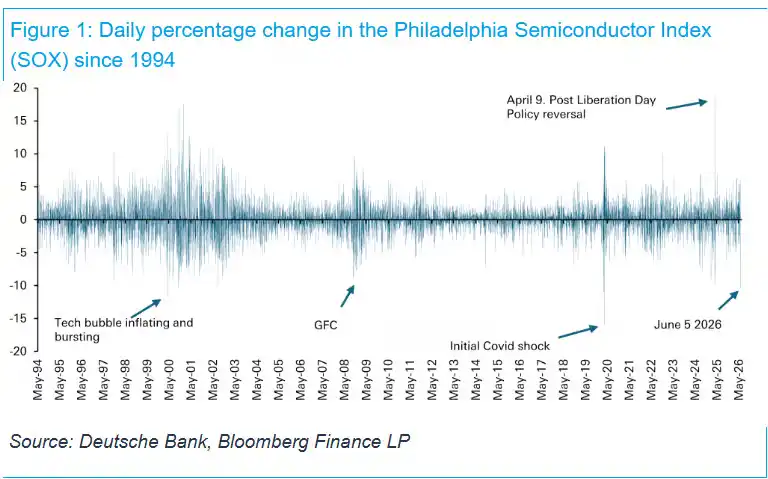
The Philadelphia Semiconductor Index plummeted over 10% last Friday, marking its largest single-day drop since March 2020 and the fourth-largest single-day decline since data records began in 1994. Strong U.S. employment data pushed bond yields higher, increasing market bets on the Fed's next move being a rate hike, further dampening risk appetite. (Related Reading: Seeking Alpha Hot Article: Why U.S. Stocks Might Crash in June?)
Savita Subramanian, Head of U.S. Equity & Quantitative Strategy at Bank of America, promptly released a report, stating "Too many danger signals, take profits," maintaining the year-end target for the S&P 500 at 7,100 points, implying approximately 6% downside from last Friday's close.

Despite this, Morgan Stanley strategist Mike Wilson maintains his forecast for the S&P 500 to reach 8,000 points by year-end, while a team led by Citigroup strategist Scott Chronert raised their year-end target price from 7,700 to 8,100 points. Both institutions cited strong corporate earnings growth and supportive macroeconomic data as their primary arguments.

These two diametrically opposed judgments leave investors facing a directional choice after the tech sell-off: whether to buy the dip or lock in profits before market volatility intensifies.

Bank of America: Bear Market Signals Triggered at 70%, Reaching Historical Peak Levels

The core basis for Bank of America's warning this time is the bank's quantitative signal system tracking bear market precursors. According to Subramanian's report, seven out of the ten monitored indicators have now been triggered — two new in May, five triggered in April, and four in March — reaching a trigger ratio of 70%, comparable to the average level before the seven S&P 500 market tops since 1990.
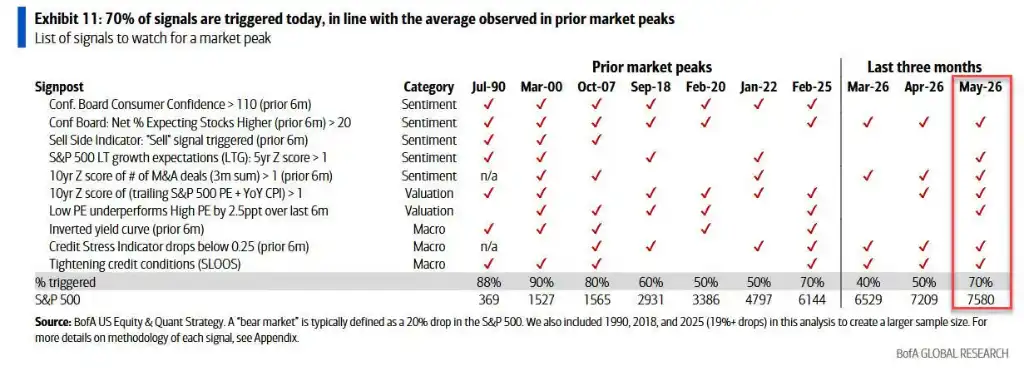
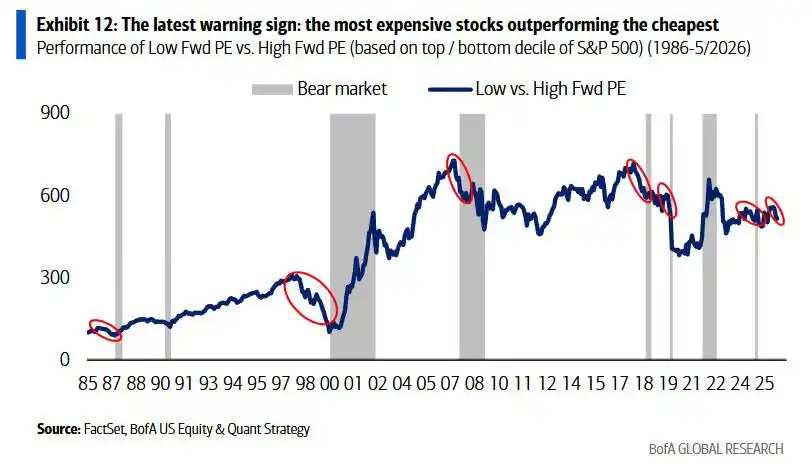
Two of the most recently triggered signals are particularly noteworthy: first, high-P/E stocks significantly outperforming low-P/E stocks, seen as a typical characteristic of excessive market speculation; second, overly high long-term growth expectations, with valuation levels entering a zone where stocks are highly sensitive to earnings disappointments.
Bank of America's sentiment model, the "Sell Side Indicator," has not officially triggered yet, but it showed significant deterioration in May, with market sentiment continuing to trend towards extreme optimism. Meanwhile, the yield curve has not yet inverted, but the spread between 2-year and 10-year Treasury yields has compressed to 39 basis points, its lowest level since the equivalent tariff period.

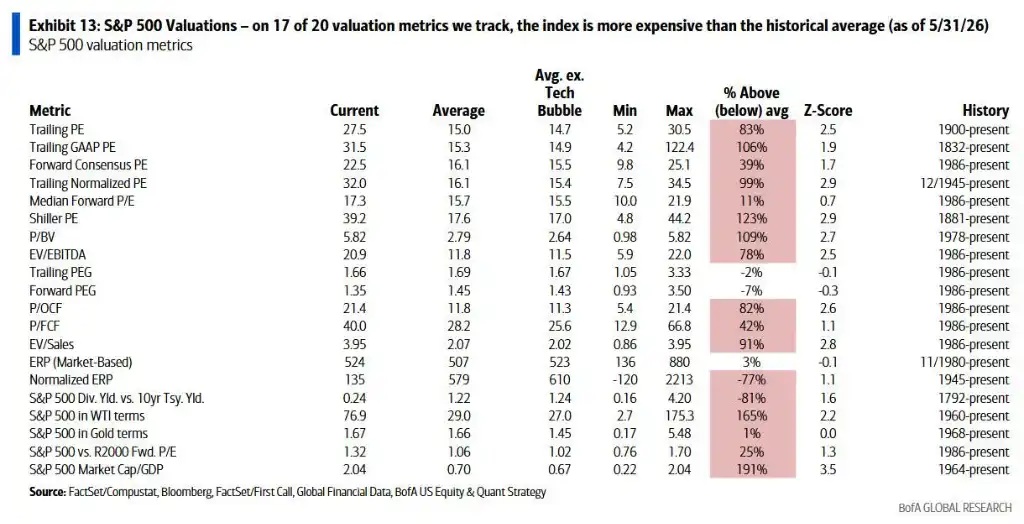
The report also points out that even from a pure valuation perspective, the S&P 500 is above its historical average in 17 out of the 20 metrics tracked by Bank of America, indicating overall index overvaluation risk.
Technology Sector Mirrors February 2000 Internet Bubble Peak

The most impactful assertion in Bank of America's warning is the direct comparison of the current technology sector's trajectory to that of February 2000—approximately one month before the peak of the dot-com bubble.

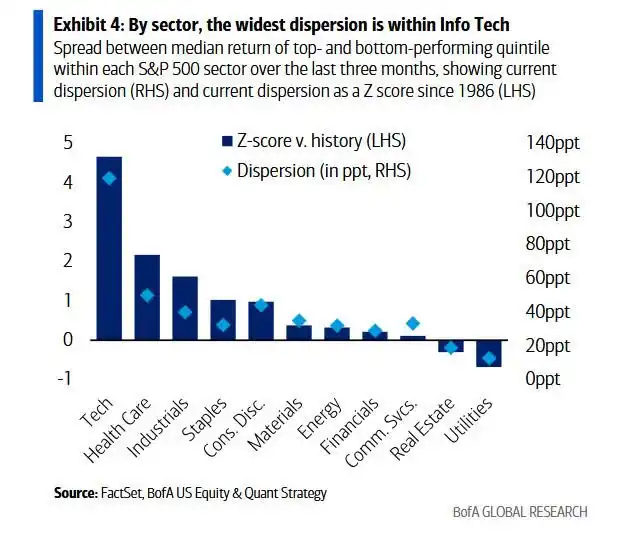
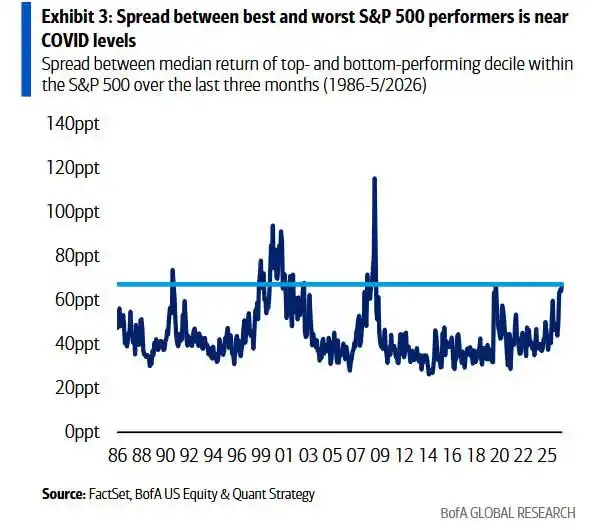
The most crucial metric cited in the report is the degree of internal sector dispersion: the median return gap between the best and worst quintile stocks within the technology sector has currently reached about 120 percentage points, the highest level since February 2000—at that time, this indicator reached about 130 percentage points before the market top on March 24, 2000.
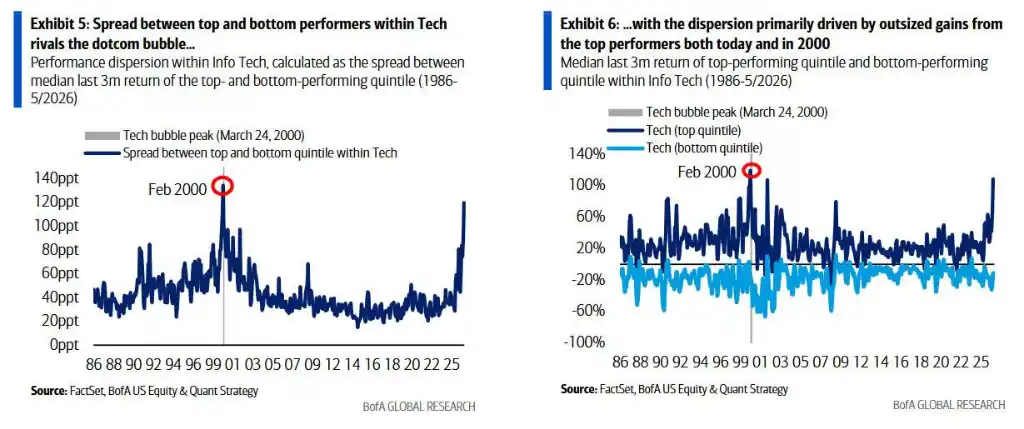
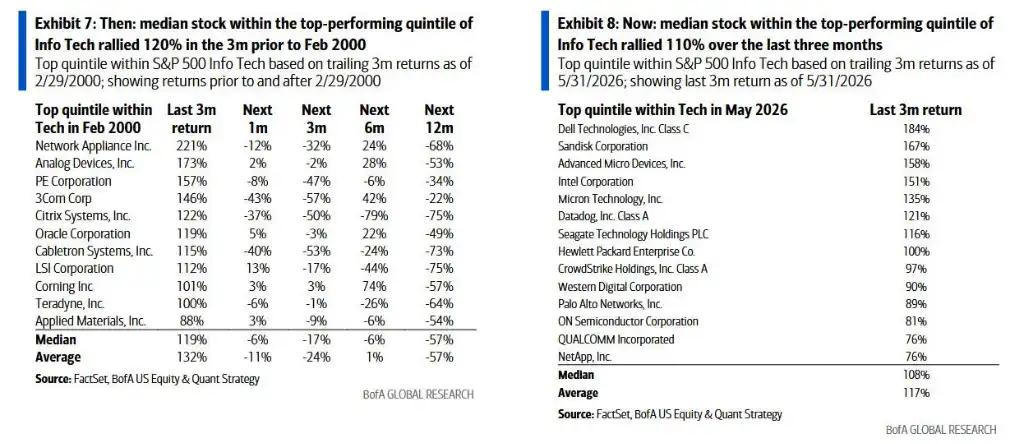
In terms of individual stock gains, within the best-performing quintile of the current tech sector, the median stock has risen about 110% over the past three months; during the internet bubble, similar stocks saw maximum gains of about 120% before the bubble burst.
Bank of America concludes that the current situation shares three highly similar characteristics with February 2000:

The energy sector ranks first in Bank of America's tactical sector model, combining momentum, earnings revisions, and valuation advantages; Information Technology and Communication Services tie for second place, with strong momentum and earnings revisions but elevated valuations; Consumer Staples rank last, identical to February 2000—and this sector performed most resiliently after the tech bubble burst, cumulatively outperforming the index by 73 percentage points from March 2000 to October 2002 when the S&P 500 bottomed.

Morgan Stanley, Citigroup Maintain Bullish Stance: Earnings Revision Breadth Hits Cycle High

Regarding the same market volatility, Morgan Stanley's Mike Wilson reached a completely different conclusion. In a research report released on Monday, he noted that the rapid rally of the S&P 500 from its March lows was inherently unsustainable, and this correction is "inevitable and ultimately beneficial for the bull market to extend through year-end."

Wilson attributes the core basis for his bullishness to earnings revision breadth: the S&P 500's earnings revision breadth has now reached 26%, a new high for this cycle.

On the macro front, the ISM Manufacturing PMI rose to 54 last week, the highest since 2022; the three-month average of private sector payroll growth improved to 166,000, the strongest since 2023. He believes that after the normalization of crowded semiconductor and memory stock holdings, cyclical sectors such as Consumer Discretionary, Transportation, and Regional Banks are expected to take over leadership.

Citigroup's Scott Chronert raised the S&P 500 year-end target from 7,700 to 8,100 points, citing a "significant jump in earnings expectations," implying 9.7% upside from last Friday's close.

Bank of America Acknowledges Tech Fundamentals Stronger Than Dot-Com Era, But Deterioration Trends Emerging

Bank of America does not completely negate the current fundamentals of the tech industry. The report points out that on multiple metrics including leverage, valuation, and capital intensity, the current health of the tech industry is superior to that during the dot-com bubble era.

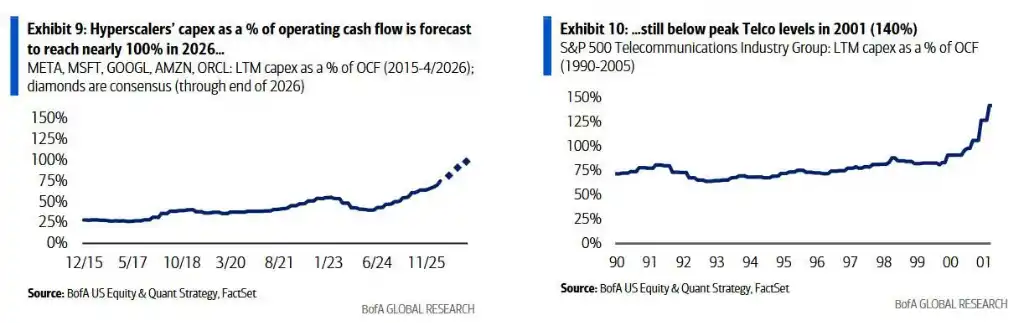
However, the report also documents several deteriorating trends emerging since the beginning of the year: cash flow conversion rates have plateaued, investment-grade bond and equity supply have increased, and the proportion of buybacks to market capitalization has slowed; the ratio of capital expenditure to operating cash flow for hyperscale cloud computing companies is expected to approach 100% by year-end, a significant increase from 40% in 2023. Although this figure remains below the 140% seen at the peak of the telecommunications industry in 2001, the pace of increase has drawn attention.
Subramanian wrote in the report that while the S&P 500 is up about 11% year-to-date, the market's overall gains have been primarily driven by earnings revisions, and the overall valuation multiple has actually compressed slightly from 22x forward P/E at the start of the year to 21x.

At the same time, sectors like Financials, Healthcare, and Consumer Discretionary have recorded negative returns year-to-date. The strong performance at the index level masks the fact that internal return dispersion has continued to climb to its highest level since the pandemic.
Related Questions

QAccording to Bank of America's warning, what percentage of their bear market precursor signals have been triggered, and what is this level comparable to?

AAccording to Bank of America's report, 70% of their tracked bear market precursor signals have been triggered. This level is comparable to the average seen before the seven S&P 500 market tops since 1990.

QWhat specific historical period does Bank of America compare the current tech sector's market behavior to, and why?

ABank of America compares the current tech sector's market behavior to February 2000, just about a month before the peak of the internet bubble. The key reason is the extreme internal dispersion within the sector, where the median return gap between the best and worst quintiles of stocks has reached about 120 percentage points, the highest level since February 2000.

QWhat are the core arguments presented by Morgan Stanley and Citigroup for maintaining a bullish outlook on the S&P 500?

AMorgan Stanley's core argument is strong earnings revision breadth, which has reached a cycle high of 26%. Citigroup raised its year-end target to 8100 points based on a 'significant leap in earnings expectations'. Both also cite robust corporate profit growth and supportive macro data.

QWhat are the two latest bear market signals triggered in May according to Bank of America's report?

AThe two latest signals triggered in May are: 1) High P/E stocks significantly outperforming low P/E stocks, a typical sign of excessive speculation. 2) Excessively high long-term growth expectations, pushing valuations into a zone where stocks are sensitive to earnings disappointment.

QHow does Bank of America assess the current fundamental health of the technology sector compared to the internet bubble era, and what concerning trends have emerged?

ABank of America acknowledges that the tech sector's fundamentals are healthier than during the internet bubble in areas like leverage, valuation, and capital intensity. However, they note deteriorating trends since the start of the year, including plateauing cash flow conversion, increased supply of investment-grade bonds and equities, slowing share buybacks, and a rapid rise in capital expenditure as a percentage of operating cash flow for hyperscale cloud companies.

Related Reads

7 Months After the Collapse of Huiwang, Southeast Asia's Escrow Platforms Undergo a Major Reshuffle

Following the collapse of Huione Pay—dubbed the "Alipay of Southeast Asia"—seven months ago, the region's underground financial guarantee platform sector is undergoing a significant reshuffle. This power vacuum has been swiftly filled by emerging platforms such as XinBi, Tiger/Navigator, JinBei (renamed JinBo), Dali/Tiancheng, and FullyLight. These platforms, operating largely via Telegram and offering services like escrow for illicit transactions, have absorbed the vast user base and markets left behind by Huione. While positioning themselves as "trust intermediaries," their primary clientele consists of networks involved in online scams, money laundering, illegal gambling, and even human trafficking. For instance, the Tiger/Navigator platform explicitly provides "escrow" services for kidnapping-for-ransom operations ("强押车交易"). Data underscores the immense scale: Huione alone processed over $103 billion in cryptocurrency payments and facilitated over $31 billion through its escrow market before its downfall, linking it to Cambodia's notorious Prince Group. Since its collapse, competitors have seen explosive growth. For example, the XinBi platform has accumulated over $1.6 billion in total USDT revenue, while platforms like NewPay, OkPay (under Dali), and FullyLight Wallet collectively processed over $4.8 billion in USDT in a single year. This ecosystem thrives in regions like Cambodia and Myanmar, where regulatory gaps allow these platforms to act as critical financial infrastructure for sprawling cybercrime industries, from scam compounds to online casinos. The article concludes that the moniker "Southeast Asian Alipay" is a misnomer, obscuring the platforms' fundamental role in enabling serious criminal enterprises rather than representing legitimate financial innovation.

Odaily星球日报59m ago

7 Months After the Collapse of Huiwang, Southeast Asia's Escrow Platforms Undergo a Major Reshuffle

Odaily星球日报59m ago

The Changing Landscape: What Are Crypto VCs Experiencing?

Title: The Shifting Landscape of Crypto Venture Capital The era of dedicated crypto venture capital funds is undergoing a significant transformation. Once essential for navigating the sector's complexity and high risk, these specialized funds are now facing an identity crisis as the market matures. This shift mirrors historical patterns in other specialized investment classes like cleantech and SPACs, where initial information advantages dissipate as technologies become mainstream and integrated into existing industry frameworks. The article argues that crypto is reaching a critical inflection point, transitioning from a "building phase" to an "integration phase." Major players like Stripe, BlackRock, and Visa now engage with crypto not for its novel mechanics but as a foundational financial infrastructure. Their needs—regulatory compliance, banking partnerships, distribution channels—align with traditional fintech, a domain easily understood by large, generalist funds like Sequoia and Founders Fund. This evolution creates a "barbell effect" within the VC landscape. On one end are massive, diversified platforms that can incorporate crypto as one vertical among many. On the other are small, nimble funds focused on niche, experimental projects. The middle ground—medium-sized dedicated crypto funds—is being squeezed out. Their typical fund size makes it impossible to generate sufficient returns solely from early-stage crypto bets, yet they cannot compete with giants for later-stage deals. Consequently, leading crypto-native firms like Paradigm and Framework Ventures are expanding into AI, robotics, and other sectors, driven partly by LP pressure for better returns amid a broader VC DPI crisis. Others, like Dragonfly and a16z, have narrowed their crypto focus predominantly to financial infrastructure like stablecoins, reframing the sector's core narrative. For crypto entrepreneurs, this consolidation presents challenges. While generalist funds offer larger checks and broader resources, crypto projects now compete fiercely with AI for attention and capital within these firms. Furthermore, the long-term, non-commercial foundational work that built the ecosystem—funded by dedicated crypto VCs—is less likely to attract generalist capital focused on direct returns. The conclusion is that "crypto investor" as a standalone category is becoming obsolete, akin to "internet investor." Crypto is becoming a baseline infrastructure layer. The future will see a barbell structure: large-scale growth financing handled by generalist funds, while pioneering, speculative projects are funded by small, specialized vehicles. The dedicated crypto funds of the 2017-2021 boom, which incubated core infrastructure, are giving way to this new, bifurcated reality.

Foresight News1h ago

The Changing Landscape: What Are Crypto VCs Experiencing?

Foresight News1h ago

As Consensus Accelerates, What Are Young Investors Betting On?

Title: As Consensus Forms Faster, What Are Young Investors Betting On? In the rapid evolution of tech investment, a new generation of young investors is navigating a landscape where AI, robotics, commercial aerospace, and quantum computing are advancing simultaneously. Traditional investment logic based on financial models is giving way to a need for deep technical understanding and the ability to act before industry consensus forms. An analysis of trends from the "WAIC FUTURE TECH" list of young investment leaders reveals key shifts in focus. The first major trend is the movement of AI from the digital screen into the physical world. Investment is shifting from large language models and chatbots towards embodied AI, robotics, AI hardware, and edge computing. While demonstrations generate excitement, the real challenge lies in achieving scalable, reliable, and cost-effective delivery in complex real-world environments like factories and logistics. Success depends not just on algorithms but on the integration of sensors, actuators, and control systems. Second, the competitive focus for large models is moving beyond raw capability toward building an "intelligence flywheel." The goal is to create self-reinforcing systems where user interaction generates data, improving the model, which in turn enhances the user experience and attracts more engagement. Companies that successfully embed AI into workflows to create these closed-loop systems can build lasting value that isn't easily erased by the next model upgrade. Third, facing a potential bottleneck in high-quality human-generated data, investors are looking at new underlying technologies. Reinforcement learning and self-play, as demonstrated by AlphaGo Zero, offer paths for AI to generate its own experience. Scientific foundation models, which aim to build general AI capabilities for fields like life sciences and materials discovery, represent a non-consensus direction that could unlock new frontiers of knowledge and data. Finally, in deep-tech areas like quantum computing, commercial aerospace, and space-based infrastructure, patient capital is essential. These fields have long, uncertain development and validation cycles involving complex engineering, supply chains, and regulations. Investment here requires a long-term view, focusing on foundational team capabilities and the eventual emergence of market demand, even if commercial returns are distant. Collectively, these trends illustrate how young investors are adapting to a new era. They are learning to make earlier, technically-informed judgments, balance hype with real-world viability, and provide the patient capital needed to build the deep-tech foundations of the future.

marsbit1h ago

As Consensus Accelerates, What Are Young Investors Betting On?

marsbit1h ago

Trading

Spot
活动图片





