Bear Market Financial Report Comparison: Pure Crypto Exchanges vs. Multi-Asset Platforms, Robinhood More Resilient Than Coinbase

marsbitPublished on 2026-05-14Last updated on 2026-05-14

Abstract

Bear Market Earnings Showcase the Resilience of Multi-Asset Platforms vs. Crypto-Only Exchanges Coinbase and Robinhood's recent earnings reports, both missing expectations and erasing $12 billion in market value, highlight a core vulnerability of exchange models in a crypto downturn: heavy reliance on transaction fees. Coinbase's Q1 revenue fell 31% to $1.41 billion, with a net loss of $394 million, driven by a 40% drop in transaction revenue as spot trading volumes plummeted. While its subscription and services segment (44% of revenue) offers some buffer, key components like stablecoin revenue remain tied to trading activity. In contrast, Robinhood reported a 15% revenue increase to $1.07 billion, with net income of $350 million. Although its crypto trading revenue fell 47%, this was offset by strong growth in other areas: prediction market revenue surged 320%, stock revenue grew 46%, and options revenue rose 8%. This diversification, with transaction revenue still at 58% of the total, made Robinhood more resilient. The analysis extends to platforms like Revolut, where payments and banking are central. In 2025, Revolut's revenue grew 45% to $6.1 billion, evenly spread across segments. Its wealth segment (including crypto, stocks, and CFDs) constituted just 15% of revenue, making it far less exposed to crypto market cycles than Coinbase or even Robinhood. The key takeaway is that platforms with diversified, non-correlated revenue streams—particularly through derivatives, ...

Author: Lex

Compiled by: Deep Tide TechFlow

Deep Tide Introduction: Coinbase and Robinhood both reported earnings below expectations last week, erasing $12 billion in market value. This exposes a fundamental issue with the exchange model: how to survive in a bear market when revenue is highly dependent on trading fees? Platforms like Revolut, which are payment-centric, are almost unaffected, with trading income accounting for only 15% of their revenue. This comparison reveals the underlying logic of competition among fintech platforms.

Cryptocurrency is in the depths of a bear market.

Bitcoin hovers around $80,000, down approximately 36% from its peak of $126,000 in October 2025. Spot trading volume on centralized exchanges has fallen to its lowest level since September 2019, down 44% year-over-year in the first quarter according to Coinbase data.
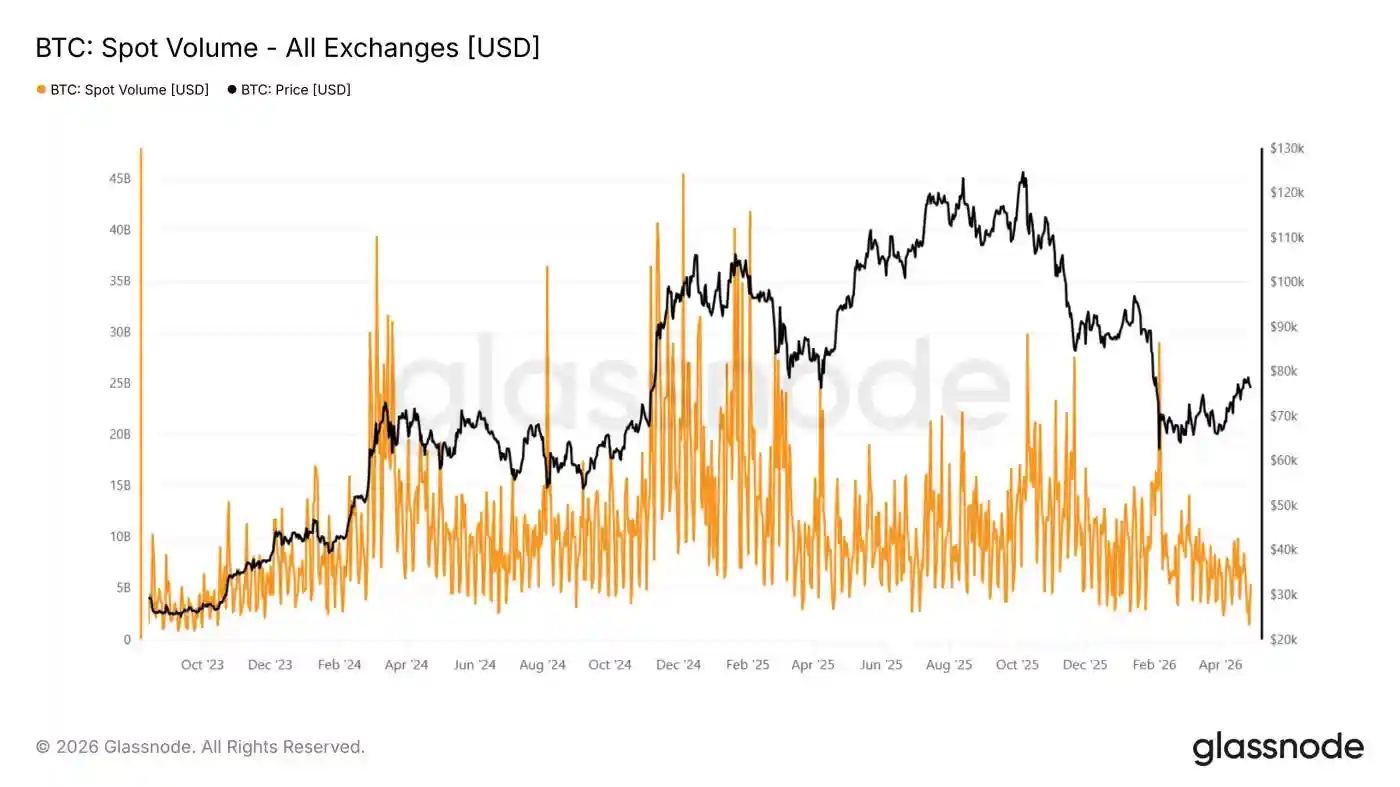
Some on-chain analysts believe the recent rebound from $60,000 may lack sustained momentum. This has been the longest bear market rally of the past two cycles, but it appears more technically than fundamentally driven. Open interest in derivatives (perpetual contracts) has risen, but spot activity is low, suggesting the rise is driven more by short liquidations and speculative position unwinding than persistent buying.

Decreased trading activity is eroding platform revenue. Coinbase's revenue fell 31% year-over-year to $1.41 billion, with a net loss of $394 million, compared to a profit of $66 million in the same period last year. Management also announced layoffs of 700 employees (about 14% of its workforce) the same week, citing both crypto cyclicality and a cost "reset for the AI era."
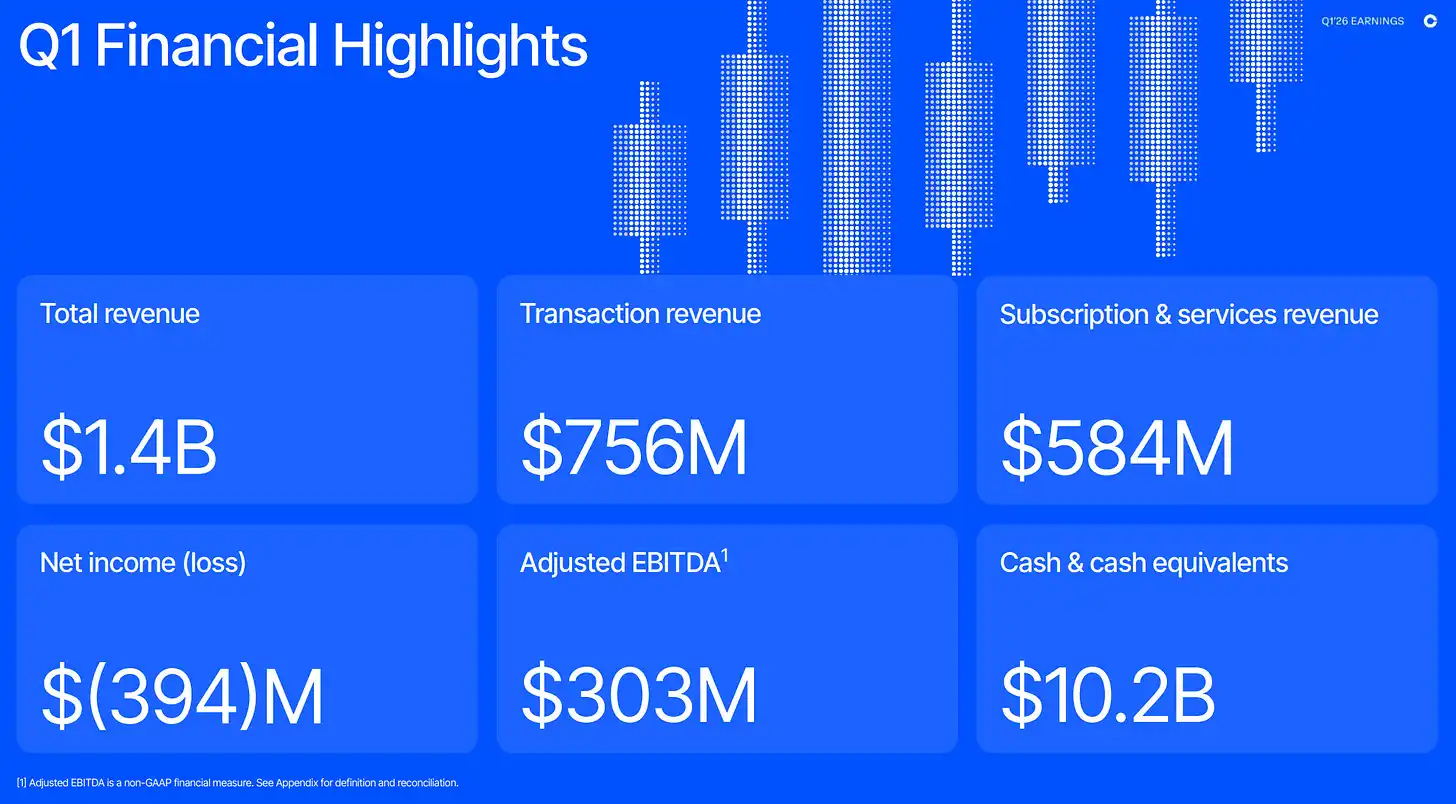
Trading business is at the center of the decline.

Transaction revenue accounted for 56% of total revenue in Q1, down 40% year-over-year. Consumer transaction revenue fell 48% to $567 million. Institutional transaction revenue actually grew during this period, but this was almost entirely due to the $4.3 billion acquisition of Deribit completed in August 2025; organic institutional trading volume actually fell 48%.
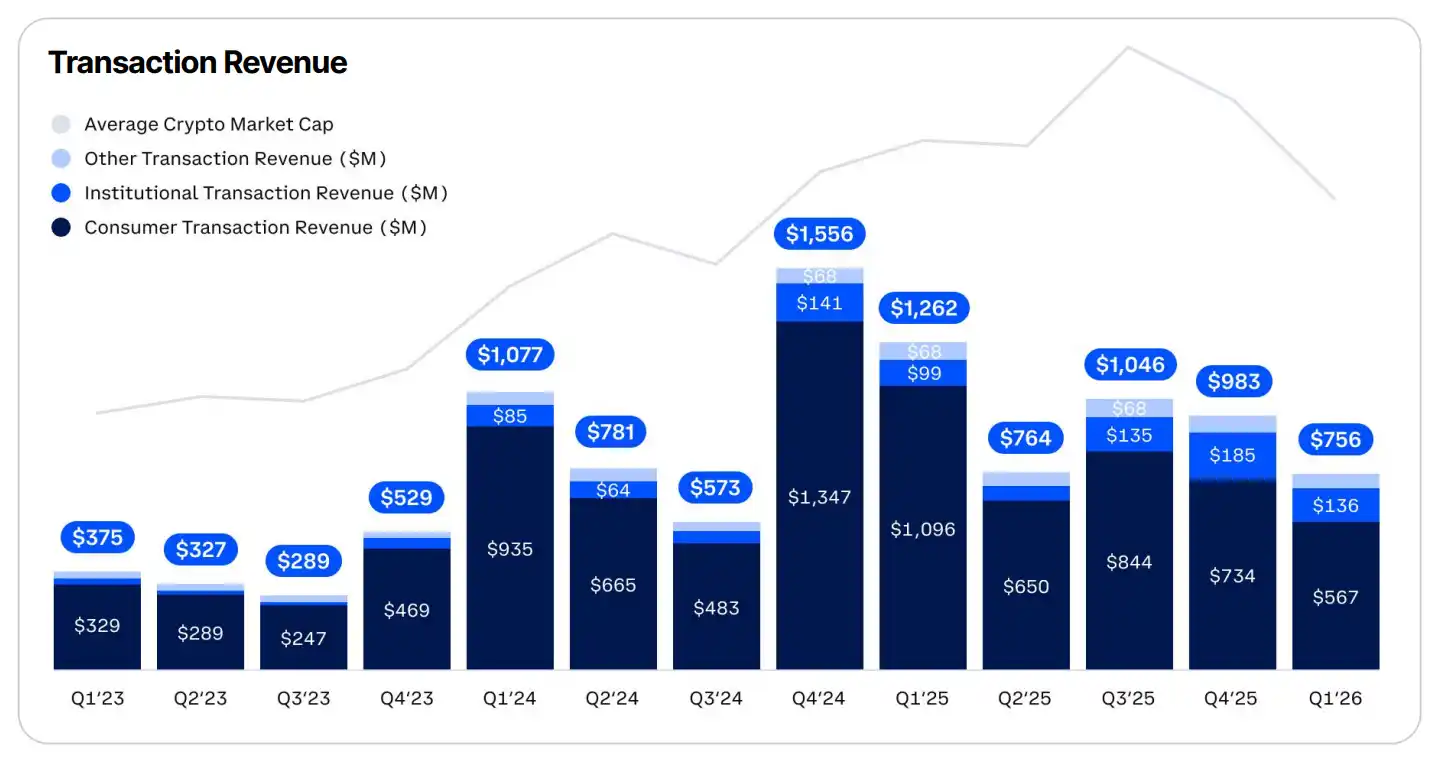
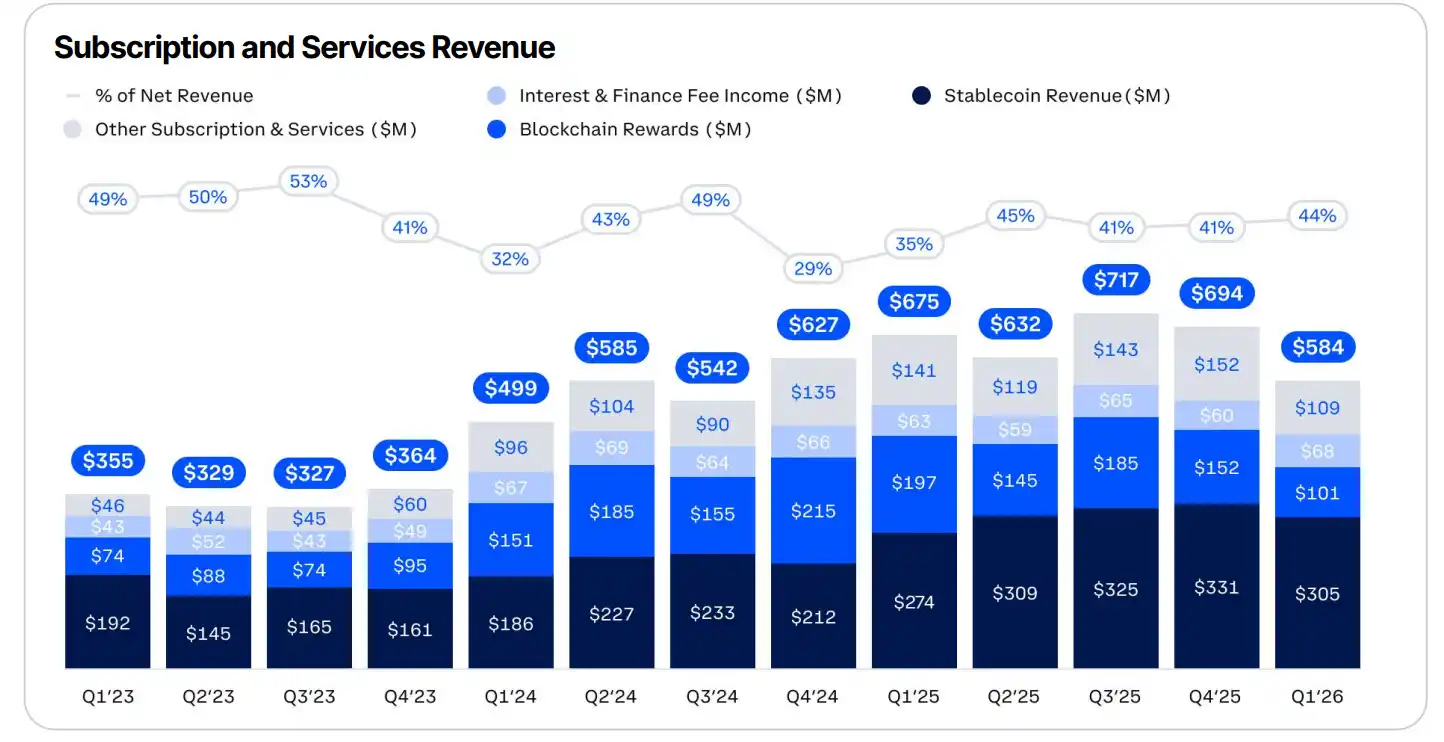
The remaining revenue comes from subscriptions and services, distributed across stablecoin revenue (interest earned from customer USDC balances via Coinbase's partnership with Circle), blockchain rewards, interest and financing fees, and other subscription products like Coinbase One.

This segment now accounts for 44% of total revenue, which management positions as a "durable buffer" against trading volatility. But this is somewhat misleading. Stablecoin revenue is the largest single item, accounting for 22% of net revenue, up 11% year-over-year, but it is also highly correlated with trading volume. Customers move into USDC to avoid volatility or rotate between assets, but reconfigure back into volatile assets once the market turns. This dynamic partly explains why the proportion of subscription and service revenue to total revenue has looked fairly steady over the past 3 years.
Meanwhile, Robinhood reported stronger numbers.

Revenue increased 15% year-over-year to $1.07 billion, with net profit of $350 million, but still missed analysts' revenue expectations. Like Coinbase, the miss was driven by crypto, with related transaction revenue falling 47% year-over-year to $134 million. Notably, this was the only major revenue line item to decline year-over-year.
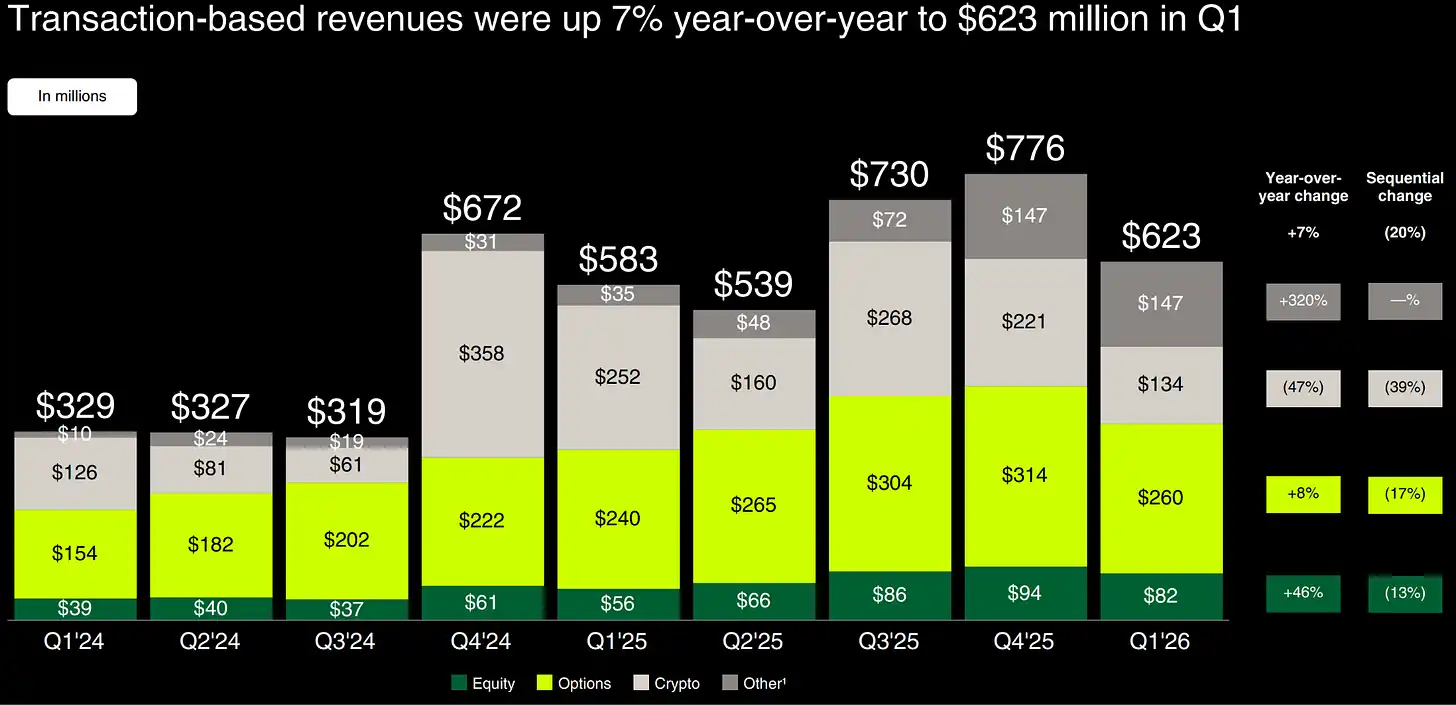
Trading still accounts for 58% of Robinhood's revenue, basically flat from a year ago. But due to the diversity of tradable asset classes, the company has performed better throughout the bear market. Total transaction revenue grew 7% year-over-year to $623 million, driven by a 320% surge in prediction market revenue via Robinhood's partnership with Kalshi, a 46% increase in stock revenue, and 8% growth in options.
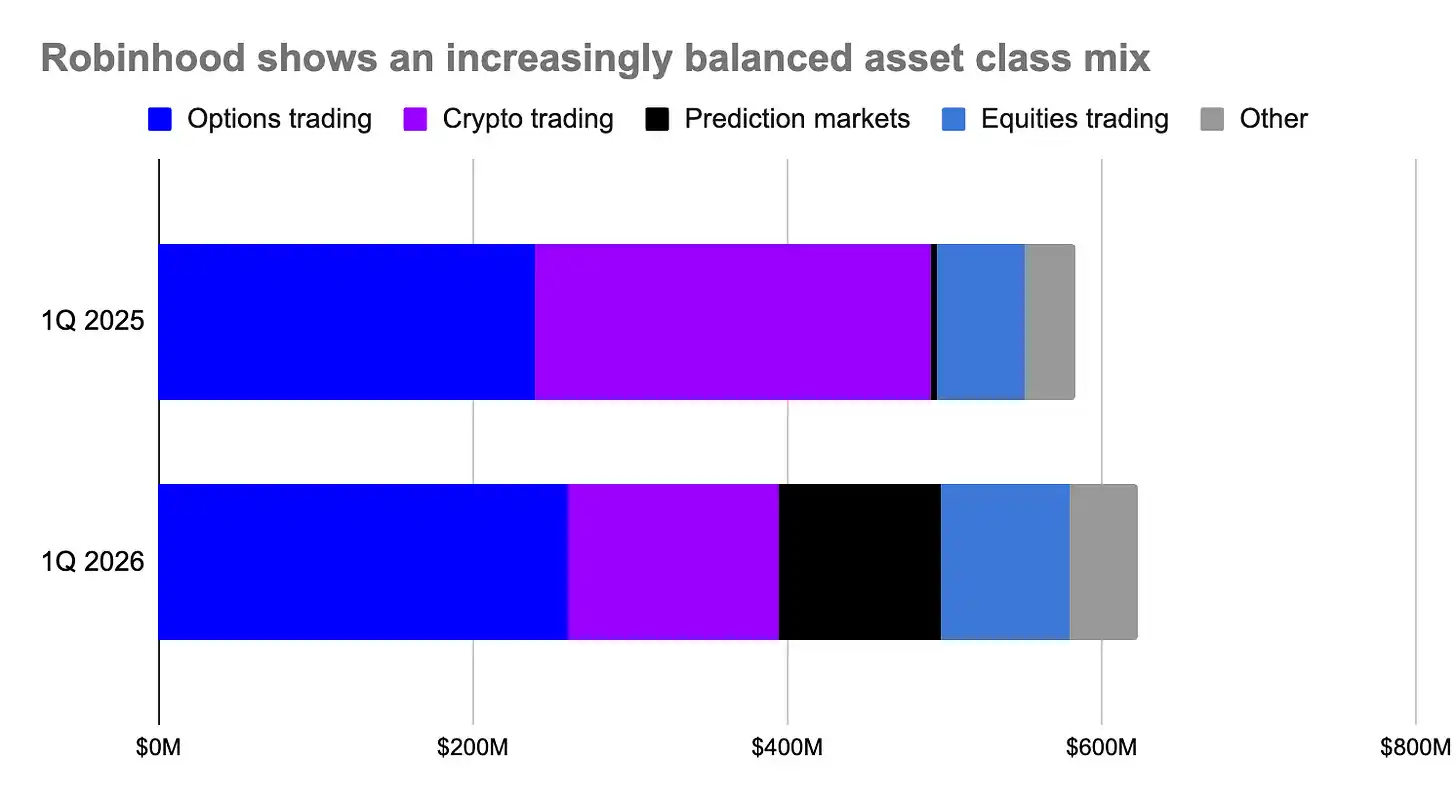
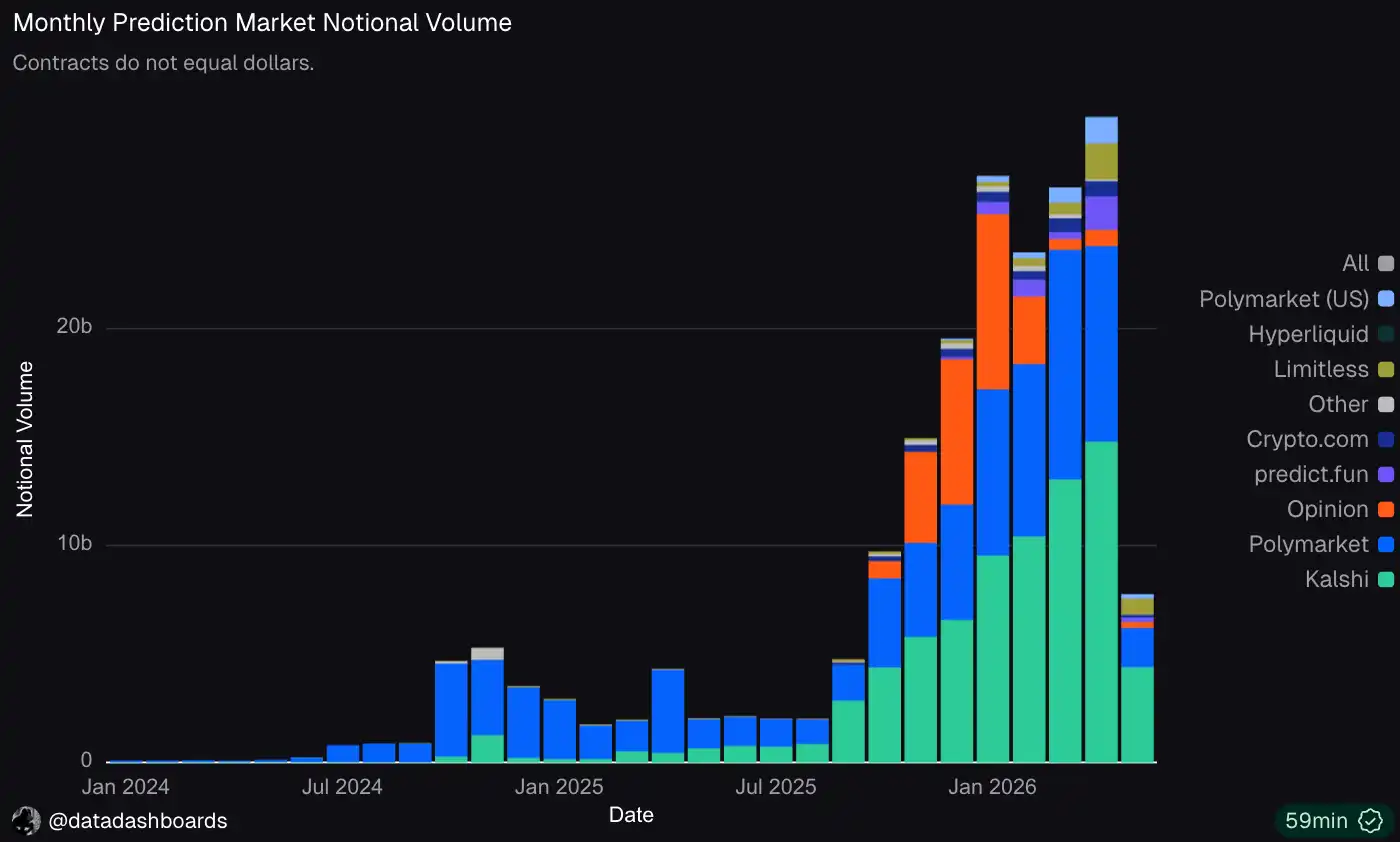
Derivatives like prediction markets and perpetual contracts have shown more resilience during downturns. Kalshi raised $1 billion last week at a $22 billion valuation, doubling its valuation in just 6 months and tripling its annualized trading volume to $178 billion.

Event-driven trading, like predictions, often focuses on sports, elections, and economic data, making it less sensitive to the broader market. But growth also stems from institutions starting to use it as a hedging tool during market volatility. There is an organic adoption tailwind masking the cyclicality.
Perpetual contracts show a similar pattern. As of the end of April, the total value of leveraged positions by traders on Hyperliquid (measured as "open interest") was $4.3 billion, having grown 9% over the past two months despite the general collapse in spot markets. While this metric is still down from the October peak, it is clearly performing better.

This is significant for trading platforms that have these features.

Prediction markets now account for 17% of Robinhood's total transaction revenue!

While it doesn't directly offer perpetual contracts, it does offer similar margin trading on stocks and crypto, and earns interest from it. In Q1 2026, margin interest revenue grew 75% year-over-year to $193 million, accounting for 18% of total revenue.

Coinbase is a latecomer to this shift. While it launched prediction markets and perpetual contracts for retail customers in January 2026, it hasn't yet had a material impact on its P&L. Consequently, the exchange has greater exposure to spot trading.

Fintech platforms centered on payments and banking, but with significant trading activity like Revolut, are much less affected. Revenue grew strongly by 45% to $6.1 billion in 2025, with a balanced distribution across major revenue streams, each accounting for 13-22% of total revenue.

Card interchange fees and interest income are the two largest items, each around $1.3 billion. Crypto trading, along with stocks and CFDs, falls under the Wealth segment, accounting for 15% of total revenue—a fraction of Robinhood's exposure and a sliver of Coinbase's.
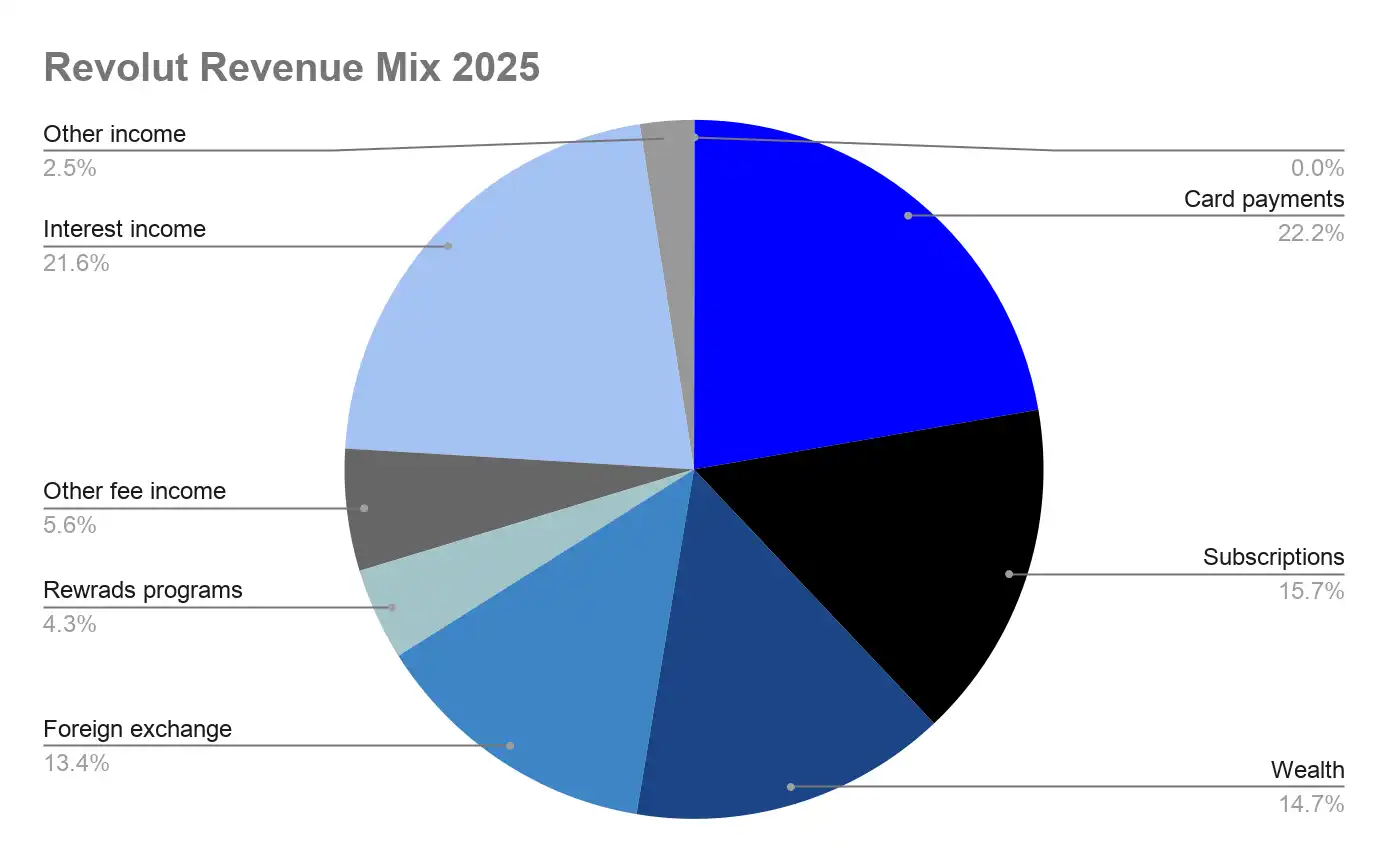
Notably, Revolut's interest income is similar to Coinbase's stablecoin revenue, both monetizing idle customer balances. As of year-end, Revolut held 90% of its $68 billion customer balance in cash and treasury investments. But the behavior driving these balances is fundamentally different. Revolut's deposits grow with primary banking relationships and direct deposit growth (up 45% year-over-year), while Coinbase's USDC balances grow as willingness to trade declines. If the crypto market turns more bullish, Coinbase is more likely to see balances decline.

The challenge for trading-first platforms like Coinbase and Robinhood is whether they can meaningfully expand into adjacent financial products while being tightly linked to market cycles. Robinhood has shown that diversity in tradable asset classes, especially prediction markets and derivatives, can act as a hedge.

Coinbase is moving in a similar direction. The risk is that a prolonged bear market hinders their growth ability, while fintech competitors like Revolut, Nubank, and Cash App take a greater share of customer deposits.


Related Questions

QAccording to the article, why did Coinbase's revenue decline in the last quarter, and what was the main driver?

ACoinbase's revenue declined 31% year-over-year to $1.41 billion, primarily driven by a 40% drop in transaction revenue. This was due to decreased trading activity in the crypto bear market, with consumer transaction revenue specifically falling 48%.

QHow did Robinhood's performance in the recent quarter differ from Coinbase's, especially regarding revenue sources?

ARobinhood's revenue grew 15% year-over-year to $1.07 billion, while Coinbase's fell. A key difference was the diversity of Robinhood's revenue streams. Although its crypto transaction revenue dropped 47%, this was offset by significant growth in prediction markets (up 320%), stock trading (up 46%), and options trading (up 8%).

QWhat is the fundamental business model challenge highlighted for trading-first platforms like Coinbase and Robinhood during a bear market?

AThe fundamental challenge is their heavy reliance on transaction fees, which are highly cyclical and tied directly to market trading volumes. During a prolonged bear market with low activity, their core revenue stream suffers significantly, raising questions about sustainability and growth.

QWhy is a platform like Revolut less affected by the crypto bear market compared to Coinbase or Robinhood, based on the article?

ARevolut is less affected because its business model is centered on payments and banking, not trading. Crypto trading is part of its 'Wealth' segment, which constitutes only about 15% of its total revenue. Its largest revenue streams are card interchange fees and interest income, which are more stable and less tied to crypto market cycles.

QWhat new product areas does the article suggest are more resilient during market downturns, and which company has benefited from this?

AThe article suggests that derivatives and event-driven trading products like prediction markets are more resilient during downturns. Robinhood has significantly benefited from this through its partnership with Kalshi (prediction markets), which now represents 17% of its total transaction revenue and saw a 320% year-over-year increase.

Related Reads

STRC Breaks Below $95: Why Does It Continue to Depeg? Is There Default Risk?

"STRC Falls Below $95: Why the Persistent Depegging and Is There Default Risk?" The article discusses the recent decline in the price of STRC, a perpetual preferred stock issued by Strategy (MSTR) designed to trade around a $100 par value. As of publication, STRC traded at $94.65, raising market concerns. STRC is described as a high-yield cash flow product, offering an 11.50% annual dividend paid monthly. Its "preferred" status grants it priority over common stock for dividends and in liquidation. Key reasons cited for the price depegging include: 1. **Bitcoin's Price Drop:** MSTR's assets are heavily tied to Bitcoin (BTC), which fell over 21% from its recent high, pressuring all Strategy-related products. 2. **Competitive Pressure:** Rival Strive Asset Management's similar product, SATA, offers daily dividends and has maintained its $100 par value with a ~13% yield. In response, Strategy has proposed changing STRC's dividend frequency from monthly to bi-weekly, pending shareholder vote. 3. **Technical Selling:** A break below $100 may have triggered algorithmic selling and stop-losses, exacerbating the decline. Regarding default risk, the analysis suggests it is currently low. Strategy founder Michael Saylor confirmed the June 2026 dividend rate remains at 11.50% with no cuts or suspensions. The company's massive reserve of 843,706 BTC provides a significant backstop for its obligations. Industry opinions are mixed. Some analysts view the BTC holdings as reliable support for dividends, while critics like Peter Schiff warn of potential dividend cuts leading to price crashes and lawsuits. Others highlight inflation risk and the company's ability to reduce dividends without a formal default. In summary, STRC's drop is attributed to BTC volatility, competition, and technical factors. While immediate default risk appears contained, the product faces challenges from market conditions and competitive dynamics.

marsbit50m ago

STRC Breaks Below $95: Why Does It Continue to Depeg? Is There Default Risk?

marsbit50m ago

AI Trading Cools, South Korean Stocks Plunge 1.8%, Spot Gold Rises 1%, Bitcoin Dives

A sell-off in AI-related stocks, triggered by Broadcom's disappointing earnings forecast, sent shockwaves through global markets. South Korea's KOSPI led Asia's decline, plunging 1.8% as the risks from concentrated chip stock gains and surging leveraged investments came to the fore. The tech-heavy Nasdaq 100 futures fell 0.5% following Broadcom's 14% after-hours plunge, which signaled a slower-than-expected transition to AI clients. This pullback extended Wall Street's weakness, halting the S&P 500's nine-day rally amid hawkish Fed signals and renewed Middle East tensions. South Korean authorities convened an emergency meeting, pledging "immediate measures" against market volatility and warning of record-high stock margin debt. The adjustment rippled across assets: Bitcoin fell to around $64,000, its lowest since February, while safe-haven gold rose 1% on bargain hunting. Oil prices dipped on Middle East ceasefire news. Market analysts noted the sell-off was driven by profit-taking after massive gains, particularly in chip stocks like Samsung and SK Hynix, which now dominate the KOSPI. Wall Street banks are divided on Korea's outlook, with Goldman Sachs raising its target while Citigroup and others warn of overvaluation and a potential bubble. Bridgewater's Ray Dalio noted that great technological shifts often create bubbles. Meanwhile, Fed officials' hints at potential future rate hikes added to the cautious mood ahead of key U.S. jobs data.

华尔街日报1h ago

AI Trading Cools, South Korean Stocks Plunge 1.8%, Spot Gold Rises 1%, Bitcoin Dives

华尔街日报1h ago

Trading

Spot
Futures
活动图片




