Base MCP, The Next Step for x402

marsbitPublished on 2026-05-28Last updated on 2026-05-28

Abstract

Base has officially launched Base MCP, allowing users to connect their Base Account to AI Agents to perform actions like swaps, transfers, portfolio tracking, and transaction history queries through conversational commands. This move aligns with Base's strategic focus on AI, driven by the broader competition in the emerging Agent-to-Agent payment sector. The evolution of Agent payments has accelerated. In late 2024, the primary method involved insecure browser automation. By 2025, solutions like Coinbase's x402 (providing crypto wallets for Agents), Google's AP2, and Visa's token-based system emerged. x402 has since processed 176 million transactions totaling over $70 million, with a median value between $0.01 and $0.10. Stablecoins, particularly USDC, dominate these settlements due to their negligible transaction costs compared to traditional payment fees, which are prohibitive for micro-payments. Coinbase faces competition from Stripe, which has built a comparable infrastructure for Agent payments with its Tempo blockchain, Privy wallets, Bridge routing (acquired for $1.1B), and the recently launched MPP protocol. Both companies are now competing at the application layer. The core reason AI is central to Base's strategy is to expand the scenarios for Agent payments, ensuring more transactions occur on its network. By securing a dominant position and scale advantage in this nascent field, Coinbase aims to capture the future commercial potential of Agent-driven payments. T...

Yesterday, Base officially launched Base MCP. By connecting Base Account to AI Agent through Base MCP, you can use colloquial language, like chatting, to have the Agent perform operations such as Swap, transfers, position tracking, and transaction history queries.

Players familiar with Base know that the main focus on the Base chain right now is AI, so such an update from Base doesn't come as a surprise. Some players even anticipate new gameplay on the Base chain, similar to the AI meme coin $SHIT on Ethereum before, where they could directly use Base MCP to let an Agent participate in chain-based token launches through chat.

But if we step back from the perspective of a chain degen and look at the competition in Agent-to-Agent payments, we might find a new answer as to why AI has become the main focus for Base.

Rapidly Developing Agent Payments

Let's rewind to September 2024. Back then, if you wanted an AI Agent to complete a payment for something, humans basically had only one choice: use browser automation tools (like headless browsers such as Playwright, Selenium) to let the AI Agent simulate human actions and complete the checkout process on a webpage.

Since this required providing payment credentials (like full credit/debit card numbers, CVV, expiration dates, etc.) to the AI Agent, this sole option was not secure.

By May 2025, Coinbase launched x402, providing an AI Agent with a crypto wallet and solving this problem in a crypto-native way. But Coinbase wasn't the only one to recognize this as a potential market, and the solutions weren't limited to just crypto-native ones. In 2025, Google launched AP2, allowing users to authorize spending permissions to an Agent. Visa expanded its existing card payment channels, launching Visa Intelligent Commerce, which doesn't give the Agent sensitive information like credit card numbers or CVV, but instead provides the Agent with specific, limited tokens to complete payments.

Today, x402 has processed 176 million transactions from AI Agents, with a total transaction volume exceeding $70 million. This amount might not seem huge, but neither Coinbase nor the traditional giants are taking this emerging payment competition lightly:

- On January 22, 2026, Capital One, the sixth-largest bank in the US with $470 billion in assets, $330 billion in deposits, and the third-largest credit card issuer in the nation, announced the acquisition of Brex for $5.15 billion to enhance AI payment capabilities.

- In March 2026, Mastercard acquired the stablecoin infrastructure company BVNK for $1.8 billion.

- In February 2025, Stripe acquired the stablecoin payment platform Bridge for $1.1 billion.

While they haven't explicitly stated it, acquiring stablecoin-related companies is likely a move to prepare for the upcoming era of Agent payments. Stablecoins are indeed crucial for Agent payments.

Why Are Stablecoins Important for Agent Payments?

According to data statistics from Keyrock, the median transaction amount for Agent transactions processed on x402 so far is between $0.01 and $0.10, with 76% of transactions being under $0.30.
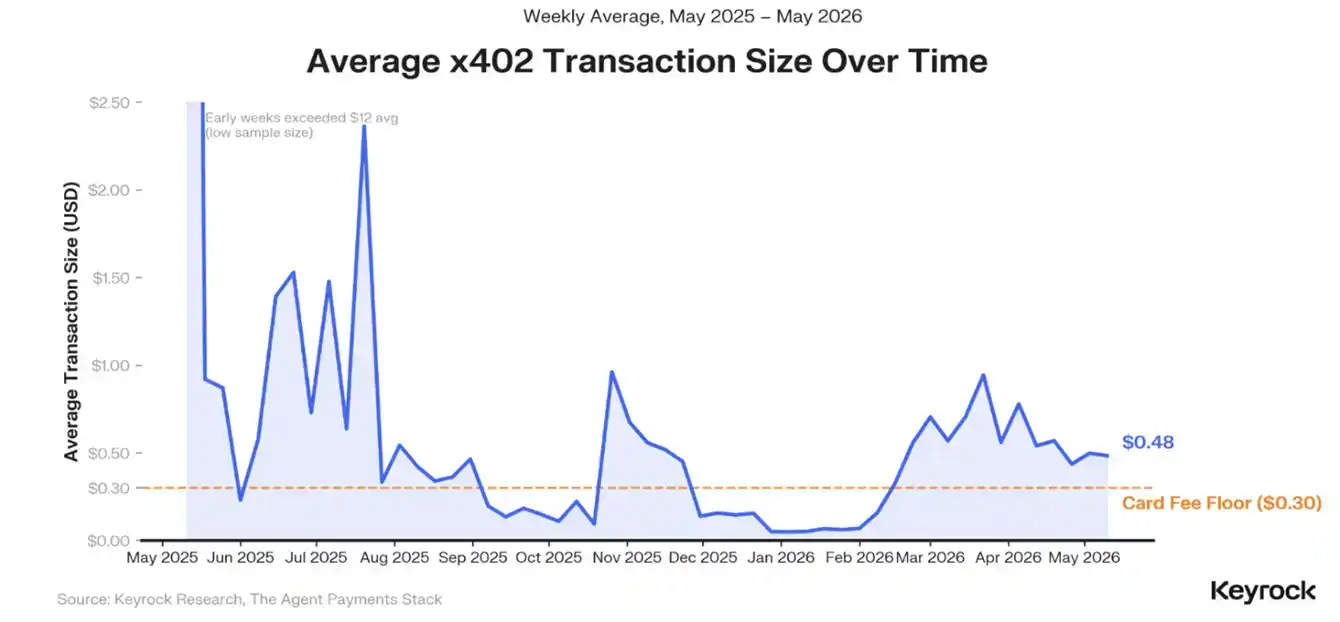
$0.30 is the most common flat fee per transaction in the US and many major markets. This fee is like a wall, making micropayments under $1 very uneconomical. For example, for a 3-cent API call, a $0.30 fee is 10 times the call cost; if an Agent pays with a credit card, the cumulative cost would be prohibitively high.

Blockchain solves this problem well. On Base, the transaction settlement cost is $0.0001. With this immense advantage, stablecoins have almost naturally won the competition against traditional payment giants in the realm of Agent payments.

Of the 176 million Agent transactions processed by x402, 98.6% were settled in USDC. Given the close relationship between Coinbase and Circle, it's fair to say Coinbase is also a big winner at the settlement layer.

But the settlement layer is just one layer in Agent payments. In the track of solving Agent payments via crypto-native means, Coinbase has a competitor—Stripe.

The Challenge from Stripe

This March, Stripe launched the Agent Payment Protocol MPP, which has brought Stripe's architecture map for Agent payments almost on par with Coinbase's.

- From the settlement layer: Coinbase has Base, Stripe has Tempo.

- From the wallet layer: Coinbase has Agent Wallet, Stripe has Privy.

- From the routing layer: Coinbase has built-in routing facilities, Stripe has Bridge, acquired for $1.1 billion.

- From the payment protocol: Coinbase has x402, Stripe has MPP.

Now let's return to the Base MCP mentioned at the beginning of the article. Since both competing sides now have these four layers of supporting infrastructure, the next battlefront is naturally the application layer.

This is the core reason why AI can become Base's main focus—Base needs to ensure that AI (at least in the cryptocurrency space) happens on Base. This is not actually about providing a perspective for degens on the Base chain, but about broadening the scenarios for Agent payments, enabling more Agents to conduct more transactions for more applications, thereby securing its leading position in the Agent payment track.

Once a dominant scale advantage is established, when Agent payments enter the commercial domain in the future, Coinbase stands to win even bigger.

Looking at the launch of Base MCP from this angle, one can sense that this is just a small step in Coinbase's grand ambition.


Related Questions

QWhat is Base MCP and what key functionality does it enable for AI Agents?

ABase MCP is a protocol recently launched by Base. It allows users to connect their Base Account to an AI Agent. Once connected, users can use natural, conversational language to instruct the Agent to perform actions such as executing token swaps, making transfers, tracking portfolio positions, and querying transaction history.

QAccording to the article, why are stablecoins considered crucial for Agent payments?

AStablecoins are crucial for Agent payments because they enable micro-transactions economically. Traditional payment methods often have fixed fees around $0.30 per transaction, which makes small payments (e.g., a few cents for an API call) prohibitively expensive. In contrast, settlement costs on Base are around $0.0001, allowing stablecoins like USDC to facilitate vast numbers of small-value transactions efficiently, as evidenced by 98.6% of x402 transactions being settled in USDC.

QHow does the article contrast Coinbase's and Stripe's approaches to the Agent payment infrastructure?

AThe article contrasts their approaches by outlining the similar four-layer infrastructure both companies have built: Settlement Layer (Coinbase has Base, Stripe has Tempo), Wallet Layer (Coinbase has Agent Wallet, Stripe has Privy), Routing Layer (Coinbase has internal routing, Stripe acquired Bridge), and Payment Protocol Layer (Coinbase has x402, Stripe has MPP). This positions them as direct competitors in the Agent payment space.

QWhat strategic reason does the article suggest is behind Base making AI its main narrative?

AThe article suggests that Base's strategic focus on AI is not primarily for on-chain 'degen' activities but to expand the scenarios for Agent payments. By ensuring more AI activity (at least in the crypto space) happens on Base, Coinbase aims to generate more Agent-driven transactions across more applications. This builds a dominant scale advantage, securing Coinbase's leading position in the emerging Agent payment competition for future commercial applications.

QWhat does the median transaction amount on x402 indicate about the nature of Agent payments?

AThe median transaction amount on x402 falls between $0.01 and $0.10, with 76% of transactions being under $0.30. This data indicates that Agent payments are predominantly micro-transactions, involving very small sums of money per transaction.

Related Reads

Goldman Sachs Research Report Analysis: Chip Shortage to Persist Until 2028, Maintain Buy Recommendations

Goldman Sachs Research Report Summary: Memory Shortage Until 2028, Maintain Buy Recommendations Goldman Sachs' latest Asia-Pacific equities report, "The 720," forecasts a sustained memory chip upcycle extending into 2028, driven by strong AI server demand visibility, limited supply growth, and binding long-term agreements. The firm believes the market significantly underestimates the cycle's duration, as evidenced by low P/E ratios for memory stocks. Key sector calls include raising 12-month price targets for Samsung Electronics and SK Hynix, and upgrading Kioxia from Hold to Buy, citing higher and more sustainable peak profits over the next 2-3 years. The report also highlights the broader AI hardware supply chain benefiting from hyperscaler capex acceleration. Recommendations include: * MediaTek (Buy) for its data center/ASIC pivot. * Eoptolink (Buy) on 1.6T optical module ramp-up. * Biren (Buy) for its AI chip migration. * Huaqin (Buy, newly covered) for its shift from consumer electronics ODM to AI data centers. * Lenovo (Buy) on the AI PC refresh cycle. Other notable mentions include China property developers (under an optimistic scenario), BYD for its affordable city NOA strategy, and select Japanese semiconductor equipment makers. A macro theme notes the divergence between AI-boom beneficiaries (e.g., Korea, Taiwan) and energy-importing economies facing inflationary pressure. The report concludes with standard disclaimers, noting that price targets are forward-looking estimates and that sell-side research has an inherent bullish bias. The core investment thesis hinges on the longevity of the memory upcycle and the AI-driven capex wave.

marsbit18m ago

Goldman Sachs Research Report Analysis: Chip Shortage to Persist Until 2028, Maintain Buy Recommendations

marsbit18m ago

A Detailed Look at Cathie Wood's Masterful Moves on Circle

Title: A Detailed Look at Cathie Wood's Masterful Moves on Circle ARK Invest's Cathie Wood executed a textbook investment strategy on Circle (CRCL), showcasing how a long-term investor can capitalize on short-term volatility. Key to her success was securing 4.49 million shares at the $31 IPO price before the public offering, leveraging pre-IPO access unavailable to most investors. The stock debuted at $69, fueled by extreme demand against a limited float of only 15% of total shares. Wood then began systematically selling as the price soared, driven by policy optimism like the GENIUS Act, which pushed shares to nearly $299. She sold approximately 1.7 million shares across four transactions at an average price around $210, partly triggered by ARK's internal rule to rebalance when a single stock's weight exceeds 10%. Following a steep decline due to lock-up expirations, increased supply, and interest rate concerns, Circle fell over 80% from its peak. Wood started buying back shares around $82-$86 after a strong Q3 earnings report ironically caused a price drop in November 2025. She continued buying on the way down, eventually rebuilding her position to roughly 4.5 million shares by Q1 2026. The core lessons from Wood's play are: 1) A firm, independent conviction in Circle's long-term narrative as a digital dollar infrastructure player. 2) Executing in phases—selling into strength and buying into weakness—without attempting to time exact tops or bottoms. 3) Strict adherence to position-sizing and rebalancing rules, which forced profit-taking at highs and created capacity to buy at lows. For most investors, chasing the volatile post-IPO "pop" is risky; Wood's success was built on pre-IPO access, deep research, and disciplined execution.

marsbit21m ago

A Detailed Look at Cathie Wood's Masterful Moves on Circle

marsbit21m ago

Morning Post | Michael Saylor Releases Bitcoin Tracker Info; Aave Publishes Kelp rsETH Bridge Attack Post-Incident Investigation; Gravity Bridge Announces Service Suspension Following Attack

ChainCatcher Daily Summary - June 1, 2026 In regulatory news, the U.S. OCC granted preliminary conditional approval for Laser Digital to establish a federally regulated trust bank. In Vietnam, a draft law amendment proposes allowing SMEs to use digital and virtual assets as loan collateral. Hong Kong's SFC chairman reported that trading volume on the city's 12 licensed virtual asset platforms grew nearly 300% YoY in Q1 2026. Notable incidents include the Cosmos ecosystem cross-chain bridge Gravity Bridge pausing services after an attack. Aave published a post-mortem on the April 18th Kelp rsETH bridge attack, attributing it to a third-party bridge infrastructure vulnerability via an RPC poisoning attack, not the Aave protocol itself. In market developments, MicroStrategy's Michael Saylor hinted at a potential upcoming Bitcoin purchase announcement. Fed Governor Waller commented that widespread stablecoin adoption could amplify the impact of U.S. monetary policy. Meanwhile, sentiment analysis from Santiment indicates a record-high Bitcoin long/short ratio of 2.23, potentially signaling a short-term price correction, while Ethereum shows signs of FUD among commentators. In legal matters, the SEC sued the founder of Privvy Investments for an alleged $12.3 million crypto AI trading bot scam. In China, a Qingdao man was sentenced to 10 years and 9 months for stealing 107 BTC by obtaining a victim's wallet seed phrase. Top trending meme tokens on ETH, Solana, and Base networks for the past 24 hours are also listed.

链捕手1h ago

Morning Post | Michael Saylor Releases Bitcoin Tracker Info; Aave Publishes Kelp rsETH Bridge Attack Post-Incident Investigation; Gravity Bridge Announces Service Suspension Following Attack

链捕手1h ago

Trading

Spot
Futures
活动图片




