Original|Odaily Planet Daily(@OdailyChina)
Author|Wenser(@wenser 2010 )

The three-year "Exploration Era" of Base, long regarded as the "King of L2," has officially come to an end.
Early this morning, Base co-founder Jesse Pollak posted a review of the ecosystem's development direction over the past two years, admitting that its previous bet on native on-chain social applications was a mistake. He stated that social directions like Farcaster, Zora, Miniapps, and creator tokens failed to become the core drivers of crypto adoption. Consequently, Base fell behind some competitors in areas like perpetual contracts, prediction markets, tokenization, and payments. Furthermore, he emphasized that the Base APP will be handed over to Cobie, a community leader acquired by Coinbase at a high cost for talent.
Previously, Coinbase CEO Brian Armstrong also admitted in response to community questions that "betting on content tokens was a mistake."
In 2026, Base, which has repeatedly wavered on the issue of launching a token, now finds itself in an awkward developmental phase. This perhaps once again confirms a truth — no transactions, no crypto.
Base's Transformation: Founder Returns to Coding, All-in-One APP Handed to Coinbase Team
Let's first focus on Jesse's "Mea Culpa" for the Base ecosystem.
In this long post, Jesse first admits his mistake — while betting on blockchain technology to drive crypto application success, he mistakenly bet on social experience to drive crypto applications in the choice of specific verticals.
Looking back, the Base ecosystem always seemed to be in a state of "self-congratulation" —
- Leadership-wise, Jesse constantly talked about the "creator economy," always using it as a banner to interact with community members, encouraging all creators to issue tokens and NFTs under the guise that "on-chain creator economy will rewrite industry development." The reality, however, is that the on-chain creator ecosystem within Base is extremely harsh, with most creators earning less than developers launching tokens to ride hype waves on pump.fun;
- Development strategy-wise, Base always championed the "Onchain Summer" banner, but the reality is that Base followed the lead of Solana and BNB Chain, adopting a follow-the-leader strategy. When the Solana Meme coin craze arrived, Base played with Meme coins; when BNB Chain's Chinese Meme coins gained popularity, Base rushed to imitate. Previous collaborations with physical brands like McDonald's often remained superficial marketing activities without substantive action.
- Transaction activity-wise, previous data suggested over 80% of on-chain activity on Base was generated by mutual interactions among a few addresses, with extremely limited real user volume; even transaction volumes in areas primarily pushed by Coinbase, such as x402 and AI Agent payments, consistently struggled to achieve breakthrough levels, remaining in a self-contained bubble.
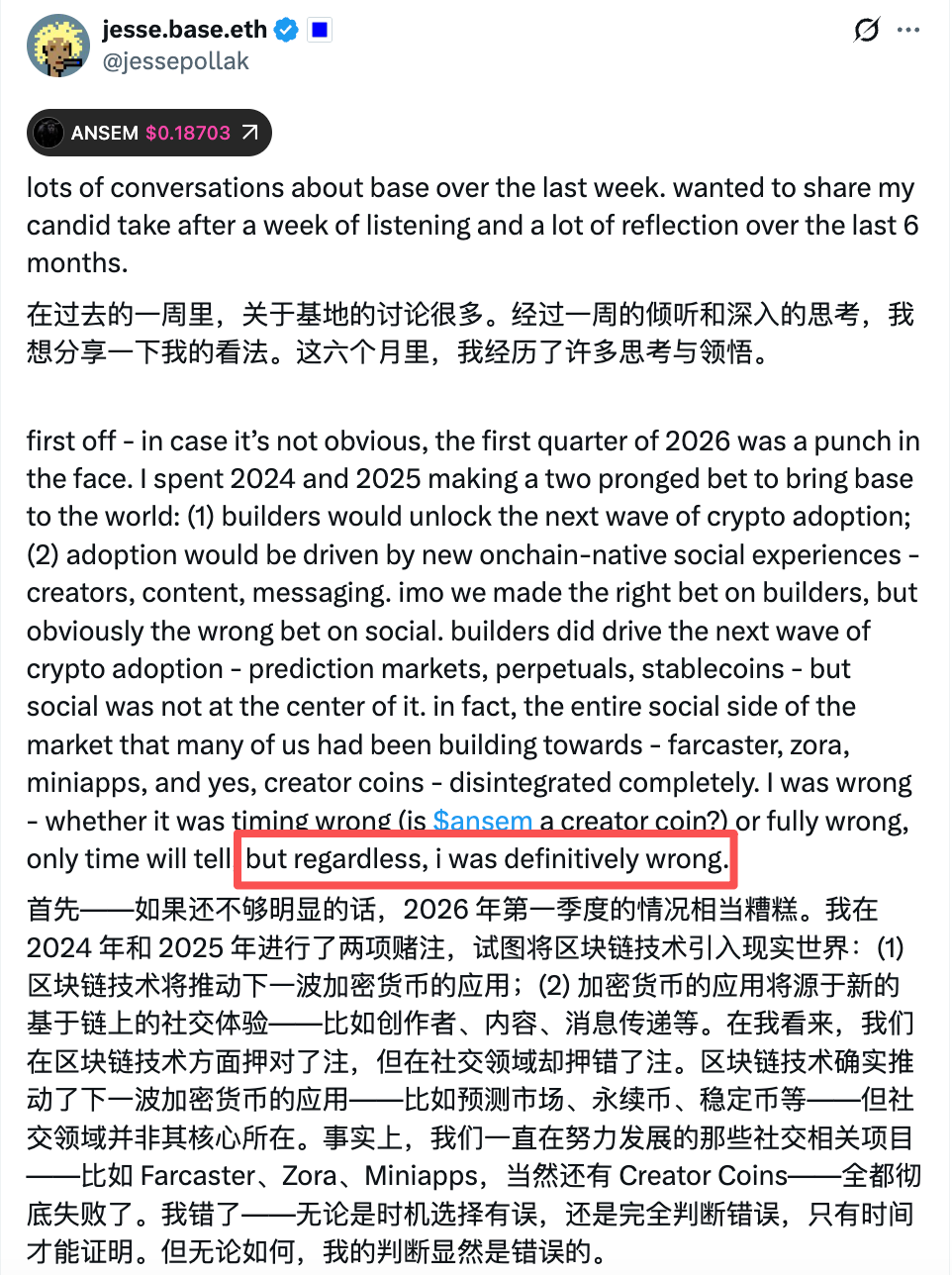
As for the failures of SocialFi platforms like Farcaster and Zora, these have long been obvious. The former's founder went to work on payments at Tempo; the latter could be considered to have "completed its mission" after issuing a token, but its token has dropped over 80%.
The beautiful vision Jesse imagined — "reaching billions globally with cryptocurrency through social media" — did not materialize. After all, Web2 social media products are numerous, not to mention the array of established giant products with better user experience, more first-mover advantages, and richer creator content.
Often, you think you're playing with Memes, creating memes, and activating the community, but you're actually building your own information silo, artificially creating small circles, and deliberately raising entry barriers.
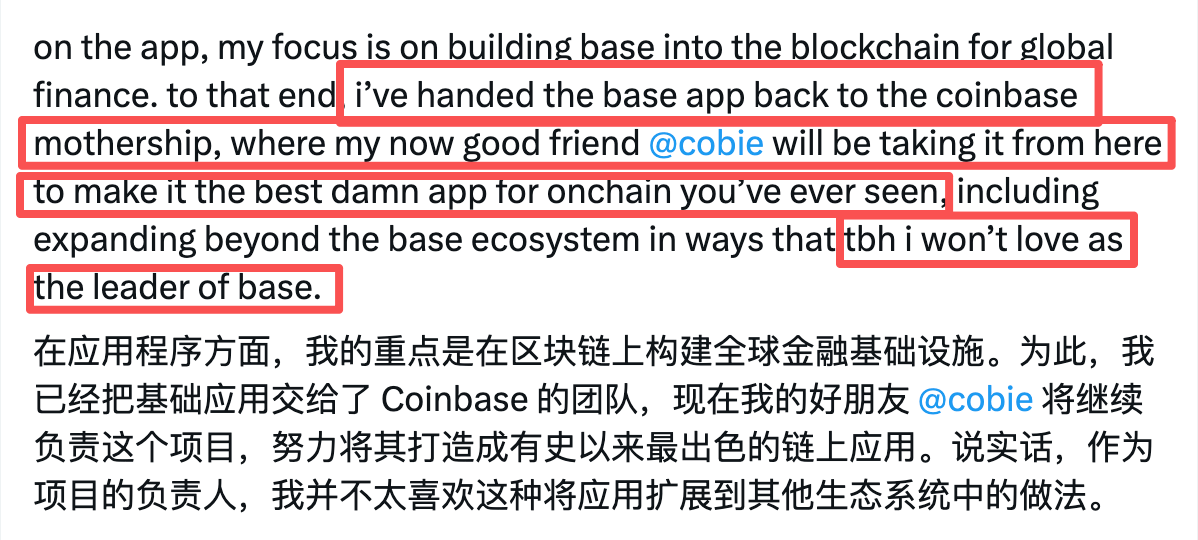
The move to hand over the ecosystem's flagship product, Base APP, to the Coinbase team is more like bringing the Base ecosystem back into Coinbase's embrace, accepting its unified arrangement, and existing as a part and a specific link within the Coinbase ecosystem. This action, to some extent, expands the openness of Base APP, naturally making it no longer exclusive to the Base ecosystem.
For crypto projects, focusing on finance, trading, and investment remains the industry's mainstay. The on-chain Perp platforms and prediction market platforms that have thrived regardless of market volatility in recent years precisely capitalized on this trend, even benefiting from high-volatility, high-risk market conditions to generate more protocol and platform revenue.
In light of this, Base has finally come to its senses, no longer fixated on "decentralized social" or the "creator economy," but pivoting to three major directions — trading, payments, and AI Agent.
Base's New Chapter: Focusing on Trading, Payments, and AI Agent Development
It's commendable to acknowledge and correct mistakes.
Although Base has taken many detours, it seems that Jesse, the Coinbase CEO, and others have recognized the problems and provided their own solutions.
Previously, Brian Armstrong responded to community skepticism, stating, "Base's primary focus is on trading, payments, and AI Agent services (in that order). I believe these three are closely interconnected. For example, to conduct payment transactions, you need foreign exchange resources; and agent services involve a lot of trading and payment business. By the way, most resources are currently allocated to the trading business. Perhaps these businesses haven't yet achieved external applications, but that is the reality."
Jesse also stated in today's long post that Base will position itself as the "blockchain for global finance," with 2026 focusing on three major directions: trading, payments, and AI Agent. Specifically,
- Trading will cover tokenized stocks, Meme coins, and utility tokens;
- Payments will revolve around global stablecoins for individuals and businesses;
- AI Agent will leverage cryptocurrency as the computer-native currency, serving future participants in the large-scale machine economy.
Base's future business priorities are not just talk; they are the relatively optimal choices based on current industry trends and its own advantages.
Trading-wise: Despite Base's limited active user base, its advantages such as low Gas friction costs, the Ethereum ecosystem circle, and the compliant US background backed by Coinbase can ensure its foundational advantages and value in areas like tokenized stocks, Meme coins, and legitimate project development;
Payments-wise: Base's low interaction costs, x402 protocol foundation, and support for USDC from Circle also lay the groundwork for individual and institutional payments and stablecoin adoption. Coupled with an "all-in-one application" like Base APP, if more supply-side brands, merchants, and institutional users can be onboarded in the future, it could promote large-scale adoption of stablecoins in the US and worldwide.
AI Agent services-wise: This step resembles a preemptive layout for the future AI Agent economy. Although AI Agents are still in early development, considering news like OpenAI's GPT-5.6, Anthropic's Fable-5 model, and Apple's recent AI partnership with Alibaba's Tongyi Qianwen model, the day when AI Agents widely use cryptocurrency for payments, trading, and consumption is coming soon. Previously, according to Alibaba's official news, by May this year, Alipay's AI autonomous order and payment transactions had cumulatively completed 300 million instances (covering scenarios like AI agent payments, AI ordering, AI consumption, such as payments completed through applications like Tongyi and Rokid).
Of course, Base's strategic shift is accompanied by personnel changes within the large organization behind it, Coinbase.
Coinbase Organizational and Personnel Changes: Some Exit, Some Continue Coding
Previously, Coinbase's Head of Engineering, Brock Miller, announced externally that he had left and joined Anthropic as a technical team member. When cryptocurrency is no longer a hot trend, some choose to follow the trend and join the AI revolution wave.
In early July, Coinbase Chief Legal Officer Paul Grewal announced his departure to join a startup. He added, "I will continue to serve as a Coinbase advisor and participate in Coinbase's trust charter work through the US Office of the Comptroller of the Currency." Subsequently, Coinbase announced that Molly Abraham will lead the company's legal team as General Counsel, and Ryan Van Grack will assume the role of Vice Chairman, expected to take on broader and more public-facing responsibilities.
This is a case of leaving but maintaining a cooperative relationship with Coinbase.
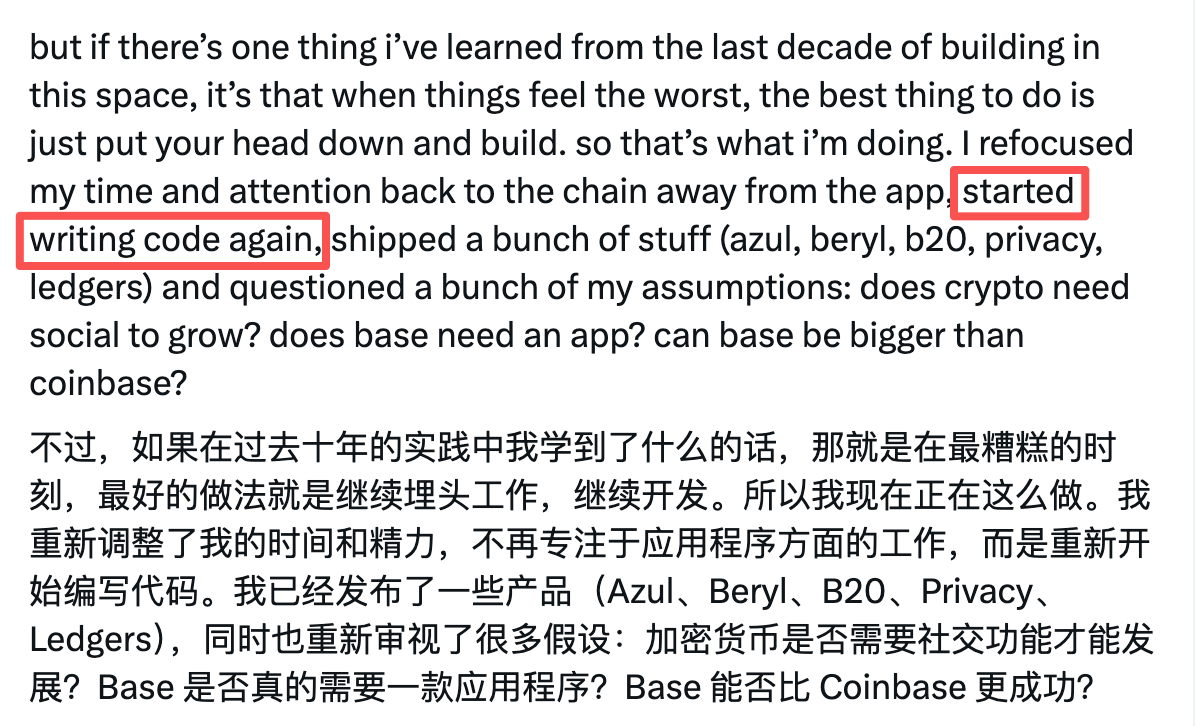
As for the person coding, it's none other than Base founder Jesse — he personally stated: "I have started coding again and have launched some products."
Recently, Coinbase's Platform Lead, Rob Witoff, stated that over 95% of the company's code is now written by or with the assistance of AI, a significant increase from the 40% figure announced in February. In an interview, he said: "In reality, 100% of Coinbase employees use AI every day." He indicated that most Coinbase engineers currently run 5 to 10 AI Agents simultaneously. The combined working capacity of these AI Agents is equivalent to about 1,200 employees.
He expects that by 2030, Coinbase's AI Agents might handle work equivalent to 100,000 employees. However, he noted that critical areas like core cryptography still require human involvement, with AI primarily used for code testing, bug checking, and prototype development.
Not only will the Base ecosystem serve the future AI Agent economy, but perhaps most Coinbase employees will also be replaced by AI Agents in the future.