Backpack Surges Over 150% in Half a Month

marsbitPublished on 2026-06-15Last updated on 2026-06-15

Abstract

BP, the token of the Backpack exchange, has surged over 150% since early June, driven by the platform's expansion into regulated US stock brokerage and asset tokenization services. On June 2nd, Backpack announced Backpack Securities, offering traditional stock trading and tokenization, causing BP's price to jump over 80%. Momentum continued on June 12th with the launch of SPCX, a tokenized product for SpaceX stock on Solana, facilitating seamless conversion between traditional securities and on-chain assets. This aligns with the RWA (Real World Assets) narrative, creating a bridge between traditional finance and Solana DeFi. The token's unique economics also support its growth. All 2.5 billion initially circulating tokens were airdropped to the community, with zero allocation to the team or investors at launch. A key feature allows users who stake BP for at least one year to gain the right to convert tokens into company equity upon an IPO or acquisition. Despite some initial community controversy over airdrop distribution, focus is shifting to BP's long-term utility and value alignment as real products launch.

Author: Ma He, Foresight News

On June 15, the Backpack exchange token BP surged over 30% again within 24 hours, currently quoted at $0.475 with a market cap of $118.48 million and a fully diluted valuation (FDV) of $473.94 million. Since early June this year, BP has skyrocketed from around $0.16, breaking through a high of $0.48.
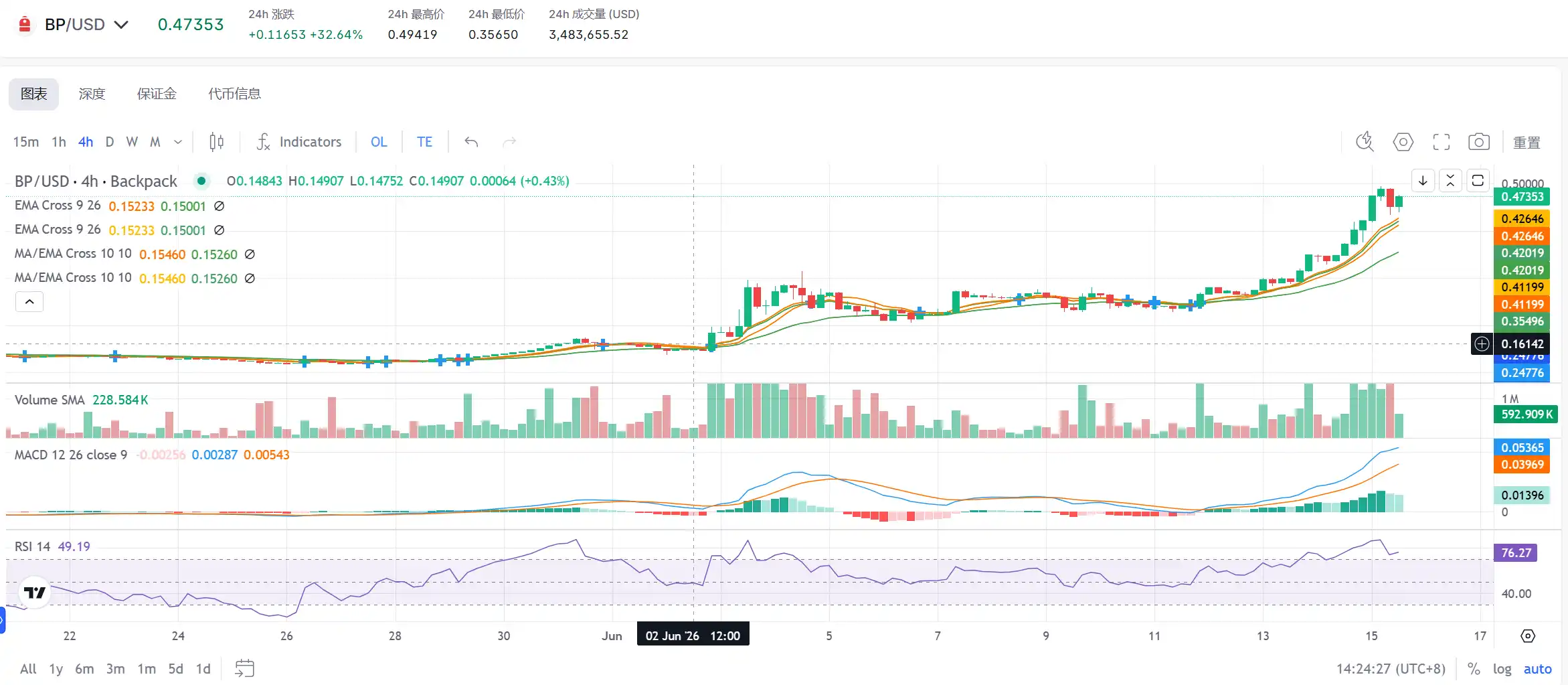
The direct catalyst for this market surge stems from the platform's latest breakthroughs in traditional U.S. stock brokerage and asset tokenization services.

Venturing into U.S. Stock Brokerage and Tokenization Business

In March 2026, BP completed its Token Generation Event (TGE) on Solana with a total supply of 1 billion tokens and an initial circulating supply of 250 million. After listing, the token price briefly touched a high point before rapidly declining, with a single-day drop exceeding 40% at its worst, as the market was once filled with profit-taking pressure. For several weeks thereafter, the price consolidated at lower levels until a turning point emerged in early June.

On June 2, Backpack announced the launch of the Backpack Securities platform, which will provide regulated U.S. stock brokerage services while also supporting the tokenization of traditional stocks for circulation on the blockchain, enabling seamless conversion between traditional securities and on-chain assets. The brokerage service is planned to launch gradually in June, with initial tokenized products rolled out in the Solana ecosystem through a partnership with Sunrise. BP skyrocketed over 80% in a single day, rapidly climbing from the $0.14-$0.15 range to around $0.27, with its market cap approaching $70 million at one point.

On June 12, coinciding with SpaceX's listing on NASDAQ, its tokenized product SPCX launched on Solana. In the subsequent 24 hours, BP rose approximately 27% further, pushing its price above $0.347. This token is pegged 1:1 to real SpaceX shares, supports 24/7 on-chain trading, and can be redeemed through a Backpack brokerage account into a traditional securities account, achieving interoperability between on-chain and off-chain assets. On its first day of launch, the product generated around $35-38 million in on-chain trading volume across DEXs like Jupiter and Raydium. According to the latest official data, the total on-chain SPCX trading volume exceeds $86 million.
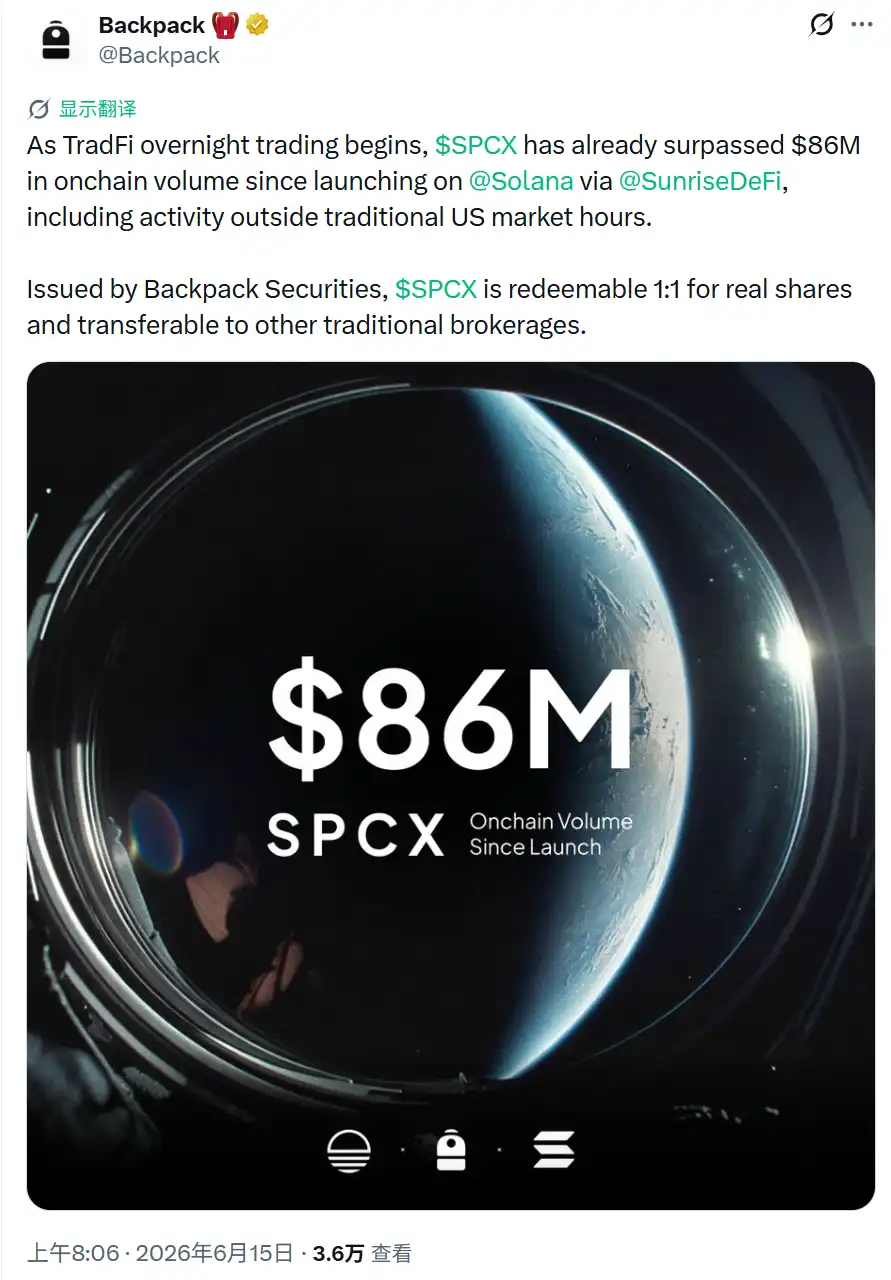
Backpack is building a bridge between traditional U.S. stocks and Solana DeFi. Users can not only trade crypto assets within the platform but also access real stocks through the same account and tokenize portions of their assets for use, trading, or composition on-chain. This pathway aligns highly with the current RWA (Real World Assets) narrative and provides the BP token with clearer use cases and demand support.

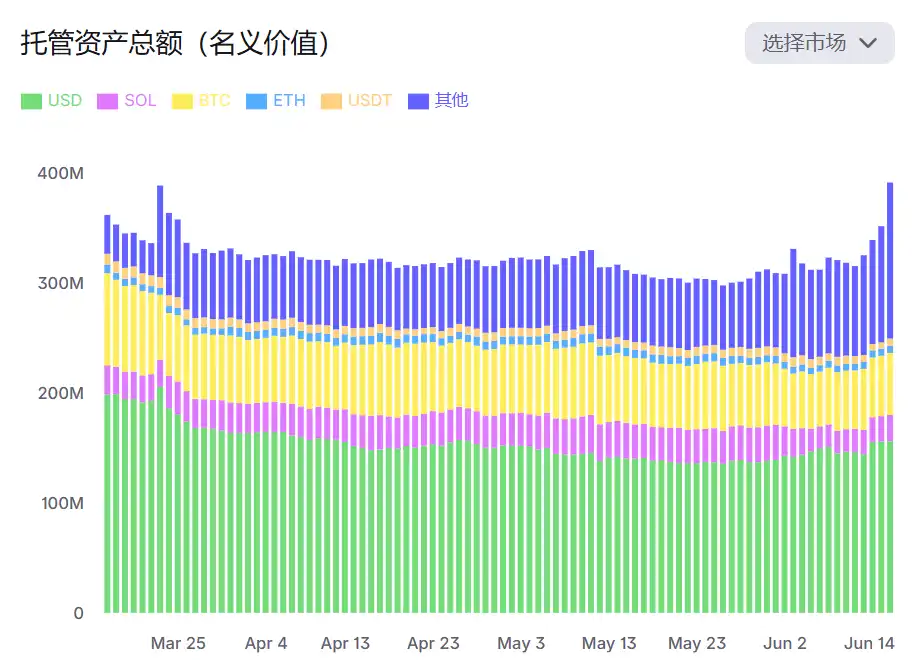
BP's recent surge stems more from substantial platform business expansion than short-term speculation. Currently, its official website shows that Backpack's total custodied assets (nominal value) have rebounded to $390 million.
No Tokens for the Team Unless the Company Goes Public

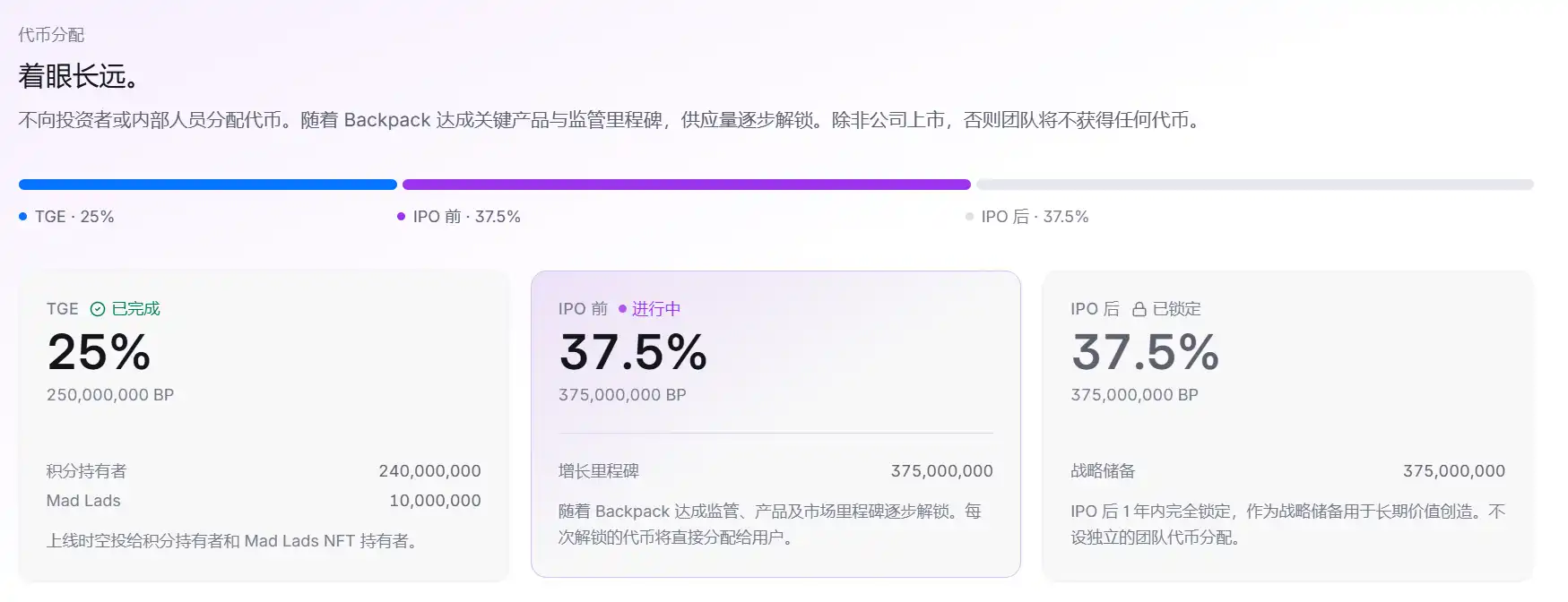
Supporting the above business development is the BP token and its unique economic structure launched as early as March. The total supply of 1 billion tokens is divided into three phases: 25% (250 million) at TGE was entirely airdropped to community users, with approximately 240 million allocated to participants in the points program and 10 million to Mad Lads NFT holders. At launch, the team, founders, and investors received 0 token allocation; 37.5% in the Pre-IPO phase is tied to growth triggers such as regulatory milestones and product launches, continuing to be distributed to users upon unlocking; 37.5% in the Post-IPO phase enters the company treasury, locked for at least one year after an IPO, with the team benefiting only through equity, not directly through tokens.
The most attention-grabbing mechanism is the equity conversion design: users who stake BP for at least 1 year gain the right to convert their tokens into company equity upon an IPO or acquisition, with the bonus increasing with holding time up to the 4th year based on the initial unlock.

Additionally, staking provides benefits such as tiered trading fee discounts, extra yield on USD collateral, free wire transfers, and priority access to the Backpack Card. Currently, about 66% (approximately 165 million) of the circulating supply is staked.

While the airdrop process was technically smooth, it also sparked community discussion. Supporters argue that the "no insider TGE allocation" model is quite radical, and the points system genuinely rewarded trading and ecosystem participation. Criticism focused on the relatively strict Sybil filtering mechanism, which led to some long-term users having their points removed, resulting in lower-than-expected allocations, as well as noticeable profit-taking during the post-listing price correction. CEO Armani Ferrante publicly denied allegations of team OTC sales.

These controversies temporarily affected market sentiment, but as tangible products like Backpack Securities were launched, the focus is gradually shifting from allocation details to the platform's long-term growth and the token's actual utility. Against the backdrop of the platform's expansion into U.S. stock brokerage and tokenization services, the long-term alignment value of BP's staking and equity mechanisms is being reevaluated.

Related Questions

QWhat is the key factor driving the recent sharp increase in the price of Backpack's BP token?

AThe key driver is Backpack's expansion into traditional U.S. stock brokerage and asset tokenization services through its new Backpack Securities platform, starting with the tokenized SpaceX (SPCX) offering on Solana.

QWhat is the unique feature of BP's tokenomics regarding team and investor allocation?

AAt TGE, 0 tokens were allocated to the team, founders, or investors. 100% of the initial circulating supply (25% of total) was airdropped to the community. Team members can only benefit through company equity (via a token conversion option post-IPO), not through direct token holdings.

QWhat significant milestone for Backpack occurred on June 12 alongside SpaceX's NASDAQ IPO?

AOn June 12, the tokenized product for SpaceX, SPCX, was launched on Solana. It is a 1:1 tokenized representation of real SpaceX stock, facilitating 24/7 on-chain trading.

QWhat major benefit can BP stakers obtain, and what percentage of the circulating supply is currently staked?

AStakers who lock BP for at least one year gain the right to convert their tokens into company equity upon an IPO or acquisition. Currently, approximately 66% (about 165 million) of the circulating supply is staked.

QWhat criticism did the BP token airdrop face from parts of the community?

ACriticism focused on the Sybil filtering mechanism being overly strict, which led to some long-term users having their points invalidated and receiving fewer tokens than expected. There were also accusations of team OTC selling, which the CEO denied.

Related Reads

9.42 Million Retail Investors Compete for Changxin Technology, Who Got Allotted?

Evergreen Technology's IPO subscription results are now available. On July 20, the domestic memory chip giant announced the offline preliminary allotment results and online lottery results for its IPO. A total of approximately 9.43 million retail investors participated in the online subscription, generating 770,000 winning lots with a final winning rate of about 0.4714%, setting a record for new shares on the STAR Market. After triggering a clawback mechanism from institutional to retail investors, the online retail allocation was significantly increased to 3.851 billion shares. Simultaneously, 285 institutional investors participated in the offline subscription, ultimately receiving 2.173 billion shares at an allotment rate of approximately 0.1756%. Leading insurers and public funds were among the major recipients. Notably, Liang Wenfeng, founder of the major AI model company DeepSeek, through his quantitative investment firms Ningbo Huanfang Quantitative and Zhejiang Jiuzhang Asset, secured the largest share among private funds, with a total allotment worth approximately 175 million yuan. Estimates suggest potential profits could reach 730 million yuan if Evergreen Technology's market capitalization reaches 3 trillion yuan post-listing. The company is expected to list on July 27 and could become the highest-valued tech stock on the A-share market, with various brokerages providing valuations ranging from 1 trillion to over 4 trillion yuan. However, recent significant corrections in global tech stocks may impact its post-listing performance. (Character count: 1,196)

marsbit42m ago

9.42 Million Retail Investors Compete for Changxin Technology, Who Got Allotted?

marsbit42m ago

L2 'Recalibration': When L1 Becomes Its Own Rollup, What Is Ethereum's Endgame?

The article discusses the evolving relationship between Ethereum's Layer 1 (L1) and Layer 2 (L2) solutions, moving beyond the initial "L2 for scaling" model. As Ethereum L1 itself scales (increasing Gas Limit, statelessness, zkEVM), the unique value proposition of L2s shifts from merely providing cheap execution to offering differentiated features like application-specific optimization, privacy, and flexible governance. The piece explores three key themes: 1. **L2's New Role:** L2s are transitioning from a pure scaling technology to a spectrum of execution environments with varying degrees of security inheritance from Ethereum L1. 2. **Interoperability as State Trust:** Solving L2 fragmentation is less about cross-chain bridges and more about enabling faster, trust-minimized state verification between environments. This involves initiatives like faster L1 finality, intent-based architectures (Open Intents Framework), and native account abstraction. 3. **Blurring Layers:** With the potential integration of zk-proofs into L1 validation (making L1 akin to its own "Rollup") and the concept of "Native Rollups," the rigid boundary between L1 and L2 may fade. The future could be a unified system with multiple execution domains (for DeFi, gaming, privacy, etc.) sharing a common security, settlement, and state framework. In conclusion, Ethereum's goal is not to abandon L2s or re-centralize everything on L1, but to re-integrate the fragmented user experience—liquidity, accounts, applications—while preserving the scaling benefits of a multi-environment ecosystem. The endgame is a cohesive "one chain" feeling for users, powered by diverse but securely interconnected execution layers.

marsbit1h ago

L2 'Recalibration': When L1 Becomes Its Own Rollup, What Is Ethereum's Endgame?

marsbit1h ago

Trading

Spot
活动图片




