As Circle, the First Stablecoin Stock, Resolves to Shed Its Label

链捕手Published on 2026-05-12Last updated on 2026-05-12

Abstract

Circle, the "stablecoin stock," reported its Q1 2026 results, showing a 20% YoY revenue increase to $694M despite a 15% drop in net profit due to post-IPO stock-based compensation and operational investments. The company's USDC stablecoin hit a record $770B in circulation with on-chain transaction volume soaring 263% YoY. However, market share slightly declined amid competition. The key market catalyst was the announcement of a $222M pre-sale for the ARC token of Circle's new institutional-focused Layer 1 blockchain, Arc, valuing the network at $30B. Led by a16z, the round included major investors like BlackRock and Apollo. CEO Jeremy Allaire positioned this as a strategic pivot from a stablecoin issuer to a broader internet platform and "financial OS" company. Circle also launched "Agent Stack" products for AI agent payments using USDC. While reaffirming its full-year 2026 guidance, the company noted the financial impact of Arc is not yet included, leaving room for future upside. Following the report, CRCL's stock surged nearly 16%. Wall Street analysts remain largely bullish on the long-term narrative, though some caution about near-term execution risks and the current immaterial contribution of new initiatives like Arc. The focus is now on Arc's mainnet launch, ARC token adoption, and evolving U.S. crypto regulation.

Author: Chloe, ChainCatcher

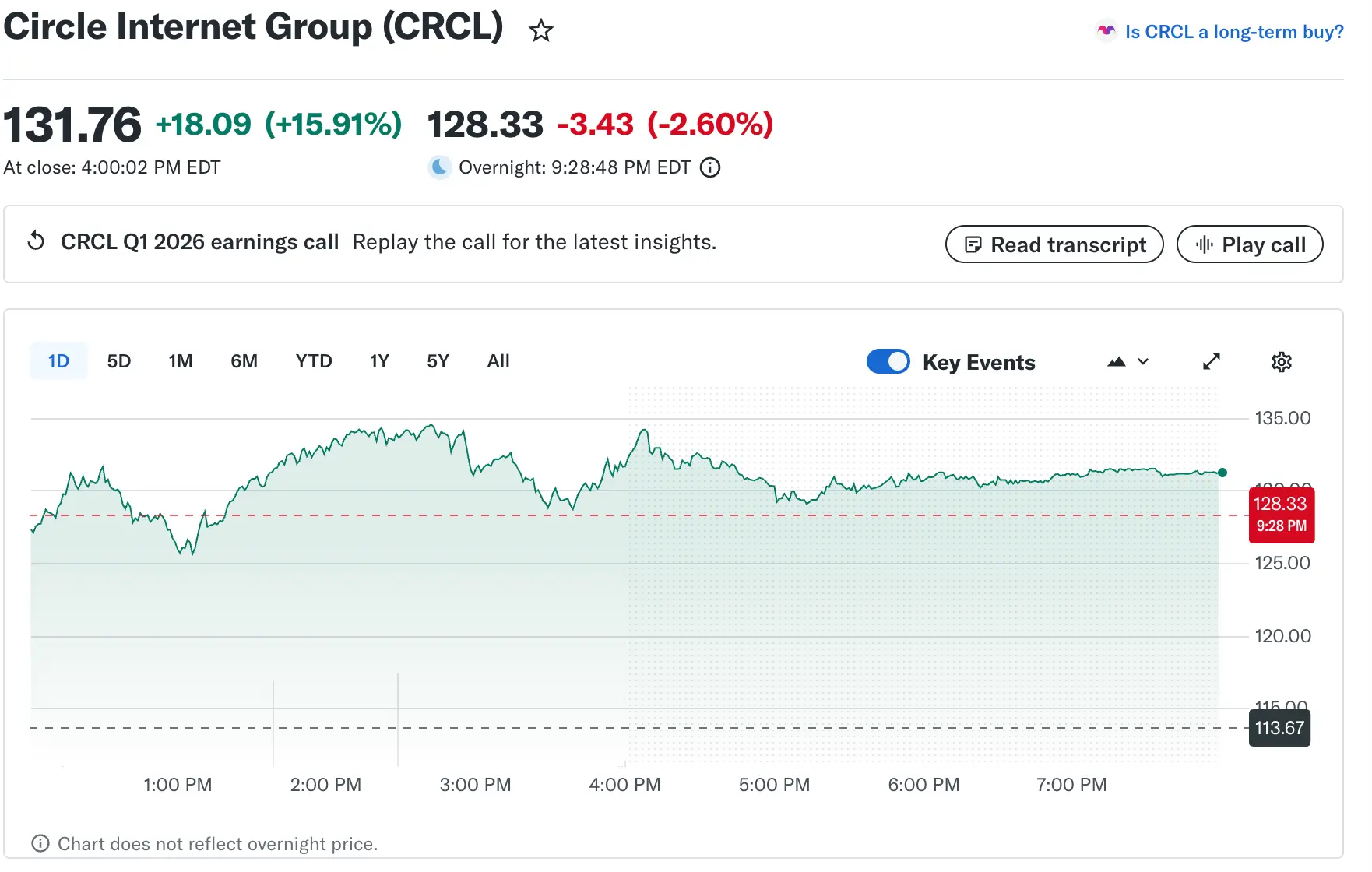
Circle released its first-quarter earnings for 2026 before the market opened yesterday, posting double-digit year-over-year revenue growth and simultaneously disclosing that its new public chain Arc's native token completed a pre-sale of $222 million at a $3 billion valuation. Although net profit declined 15% year-over-year due to increased stock-based compensation and operational investments, market focus remained centered on the long-term narrative of Arc and AI agent payments. CRCL's stock price surged nearly 16% that day, closing at $131.76, hitting a new high since mid-March.
USDC Scale Hits New Record, On-chain Transaction Volume Up 263% YoY

Circle's first-quarter total revenue and reserve income reached $694 million, a 20% increase year-over-year. Breakdown:

  • Reserve Income: $653 million, up 17% YoY, primarily benefiting from a 39% YoY increase in average USDC circulation, partially offset by a 66 basis point decrease in reserve yield (down to 3.5%).

  • Other Revenue: $42 million, roughly doubling YoY, reflecting strong growth in subscription, service, and transaction revenues.

  • Net Income from Continuing Operations: $55 million, down 15% YoY, mainly due to stock-based compensation and related payroll taxes post-IPO, as well as increased investment in products, distribution, and operational infrastructure.

  • Adjusted EBITDA: $151 million, up 24% YoY; Adjusted EBITDA margin was 53%.

Notably, both revenue and net income fell short of Wall Street analysts' expectations prior to the earnings release. According to Bloomberg, sell-side analysts had forecast revenue around $720.8 million and a reserve yield of 3.56%, neither of which were met. However, the adjusted EBITDA of $151 million exceeded the market expectation of $137.9 million, providing some support. This also indicates that the interest rate environment will be one of the most critical external variables for Circle moving forward.

On the operational front, USDC circulation reached $77 billion, up 28% YoY. First-quarter USDC on-chain transaction volume reached $21.5 trillion, a 263% YoY increase, reflecting a significant rise in stablecoin usage density as a payment and settlement medium.

According to Visa Onchain Analytics data, USDC accounted for 63% of stablecoin transaction volume in Q1. Meanwhile, Circle's USYC has become the world's largest tokenized money market fund as of May 7. Other key operational metrics include a USDC "platform retention" balance of $13.7 billion at quarter-end, up 254% YoY; 7.2 million "active wallets" holding over $10 in USDC, up 47% YoY; and a stablecoin market share of 28%, down 62 basis points YoY, directly reflecting competitive pressure from Tether and other rivals.

Public Chain Arc Completes $222 Million Token Financing with Star-Studded Investor Lineup

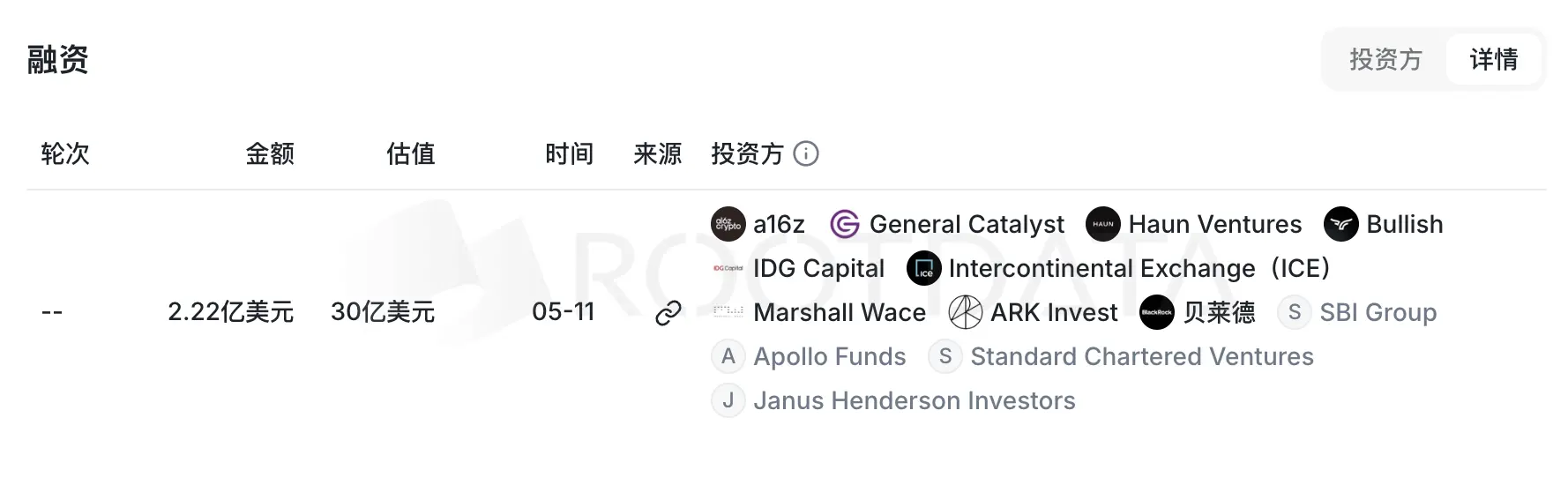
Circle also announced that the native token ARC for Arc, its institutionally-focused Layer 1 public chain, has completed a $222 million pre-sale, with a fully diluted network valuation of $3 billion. According to crypto asset data platform RootData, the financing was led by a16z with a $75 million investment. Other participating investors include BlackRock, Apollo Funds, Intercontinental Exchange (ICE), Standard Chartered Ventures, ARK Invest, Bullish, and over ten other institutions.
Circle CEO Jeremy Allaire stated that the company is transitioning from a stablecoin issuer to a broader internet platform company, entering the operating system and application business. Regarding token distribution, Circle holds 25% of the initial 10 billion token supply, 60% is allocated to network builders and participants, and 15% is reserved as long-term reserves.

Notably, Circle stated that this financial forecast does not incorporate the financial impact of the ARC token pre-sale, Arc incentive programs, or future Arc-related revenues.

Reaffirms Previously Announced Full-Year Guidance, No Adjustments

Additionally, Circle simultaneously launched a series of "Agent Stack" products, including Circle CLI (Command Line Tool), Agent Wallets, and Agent Marketplace, enabling developers and merchants to create, fund, and monetize AI agent-driven activities using USDC across multiple public chains and payment protocols.

The earnings report also revealed that, in terms of payment business, the Circle Payments Network (CPN) processed an annualized transaction volume of $8.3 billion as of March 31, based on the past 30 days of activity. Managed Payments, launched in April, allows financial institutions to offer stablecoin payment services without managing digital assets themselves.

New enterprise use cases for USDC include: Kyriba embedding USDC into its corporate treasury system, and Polymarket expanding its use of USDC as a core collateral and settlement asset.

Finally, regarding the outlook for the full year 2026, Circle chose to reiterate its previously announced performance guidance without any upward or downward revisions. Specifically, USDC circulation is still expected to maintain a 40% compound annual growth rate (CAGR) over multi-year cycles. FY2026 other revenue is projected between $150 million and $170 million; RLDC margin is expected between 38% and 40%; and adjusted operating expenses are forecast at $570 million to $585 million.

Similarly, this set of guidance does not incorporate the financial impact of the ARC token pre-sale, Arc incentive programs, or future Arc-related revenues, meaning there is room for upward revision once the Arc ecosystem successfully launches.

Majority of Wall Street Analysts Issue Bullish Ratings

Following the earnings release, CRCL surged approximately 16% that day, closing at $131.76, reaching its highest level since March 18. The stock has gained 66% year-to-date, with market capitalization rebounding to around $35 billion.

Wall Street analysts are generally optimistic about Circle's stock price performance over the next 12 months and beyond. According to TipRanks statistics, the consensus target price is $138.50. Among them, Peter Christiansen of Citi gave a 12-month target of $243, while Gautam Chhugani of Bernstein set a target of $190. Along with ten other analysts, all issued "Buy" ratings.

However, analysts still retain some reservations about short-term execution risks. Clear Street analyst Owen Lau pointed out that while the narratives of Arc and Agent Stack are eye-catching, they are "not yet a material business." John Todaro of Needham & Co. noted that recent DeFi protocol hacks could indirectly affect USDC use cases: "If capital leaves DeFi, how does that impact Circle's business?" Andrew Jeffrey of William Blair believes that CRCL stock price volatility will remain high in the short term, but Circle holds a significant advantage in "stablecoin commerce" with multiple catalysts progressing simultaneously.

It can be seen that Circle's earnings report presents a dual structure: the stablecoin business is still scaling rapidly, but unit economics are being compressed by interest rates and distribution costs. The market's willingness to award a 16% single-day gain is more of a bet that the Arc public chain, ARC tokenomics, and AI agent payments can reposition Circle from a stablecoin issuer to a "network financial operating system" in the medium to long term, opening up second and third growth curves beyond the existing USDC spread model.

Perhaps the market's focus going forward will be on the Arc mainnet launch timeline, market acceptance of the ARC token after public circulation, and the impact of subsequent U.S. GENIUS Act and Clarity Act implementations on the overall stablecoin competitive landscape.


Related Questions

QWhat was Circle's stock price performance after the release of its Q1 2026 earnings report?

AFollowing the release of its Q1 2026 earnings report, Circle's stock (CRCL) rose nearly 16% on the day, closing at $131.76, which was a new high since mid-March.

QWhat major development did Circle announce alongside its earnings?

AAlongside its earnings, Circle announced that the native token ARC of its new institutional finance-focused Layer 1 blockchain, Arc, completed a pre-sale of $222 million at a fully diluted network valuation of $30 billion.

QWhat were the key financial results for Circle in Q1 2026?

AIn Q1 2026, Circle's total revenue and reserve income was $694 million, a 20% year-over-year increase. However, net income from continuing operations was $55 million, down 15% YoY. Adjusted EBITDA was $151 million, a 24% YoY increase.

QWho led the funding round for the ARC token?

AThe funding round for the ARC token was led by the venture capital firm Andreessen Horowitz (a16z), which invested $75 million.

QAccording to the article, what is the main transformation that Circle's CEO Jeremy Allaire described for the company?

ACircle's CEO Jeremy Allaire stated that the company is transforming from a stablecoin issuer into a broader internet platform company, entering the operating system and application businesses.

Related Reads

SpaceX, OpenAI, Anthropic: The Three AI Giants Racing for IPO, Which One Is Worth Betting On?

SpaceX, OpenAI, and Anthropic are poised for historic IPOs within weeks, potentially raising a combined $180 billion—a sum exceeding the entire internet bubble's fundraising. The hosts of the Limitless Podcast argue this isn't just individual company financing but an unprecedented capital concentration for AI infrastructure, driven by an insatiable need for compute, data centers, power, and chips. SpaceX's IPO is notable for reportedly changing market index rules to allow faster inclusion, potentially funneling trillions in passive retirement funds into its stock, despite its unproven space-based data center business model. In contrast, Anthropic demonstrates explosive growth, with ARR reportedly hitting $45 billion and approaching profitability, fueled by strong enterprise adoption of products like Claude Code. Google's separate $80 billion raise highlights the immense capital pressure, even for giants. The discussion acknowledges bubble risks but leans optimistic. The hosts contend the massive spending is building essential physical infrastructure for the next technological era. A key bottleneck isn't capital but the real-world limits of chip manufacturing and construction speed. As long as demand for AI compute outstrips supply, this investment cycle represents a foundational build-out rather than a purely financial bubble. All three companies are seen as foundational bets on the future, with Anthropic often cited as the most immediately compelling due to its proven revenue trajectory.

marsbit23m ago

SpaceX, OpenAI, Anthropic: The Three AI Giants Racing for IPO, Which One Is Worth Betting On?

marsbit23m ago

From 'Old Guys' to 'New Favorites': How AI Is Revaluing Old Infrastructure from Dell to Nokia?

From "Vintage Tech" to "New AI Darlings": How AI Revalues Old Infrastructure One year ago, tech giants like Dell, Nokia, Cisco, and Western Data were seen as slow-growth, low-valuation stories, far from the AI spotlight dominated by players like Nvidia. Now, these legacy tech stocks are gaining market attention, sparking debate on whether this is genuine industry revaluation or a temporary narrative. As AI moves from model parameters to real-world data centers, the market is recognizing companies with proven delivery and infrastructure capabilities. This shift marks a change in the AI investment thesis: from pure model and GPU focus to the complex systems engineering required for deployment. Companies like Dell, HPE, and Corning are being revalued not for being "sexy" AI innovators, but for their decades of accumulated expertise in supply chains, enterprise delivery, and infrastructure—assets that have become critical in the AI buildout phase. The revaluation is unfolding across three key infrastructure lines: 1. **Servers & System Integration:** Dell and HPE are emerging as crucial system integrators or "general contractors" for AI data centers, translating GPU orders into complete, deployable server racks integrated with power, cooling, and networking. 2. **Networking & Connectivity:** AI's scale demands robust high-speed connections. Corning (fiber optics), Nokia (AI-RAN, 6G), and Cisco (data center switches) are gaining importance for enabling efficient data transfer within and between AI clusters. 3. **Storage:** Beyond high-speed memory (HBM/DRAM), the AI data explosion is driving demand for high-capacity hard drives (HDDs) from companies like Western Digital and Seagate to handle training data, logs, and cold storage cost-effectively. For this revaluation to be substantive and not just a narrative, three criteria are key: 1) Concrete AI-related order and revenue growth (e.g., Dell's AI server sales), 2) Upward revisions to company financial guidance, and 3) Sustainable improvements in profit quality, not just top-line revenue spikes. In essence, AI's transition to a real construction phase is re-pricing "old assets" against "new demand." The opportunity, however, is selective. Only those legacy firms that are demonstrably integrated into the capital expenditure chains of data center and enterprise AI deployment are likely to experience a true "logic re-rating" rather than just a temporary valuation bounce.

marsbit29m ago

From 'Old Guys' to 'New Favorites': How AI Is Revaluing Old Infrastructure from Dell to Nokia?

marsbit29m ago

The Merger of Codex and ChatGPT Marks the Beginning of a Major Reshuffle in Programming Tools

OpenAI is shifting its strategic focus from ChatGPT to Codex, merging them along with the browser tool Atlas into a unified desktop super-app. This move signals an internal belief that Codex, originally a programming tool, represents the next evolution of AI more than conversational models like ChatGPT. Over the past year, Codex's weekly active users have surged past 5 million. The key distinction is that while ChatGPT answers questions, Codex executes tasks. Enterprises increasingly value this ability to get work done over simply receiving advice. Consequently, Codex is attracting professionals beyond developers, including analysts, bankers, marketers, and product managers. OpenAI's reorganization and increased investment in Codex stem from recognizing that the future of AI competition lies in execution capabilities, not just conversation. The company is launching role-specific plugins (e.g., for data analysis, sales, design) to transform Codex into a broad knowledge work platform that automates and redefines white-collar workflows. Beyond being a tool, Codex reflects OpenAI's ambition to redefine software. New features like "Sites"—which generates interactive websites from documents—and collaborative "Annotations" aim to create a paradigm where the AI understands the goal and handles the tools and steps, functioning more like a digital colleague than traditional software. The ultimate goal is a unified experience where the user cares only about the completed task.

marsbit38m ago

The Merger of Codex and ChatGPT Marks the Beginning of a Major Reshuffle in Programming Tools

marsbit38m ago

Interpreting Investment Opportunities in the Age of Great Navigation, Invesco Great Wall Fund Releases '2026 Report on Chinese Enterprises Going Global'

Invesco Great Wall Fund has released its "2026 China Corporate Globalization Report," titled "The 'Great Navigation Era' of Chinese Enterprises." The report analyzes the new trends and investment opportunities as Chinese companies expand globally, moving from simple product exports to comprehensive overseas operations involving services, branding, and local production. Driven by factors like trade friction, the pursuit of higher profit margins abroad, and policy support, globalization is becoming essential for Chinese companies. The report outlines an evolution: from early product export ("Globalization 1.0") to the current "Globalization 2.0," characterized by overseas capacity, capital goods investment, consumer brand expansion, and service exports. Chinese firms' competitive advantages are highlighted, including a vast engineer talent pool, low-cost and robust infrastructure, and complete industrial clusters. Specific sectors with significant出海 potential are identified: * **Capital Goods** (e.g., engineering machinery, power equipment): Benefiting from global demand, especially in Belt & Road markets and the AI-driven power grid upgrade cycle. * **Consumer Brands**: Transitioning from cost to brand advantage, leveraging供应链 efficiency. * **Technology & Innovation**: Including AI applications, optical modules within global tech supply chains, and new energy vehicles focusing on local production. * **Pharmaceuticals**: Chinese biotech firms are becoming preferred partners for global pharma, with potential for breakthrough drugs in areas like oncology and weight loss. The report concludes that corporate globalization represents a sustained, core theme for China's capital markets, though companies must navigate challenges like geopolitics and localization.

marsbit51m ago

Interpreting Investment Opportunities in the Age of Great Navigation, Invesco Great Wall Fund Releases '2026 Report on Chinese Enterprises Going Global'

marsbit51m ago

Trading

Spot
Futures
活动图片