Arthur Hayes argues new Fed liquidity tool “RMP” masks renewed money printing

cointelegraphPublished on 2025-12-19Last updated on 2025-12-19

Abstract

Arthur Hayes, former BitMEX CEO, argues the Federal Reserve's new "Reserve Management Purchases" (RMP) program is effectively a disguised form of quantitative easing (QE). He claims that by purchasing short-term Treasury bills and managing liquidity, the Fed is financing government spending while avoiding the political stigma of QE. Hayes warns this is highly inflationary and erodes the purchasing power of ordinary citizens, while benefiting holders of scarce assets like Bitcoin, gold, and silver. The article notes the Fed recently cut rates and announced $40 billion in short-term Treasury purchases, which Chair Jerome Powell framed as a technical adjustment. However, analysts suggest mixed signals may dampen a sustained Bitcoin rally. Polymarket data indicates a high probability of no further rate cuts in January.

Arthur Hayes, co-founder and former CEO of crypto exchange BitMEX, argued in a Substack essay published Friday that the Federal Reserve’s new “reserve management purchases” (RMP) program is effectively a rebranded form of quantitative easing.

Hayes argues that by buying short-term Treasury bills and recycling liquidity through money markets, the Fed is effectively financing government spending while avoiding the political stigma of quantitative easing, even as officials frame the program as a technical liquidity operation.

“The RMP is a thinly disguised way for the Fed to cash the government’s checks. This is highly inflationary from both a financial and real goods/services perspective,” he wrote.
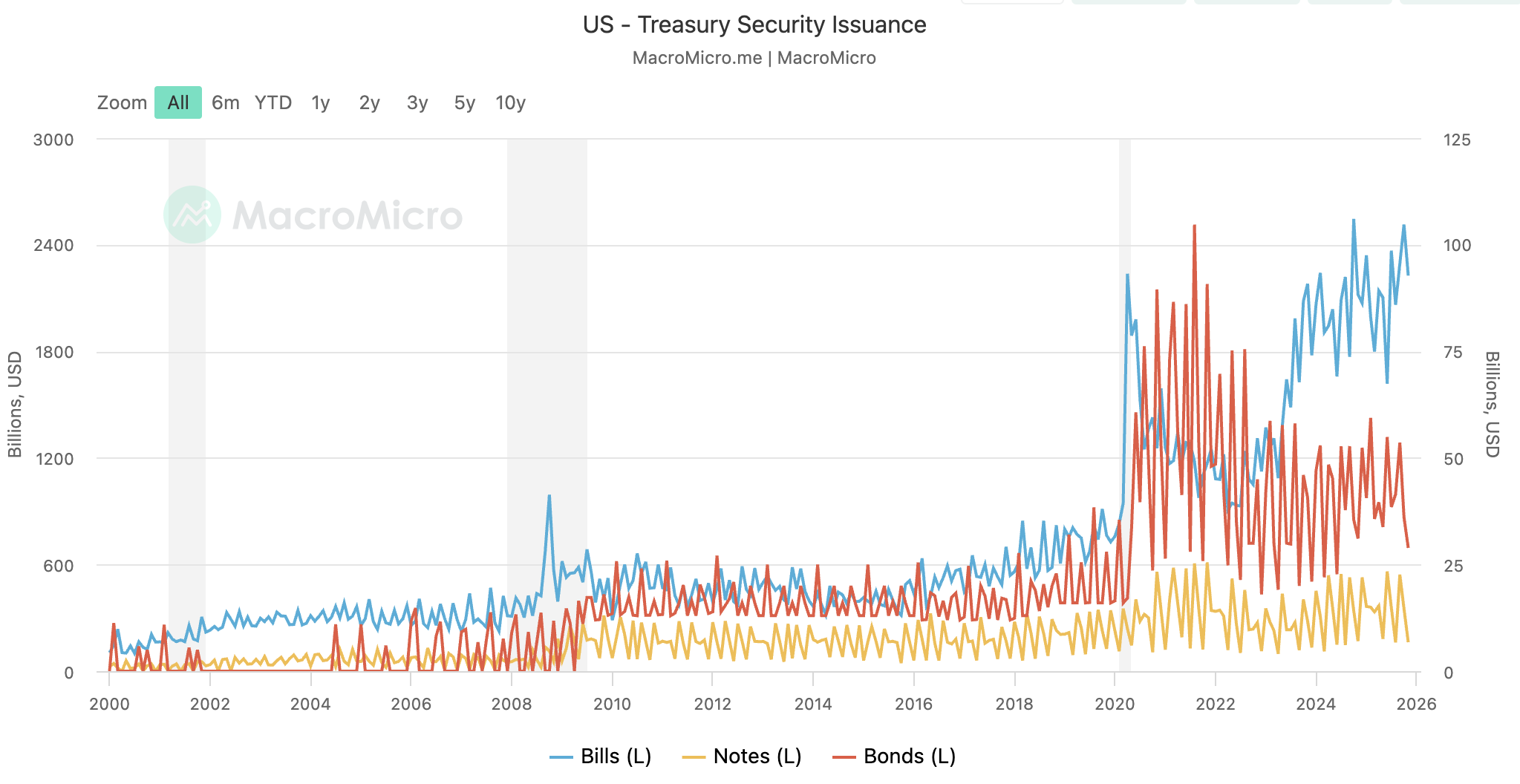
US Treasury issuance by maturity. Source: MacroMicro

Hayes said policies like RMP expand fiat liquidity and, in his view, favor scarce assets such as Bitcoin, gold and silver.

I love QE because it means money printing, and thankfully I own financial assets like gold, gold/silver mining stocks, and Bitcoin that rise faster than the pace of fiat money creation.

At the same time, he warned that people without assets are harmed, as money creation erodes purchasing power, weakens wages relative to prices and shifts wealth toward asset holders.

“Unfortunately, in the here and now for most of humanity, money printing destroys their dignity as productive humans,” he wrote. “When the government intentionally debases the currency, it destroys the link between energy inputs and economic outputs.”

Related: Bitcoin rebounds on Japan rate hike as Arthur Hayes sees dollar at 200 yen

Polymarket points to pause after December rate cut

On Dec. 10, the Federal Open Market Committee (FOMC) cut interest rates by 25 basis points and announced purchases of short-term Treasury securities, a move Fed Chair Jerome Powell said was “solely for the purpose of maintaining an ample supply of reserves” and separate from the stance of monetary policy.

The Fed said the purchases would initially total about $40 billion in the first month and could remain elevated for several months to ease near-term pressures in money markets, particularly around seasonal fluctuations such as tax payments.

Despite the interest rate cut and the announcement of short-term Treasury purchases, analysts said mixed signals from Powell were likely to dampen a sustained Bitcoin rally until the rate-cutting cycle resumes in 2026.

The price of Bitcoin was about $92,695 on Dec. 10, according to Yahoo Finance data. It is was trading around $87,300 at time of writing.

At the time of writing, Polymarket traders were overwhelmingly pricing in no change to Fed policy in January, with the probability of rates staying unchanged at about 77%, while odds of another 25 basis point cut sit near 21% and larger moves are viewed as highly unlikely.
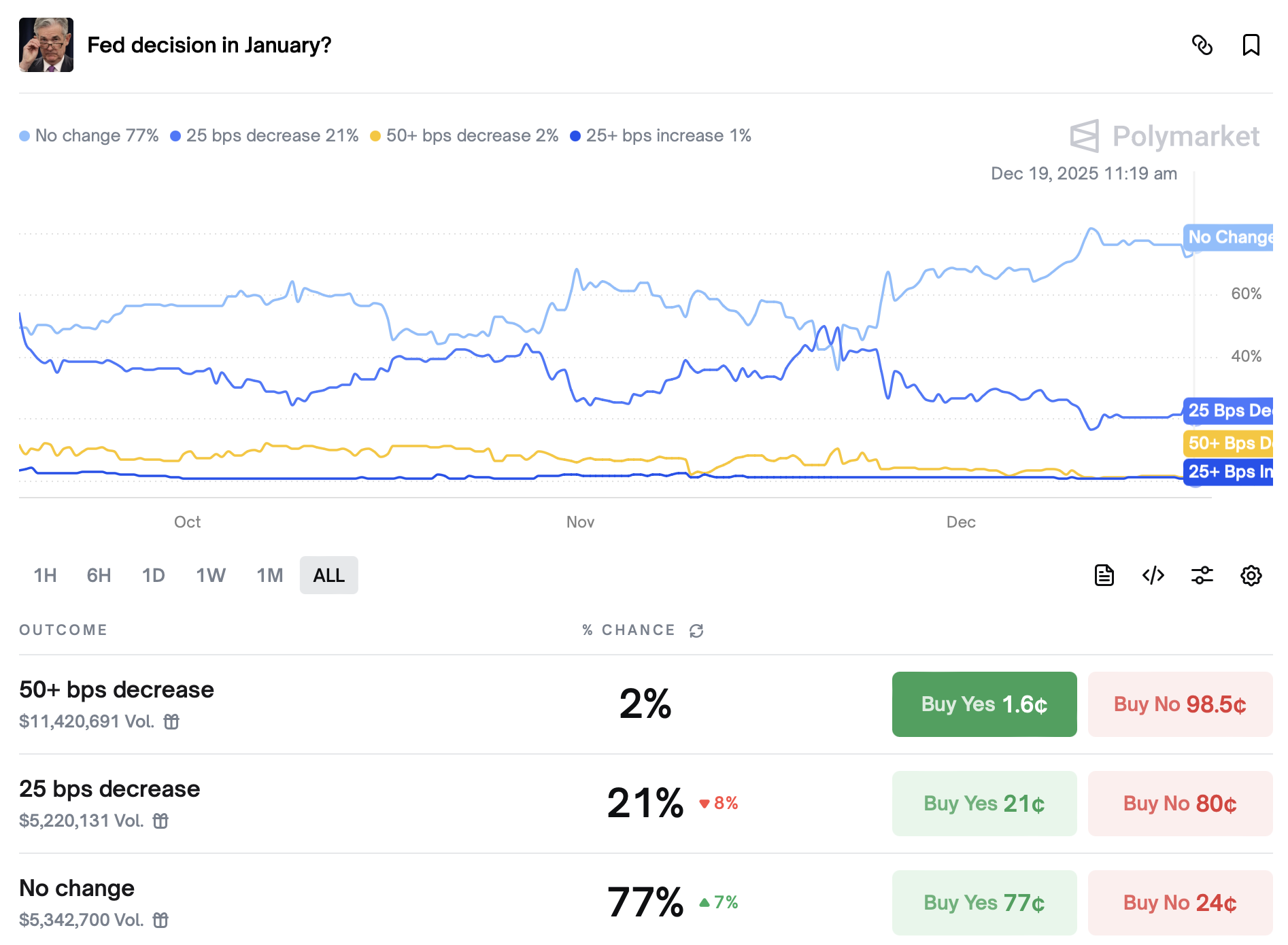
Odds of Fed rate cut in Jan. Source: Polymarket

Powell’s term is set to expire in May 2026. US President Donald Trump, who has publicly pushed for the next Fed chair to pursue aggressive interest rate cuts, is preparing to interview finalists to succeed him, with National Economic Council Director Kevin Hassett widely viewed as the frontrunner.

Magazine: Big questions: Would Bitcoin survive a 10-year power outage?

Related Questions

QWhat is Arthur Hayes' main argument regarding the Federal Reserve's new RMP program?

AArthur Hayes argues that the Fed's Reserve Management Purchases (RMP) program is effectively a rebranded form of quantitative easing (QE) that allows the Fed to finance government spending while avoiding the political stigma associated with QE.

QAccording to Hayes, what is the inflationary impact of the RMP program?

AHayes states that the RMP is 'highly inflationary from both a financial and real goods/services perspective' because it expands fiat liquidity.

QWhich assets does Hayes believe benefit from policies like RMP and QE?

AHayes believes that scarce assets such as Bitcoin, gold, and silver mining stocks benefit from these policies, as they tend to rise faster than the pace of fiat money creation.

QWhat was the Fed's stated reason for initiating the purchases of short-term Treasury securities?

AFed Chair Jerome Powell stated that the purchases were 'solely for the purpose of maintaining an ample supply of reserves' and were a technical liquidity operation, separate from the stance of monetary policy.

QWhat is the market's expectation for the Fed's January policy meeting, according to Polymarket data?

AAccording to Polymarket, traders are pricing in a 77% probability of no change to interest rates in January, with only a 21% chance of another 25 basis point cut.

Related Reads

Tiger Research: Zuckerberg Begins Betting on Prediction Markets, While Asian Nations Still View Them as Gambling

This article examines the rise of prediction markets, contrasting their growing institutional acceptance in the West with their restrictive regulation in Asia. It details how prediction markets, which originated from informal political betting and academic experiments like the Iowa Electronic Market, aggregate crowd wisdom into probabilistic prices through binary contracts. Their growth accelerated around 2020, reaching over $14 billion in monthly volume. A key driver is the "skin in the game" principle, where users risk their own capital, leading to high accuracy in predicting events like Fed rate decisions and elections, as demonstrated by platforms like Polymarket. Meta's entry, with Mark Zuckerberg reportedly leading the development of the Arena app, signals the market's maturation. In the U.S., court rulings have distinguished prediction markets from gambling, facilitating entry by traditional financial institutions. However, most Asian jurisdictions still classify them as gambling, focusing on social control rather than financial innovation. The article argues this stance creates three problems for Asia: 1) regulatory arbitrage pushes users to riskier offshore platforms, 2) loss of sovereign information infrastructure as valuable social sentiment data accumulates abroad, and 3) abandonment of user protection. It concludes that Asia needs a policy shift from prohibition to constructive regulation, integrating these markets into the formal system to harness their data as a national asset, as initiatives like Limitless Research are beginning to do.

marsbit17m ago

Tiger Research: Zuckerberg Begins Betting on Prediction Markets, While Asian Nations Still View Them as Gambling

marsbit17m ago

Ethereum's Next Decade in the Eyes of Vitalik

"Lean Ethereum" Long-Term Roadmap Unveiled by Vitalik Buterin On July 5, 2026, Vitalik Buterin published the "Lean Ethereum" roadmap, positioning it as Ethereum's third major evolution following the Merge. This multi-year, multi-phase upgrade aims to fundamentally transform Ethereum's core protocol through staged network upgrades extending to 2029. Key goals include achieving 1 gigagas per second L1 throughput (a massive increase from the current ~32 TPS), near-instant finality, and quantum-resistant cryptography. The plan involves transitioning Ethereum's security model from full transaction re-execution by all nodes to native verification via recursive STARK proofs. A major proposed change is replacing the EVM with a proof-friendly architecture like RISC-V or leanISA, though this remains a point of contention, especially with L2s like Arbitrum favoring alternatives like WASM. Other planned upgrades include a restructured state model with a large, cheap "warehouse" storage layer to drastically reduce fees for migrated applications, multi-dimensional gas pricing, and a new focus on making privacy a first-class, native protocol feature. While the roadmap significantly raises Ethereum's long-term technical ceiling, analysts note it does not directly address ETH's mid-term token economics or value capture. The plan's multi-year timeline means near-term price impact will likely depend on observable progress milestones, such as the successful deployment of the upcoming Glamsterdam gas limit increase, growth in L2 activity and blob usage, and trends in L1 fee revenue and ETH burn.

链捕手1h ago

Ethereum's Next Decade in the Eyes of Vitalik

链捕手1h ago

In Just 11 Days, Claude Rewrote Millions of Lines of Code, an Epic AI Engineering Feat Sparks Fury

In just 11 days, Bun's founder Jarred Sumner used Anthropic's Claude AI models to rewrite its million lines of code from Zig to Rust. This move sparked significant controversy, particularly from Zig's creator, Andrew Kelley, who publicly criticized Sumner's engineering practices and the decision to use AI for such a massive rewrite. Bun, a high-performance JavaScript/TypeScript runtime and rival to Node.js, was originally written in Zig. After Anthropic acquired Bun, the team encountered persistent stability and memory safety bugs in the Zig codebase. These issues, combined with Zig's strict policy against LLM-generated code, led to the decision to rewrite in Rust. The rewrite was executed using Claude AI tools at an estimated API cost of $165,000, dramatically reducing the expected time and financial cost. Andrew Kelley's response was scathing. He blamed the original bugs on poor engineering habits, calling Bun's Zig code a collection of "hacks on top of hacks." He expressed relief that Bun was no longer associated with Zig, fearing it would misrepresent the language and attract low-quality, AI-generated contributions. The tech community is divided; some view Kelley's critique as unprofessional, while others see it as a defense of engineering integrity. A major concern about the AI-driven rewrite is the resulting code quality. The translation from Zig left approximately 27,000 lines of unsafe Rust code, raising fears about long-term maintainability and technical debt. The debate centers on whether this project is a milestone in AI-assisted development or a future maintenance nightmare.

marsbit2h ago

In Just 11 Days, Claude Rewrote Millions of Lines of Code, an Epic AI Engineering Feat Sparks Fury

marsbit2h ago

From Auto Finance to Bitcoin to AI Engines: An Analysis of Cango's 'What Not to Do' Strategy

From Auto Finance to Bitcoin and Now AI: Cango's "What Not to Do" Strategy Cango, a Chinese auto finance platform that went public on the NYSE in 2018, is undergoing its third major transformation. After selling its entire auto business in 2024, it pivoted to become a large-scale Bitcoin miner, acquiring 50 exahash of mining rigs from Bitmain. However, its true goal was never Bitcoin, but owning and controlling energy infrastructure. Now, Cango is pivoting again. While most listed Bitcoin miners are leasing power to giant hyperscalers for AI training clusters, Cango is taking the opposite path. It has launched an AI inference subsidiary called EcoHash, focusing not on training but on distributed inference. The company's strategy hinges on the insight that over 70% of mining industry power is controlled by small, independent sites (10-50 MW), which are too small for hyperscalers but ideal for low-latency AI inference. Cango aims to partner with these small operators, providing the AI technology, customers, and financing through its EcoLink software layer, which can distribute workloads across sites for reliability. Cango maintains a hybrid model, running roughly 31.7 EH/s of Bitcoin mining for cash flow while aggressively cleaning its balance sheet—slashing long-term debt by 94.5% to $30.6 million and raising $75 million for its AI venture. Its first AI deployment will be at a 50 MW site in Georgia. The strategy faces skepticism, given the high costs of converting mining sites and the potential for an AI bubble. However, Cango's leadership believes discipline around "what not to do"—avoiding direct competition with hyperscalers in training—positions it to capture the long-tail demand for distributed AI inference power.

Foresight News3h ago

From Auto Finance to Bitcoin to AI Engines: An Analysis of Cango's 'What Not to Do' Strategy

Foresight News3h ago

Trading

Spot
活动图片