Anthropic Has Developed the Most Powerful AI Model in History, But Dares Not Release It...

Odaily星球日报Published on 2026-04-08Last updated on 2026-04-08

Abstract

Anthropic has developed its most powerful AI model to date, named Mythos, which boasts over 10 trillion parameters—far surpassing current leading models—and a training cost of $10 billion. Mythos demonstrates exceptional capabilities in software coding, academic reasoning, and cybersecurity, significantly outperforming its predecessor, Claude Opus 4.6, in benchmark tests. In a matter of weeks, Mythos autonomously identified thousands of previously unknown zero-day vulnerabilities across major operating systems, browsers, and critical software. Notable discoveries include a 27-year-old flaw in OpenBSD and a 16-year-old vulnerability in FFmpeg, demonstrating its ability to find and exploit complex security weaknesses with minimal human intervention. Due to its unprecedented power and potential for misuse by malicious actors, Anthropic has refrained from publicly releasing Mythos. Instead, it launched the "Project Glasswing" initiative, partnering with leading tech and financial firms like Amazon, Apple, Google, Microsoft, and JPMorgan. Through this program, select organizations gain early access to Mythos Preview to identify and patch vulnerabilities in critical systems. Anthropic is providing $100 million in usage credits to participants and donating millions to open-source security foundations. While AI like Mythos could lower the barrier for cyber attacks, Anthropic emphasizes its potential to greatly enhance defensive capabilities, helping to build more resilient systems...

Original | Odaily Planet Daily (@OdailyChina)

Author | Azuma (@azuma_eth)

On April 8, Anthropic, the AI development company behind Claude, officially announced the launch of a new initiative called "Project Glasswing." This project will be jointly advanced in collaboration with several industry giants including Amazon, Apple, Broadcom, Cisco, CrowdStrike, Google, JPMorgan Chase, the Linux Foundation, Microsoft, NVIDIA, and Palo Alto Networks.

Anthropic stated that this is an urgent measure aimed at protecting the world's most critical software. The parties will jointly use the Mythos Preview version to discover and fix potential flaws in the systems the world currently relies on.
Mythos is the next-generation AI model currently under development by Anthropic. It is the first model in human history to surpass the ten trillion parameter mark (in contrast, mainstream models on the market currently range from hundreds of billions to one trillion parameters), with a staggering training cost of $10 billion. Compared to Claude's current most powerful model, Opus 4.6, Mythos shows significantly improved scores in tests for software coding, academic reasoning, and cybersecurity.

Rumors about Mythos began circulating in the market last week, with widespread concern being — would Mythos, with its specialized cybersecurity capabilities, affect the current security offense and defense landscape? If maliciously used, could it cause larger-scale security incidents? Odaily also reported on this matter and discussed the potential impact on security offense and defense in the cryptocurrency industry with Yu Xian, founder of the security firm SlowMist (see 《Odaily Interview with Yu Xian: Leak of Anthropic's Nuclear-Grade New Model, How Will It Affect Crypto Security Offense and Defense?》). However, Anthropic had not publicly acknowledged the existence of Mythos at that time, so relevant information remained limited.

On April 8, with the announcement of the "Project Glasswing" plan, Anthropic disclosed more details about Mythos. Based on the actual test cases published by Anthropic, the company has not exaggerated Mythos's capabilities. In fact, its power is such that the company dares not release the model publicly directly, for fear of it being maliciously used by hacker groups. Instead, it plans to first allow major corporations to试用 (try out) through the "Project Glasswing" initiative to identify and patch potential vulnerabilities in advance.

Mythos Shows Its Muscle: Unearthing Thousands of "Zero-Day Vulnerabilities" in Weeks

When discussing Mythos's capabilities, Anthropic直言 (stated bluntly) that the model's birth signifies the arrival of a严峻 (grim) reality — the coding ability of AI models has reached an extremely high level, and in terms of discovering and exploiting software vulnerabilities, they can almost surpass all but the most skilled humans.

According to Anthropic's disclosure, within just a few weeks, Anthropic used Mythos to identify thousands of zero-day vulnerabilities (i.e., defects previously unknown even to the software developers themselves). Many of these are high-risk vulnerabilities, affecting all major operating systems and mainstream browsers, and impacting a range of other critical software.

Anthropic provided several representative examples:

  • Mythos discovered a 27-year-old vulnerability in OpenBSD, a system long renowned for being "extremely secure" and widely used in critical infrastructure like firewalls. This vulnerability allows an attacker to remotely crash the system directly;
  • In the widely used video processing library FFmpeg, Mythos found a 16-year-old vulnerability. The code containing this issue had been triggered over 5 million times by automated tests but remained undetected;
  • Mythos was also able to automatically chain multiple vulnerabilities in the Linux kernel to escalate privileges from a regular user level to full control of the server.

More worryingly, Anthropic stated that most of these vulnerabilities were "autonomously discovered and exploitation paths constructed" by Mythos with almost no human intervention. This perhaps indicates that AI has begun to possess automated offensive and defensive capabilities similar to top-tier hacker teams.

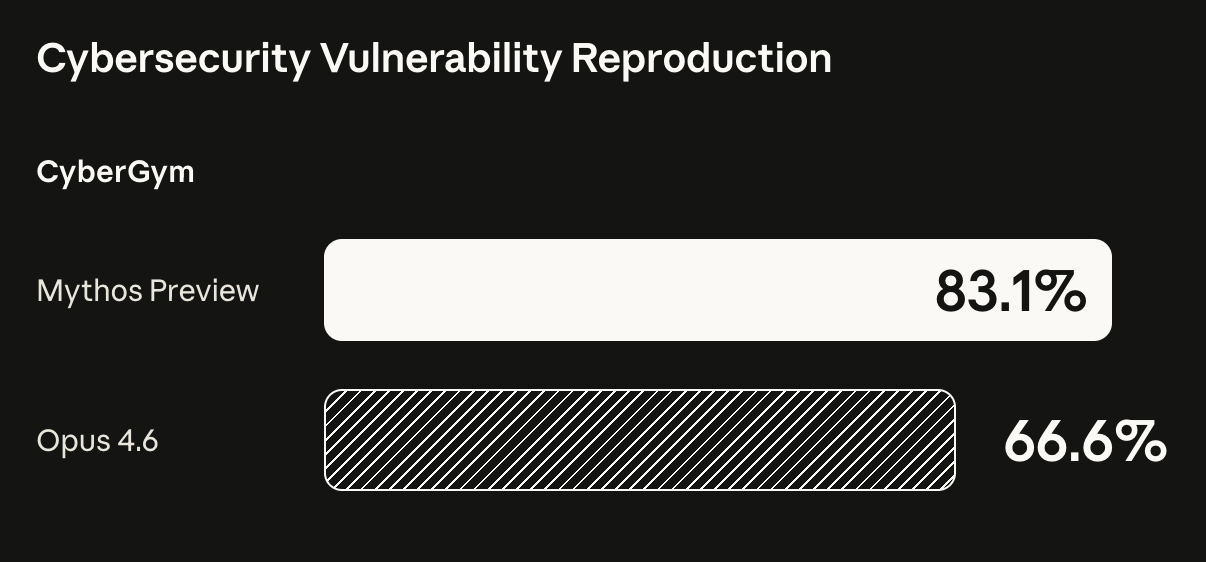
On evaluation benchmarks, Mythos also shows a断层级 (generational leap) evolution compared to Opus 4.6. For example, in cybersecurity vulnerability reproduction tests, Mythos achieved 83.1%, while Opus 4.6 scored 66.6%; it also achieved significant leads in multiple coding and reasoning tests.
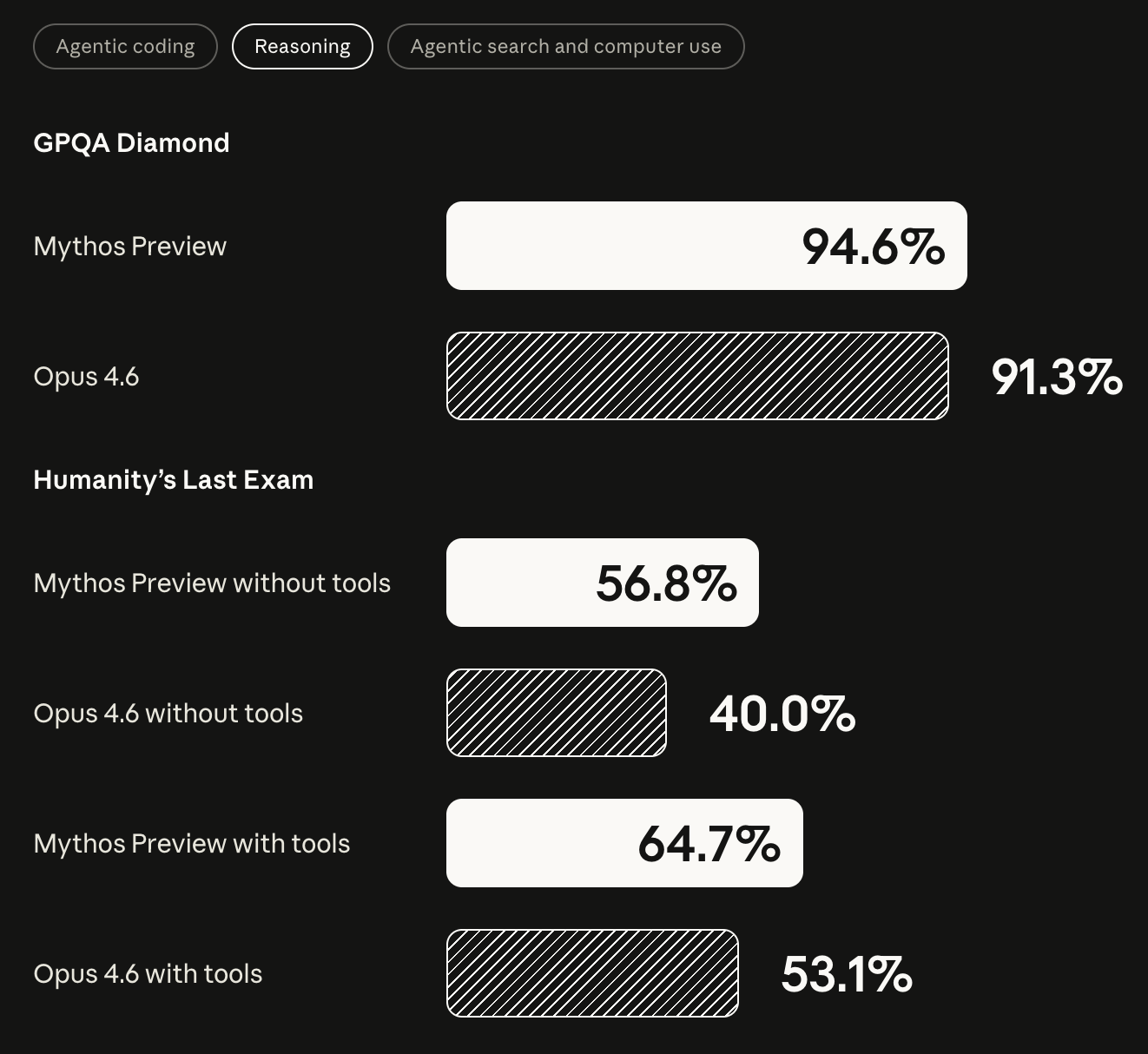
Perhaps precisely because Mythos's capabilities are too powerful, Anthropic did not choose to open the model directly but first launched the "Project Glasswing" initiative to allow the entire internet to "fortify" in advance.

Through this initiative, Anthropic will provide early access to the Mythos Preview version to participating parties, for use in discovering and fixing vulnerabilities or weaknesses in their foundational systems — focusing on tasks such as local vulnerability detection, black-box testing of binary programs, endpoint security hardening, and system penetration testing.

Anthropic also承诺 (committed) to provide participating parties with a total of $100 million in model usage credits to support usage throughout the research preview phase. Thereafter, the Mythos Preview version will be available to participants at a price of $25 per million input tokens / $125 per million output tokens (participants can also access the model via Claude API, Amazon Bedrock, Google Cloud Vertex AI, and Microsoft Foundry). In addition to the model usage credits, Anthropic will donate $2.5 million to the Linux Foundation for Alpha-Omega and OpenSSF, and $1.5 million to the Apache Software Foundation, to help open-source software maintainers cope with the evolving security landscape.

Anthropic plans to gradually expand the participation scope of "Project Glasswing" and continue推进 (advancing) it for several months, while sharing experiences as much as possible so that other organizations can apply the relevant insights to their own security construction. Within 90 days, Anthropic will publicly report阶段性成果 (phase results), including fixed vulnerabilities and disclosable security improvements.

Technology Will Only Keep Advancing, But There's No Need for Excessive Worry

AI is irreversibly changing the world we are familiar with, including the field of cybersecurity focused on in this article. As the门槛 (threshold) for discovering and exploiting vulnerabilities is significantly lowered, people inevitably worry: will AI become a sharp blade in the hands of malicious actors, threatening the existing balance of network security? (PS: For cryptocurrency users who need to place real money in wallet systems or on-chain protocols, this concern is particularly strong.)

Addressing this issue, Anthropic believes "there are still reasons for optimism." AI models are dangerous precisely because they have the capability to cause harm in the hands of wrongdoers. But at the same time, AI also holds immeasurable value in discovering and fixing critical software defects and developing newer, safer software.

It is predictable that AI capabilities will continue to evolve rapidly in the coming years. However, as new attack methods emerge, new defense mechanisms will also appear simultaneously. Technological upgrades are inevitable, but this does not mean the risk is必然失控 (necessarily uncontrollable) — as long as the defense system evolves同步 (synchronously), it might even be possible to use AI to build a higher-strength security moat.


Related Questions

QWhat is the name of Anthropic's new AI model and what makes it so powerful?

AThe new AI model is called Mythos. It is the first model in human history to exceed ten trillion parameters (compared to current mainstream models in the hundreds of billions to one trillion range) and was trained at a cost of $10 billion. It demonstrates a massive performance leap over its predecessor, Claude Opus 4.6, particularly in software coding, academic reasoning, and cybersecurity tests.

QWhy is Anthropic hesitant to publicly release the Mythos model immediately?

AAnthropic is hesitant to release Mythos immediately because its capabilities in autonomously discovering and exploiting software vulnerabilities are so advanced that the company fears it could be maliciously used by hackers. To mitigate this risk, they are first launching the 'Project Glasswing' initiative to allow major corporations to use a preview version to find and patch vulnerabilities in critical systems.

QWhat is the goal of Anthropic's 'Project Glasswing' initiative?

AThe goal of 'Project Glasswing' is a critical, urgent effort to protect the world's most crucial software. It involves a coalition of major tech and finance companies (like Amazon, Apple, Google, Microsoft, JPMorgan) who will employ the Mythos Preview version to discover and fix potential flaws in the systems the world relies on before the model is more widely available.

QWhat are some specific examples of vulnerabilities that Mythos was able to discover?

AIn just a few weeks, Mythos identified thousands of zero-day vulnerabilities. Specific examples include: a 27-year-old vulnerability in the 'extremely secure' OpenBSD system that allows remote crashes; a 16-year-old bug in the FFmpeg video processing library that had been triggered over 5 million times in automated tests but never found; and the ability to chain multiple Linux kernel vulnerabilities to escalate from user permissions to full server control.

QAccording to Anthropic, why should we remain optimistic about the rise of such powerful AI models in cybersecurity?

AAnthropic argues for optimism because while AI models like Mythos can be dangerous in the hands of malicious actors, they also possess immense value for discovering and repairing critical software defects and for developing new, more secure software. They believe that as new AI-powered attack methods emerge, new AI-powered defense mechanisms will also be developed, allowing security systems to evolve and potentially build even stronger defenses.

Related Reads

Must-Watch Events Next Week|CLARITY Act Could Face Senate Vote; SpaceX, Circle to Report Earnings (8.3-8.9)

**Summary: Key Events and Developments to Watch (August 3-9)** The upcoming week is marked by significant financial disclosures, key legislative deadlines, and notable product updates. **Major Financial Events:** Several companies are scheduled to release their Q2 2026 earnings. American Bitcoin (ABTC) will report on August 3, followed by SpaceX and Hut 8 Mining Corp. on August 4, and Circle on August 5. Notably, a significant portion of SpaceX shares (up to 12% of total shares) will be unlocked on August 6 following their earnings release. **Key Legislative Deadline:** The U.S. Senate faces an August 7 deadline to secure 60 votes for the CLARITY Act, a bipartisan bill aiming to establish a federal regulatory framework for cryptocurrencies. The Senate may hold a full vote on the bill during the week. **Economic Data:** The U.S. July Non-Farm Payrolls report will be released on August 7, providing crucial labor market data. **Technology & Product Updates:** * **Shutdowns:** DeFi portfolio tracker Zapper and wallet app Ctrl Wallet will cease operations on August 3. * **Upgrades:** LayerZero will deprecate its v1 relayers on August 3. XRP Ledger's new version 3.3.0, featuring five new functions, is expected next week. * **AI:** Elon Musk announced that the advanced Grok 4.6 AI model is set for release around August 7. * **Bitcoin:** The BIP-110 forced signaling for a potential Bitcoin network change is scheduled to begin around August 8. **Other Notable Events:** Chinese robotics firm Unitree Tech has set its preliminary price inquiry for its IPO for August 5. South Korean exchange Upbit will delist AQT and AERGO tokens on August 3.

marsbit49m ago

Must-Watch Events Next Week|CLARITY Act Could Face Senate Vote; SpaceX, Circle to Report Earnings (8.3-8.9)

marsbit49m ago

Stocks Are Plummeting More Sharply Than Cryptocurrencies. Where Has the Money Gone?

Stock Markets Plunge Deeper Than Cryptocurrencies: Where Did the Money Go? In late July, Seoul's Kospi index triggered circuit breakers for two consecutive days, plummeting over 40% from its June high. The collapse was led by heavyweight stocks like SK Hynix, whose record profits still disappointed investors, and devastating leveraged ETFs, with one major product losing over 83% of its value. This signaled a global, forced deleveraging targeting the most crowded trades. Interestingly, while stocks exhibited extreme volatility akin to crypto markets, Bitcoin rose nearly 15% in July after a prior steep drop. Analysis shows the money fleeing equities did not flow into Bitcoin. Instead, Bitcoin had already absorbed its sell-off in May-June, when U.S. spot Bitcoin ETFs saw historic outflows. The true safe-haven beneficiary was gold, whose price rose over 20% year-on-year, highlighting a decoupling between Bitcoin and gold as "digital gold." The sell-off was a targeted unwinding of leveraged positions in tech and semiconductors, accelerated by broker-dealer risk management and shifts in the AI narrative, including new competition from Chinese memory chipmakers. The retreat path was clear: from high-valuation tech stocks to cash and U.S. Treasuries, then to gold. For Bitcoin to attract sustained institutional inflows, conditions like eased global liquidity pressure, a "soft-landing" Fed rate cut, and U.S. regulatory clarity via legislation like the stalled CLARITY Act are needed. Currently, Bitcoin is not a safe haven but an already-cleared asset. Its low correlation with tech stocks, however, makes it a potential diversification play for institutional portfolios once the storm passes. The money isn't here yet, but the positioning is underway.

marsbit49m ago

Stocks Are Plummeting More Sharply Than Cryptocurrencies. Where Has the Money Gone?

marsbit49m ago

In Conversation with Ray Dalio: We Are Currently in an AI Bubble, with 1% of My Portfolio in Bitcoin

Ray Dalio, founder of Bridgewater Associates, warns in an interview that the current AI boom shows classic bubble characteristics, which could lead to significant economic downturns as seen in past cycles like 1929 or 2000. He explains that speculative enthusiasm, fueled by debt and overvaluation, often precedes a crash when rising rates or taxation force asset sales, causing widespread losses and recession. Dalio also outlines his "Big Cycle" theory, describing an approximate 80-year pattern where widening wealth gaps, massive government deficits, and shifting geopolitical power (like China's rise) create internal conflict and global instability. He emphasizes that we are in a late-cycle, transitional phase where traditional powers like the US and UK face decline. For personal wealth protection, Dalio advises diversification beyond cash into assets like stocks, bonds, real estate, and particularly gold, which he prefers over Bitcoin. While he holds about 1% of his portfolio in Bitcoin as a non-printable hard asset, he views gold as more secure from technological or governmental threats. Regarding AI's impact, Dalio believes it will disproportionately benefit capital owners, worsening inequality by replacing both physical and cognitive labor. He suggests that human intuition and emotional intelligence, combined with AI, will be key for future workers. On taxation, Dalio argues that wealth taxes are impractical and risk triggering asset sell-offs, reducing productive investment. He points to the UK as a cautionary example of debt, low productivity, and political strife. Geopolitically, Dalio foresees a more regionalized world, with the US showing weakness in prolonged conflicts like with Iran, akin to past imperial declines. The ideal outcome, he suggests, is coexisting powerful blocs (e.g., Americas, China-Asia Pacific) without major war.

marsbit4h ago

In Conversation with Ray Dalio: We Are Currently in an AI Bubble, with 1% of My Portfolio in Bitcoin

marsbit4h ago

Daily 7.2 Trillion KRW: Foreign Capital's Record Net Buying on Friday! Wall Street Says Headwinds for Korean Stock Fund Flows Have Subsided

South Korean stock market sees a dramatic shift in fund flows. On July 31, foreign investors made a record net purchase of approximately KRW 7.2 trillion in KOSPI stocks, marking a fundamental reversal from the persistent large-scale net outflows seen in previous months. This contributed to a significant narrowing of foreign net selling in July to KRW 9.8 trillion, down sharply from KRW 48.4 trillion in June and KRW 44.5 trillion in May. Simultaneously, domestic institutional pressure eased. South Korean pension funds and asset managers turned to a net buying position in July, purchasing KRW 1.0 trillion worth of KOSPI shares, contrasting with net sales in May and June. Market volatility is expected to be dampened by new financial regulations. Effective July 31, the Financial Services Commission tightened access for retail investors to single-stock leveraged ETFs by raising the minimum cash deposit requirement. Trading volumes for these products subsequently dropped to about 50% of their monthly average. Citigroup Research maintains its year-end KOSPI target of 10,000 points. The firm cites several supportive factors: the substantial easing of headwinds from capital outflows, a robust fundamental outlook for the semiconductor sector, historically low market valuations, strong economic fundamentals, and the potential for policy support from financial authorities if needed.

marsbit4h ago

Daily 7.2 Trillion KRW: Foreign Capital's Record Net Buying on Friday! Wall Street Says Headwinds for Korean Stock Fund Flows Have Subsided

marsbit4h ago

Trading

Spot
活动图片




