Anthropic and OpenAI Personally Sever the Logic of Pre-IPO Crypto-Stocks

Odaily星球日报Published on 2026-05-12Last updated on 2026-05-12

Abstract

The pre-IPO token market has been rocked by strong statements from Anthropic and OpenAI. Both AI giants have updated official warnings, declaring that any sale or transfer of their company shares without explicit board approval is "invalid" and will not be recognized on their corporate records. This directly targets Special Purpose Vehicles (SPVs), the common legal structure used by pre-IPO token platforms. These platforms typically use an SPV to acquire shares from employees or early investors, then issue blockchain-based tokens representing a claim on the SPV's economic benefits. Anthropic and OpenAI's position means that if an SPV's share purchase lacked authorization, the underlying asset could be deemed worthless, nullifying the token's value. Anthropic explicitly warned that any third party selling its shares—via direct sales, forwards, or tokens—is likely fraudulent or offering a valueless investment. The crackdown highlights risks in the popular SPV model, including complex multi-layered "Russian doll" SPV structures that obscure legal ownership, add fees, and concentrate risk. If one layer is invalidated, the entire chain could collapse. Following the announcements, tokens like ANTHROPIC and OPENAI on platforms like PreStocks fell sharply (over 20%). In contrast, purely speculative pre-IPO prediction contracts remained stable, as they involve no actual share ownership. The move is seen as a corrective measure amid a market frenzy where some pre-IPO token valuation...

Original | Odaily Planet Daily (@OdailyChina)

Author | Azuma (@azuma_eth)

The pre-IPO (Pre-IPO) stock token market has just experienced a severe shock. The epicenter of this earthquake stems from two statements issued by two major AI companies, Anthropic and OpenAI.

Anthropic and OpenAI Successively Declare They 'Do Not Acknowledge' Unauthorized Sales

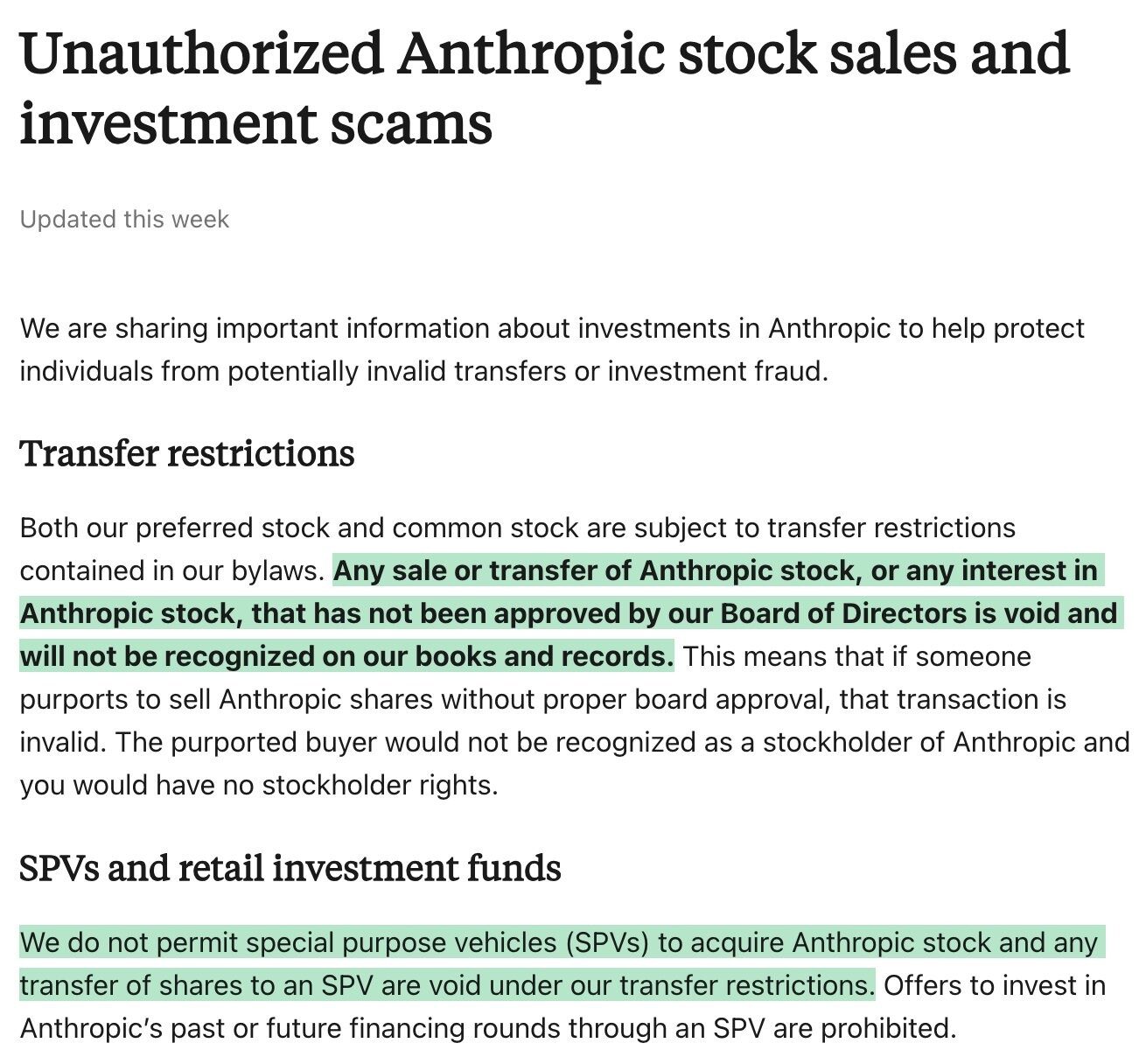
Today, Anthropic updated an official statement it released in February titled "On Unauthorized Sales of Anthropic Stock and Investment Scams".

Anthropic explicitly stated in the article: "Any sale or transfer of Anthropic stock that is not approved by our Board of Directors, or any disposition of economic interests in Anthropic stock, is invalid (note the term 'invalid') and will not be recognized on the company's books and records. This means that if someone sells Anthropic stock without board approval, the transaction will be deemed invalid. The purported buyer will not be recognized as a shareholder of Anthropic and will not enjoy any shareholder rights."
Shortly after Anthropic updated its statement, OpenAI also followed up with an announcement stating: "All equity is subject to transfer restrictions. No shares may be transferred, directly or indirectly, without the Company's written consent. Any sale without consent is not only unauthorized but also invalid."
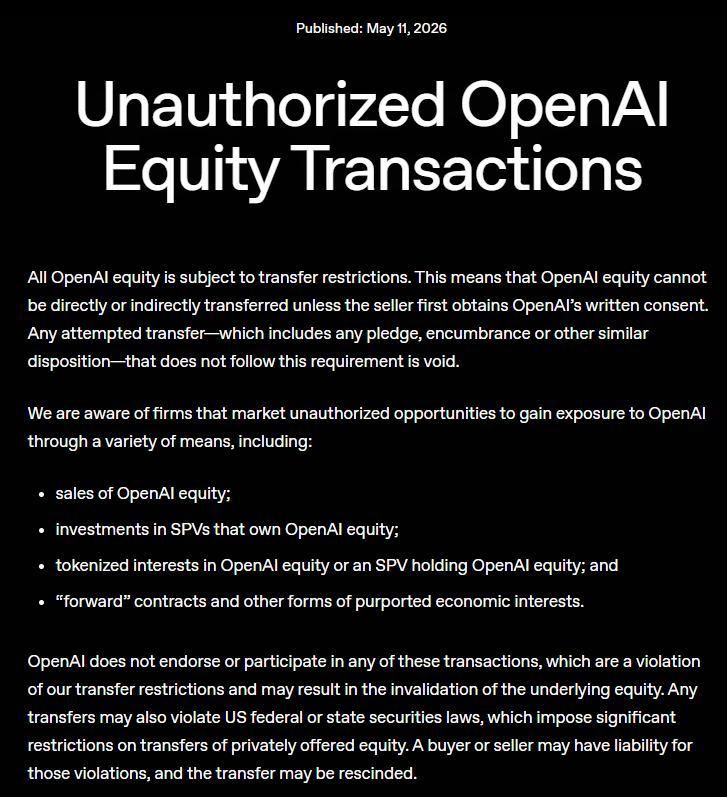
In their announcements, both Anthropic and OpenAI explained that the companies' preferred and common shares are subject to transfer restrictions stipulated in their charters, meaning all stock transfers require board consent.

Anthropic particularly emphasized that the company also does not permit "Special Purpose Vehicles" (SPVs) to acquire its shares, and any transfer of shares to an SPV violates the company's transfer restrictions...... Certain investment funds may claim to provide indirect access to Anthropic stock, but these funds are likely attempting to circumvent transfer restrictions. Therefore, any third party claiming to sell Anthropic stock to the public — whether through direct sales, forward contracts, stock tokens, or other mechanisms — may be engaged in fraud or offering worthless investments due to Anthropic's transfer restrictions.
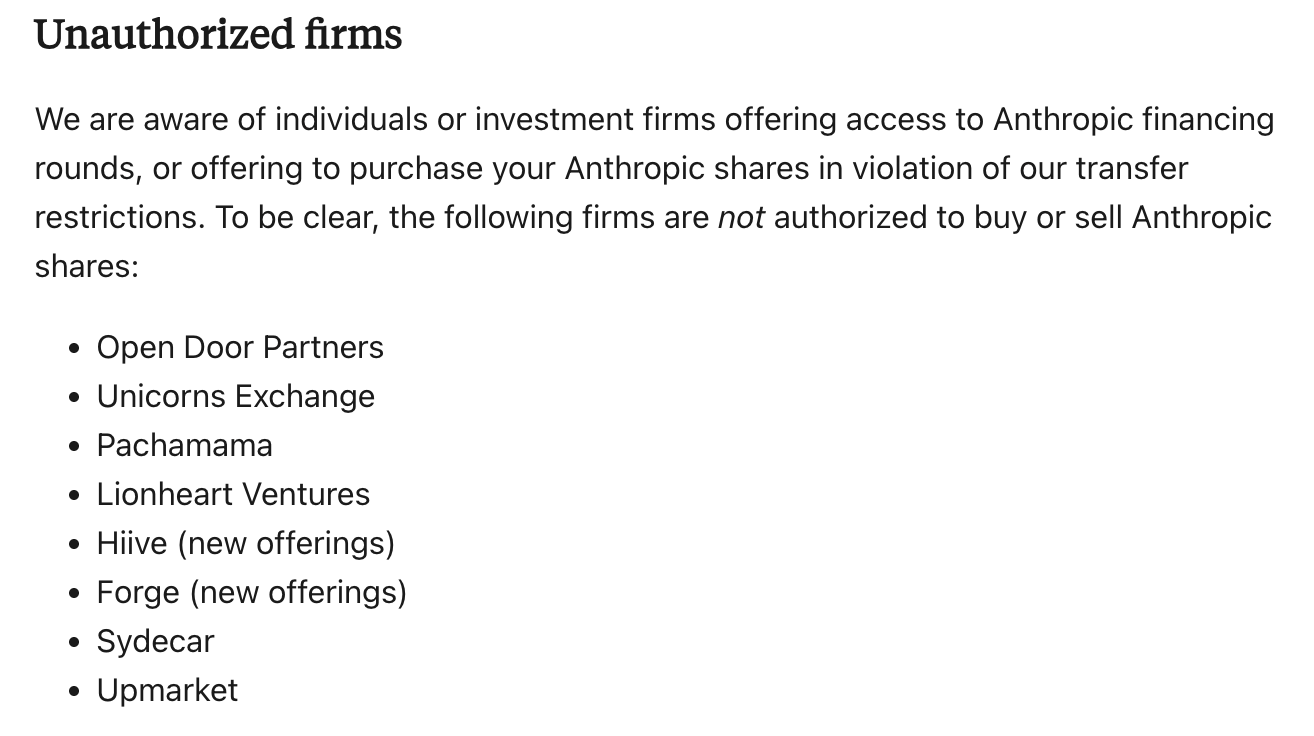
  • Odaily Note: The image shows platforms named by Anthropic for unauthorized equity transfers.

What is an SPV?

To understand why this update has such a massive impact on the pre-IPO stock token market, one must first understand what an SPV is.

In traditional pre-IPO stock trading, directly transferring original shares is extremely difficult, restricted not only by company charters but also involving complex legal procedures. In this context, SPVs emerged.

An SPV is a legal entity established separately for a specific transaction or investment purpose, which can be understood as a 'shell company specifically used to hold a certain asset' — multiple investors can indirectly hold shares in a company or a type of asset by contributing capital to the same SPV, thereby achieving centralized ownership, lowering entry barriers, and optimizing legal and tax structures. SPVs are especially common in popular pre-IPO stock trades. As many star companies are often unwilling to directly introduce a large number of small shareholders, institutions typically first establish an SPV, which then uniformly invests in the target company.

For example, the so-called "early participation in Anthropic or OpenAI share subscriptions" in the market essentially involves investors first contributing capital to an SPV, which then uniformly acquires the unlisted equity of Anthropic.

Currently, most pre-IPO stock token platforms in the market (such as Prestock) adopt the SPV structure.

  • The platform or its partners will register an SPV in a certain jurisdiction. The sole task of this SPV is to buy original shares of Anthropic in the secondary market (usually from employees or early investors);
  • The platform then issues derivative tokens on-chain (such as ANTHROPIC or OPENAI), which are legally defined in agreements as "claims to the economic benefits of that SPV";
  • In theory, these tokens are 1:1 pegged to the original shares; for every token issued, the offline SPV should hold a corresponding share of stock.

But now the problem is, Anthropic and OpenAI have explicitly stated they 'do not acknowledge unauthorized stock transfers'. This means if an SPV transfers stock without board approval (which is basically impossible to obtain), the stock held by that SPV may be considered invalid in the eyes of Anthropic and OpenAI — if the SPV's stock is invalid, then the "economic benefits" referenced by the on-chain tokens become worthless.

The Risk of SPV "Nesting"

A significant reason why Anthropic and OpenAI are so resistant to SPVs is that with the ongoing speculative frenzy around their pre-IPO stock tokens (Anthropic's pre-IPO valuation once soared to $1.4 trillion, far higher than its last funding round valuation), the risk of SPVs becoming over-financialized has begun to surface.

Among these risks, the "nesting" problem of SPVs is most noteworthy — many investors buying pre-IPO stock tokens believe they are purchasing company shares, but in reality, they only hold claims to the economic benefits of some SPV. Even more exaggeratedly, many SPVs do not directly hold Anthropic's original shares but are themselves nested two or three SPV layers down.

This "nesting" structure is, in fact, very dangerous.

  • Legal Transparency Issues: With each additional layer, the authenticity of the underlying asset becomes more ambiguous. Investors find it difficult to confirm whether the SPV at the very bottom has actually received board approval for the transfer.
  • Management Fee Exploitation: Each SPV layer charges management fees, performance fees, and dividends. After layers of skimming, investors' actual returns are severely diluted.
  • Risk of Wipeout: If the equity transfer at any layer is deemed "invalid" by Anthropic, the entire value chain can collapse instantly.

Whether for reputation or investor protection considerations, Anthropic and OpenAI clearly do not want to see this situation.

Pre-IPO Stock Tokens Plunge, Contracts Remain Relatively Stable

Once the announcements from Anthropic and OpenAI spread, the market reacted immediately.

ANTHROPIC on PreStocks plunged sharply, once falling below $1,000, temporarily reported at $1,082 as of 12:00, down 20.62% for the day; OPENAI temporarily reported at $1,440, down 26.82% for the day.
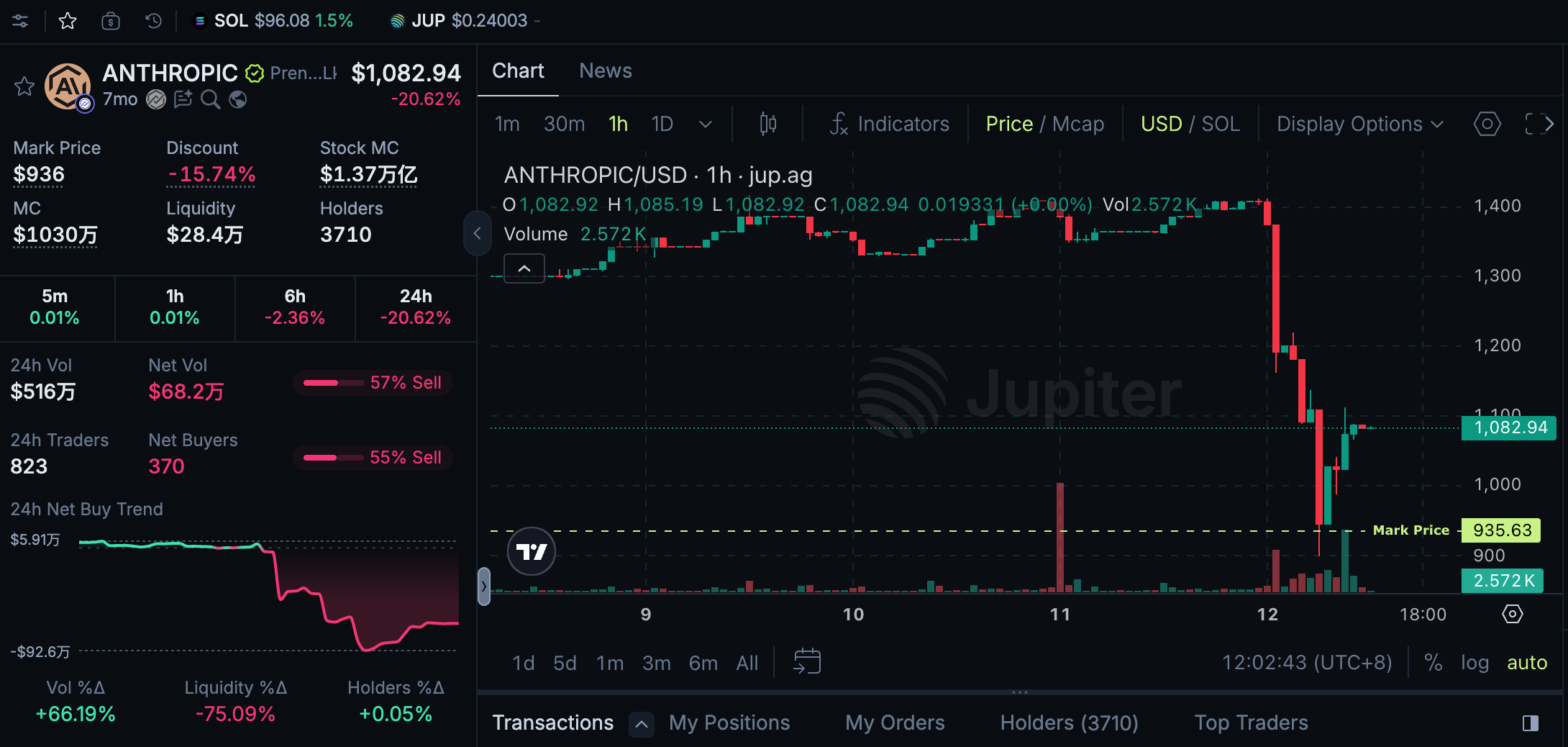
Investors' panic is easily understood. Since Anthropic and OpenAI explicitly stated they do not acknowledge unauthorized holdings, the "rights" behind these tokens face the probability of becoming "worthless paper," and holders may face significant risks in confirming ownership and legal litigation costs.

Interestingly, while pre-IPO stock tokens were under pressure, another type of pre-IPO trading product performed relatively stably — pre-IPO contracts that rely entirely on market bilateral speculation. This is because such products do not inherently hold any real stock; the restrictions by Anthropic and OpenAI have no direct impact on them. They are essentially "bilateral bets" on the future IPO price, relying on price competition between buyers and sellers.

Future Trend Predictions

Facing Anthropic and OpenAI's "non-acknowledgment" stance, two contrasting voices have emerged within the industry.

Some believe the logic of pre-IPO crypto-stock trading is dead. If headliners like Anthropic and OpenAI take the lead in banning SPVs, other giants may follow suit. With the backing of equity rights being shaken, whether pre-IPO stock tokens still hold value is questionable.

However, others, including Rivet founder Nick Abouzeid, believe this is not a big deal. Trading pre-IPO stock tokens through unofficial channels is inherently a gamble; buyers should have been prepared for the possibility that the "company would not acknowledge" them from day one — what you lack is direct investment opportunities; obtaining such opportunities through other means always carries certain risks.

In summary, with the continuous expansion of pre-IPO stock token premiums and increasingly fervent market sentiment, the stance of Anthropic and OpenAI undoubtedly pours a bucket of cold water on the entire sector.

Over the past few months, more and more investors have begun to view pre-IPO stock tokens as a "low-barrier channel to participate in the growth of top AI companies." The valuations of some AI-concept pre-IPO stock tokens have clearly detached from reality, even experiencing frenzied speculation far exceeding the valuations of their last funding rounds. Against this backdrop, the public "debunking" by Anthropic and OpenAI is, in a way, redrawing boundaries for this wildly growing new market.

For speculators, this is a risk education; but for the industry's long-term development, the market may also need such a "de-bubbling" moment.


Related Questions

QWhat did Anthropic and OpenAI declare regarding the transfer of their stocks?

ABoth Anthropic and OpenAI declared that any transfer or sale of their company stock without the express approval of their respective boards of directors is unauthorized and considered 'invalid.' They will not recognize such transfers on their company books and records, meaning buyers in these unauthorized transactions would not be considered shareholders and would have no shareholder rights.

QWhat is an SPV (Special Purpose Vehicle) and what is its role in pre-IPO stock token trading?

AA Special Purpose Vehicle (SPV) is a legal entity created for a specific transaction or investment purpose, often acting as a 'shell company' to hold an asset. In pre-IPO stock token trading, platforms use SPVs to indirectly acquire shares of a target company (like Anthropic) from employees or early investors. The platform then issues blockchain tokens representing a claim on the economic benefits of the SPV, theoretically pegged 1:1 to the underlying shares.

QWhy did the announcements by Anthropic and OpenAI cause a significant drop in the price of pre-IPO stock tokens?

AThe announcements caused a significant price drop because they fundamentally questioned the value of the underlying assets. By declaring unauthorized stock transfers 'invalid,' Anthropic and OpenAI implied that the shares held by the SPVs backing the tokens might be worthless. This creates substantial legal and ownership risks for token holders, leading to panic selling and a loss of confidence in these instruments.

QWhat is the 'nesting doll' risk associated with SPVs mentioned in the article?

AThe 'nesting doll' risk refers to a structure where an SPV does not directly hold the target company's shares but instead holds interests in other SPVs, which themselves may hold shares or interests in further SPVs. This creates several dangers: it obscures the true ownership and validity of the underlying shares, subjects investor returns to multiple layers of management fees, and increases the risk of total loss ('going to zero') if any layer in the chain is deemed invalid by the target company.

QAccording to the article, how did pre-IPO stock futures contracts react compared to the token market after the announcements?

AAccording to the article, pre-IPO stock futures contracts remained relatively stable compared to the collapsing token market. This is because these futures contracts are purely speculative derivatives based on the future IPO price and do not involve any claim on or holding of the actual company shares. Therefore, they were not directly affected by Anthropic's and OpenAI's statements regarding the invalidity of unauthorized share transfers.

Related Reads

AI PC Battle: Bet on the Toll Booth, Not the Camp

**Title:** The AI PC Battle: Don't Bet on Sides, Bet on the Tollbooth **Summary:** The AI PC competition is moving beyond simple "x86 vs. Arm" narratives. The core investment thesis should focus on identifying which players can sustain margins, cash flow, and pricing power throughout the upgrade cycle, rather than backing a particular architecture. The opportunity is analyzed in three layers: 1. **The Advanced Foundry Tollbooth:** TSMC is positioned to collect "tolls" regardless of which chip designer wins, due to its dominant ~70% share in advanced semiconductor manufacturing, which is essential for high-end AI PC chips. 2. **Compute & Platform Spillover:** AMD represents an offensive in the x86 CPU+GPU space, while NVIDIA leverages its GPU and CUDA software stack dominance. Both benefit from the demand for increased local AI compute. 3. **Architecture Diffusion & Turnaround Plays:** ARM and Intel offer potential for significant upside (elasticity), but investments here require stricter discipline due to higher execution risks and competitive challenges. The industry is transitioning from concept to shipment validation. While short-term forecasts for AI PC adoption have been revised down slightly due to tariffs and procurement delays, the long-term trend towards AI becoming a standard PC feature remains intact. The key driver for upgrade cycles will be whether compelling enterprise applications (e.g., privacy-sensitive computing, low-latency inference) emerge beyond consumer-focused features like meeting summarization. Investment strategy should prioritize companies with platform-level advantages and recurring revenue streams. TSMC offers high certainty as the foundational tollbooth. AMD presents a strong offensive play within the established ecosystem. ARM and Intel are higher-risk, higher-potential-reward turnaround bets. The report cautions against chasing short-term hype and emphasizes a disciplined, long-term approach focused on buying ecosystem strength and cash-flow certainty after market enthusiasm subsides. **Key Risks:** Underwhelming AI PC applications slowing upgrade cycles; slow improvement in Windows on Arm compatibility; macro/tariff impacts on PC demand; potential advanced node supply-demand mismatches affecting TSMC; high overall AI sector valuations making stocks vulnerable to a risk-off shift in markets.

marsbit10m ago

AI PC Battle: Bet on the Toll Booth, Not the Camp

marsbit10m ago

Ten-Thousand-Word Analysis: From $10 to $290, MRVL Wins the Entire AI Era by 'Not Making GPUs'

Marvell Technology's stock price surged from under $10 in 2016 to a record $290 in June 2026, fueled not by making GPUs, but by dominating AI infrastructure connectivity. This analysis argues the market misvalues MRVL as merely a smaller Broadcom in custom AI chips, overlooking its true, unique position. Marvell's core strength lies in enabling high-speed data flow for AI clusters through three interconnected businesses. First, it holds a commanding ~70% market share in high-speed optical DSPs (essential for data center light modules), a deep-moat business with accelerating growth. Second, its custom AI chip design business serves hyperscalers like AWS, Microsoft, and Google, with a significant revenue pipeline despite lower margins. Third, stable cash flows come from Ethernet switch chips and enterprise storage controllers. Together, they form a full-stack "AI data movement" platform. CEO Matt Murphy's transformative leadership since 2016, involving strategic divestments, key acquisitions (like Inphi for optical DSPs), and securing long-term agreements with major cloud providers, repositioned the company. A pivotal $2 billion strategic investment from NVIDIA in 2026 underscored Marvell's critical role in the AI ecosystem, particularly through collaborations like NVLink Fusion. While Marvell faces risks—including client concentration (losing the Amazon Trainium3 design), lower-margin business mix, competitive threats, insider selling, and complex supply chains—its fundamentals remain strong. The optical interconnect moat is widening with the acquisition of Celestial AI (photonics fabric), and financial metrics show accelerating revenue growth and operating leverage. With a PEG ratio suggesting undervaluation relative to its growth, the thesis is that the market undervalues Marvell's monopolistic position in AI "plumbing" while overemphasizing its competitive custom chip segment. The story transcends investing, symbolizing how in any complex system—from the internet to AI—the value of "connection" ultimately surpasses that of individual "nodes."

marsbit40m ago

Ten-Thousand-Word Analysis: From $10 to $290, MRVL Wins the Entire AI Era by 'Not Making GPUs'

marsbit40m ago

AI Relay Stations Spark Heated Debate on Zhihu: Behind Cheap Tokens, What Are Users Really Worried About?

A discussion on Zhihu about "AI relay stations" shifted the niche developer topic of "cheap tokens" into broader user awareness. Users moved beyond simply questioning the legitimacy of these services to focus on practical concerns: Where do cheap tokens truly come from? Is the model being accessed the real one? Can relay stations see prompts, code, and API keys? For occasional users, are the risks worth it? The core debate centered less on price and more on trust. A primary worry is model authenticity—the risk of "model swapping," where users paying for a premium model might be routed to a cheaper one, creating an information asymmetry. Others argued that cost comparisons matter; while cheaper than official pay-as-you-go APIs, relay stations may not be the lowest-cost option versus subscriptions, domestic models, or free tiers, making user needs assessment crucial. Speculation about token sources ranged from legitimate bulk discounts to gray-area methods like account sharing or exploiting regional pricing. This opacity makes risk assessment difficult for users. Data security emerged as a critical concern, especially for enterprise use. When processing sensitive information like code, contracts, or client data, the inability to verify a relay station's data handling, retention, or access policies poses significant compliance and confidentiality risks. The evolving consensus suggests relay stations can be used cautiously for low-sensitivity, disposable tasks (e.g., summarizing public info, simple translation). However, they should not be the default for sensitive, professional, or production workflows involving proprietary data, Agents, or automated systems. Recommendations include avoiding large prepayments, not relying on a single service, using test prompts to monitor quality, anonymizing data where possible, and keeping official channels as backups. Ultimately, the discussion framed tokens not just as a billing unit but as a measure of real cost encompassing price, model integrity, data security, and service stability. The popularity of relay stations highlights user demand for affordable access, but the debate underscores a key trade-off: the savings from cheap tokens may come at the price of trust, transparency, and control over one's data and AI experience.

marsbit1h ago

AI Relay Stations Spark Heated Debate on Zhihu: Behind Cheap Tokens, What Are Users Really Worried About?

marsbit1h ago

In-Depth Research Report on TradFi: The Convergence Wave of Crypto and Traditional Finance

In 2026, the crypto industry is undergoing a profound infrastructure-level transformation—TradFi assets are migrating on-chain at an unprecedented pace. According to CoinGecko's Q1 2026 report, the total value locked (TVL) of tokenized real-world assets (RWA) has surpassed $31 billion, a nearly 4x increase from $7.8 billion at the beginning of 2025, with the sector’s aggregate market capitalization reaching $19.3 billion. Among these, the market cap of tokenized stocks surged from $2 million to $486 million, with Q1 spot trading volume reaching $15.1 billion—a single quarter already surpassing the entire second half of 2025. RWA perpetual contract Q1 trading volume reached a staggering $524.8 billion, far exceeding the $313 billion for all of 2025. Meanwhile, BlackRock's BUIDL fund has reached $2.3 billion in scale and has filed for two new tokenized funds, signaling that the world's largest asset manager's tokenization strategy is evolving from pilot to product suite expansion. HTX, as a core participant in the crypto exchange sector, officially launched TradFi perpetual futures products including NVDA, AAPL, MSFT, META, and SPY in 2026, enabling crypto users to gain 24/7 trading access to core U.S. equities. Boston Consulting Group predicts that global tokenized asset scale could reach $16 trillion by 2030, while McKinsey offers a conservative estimate of approximately $2 trillion. The on-chain migration of TradFi assets is no longer a "future narrative" but a structural transformation unfolding in real time, as crypto exchanges evolve from single crypto asset trading platforms toward "multi-asset-class trading infrastructure."

HTX Learn1h ago

In-Depth Research Report on TradFi: The Convergence Wave of Crypto and Traditional Finance

HTX Learn1h ago

Trading

Spot
Futures
活动图片




