Anthropic and OpenAI Have Single-Handedly Severed the Logic of Pre-IPO Stock Tokenization

marsbitPublished on 2026-05-12Last updated on 2026-05-12

Abstract

The pre-IPO stock token market is experiencing significant turmoil following strong statements from AI giants Anthropic and OpenAI. Both companies have updated their official policies, declaring that any transfer of their company shares—including sales, transfers, or assignments of share interests—without prior board approval is "invalid" and will not be recognized in their corporate records. This means buyers in such unauthorized transactions would not be recognized as shareholders and would have no shareholder rights. A major point of contention is the use of Special Purpose Vehicles (SPVs), which are legal entities commonly used by pre-IPO token platforms to pool investor funds and indirectly acquire shares from employees or early investors. The companies explicitly state they do not permit SPVs to acquire their shares, and any such transfer violates their restrictions. They warn that third parties selling shares through SPVs, direct sales, forward contracts, or stock tokens are likely engaged in fraud or are offering worthless investments due to these transfer limits. This stance directly threatens the core model of many pre-IPO token platforms, which rely on SPV structures. The announcement revealed additional risks within this model, such as complex "SPV-within-SPV" layering that obscures legal transparency, increases management fees, and creates a chain reaction risk of invalidation. Following the news, tokens like ANTHROPIC and OPENAI on platforms like PreStocks fel...

Original | Odaily Planet Daily (@OdailyChina)

Author | Azuma (@azuma_eth)

The pre-IPO stock token market has just experienced a severe shockwave. The epicenter of this earthquake comes from two statements issued by AI giants Anthropic and OpenAI.

Anthropic and OpenAI Successively State They "Do Not Recognize" Unauthorized Transfers

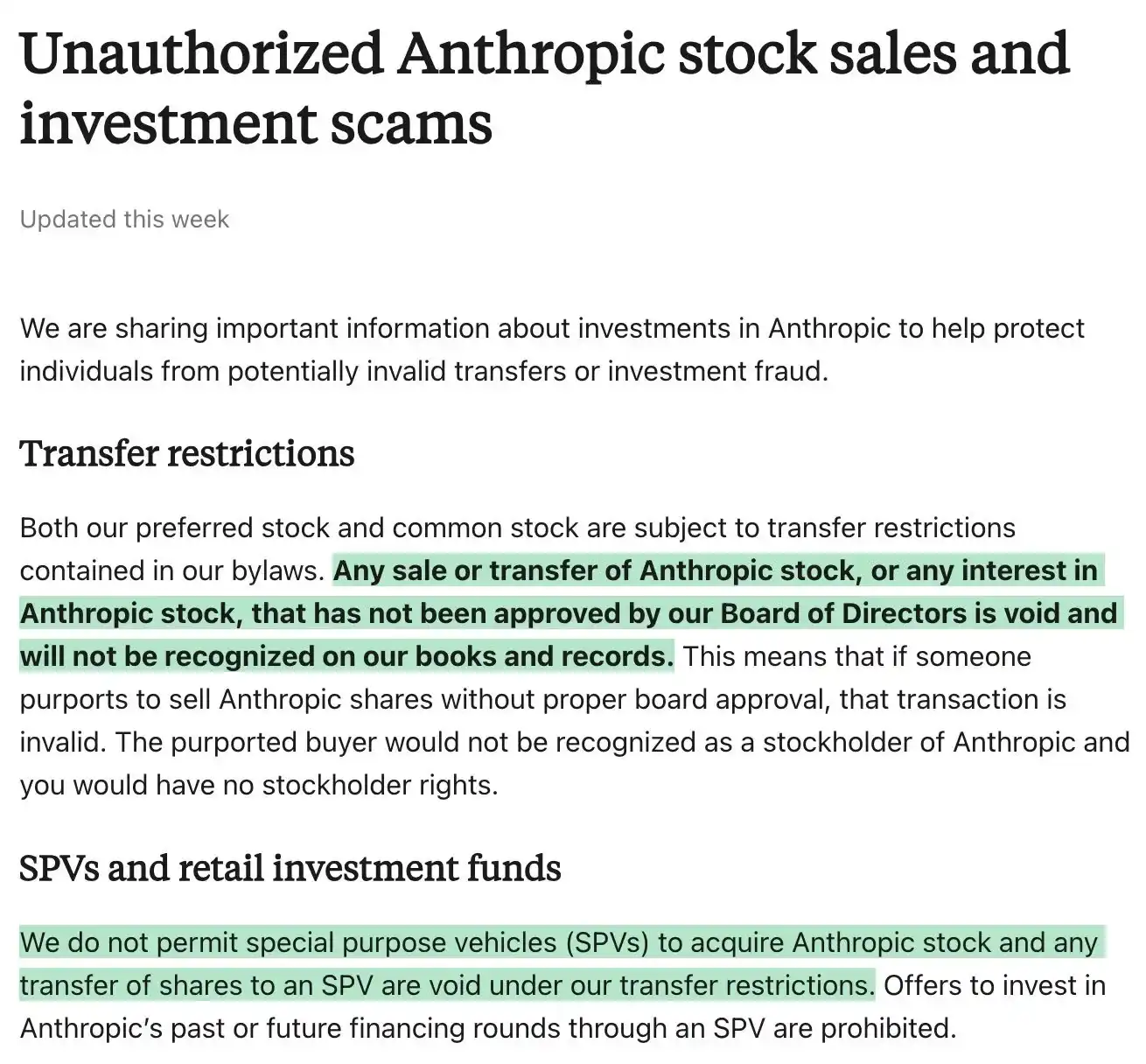
Today, Anthropic updated an official statement it released in February titled "On Unauthorized Anthropic Stock Sales and Investment Scams."

In the article, Anthropic explicitly stated: "Any sale or transfer of Anthropic stock, or disposition of an interest in Anthropic stock, that has not been approved by our board of directors, is invalid (note the use of 'invalid') and will not be recognized on the company's books and records. This means that if anyone sells Anthropic stock without board approval, the transaction will be deemed invalid. The purported buyer will not be recognized as an Anthropic shareholder and will not enjoy any shareholder rights."
Shortly after Anthropic updated its statement, OpenAI also followed up with an announcement stating: "All equity interests are subject to transfer restrictions. No shares may be transferred directly or indirectly without the written consent of the company. Any sale without consent is not only unauthorized but also invalid."
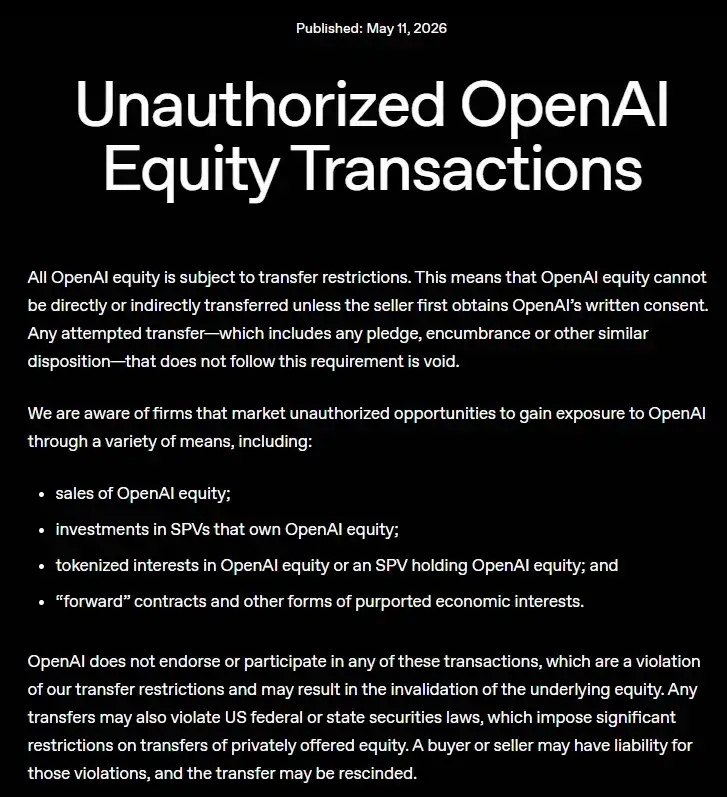
In their announcements, both Anthropic and OpenAI explained that the companies' preferred and common stock are subject to transfer restrictions stipulated in their charters, meaning all stock transfers require board approval.

Anthropic also emphasized, "The company also does not permit the acquisition of Anthropic shares by 'Special Purpose Vehicles' (SPVs). Any transfer of shares to an SPV violates the company's transfer restrictions... Some investment funds may claim to offer indirect access to Anthropic shares, but these funds are likely attempting to circumvent transfer restrictions. Therefore, any third party claiming to sell Anthropic shares to the public — whether through direct sales, forward contracts, stock tokens, or other mechanisms — may be involved in fraud or offering worthless investments due to Anthropic's transfer restrictions."
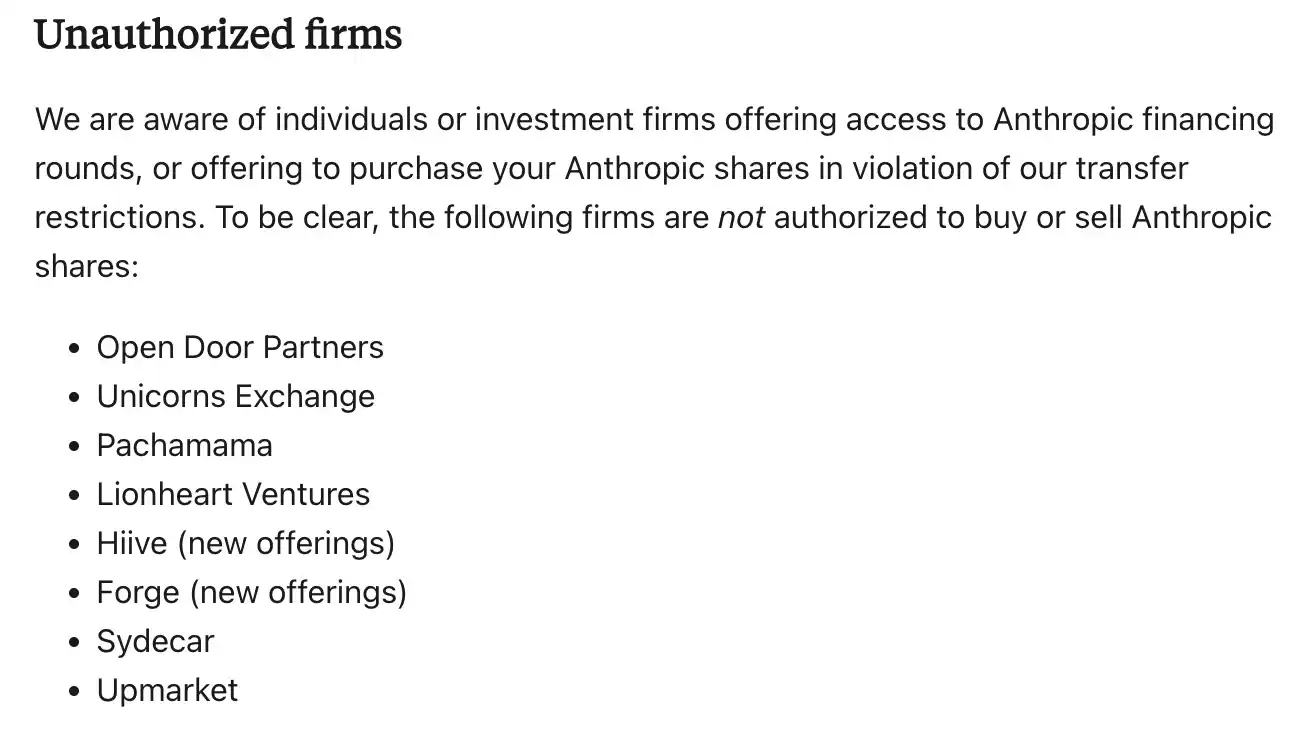
  • Odaily Note: The image shows unauthorized equity transfer platforms named by Anthropic.

What is an SPV?

To understand why this update has had such a massive impact on the pre-IPO stock token market, one must first understand what an SPV is.

In traditional pre-IPO stock trading, directly transferring original shares is extremely difficult, restricted not only by company charters but also involving complex legal procedures. In this context, SPVs emerged.

An SPV is a legal entity established specifically for a particular transaction or investment purpose. It can be understood as a 'shell company dedicated to holding a specific asset.' Multiple investors can indirectly hold shares in a company or a certain asset by contributing capital to the same SPV, achieving goals such as centralized ownership, lowered entry barriers, and optimized legal and tax structures. SPVs are particularly common in popular pre-IPO stock trading. Since many high-profile companies are often unwilling to directly introduce numerous small shareholders, institutions typically first set up an SPV, which then uniformly invests in the target company.

For example, so-called "early participation in Anthropic or OpenAI share subscriptions" in the market essentially involves investors first contributing capital to an SPV, which then purchases the unlisted equity of Anthropic or OpenAI.

Currently, most pre-IPO stock token platforms (such as Prestock) adopt the SPV structure.

  • The platform or its partners will register an SPV in a certain jurisdiction. The sole purpose of this SPV is to buy original Anthropic shares in the secondary market (usually from employees or early investors).
  • The platform will then issue derivative tokens on-chain (e.g., ANTHROPIC or OPENAI), which are legally defined in agreements as "claims to the economic benefits of that SPV."
  • Theoretically, these tokens are 1:1 pegged to the original shares. For every token issued, the underlying SPV should hold a corresponding share of stock.

The problem now is that Anthropic and OpenAI have now explicitly stated they 'do not recognize unauthorized stock transfers.' This means if an SPV transfers stock without board approval (which is highly unlikely to be granted), the stock held by that SPV may be considered invalid in the eyes of Anthropic and OpenAI. If the stock held by the SPV is invalid, then the "economic benefits" referenced by the on-chain tokens become worthless.

The Risk of SPV "Nesting"

A significant reason for Anthropic and OpenAI's strong opposition to SPVs is the growing risk of over-financialization as their pre-IPO stock tokens continue to be hotly traded (Anthropic's pre-IPO valuation once soared to $1.4 trillion, far exceeding its last funding round valuation).

Among these risks, the "nesting" of SPVs is most concerning — many investors buying pre-IPO stock tokens believe they are purchasing company shares, but are actually only buying claims to the economic benefits of an SPV. More exaggeratedly, many SPVs do not directly hold Anthropic's original shares but are instead nested two or three SPV layers down.

This "nesting" structure is, in fact, very dangerous.

  • Legal Transparency Issues: With each additional layer, the authenticity of the underlying assets becomes more blurred. Investors find it difficult to confirm whether the bottom-most SPV has actually obtained the company's board transfer approval.
  • Management Fee Exploitation: Each layer of SPV charges management fees, performance fees, and dividends. After layer-by-layer skimming, investors' actual returns are severely diluted.
  • Zeroing Risk: If the equity transfer at any layer is deemed "invalid" by Anthropic, the entire value chain could instantly collapse.

Whether for reputational reasons or investor protection, Anthropic and OpenAI clearly do not want to see this situation.

Pre-IPO Stock Tokens Plummet, Contracts Remain Relatively Stable

Once the announcements from Anthropic and OpenAI spread, the market immediately reacted.

ANTHROPIC on PreStocks plunged sharply, falling below $1,000 at its lowest, temporarily reported at $1,082 as of 12:00, down 20.62% for the day; OPENAI was temporarily reported at $1,440, down 26.82% for the day.
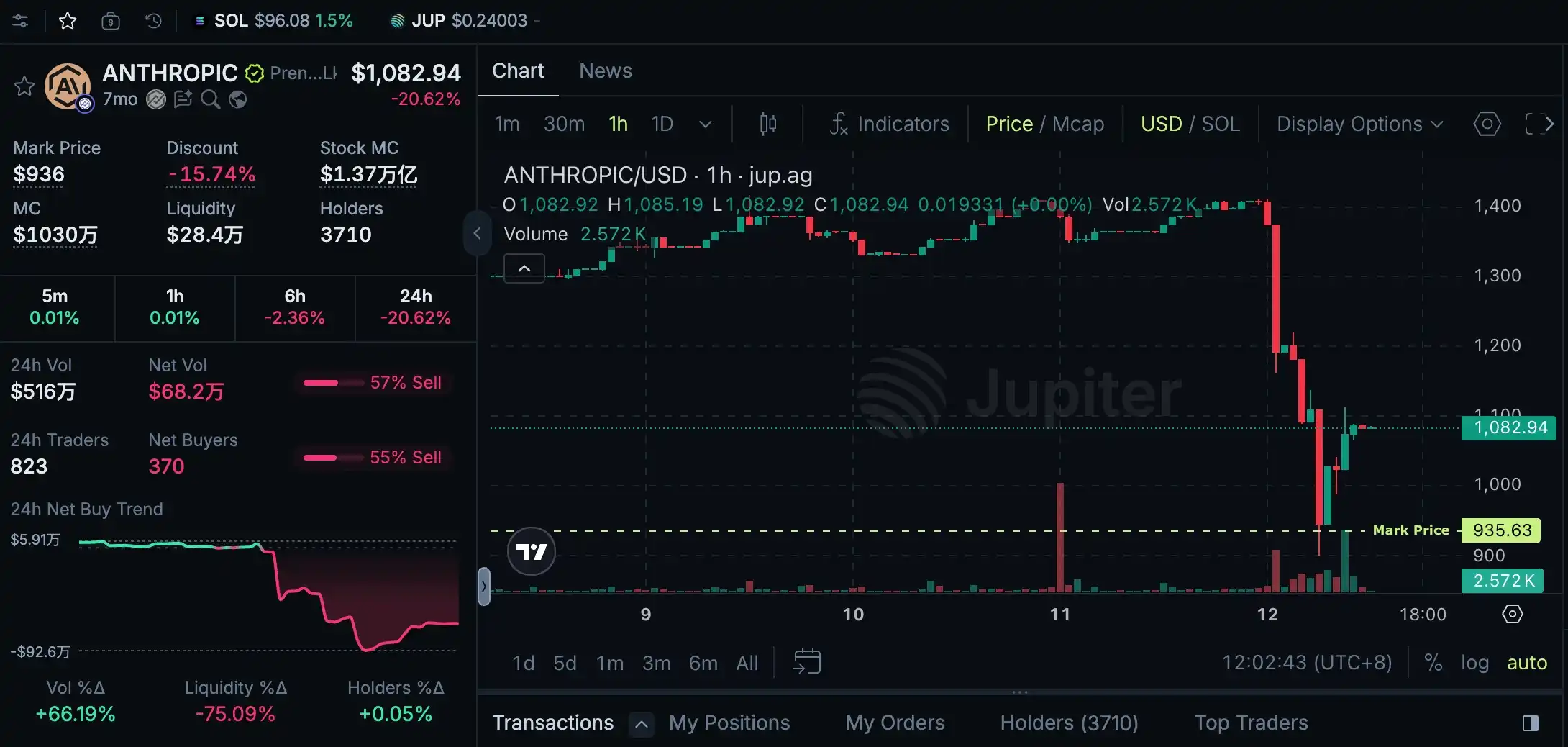
Investor panic is easily understood. Since Anthropic and OpenAI explicitly stated they do not recognize unauthorized shareholdings, the "rights" behind these tokens face the probability of becoming "worthless paper." Holders may confront significant claim validation risks and legal litigation costs.

Interestingly, while pre-IPO stock tokens came under pressure, another type of pre-IPO stock trading product performed relatively stably — pre-IPO contracts that rely entirely on market-driven bilateral betting. The reason for this is that such products do not hold any real stock; Anthropic and OpenAI's restrictions have no effect on them. They are essentially "bilateral betting pools" on future IPO prices, relying on price competition between buyers and sellers.

Predictions for Future Direction

In response to Anthropic and OpenAI's "non-recognition" statements, two distinctly different voices have emerged in the industry.

Some believe the logic of pre-IPO tokenized stock trading is dead. If headliners like Anthropic and OpenAI are leading the charge to ban SPVs, other giants may follow suit. With equity backing being questioned, the value of so-called pre-IPO stock tokens is in doubt.

However, others, including Rivet founder Nick Abouzeid, believe this is not a cause for alarm. Trading pre-IPO stock tokens through unofficial channels was always a gamble; buyers should have had the awareness from day one that the "company might not recognize" the shares. What you lack is direct investment opportunity; obtaining that opportunity through other channels always carries certain risks.

In summary, at a time when premiums for pre-IPO stock tokens have continued to expand and market sentiment has grown increasingly feverish, Anthropic and OpenAI's statements undoubtedly pour cold water on the entire sector.

Over the past few months, more and more investors have begun viewing pre-IPO stock tokens as a 'low-barrier channel to participate in the growth of top AI companies.' Valuations for some AI-concept pre-IPO stock tokens have significantly detached from reality, with even crazy speculation far exceeding the valuations of the last funding rounds. Against this backdrop, the public "debunking" by Anthropic and OpenAI, in a way, is also about redrawing the boundaries for this wildly growing new market.

For speculators, this is a lesson in risk; but for the long-term development of the industry, the market may also need such a moment of "de-bubbling."


Related Questions

QAccording to the article, what did Anthropic and OpenAI announce regarding unauthorized stock transfers?

ABoth Anthropic and OpenAI announced that any sale or transfer of their company stock without board approval is unauthorized and invalid. They will not recognize such transactions on their books, meaning buyers of such shares will not be considered shareholders and will have no shareholder rights.

QWhat is an SPV, and how was it typically used in the pre-IPO stock token market as described?

AAn SPV (Special Purpose Vehicle) is a legal entity created for a specific transaction or investment. In the pre-IPO token market, platforms would use an SPV to purchase company stock (e.g., from employees). They would then issue tokens on a blockchain, which represented a claim on the economic benefits of that SPV, theoretically 1:1 with the underlying shares.

QWhy does the article consider the multi-layered 'nesting' of SPVs particularly risky?

AMulti-layered 'nesting' of SPVs is risky because it obscures the transparency of the underlying asset, makes it hard to verify if the transfer was authorized, involves multiple layers of fees that dilute investor returns, and creates a chain where if any one transfer is deemed invalid by the company, the entire value chain can collapse.

QHow did the market react to the announcements from Anthropic and OpenAI, particularly concerning different types of pre-IPO products?

AThe market reacted negatively to pre-IPO stock tokens based on SPV structures. For example, ANTHROPIC and OPENAI tokens on PreStocks saw significant price drops (over 20%). However, pre-IPO contracts, which are purely speculative bilateral bets on future IPO prices and do not hold actual stock, remained relatively stable as they were unaffected by the companies' transfer restrictions.

QWhat are the two contrasting viewpoints presented in the article regarding the future of the pre-IPO stock token market after these announcements?

AOne viewpoint is that the logic behind pre-IPO token trading is dead, as other major companies might follow Anthropic and OpenAI's lead, undermining the value of tokens without recognized underlying equity. The other viewpoint, from figures like Nick Abouzeid, is that this was always a known risk when buying through unofficial channels, and investors should have been aware that the company might not recognize such holdings from the start.

Related Reads

After Three Consecutive Quarters of Decline, Can the Crypto Market Find a Window for Stabilization in Q3?

The cryptocurrency market has just concluded its worst-performing quarter since 2022, with total capitalization dropping 12.6% to $2.1 trillion. All core metrics indicate capital is leaving the sector, not just rotating within it. Bitcoin fell 14.2% and Ethereum dropped 25.4% in Q2, breaking their previous correlation with US tech stocks. A key driver is the reversal in US spot Bitcoin ETF flows, which saw a net outflow of approximately $4.67 billion in Q2, including a record monthly outflow near $4.5 billion in June. While recent data suggests long-term holders are accumulating again, sustained ETF outflows mean continued selling pressure. Market focus is now singularly on the Federal Reserve. The upcoming July FOMC meeting is seen as the most critical event for Q3. A dovish signal could support Bitcoin reclaiming a $68,000-$84,000 range, while a hawkish stance might establish a new trading band around $50,000-$56,000. Additionally, regulatory uncertainty persists, with the progress of the crucial *CLARITY Act* stalling in the Senate, reducing its perceived 2026 passage probability to 40-45%. Despite the broad downturn, a few sectors showed growth. Prediction markets saw nominal volume surge 48.7% year-over-year to $113.8 billion, and tokenized collectibles transaction volume rose 143% quarterly to $1.4 billion. The Real-World Asset (RWA) tokenization sector also continued steady growth, now representing ~$28.1 billion in on-chain value. The market's foundation for an extreme crash appears limited, with Bitcoin price hovering near its 200-week moving average. However, the trading paradigm has shifted from narrative-driven speculation to decisions based on price action, policy developments, and interest rate expectations, making a broad sentiment-driven rally unlikely in the near term.

marsbit14h ago

After Three Consecutive Quarters of Decline, Can the Crypto Market Find a Window for Stabilization in Q3?

marsbit14h ago

BIT Trading Moment: BTC Still Suppressed by Weekly 200 EMA, Rejection May Restart Decline; Storage and Semiconductors that Surged Last Night Begin Falling in Evening Trading

**Crypto & Stock Market Wrap: Bitcoin Tests Resistance, Stocks Retreat After AI Surge** Bitcoin consolidates around $66,000, facing key resistance near $68,000—an area seen as a major psychological and technical hurdle where previous rallies have failed. Analysts note the cryptocurrency is caught between its 200-week moving average (~$63,333) and 200-week EMA (~$68,328). A clear break above $68k is needed to signal a stronger bullish trend, while a rejection could lead to a retest of $63k support. Market sentiment remains cautious, with low futures open interest pointing to a low-liquidity rebound rather than a full bull market. Bitcoin spot ETFs saw another $203 million inflow. US stock futures pointed lower after a strong Tuesday session led by a massive rebound in semiconductors and memory stocks. The rally was fueled by renewed optimism about AI-driven hardware demand, with Micron, SanDisk, and SK Hynix surging. However, those gains reversed in pre-market trading. Super Micro Computer (SMCI) soared over 20% after hours on strong guidance and a record backlog. Other standouts included Rocket Lab and nuclear energy plays Oklo and X-Energy. Rising oil prices (Brent above $91) and climbing Treasury yields (10-year near 4.64%), however, are reigniting inflation concerns and acting as a headwind for equities. In Asia, markets were mixed. South Korea's KOSPI pared early gains to close slightly higher as semiconductor stocks like SK Hynix gave back initial surges. Japan's Nikkei edged lower as the yen hit a fresh 38-year low against the dollar, raising fears of potential market intervention. Key events to watch include the Samsung Galaxy launch, AMD's AI event, and a slew of major tech earnings from Alphabet, Tesla, and IBM after the close on Wednesday, followed by the ECB meeting and Intel's earnings on Thursday.

marsbit14h ago

BIT Trading Moment: BTC Still Suppressed by Weekly 200 EMA, Rejection May Restart Decline; Storage and Semiconductors that Surged Last Night Begin Falling in Evening Trading

marsbit14h ago

Former CFTC Chairman, Circle President Tarbert: Preaching Long-Termism While Cashing Out $30 Million Himself

Former CFTC Chairman and Circle President Heath Tarbert has consistently advocated for a long-term vision in public, urging patience from investors as Circle’s stock price has fallen significantly from its peak. However, it has been revealed that since Circle’s IPO, Tarbert has continuously sold his CRCL shares through pre-arranged trading plans, cashing out approximately $30 million, without making any public market purchases. This contrast between his public messaging and personal actions has drawn criticism. Tarbert joined Circle in July 2023 as Chief Legal Officer, leveraging his regulatory experience to help guide the company through its IPO and expansion. Despite promoting stablecoins as long-term infrastructure, he established a 10b5-1 trading plan just before Circle went public, leading to substantial stock sales over the following year. In March 2026, he initiated another plan to sell more shares. His career trajectory highlights a pattern of moving between high-level regulatory roles and influential positions in the financial sector. After resigning as CFTC Chairman in early 2021, he joined Citadel Securities as Chief Legal Officer just 27 days later, during a period of intense regulatory scrutiny for the firm. He later joined Circle, aiding its efforts to navigate regulatory challenges for its public listing. While Tarbert's expertise in policy and compliance is valuable to companies like Circle, his actions—advocating long-term confidence while personally divesting—raise questions about the alignment between his public statements and his private financial decisions, leaving investors who followed his advice to bear the market risks.

marsbit14h ago

Former CFTC Chairman, Circle President Tarbert: Preaching Long-Termism While Cashing Out $30 Million Himself

marsbit14h ago

Gate Research Institute: The 'Wall Street-ization' Wave of Crypto Financial Products – Competition or Integration?

The article titled "Gate Research Institute: Are Crypto Financial Products Sparking a 'Wall Street' Wave—Competition or Convergence?" explores the evolving relationship between the crypto ecosystem and traditional finance (TradFi). The piece begins by reflecting on Bitcoin's original 2009 vision of decentralization, disintermediation, and moving away from banks. It then contrasts this with the 2024 landscape, where key crypto assets like Bitcoin are increasingly held through Wall Street products like ETFs issued by giants like BlackRock. The article questions whether this signifies that TradFi is systematically taking over the rights to issue, price, custody, and distribute crypto financial assets. The core argument is that this is not a zero-sum takeover but rather a bidirectional convergence where each side addresses the other's weaknesses. Crypto offers 24/7 global markets, programmable settlement, and open access but lacks compliant channels, institutional-grade custody, deep fiat liquidity, and mainstream distribution. TradFi possesses these but is constrained by legacy systems, limited operating hours, and slow settlement. Two primary convergence paths are highlighted: * **Path A (CEX to TradFi):** Exemplified by Gate, which has progressed from offering tokenized stocks and CFDs to providing direct, real stock trading (US, Hong Kong, South Korea) within its platform, using USDT. * **Path B (TradFi to Crypto):** Exemplified by Robinhood, which has integrated crypto trading, acquired exchanges like Bitstamp, and is moving traditional assets like stocks onto the blockchain via tokenization and its own Layer 2. Both paths are ultimately competing to become the next-generation, unified financial account—a "super account" where users can seamlessly trade cryptocurrencies, stocks, ETFs, RWA (Real World Assets), and tokenized treasury products in one interface. The growth of RWA and tokenized treasuries (e.g., BlackRock's BUIDL) is presented as the asset-layer fusion, providing stable, yield-bearing assets on-chain and acting as a bridge between the two worlds. In conclusion, the "Wall Street-ization" of crypto is framed as a mutual transformation. Decentralized ideals persist in the protocol layer, while at the application layer, a more efficient, global, and accessible unified capital market is emerging from this convergence. The future competition lies not between crypto exchanges and stockbrokers, but between platforms vying to offer the most comprehensive asset coverage, liquidity, and user experience within a single account.

marsbit14h ago

Gate Research Institute: The 'Wall Street-ization' Wave of Crypto Financial Products – Competition or Integration?

marsbit14h ago

Trading

Spot
活动图片




