Ant Digital Tech Proposes New Architecture for Agent Economy, Covering Four Layers: Identity, Payment, Risk Control, and Compliance

marsbitPublished on 2026-04-20Last updated on 2026-04-20

Abstract

Ant Digital Technologies (Ant Digital) has introduced a new architectural framework for the agentic economy, named the "4R Full-Stack Architecture," at the Hong Kong Web3 Festival. The framework is designed to address four core challenges in AI agent operations: identity, payment, risk control, and compliance. The four layers include: - **Agentic Runtime**, featuring DTClaw with the CARLI security model to enforce behavioral constraints and ensure controllability and auditability; - **Payment Rails**, which provide on-chain payment channels supporting smart decision-making, verifiable credentials, instant settlement, and cross-chain asset transfers; - **Agent Registry**, leveraging DIDs and the ERC-8004 standard to assign verifiable on-chain identities to agents; - **Root Infrastructure**, built on Jovay Layer2 and ZKVM technology to enable high-speed micro-payments and trusted off-chain computation with on-chain verification. According to CTO Yan Ying, the architecture aims to resolve fundamental gaps in the current agent economy—such as execution vulnerabilities, identity issues, payment barriers, and trust deficits—by redesigning underlying infrastructure rather than applying superficial fixes. The initiative builds on Ant Digital’s extensive experience in financial-grade security, privacy computing, and blockchain.

On April 20, Ant Digital Tech introduced the "4R Full-Stack" architecture concept for the agent economy at the Hong Kong Web3 Festival, encompassing four layers: Agentic Runtime, Payment Rails, Agent Registry, and Root Infrastructure. This framework aims to provide AI agents with a technical infrastructure covering identity, payment, risk control, and compliance.

Ant Digital Tech CTO Yan Ying pointed out in her speech that the current foundation of the agent economy suffers from "four gaps": execution failures due to prompt logic vulnerabilities, responsibility vacuums caused by AI's lack of credible identity, transaction barriers from payment gateways designed for humans, and collaboration risks arising from a lack of trust between unfamiliar agents. "These cannot be resolved by simply patching software; they require a redesign from the underlying infrastructure level," she said.

According to Yan Ying, the core product of the Agentic Runtime layer is DTClaw, which incorporates the CARLI security model to enforce constraints on agent behavior at the execution level. It supports multi-model compatibility and financial-grade compliance standards, aiming to make every AI operation controllable, auditable, and recoverable.

The Payment Rails layer builds native on-chain payment channels, integrating agent intelligent decision-making with verifiable credential chain technology. This ensures precise payment intent recognition and full-link security control while achieving transparency and immutability in the transaction process. For high-frequency micro-transaction scenarios, the platform constructs a native instant settlement network that supports cross-chain, multi-asset seamless flow, and intelligent routing, significantly improving capital turnover efficiency. Additionally, by providing a standardized development toolchain and a seamless wallet integration experience, the solution greatly reduces development barriers and user costs, forming a payment closed-loop that balances financial-grade security and an optimal user experience.
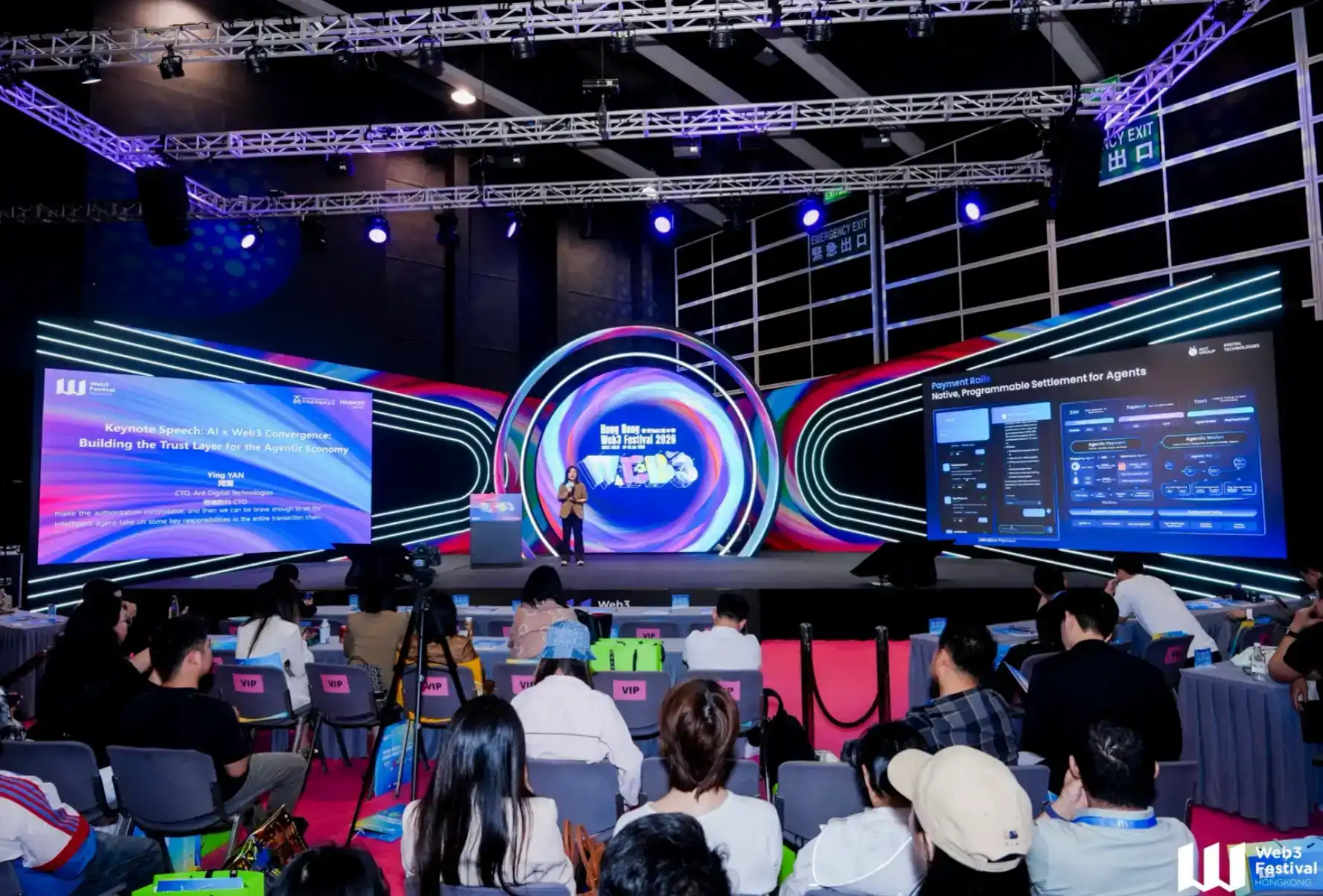
The Agent Registry layer issues on-chain identities for each agent based on DID (Decentralized Identity) and the ERC-8004 standard, ensuring that every collaboration between agents is documented. The Root Infrastructure layer serves as the architectural foundation, utilizing Jovay Layer2 to achieve 120-millisecond confirmation times to support AI micro-payments, and combining ZKVM technology to enable off-chain computation and on-chain verification, addressing the trust issues in AI economy computing power. Yan Ying stated, "The Root Infrastructure uses blockchain and privacy computing technologies to provide agents with an immutable contract execution environment. Even two unfamiliar AIs can establish trust based on code and conduct transactions with confidence."

Currently, AI is evolving from the era of Chat and Action to the era of the agent economy. Yan Ying believes that the qualitative change in the third stage lies not in AI becoming smarter, but in it beginning to possess assets and transaction rights. She noted that over the past decade, Ant Digital Tech has accumulated extensive engineering practices in financial-grade security, privacy computing, blockchain, and compliance systems, and the 4R architecture is built upon this foundation with全新研发和设计 (entirely new research and design).


Related Questions

QWhat is the '4R Full-Stack' architecture proposed by Ant Digital Tech, and what are its four layers?

AThe '4R Full-Stack' architecture is a framework for the agentic economy proposed by Ant Digital Tech. Its four layers are: Agentic Runtime, Payment Rails, Agent Registry, and Root Infrastructure.

QAccording to Ant Digital Tech's CTO, what are the 'four fractures' in the current foundation of the agentic economy?

AThe 'four fractures' are: 1) Execution loss of control due to prompt logic vulnerabilities, 2) A responsibility vacuum caused by AI's lack of a trusted identity, 3) Transaction barriers from payment gateways designed for humans, and 4) Collaboration risks from a lack of trust between unfamiliar agents.

QWhat is the core product in the Agentic Runtime layer and what is its primary function?

AThe core product in the Agentic Runtime layer is DTClaw. Its primary function is to enforce mandatory constraints on agent behavior at the execution level, making every AI operation controllable, auditable, and recoverable.

QHow does the Payment Rails layer facilitate transactions for AI agents?

AThe Payment Rails layer builds native on-chain payment channels that integrate agent intelligent decision-making with verifiable credential chain technology. It ensures precise payment intent recognition, full-link security, transparency. It also features an instant settlement network for high-frequency micro-transactions, supporting cross-chain, multi-asset flow and smart routing.

QWhat technologies are used in the Root Infrastructure layer to support the agentic economy?

AThe Root Infrastructure layer utilizes Jovay Layer2 to achieve 120-millisecond confirmation times to support AI micro-payments, and combines ZKVM technology to enable off-chain computation with on-chain verification, solving the trust problem in AI economy computing power.

Related Reads

A Hair Dryer Blows Away $34,000 from Polymarket

A hairdryer was used to manipulate a temperature sensor at Paris Charles de Gaulle Airport (LFPG) on April 6 and 15, 2026, causing short-lived artificial temperature spikes. These false readings were used to exploit a prediction market on Polymarket, where users bet on Paris’s daily maximum temperature. The attacker targeted low-probability high-temperature outcomes, which settled as "Yes" based on the corrupted data, netting a total of $34,000 in profit. The attacker’s a newly created anonymous account funded just two days before the first incident. After the successful manipulations, the funds were quickly moved through mixers and decentralized exchanges to avoid tracing. French meteorological experts and authorities confirmed the anomalies were inconsistent with actual weather conditions and nearby station data, pointing to physical intervention. Legal action was initiated for "disrupting automated data processing systems," which carries severe penalties under French law. Polymarket’s market rules relied solely on a single, publicly accessible sensor and did not account for subsequent data revisions, making the system vulnerable to such physical oracle attacks. In response, Polymarket silently switched its data source to Paris-Le Bourget Airport (LFPB) without public explanation or refunding the exploited funds. The incident highlights the risks of single-point data dependencies in prediction markets and the low-cost, high-reward potential of real-world manipulation.

marsbit16m ago

A Hair Dryer Blows Away $34,000 from Polymarket

marsbit16m ago

In-Depth Report on the On-Chain Lending Market: When Off-Chain Credit Meets On-Chain Liquidation

The on-chain lending market has evolved from a peripheral DeFi niche into core financial infrastructure. As of early 2026, total value locked (TVL) in on-chain lending protocols has reached $64.3 billion, accounting for 53.54% of total DeFi TVL, making it the largest and most mature vertical within decentralized finance. Aave dominates the sector with approximately $32.9 billion in TVL, commanding nearly half of the market—a leadership position that is unlikely to be challenged in the foreseeable future. However, the path of on-chain lending forward is not without risk. Liquidation cascades, credit defaults, and cross-chain vulnerabilities remain systemic threats hanging over the industry. At the same time, a deeper structural transformation is underway: on-chain lending is shifting from a “leverage tool for crypto-native users” to a “compliant gateway for institutional capital”. The scale of RWA (Real World Asset) lending has surpassed $18.5 billion, with U.S. Treasuries and government securities increasingly serving as core collateral. Institutional capital inflows are reshaping both the user base and risk appetite of the sector. This report systematically analyzes the evolution of on-chain lending definitions, competitive dynamics, core risks, and future trends, providing a comprehensive industry outlook for investors and trade practitioners. Key findings suggest that the “one dominant player with several strong challengers” structure will persist in the short term, while fixed-rate lending, compliant collateral, and institutional credit underwriting will define the next phase of competition. For investors focused on DeFi infrastructure, three key opportunity tracks stand out, namely, the Aave ecosystem (Morpho, Spark), RWA lending protocols (Ondo, Maple) and fixed-rate innovation (Notional, Pendle).

HTX Learn1h ago

In-Depth Report on the On-Chain Lending Market: When Off-Chain Credit Meets On-Chain Liquidation

HTX Learn1h ago

Trading

Spot
Futures
活动图片




