Annual Revenue of Hundreds of Millions, Aggressive Buybacks: Why is Pump.fun Still Being 'Shorted' by the Market?

marsbitPublished on 2026-03-19Last updated on 2026-03-19

Abstract

Despite circulating rumors, on-chain evidence and multiple independent data sources (DeFiLlama, Dune, and verifiable wallet transactions) confirm that Pump.fun's revenue and aggressive buyback program are legitimate. Over eight months, 99.5% of daily protocol revenue—totaling $328 million—was used to repurchase and burn 105.1 billion PUMP tokens, offsetting 29.52% of the circulating supply. Statistical analyses of the 747-day revenue data further validate its authenticity, showing expected patterns like weekend effects, autocorrelation, and structural breaks aligned with product updates. However, PUMP's valuation remains suppressed due to three key factors: its classification as a "sin stock" (98.6% of tokens launched on the platform are alleged scam "rug pulls"), trust issues (anonymous founders, discretionary buyback policy, and historical controversies), and insider selling pressure (notable wallets dumping tokens at market prices despite the buyback). While community token emissions will stop in July 2026—reducing monthly inflation from 10 billion to 9.2 billion tokens—current buybacks already absorb twice the new supply. The trust discount, rather than fundamentals, explains the undervaluation of a protocol generating $1.25 million in daily verifiable revenue.

Original Author: Four Pillars

Original Compilation: AididiaoJP, Foresight News

Key Points

Completed a $328 million buyback in eight months using 99.5% of daily protocol revenue. Two independent data aggregators, despite not being interconnected, reached the same conclusion. To manipulate the data, one would need to simultaneously deceive DeFiLlama, maintain a stable 68-69% ratio with Adam_tech's Dune data (which only indexes Solana), and have 105.17 billion PUMP tokens in verifiable wallets as support.

The "dilution curve" in August 2026 is actually a supply replacement rather than an addition. At current revenue levels, the buyback can absorb twice the new supply. Community emissions will cease when team and investor unlocks begin. Monthly emissions will drop from 10 billion tokens to 9.2 billion tokens.

The real reasons for the current suppressed valuation multiples are: industry classification (the nature of "original sin stocks"), trust foundation (anonymous team, discretionary buybacks), and capital flow (insiders allegedly using buybacks to sell).

1. Proof of the $328 Million Buyback

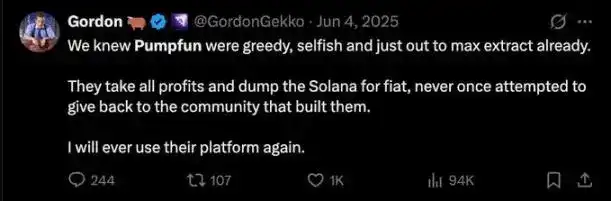
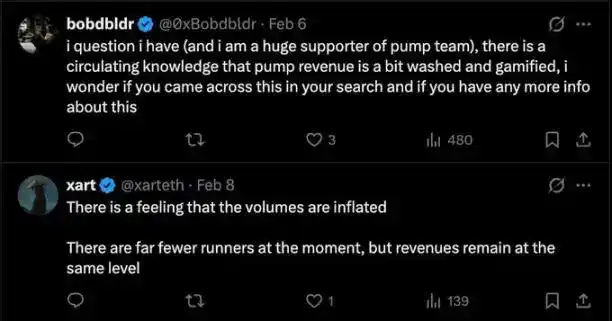
Rumors of Pump.fun's fabricated revenue have been circulating on Twitter. The following analysis shows these rumors are false.
As of March 15, 2026, data from fees.pump.fun shows a cumulative buyback amount of $328 million. This means 2,283,518 SOL was used to purchase 104.5 billion PUMP, accounting for 10.45% of the total supply and offsetting 29.52% of the circulating supply. Over eight months, the daily buyback amount remained between 99.5% and 100.5% of protocol revenue, averaging $1.25 million per day as of February 2026. Fabricating revenue would require massive capital support: for every dollar bought back, one dollar of SOL flows out from a verifiable wallet to purchase tokens stored in an auditable address. To fake $328 million in revenue, one would need to actually spend $328 million.

The relevant tokens are stored on-chain and can be verified (as of March 17, wallet G8CcfRff holds 103.96 billion PUMP, 8PSmqJy6 holds 1.21 billion PUMP, totaling 105.17 billion). The initial execution wallet 3vkpy5Y (marked as "Pump Buy Back" on Solscan) completed transfers to the holding wallets and was rotated in August 2025, now with a zero balance.

DeFiLlama recorded total protocol revenue from July 15, 2025, to February 21, 2026, as $300,041,880. During the same period, the cumulative buyback amount on fees.pump.fun was $300,178,162. The match is 100.05%, with only a $136,000 difference between two independent systems on a total of $300 million.

Adam_tech's Dune dashboard provides a third layer of verification. This platform only tracks Solana chain revenue, consistently representing 68-69% of DeFiLlama's multi-chain data, as it does not index Padre revenue launched on Base, Ethereum, and BNB Chain in October 2025. This ratio remains stable daily, indicating both are independently reading the same on-chain events.
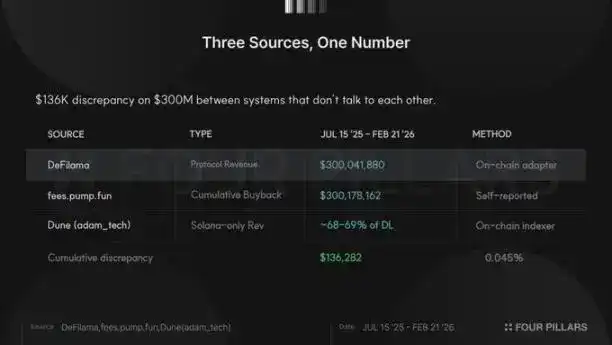
Before the launch of PumpSwap in March 2025, the error margin between the three data sources was within 1-5%. After PumpSwap launched, the data differentiated into three layers: total fees, protocol revenue, and Solana-only revenue. If someone were to fabricate revenue data, they would need to simultaneously deceive two independent on-chain indexers, maintain stable cross-correlation ratios through three product changes, keep a multi-chain revenue split ratio consistent with actual business expansion, and support it with token purchases in verifiable wallets.

2. Four Statistical Tests

In addition to on-chain evidence, 747 days of fee data can be subjected to four standard tests to verify the authenticity of the financial data. While a single test is not conclusive, when four tests point to the same conclusion, credibility increases significantly.

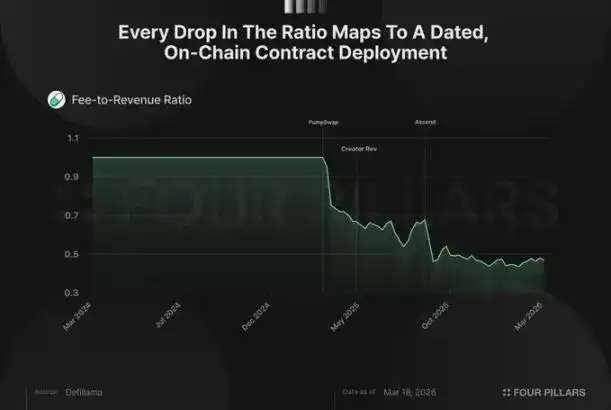
The first test is the fee-to-revenue ratio, the hardest indicator to fake. Pump.fun collects fees from each bonding curve transaction, but not all count as protocol revenue; some go to LPs, creators, and referral rewards. In the dataset, the total fee to net revenue ratio dropped from 1.0 to about 0.48, but not gradually. It dropped sharply in three stages, each corresponding to a documented on-chain product change:

  • March 20, 2025: PumpSwap launched with an LP fee split mechanism, ratio dropped from 1.00 to 0.70 in two days.
  • May 13, 2025: Creator revenue sharing mechanism launched, ratio dropped from 0.69 to 0.56.
  • September 2-3, 2025: The Ascend project introduced a dynamic fee mechanism, layered pricing allowing creators to get up to 0.95% fees on low-market-cap tokens, with the protocol keeping only 0.05%, ratio dropped from 0.68 to 0.46.

Faking this data would require simulating fee and revenue series undergoing three structural adjustments simultaneously, with the daily ratio fluctuating between 0.40 and 0.55 based on token tier composition. This complexity makes fabrication difficult. The reality is that product iterations naturally caused the changes, not artificial construction aligning with contract deployment times.
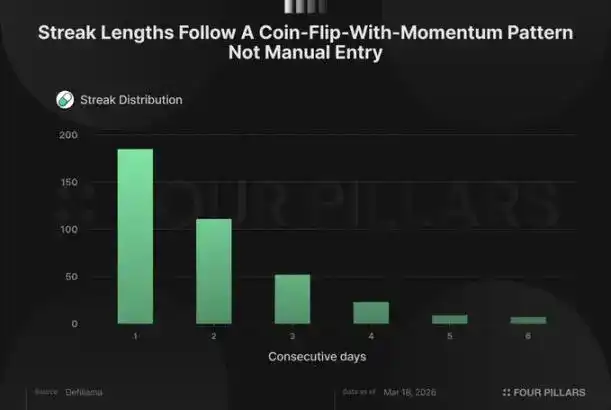
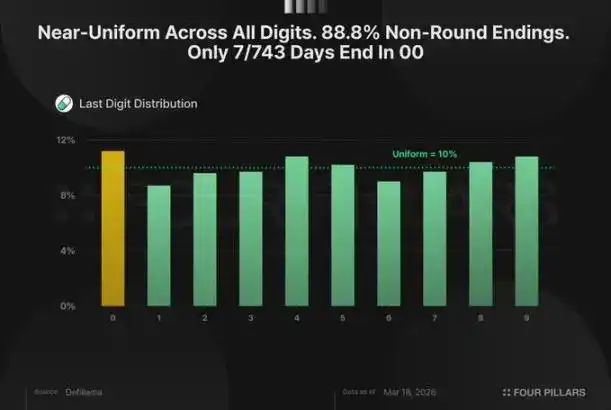
The second test examines continuity and digit distribution, aiming to determine if the data shows signs of manual entry. Humans struggle to generate truly random sequences, tend to avoid long streaks, prefer integers, and have unconscious biases toward specific digits. Pump.fun data lacks these characteristics:

The longest consecutive rise or fall is 6 days, with an average streak length of 1.92 days, consistent with expectations for a natural process with moderate momentum. Streak length decreases geometrically: 185 one-day streaks, 111 two-day streaks, 52 three-day streaks, down to 7 six-day streaks.

The last digit of daily fees is nearly uniformly distributed between 0-9, with each digit accounting for 8.7%-11.2%. 88.8% of days do not end with an integer; only 7 out of 743 non-zero days end with 00 or 000.
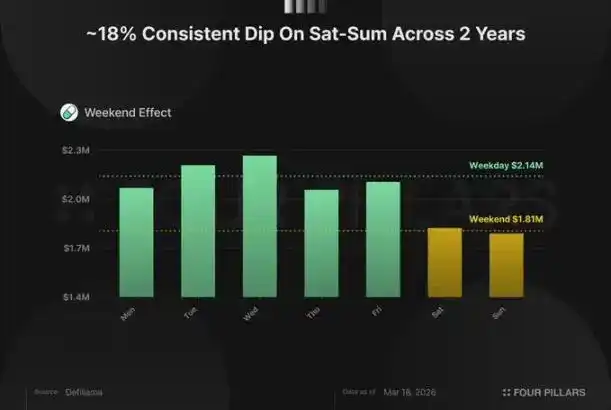
The third test examines the weekend effect. Pump.fun is a retail platform; users issue tokens more on weekdays than weekends. Average daily fees are $2.14 million on weekdays and $1.81 million on weekends, a consistent ~18% drop, appearing week after week in the two-year data. A Mann-Whitney test shows a p-value of 0.003, statistically significant. If data were fabricated, one would need to deliberately keep weekends consistently lower, increasing the complexity and risk of detection.
The final test examines autocorrelation, measuring the relationship between today's revenue and tomorrow's. Pump.fun's first-order lag autocorrelation is 0.78, meaning today's fees are 78% correlated with yesterday's; it remains 0.65 after one week (lag 7 days); and 0.57 after two weeks (lag 14 days). This slow, smooth decay reflects the momentum characteristic of organic platform activity: active periods cluster, and downturns persist. If daily revenue were generated randomly, correlation between adjacent days would be near zero, and the data would jump like noise rather than flow like a market. Faking high autocorrelation for a single lag is not difficult, but faking the entire decay structure (monotonically decreasing step by step for each lag), while maintaining the weekend effect, streak characteristics, and realistic digit distribution, is nearly impossible.
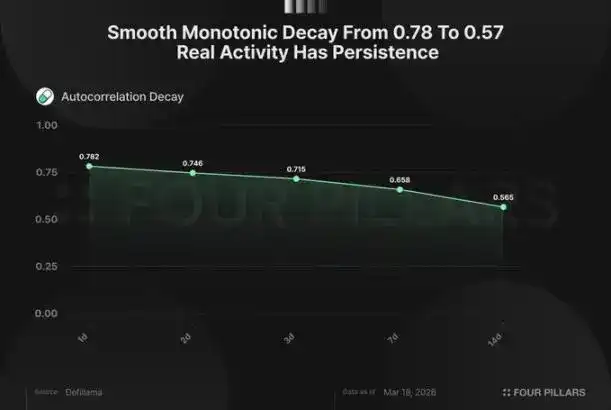
Four independent tests, four consistent conclusions, three data sources corroborating each other. The revenue data is authentic and reliable.

3. Analysis of Remaining Valuation Discount Factors

Rumors of fabricated revenue are one reason for PUMP's current suppressed valuation. The previous analysis has clarified this. But the token still trades at a discount; other suppressing factors and their validity need exploration.

First, analyze the August team unlock. Community emissions are 10 billion tokens monthly, will reach 240 billion tokens by July and then stop, coinciding with the start of team and investor unlocks, totaling 9.2 billion tokens monthly. Monthly emissions will drop from 10 billion to 9.2 billion tokens, an 8% decrease in inflation rate. At the current average daily revenue of $1.25 million, the monthly average buyback is $38 million. At a price of $0.0021 per token, this can absorb about twice the $19 million worth of new monthly supply. After August, emissions decrease while buybacks continue, further improving this ratio.

Revenue shows no sign of decline either. Over fourteen months, monthly average fees fluctuated between $2.3 million and $4.8 million daily: down 49% in July 2025, rebounded 94% in August, surged 72% in September, and jumped 45% in January 2026. Overall, it mean-reverts around a daily average of $2.5-3 million, with weekly trading volume stable at $640-700 million. The so-called "Q3 to Q1 decline" is a one-sided conclusion drawn by selectively picking September peak data.

The remaining suppressing factors are as follows:

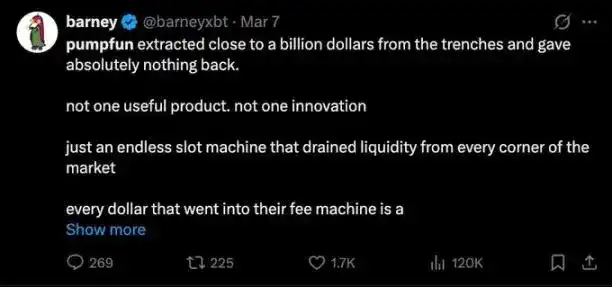
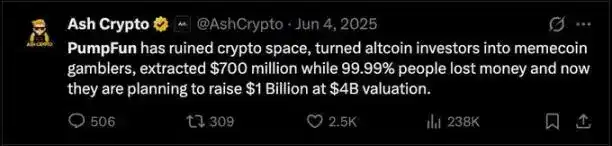
The "original sin stock" discount is the most persistent. Solidus Labs found that 98.6% of tokens on the platform have "rug pull" characteristics. This finding had the intended effect: regardless of revenue, institutional allocators will not include a "meme coin casino" in their portfolios. This is a persistent structural factor, completely unrelated to revenue quality.
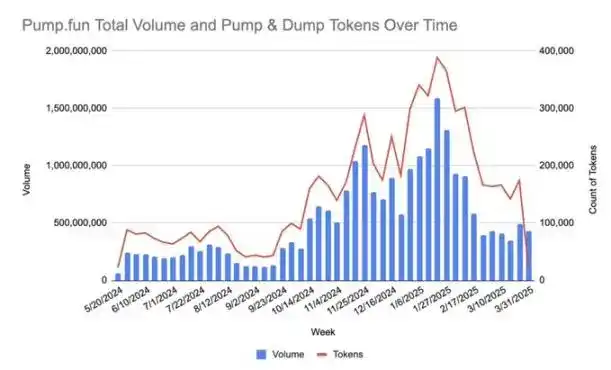
Source: Solidus Labs
Alleged insider selling constitutes tangible recent pressure. Wallet 77DsB received 3.75 billion PUMP in July 2025 from an address marked "Token Custody Wallet" on Solscan, allegedly liquidated its position for 8.02 million USDC between February 16 and 22, 2026. Wallet GpCfm transferred 1.21 billion PUMP ($2.57 million) to Bitget during the same period. A third wallet deposited 1.757 billion PUMP ($3.54 million) into Bitget on March 6. Although no source confirms actual ownership, at least $14 million flowed to exchanges at a market price of $0.002 within thirty days while the protocol was buying back, compared to a private round price of $0.004. This situation raises questions, regardless of the wallet owners' identities.

The trust aspect is the hardest to price. The founders are anonymous (co-founder Dylan has a "rug pull" record from 2017); buybacks are explicitly "discretionary" ("pump.fun may modify or中止 the plan at any time"); Bubblemaps once alleged Hayden Davis was associated with a $50 million private placement, but later deleted the claim after co-founder Alon called it "defamation." On-chain associations exist, but attribution is disputed and unverified.

None of these factors relate to business fundamentals. The revenue is real, supported by data, and the unlock arrangement is favorable to holders. The "original sin stock" label, anonymous founders, and insider fund flows are all trust discounts applied to a protocol with $1.25 million in daily verifiable on-chain revenue, whose buybacks can absorb twice the new supply. The trust discount will eventually narrow; revenue of this scale will not be mispriced forever.

Related Questions

QWhat evidence supports the claim that Pump.fun's $328 million in buybacks and revenue are real and not fabricated?

AMultiple independent data sources (DeFiLlama, fees.pump.fun, and Adam_tech's Dune dashboard) align, showing a 100.05% match on $300 million in total revenue and buybacks. The buybacks are verifiable on-chain, with 105.17 billion PUMP tokens held in public wallets. The data also passes statistical tests for authenticity, including fee-to-revenue ratio changes corresponding to product updates, natural number distribution, a consistent weekend effect, and realistic autocorrelation patterns, making a coordinated fraud across all these metrics highly improbable.

QHow does the upcoming 'dilution curve' in August 2026 affect PUMP token supply and inflation?

AThe community emissions of 10 billion tokens per month will cease upon the start of team and investor token unlocks in August 2026. The new combined monthly issuance from unlocks will be 9.2 billion tokens. This represents an 8% reduction in the monthly inflation rate, from 10 billion to 9.2 billion tokens. Furthermore, at current revenue levels, the protocol's buybacks are sufficient to absorb twice the amount of new supply being created.

QWhat are the key factors cited as the real reasons for PUMP's discounted valuation, despite its high revenue?

AThe three main factors suppressing PUMP valuation are: 1. The 'sin stock' discount, as the platform is associated with meme coins and rug pulls, deterring institutional investment. 2. Trust issues stemming from an anonymous founding team, a discretionary buyback policy that can be changed, and past controversies. 3. Insider selling pressure, with significant amounts of tokens from early wallets being sold on exchanges concurrently with the protocol's buyback program.

QWhat statistical tests were performed on the revenue data, and what did they conclude?

AFour statistical tests were performed: 1. Fee-to-Revenue Ratio Test: Showed structural breaks that perfectly matched three specific product updates, a pattern too complex to fake. 2. Continuity and Digit Distribution Test: Found natural sequences and a near-uniform distribution of ending digits, lacking human manipulation patterns. 3. Weekend Effect Test: Confirmed a statistically significant 18% drop in revenue on weekends, consistent with user behavior. 4. Autocorrelation Test: Revealed a high and smoothly decaying correlation between daily revenues, indicating organic market momentum. All tests concluded the data is authentic.

QHow does the protocol's current buyback capacity compare to the new token supply being emitted?

AAt the daily revenue rate of $1.25 million, the protocol generates approximately $38 million monthly for buybacks. At the current price of $0.0021 per PUMP, this allows it to buy back roughly 18 billion tokens per month. This buyback power is double the current monthly community emission of 9.2 billion tokens, meaning the buyback absorbs twice the new supply being created. This ratio is expected to improve further after August 2026 when emissions decrease.

Related Reads

$30 Billion DeFi Capital Exodus: LayerZero Stumbles, Chainlink Feasts

Following the major DeFi security incident involving Kelp DAO, a significant migration of funds is underway from the cross-chain protocol LayerZero to Chainlink's CCIP (Cross-Chain Interoperability Protocol). Over $30 billion in Total Value Locked (TVL) from protocols like Kelp DAO, Solv Protocol, Re, and Tydro has moved to Chainlink in the past week, driven by security concerns. LayerZero is facing a severe trust crisis after the attack. Initially denying responsibility, LayerZero Labs has now issued a public apology, acknowledging management oversights. These include a vulnerable "1/1" single-node configuration for its Decentralized Verification Network (DVN) and past misuse of a multi-signature wallet by a team member. The protocol's weekly bridge volume has slumped to near-historic lows of around $470 million. In contrast, Chainlink is experiencing a surge in adoption and activity. Its independent active addresses recently hit multi-month highs, and whales have been accumulating LINK tokens. Beyond DeFi, Chainlink is securing partnerships with traditional finance giants like DTCC, European stock exchange operator SIX Group, and asset manager Amundi. While LayerZero has announced security upgrades—such as migrating to stronger multi-signature configurations and developing a second DVN client—and contributed to a rescue fund, the event underscores that security is becoming a decisive competitive factor as DeFi matures.

marsbit7m ago

$30 Billion DeFi Capital Exodus: LayerZero Stumbles, Chainlink Feasts

marsbit7m ago

The $13 Trillion Repo Market Is Quietly Being Rewritten by Blockchain

The $13 trillion repurchase agreement (repo) market, a crucial artery for global short-term funding, is experiencing a significant transformation through blockchain technology. After years of limited impact in finance, blockchain is finding substantial adoption in repo transactions. Major institutions like JPMorgan Chase, HSBC, and Broadridge are deploying tokenized repo platforms, with daily volumes already reaching tens of billions of dollars. Traditional repo markets operate with fixed hours, rely on intermediaries, and involve manual, time-consuming processes. Tokenized repos, by contrast, use blockchain to create digital tokens representing cash and securities collateral. This enables near-instantaneous settlement, 24/7 trading, automated execution, and enhanced auditability. The key drivers for adoption include maturing technology, more receptive regulators, and growing client recognition of tangible benefits like reduced operational friction and capital efficiency. Analyses, such as one from Broadridge, indicate that moving a portion of repo activity onto blockchain can significantly reduce a bank's required liquidity buffers, potentially freeing up billions in capital. The infrastructure is also seen as foundational for a future of round-the-clock trading for traditional assets. Challenges remain, including the existence of fragmented blockchain networks, the need for stress testing under extreme market conditions, and the loss of operational flexibility compared to manual processes. However, the industry consensus is that these are implementation hurdles. Tokenized repo has moved beyond pilot stages to become one of blockchain's most concrete and impactful applications in traditional finance, marking a pivotal shift in how a core market functions.

marsbit7m ago

The $13 Trillion Repo Market Is Quietly Being Rewritten by Blockchain

marsbit7m ago

From Gas Limit to 'Keyed Nonces', How to Understand the Next Step in Ethereum Scalability?

Ethereum’s scalability efforts are shifting toward a user-centric approach—focusing not only on higher TPS, but on translating technical upgrades into lower costs, smoother operations, and better wallet experiences. Two recent developments highlight this direction: - **Raising the Gas Limit to 200 million**: Following the Fusaka upgrade that increased it to 60 million, a consensus has formed around a potential future increase to 200 million. This would boost Ethereum’s execution capacity, but it is planned alongside other upgrades—such as ePBS, Block-Level Access Lists (BAL), and EIP-8037—to manage state growth and keep node operation viable for average participants. - **Keyed Nonces (EIP-8250)**: This proposal aims to improve how transactions are queued. Instead of a single linear nonce per account, it introduces multiple independent nonce domains. This prevents different types of transactions—such as private payments, session keys, or batch operations—from blocking each other. Vitalik Buterin views this as a foundational step toward better privacy support and more flexible state scalability. Together, these upgrades are part of a broader move to push complexity from wallets, DApps, and relays back into the protocol layer. For everyday users, this means future Ethereum interactions could become less congested, more intuitive, and safer—especially as core improvements in account abstraction, cross-L2 interoperability, and node decentralization continue to progress. Ultimately, Ethereum is evolving to handle not just more transactions, but more varied and complex on-chain use cases while preserving its decentralized foundation.

marsbit30m ago

From Gas Limit to 'Keyed Nonces', How to Understand the Next Step in Ethereum Scalability?

marsbit30m ago

Leaving OpenAI, How Much Has Their Net Worth Increased?

Former OpenAI employees have collectively accrued near-trillion dollar valuations through ventures and investments, charting AI's future. The article highlights two main paths: founding high-value companies like Anthropic and Perplexity, or applying insider insights as investors. Leopold Aschenbrenner exemplifies the investor path. After being fired from OpenAI, he leveraged firsthand knowledge of AI's massive energy demands to make hugely successful public market bets on nuclear and fuel cell companies, practicing "cross-industry cognitive arbitrage." Other alumni, like the Zero Shot VC fund founders, use their technical foresight for early-stage investing. Their key advantage lies not just in picking winners, but in knowing which technical approaches are likely dead ends—a "veto list" derived from internal OpenAI experience. Angel investing within the network, as seen with Mira Murati and Sam Altman, operates on deep, pre-existing understanding of a founder's capabilities, reducing due diligence to near zero. This creates an ecosystem bound by a shared belief in AGI's imminent arrival, differing from networks like the "PayPal Mafia" which were built on shared past struggles. The shift of these builders to investors signals a profound conviction: their situational awareness of the AI landscape is now so clear that deploying capital based on that judgment is more efficient than building themselves. They are allocating bets on the future they helped shape from the inside.

marsbit41m ago

Leaving OpenAI, How Much Has Their Net Worth Increased?

marsbit41m ago

Trading

Spot
Futures
活动图片