Animoca, Solv to help Japanese Bitcoin companies generate yield

cointelegraphPublished on 2025-12-10Last updated on 2025-12-10

Abstract

Web3 gaming firm Animoca Brands has partnered with Solv Protocol to help Japanese companies with large Bitcoin holdings generate yield on their assets. The collaboration will use Solv's infrastructure to offer annual yields between 4% and 12% through methods like lending markets and liquidity provisioning. This initiative aims to transform Bitcoin from a passive holding into a productive financial tool for corporate growth. Currently, 11 Japanese public companies hold Bitcoin, with Metaplanet being the largest. The venture is backed by investors including Binance Labs and manages over $2.8 billion in assets.

Web3 gaming giant Animoca Brands has partnered with decentralized finance platform Solv Protocol to help large Bitcoin holders in Japan generate yield from their holdings.

The partnership aims to combine Solv’s infrastructure with Animoca Brands’ institutional network to target corporations and listed entities with large Bitcoin (BTC) treasuries, according to a statement shared with Cointelegraph on Wednesday.

Kensuke Amo, the CEO of Animoca Brands Japan, said that most companies only hold Bitcoin, but the new venture with Solv aims to change that.

“Through this collaboration, we aim to create an environment where companies can not only hold Bitcoin as a financial asset but also leverage it as a new revenue engine that drives corporate growth,” he said.

Bitcoin isn’t traditionally a yield-generating asset because holding it in a wallet doesn’t generate interest, dividends, or staking rewards; instead, it requires an external system, such as lending or locking.

Solv offering between 4% and 12% Bitcoin yield

The new venture will utilize Solv’s universal Bitcoin-backed wrapper, enabling treasury firms to generate an annual percentage yield of between 4% and 12%.

Solv generates Bitcoin yield through lending markets, liquidity provisioning to AMM pools, and participation in structured staking programs, according to its white paper.

Ryan Chow, co-founder and CEO of SOLV, said his protocol has proven “Bitcoin can serve as productive capital,” and the next phase of expansion will be “delivering secure, compliant, and high-yield treasury solutions to Japan’s most forward-thinking corporations.”

Related: Metaplanet eyes $135M raise via new Class B shares to fuel more Bitcoin buys

SOLV is backed by investors including Binance Labs and Blockchain Capital, and has over $2.8 billion in managed assets, according to the company.

Metaplanet has the largest Japan-based Bitcoin treasury

There are 11 Japan-based public companies holding Bitcoin on their balance sheets, according to Bitbo. The top company holding Bitcoin, and the fourth-largest overall, is Metaplanet, with roughly 30,823 coins on its balance sheet.
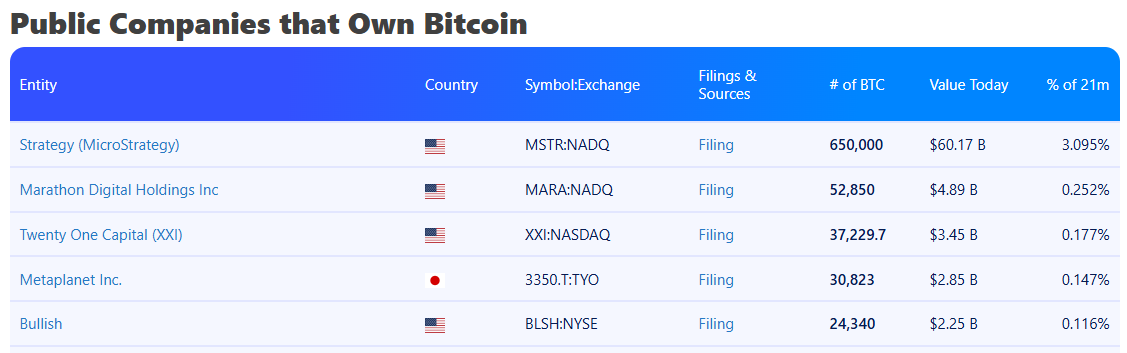
The Japan-based Metaplanet has the fourth-largest listed Bitcoin treasury. Source: Bitbo

Next in line is Nexon, a South Korean video game developer, which has its headquarters in Japan and holds 1,117 Bitcoin. Rounding out the top three is consulting services company Remixpoint.

Only one private company has any Bitcoin in its stash, Mt. Gox, the collapsed exchange that still holds over 34,000 tokens despite going bankrupt in 2014.

Magazine: Mysterious Mr Nakamoto author — Finding Satoshi would hurt Bitcoin

Related Reads

Axe Compute (NASDAQ: AGPU) Completes Corporate Restructuring (formerly POAI), Enterprise-Grade Decentralized GPU Computing Power Aethir Officially Enters Mainstream Market

Predictive Oncology has officially rebranded as Axe Compute (NASDAQ: AGPU), marking its transition into commercializing Aethir’s decentralized GPU network to provide enterprise-grade, guaranteed computational power for global AI companies. The core infrastructure is supported by the Aethir Strategic Compute Reserve (SCR), which offers predictable GPU reservations, dedicated computing clusters, and enterprise-level SLAs to address AI training, inference, and data-intensive workload demands. This move represents the first time decentralized GPU infrastructure has entered mainstream capital markets via a U.S. publicly listed company. Axe Compute will serve as the enterprise-facing entity, delivering compliant and scalable computational resources, while Aethir continues to power the underlying decentralized GPU-as-a-Service infrastructure. The structure bridges Web3 decentralized networks with Web2 enterprise needs, allowing businesses to utilize distributed GPU resources within familiar procurement and compliance frameworks. Aethir’s network currently spans 93 countries and over 200 regions, with more than 435,000 GPU containers deployed, supporting high-end hardware like NVIDIA H100, H200, B200, and B300. Axe Compute’s model aims to mitigate industry challenges such as long GPU procurement cycles, centralized cloud queuing, and pricing volatility by offering reserved GPU access, bare-metal performance, multi-region deployment, and enterprise SLAs. This listing is seen as a significant milestone in scaling decentralized AI infrastructure into enterprise markets, providing a publicly evaluable model for the commercial adoption of distributed computational resources.

marsbit1m ago

Axe Compute (NASDAQ: AGPU) Completes Corporate Restructuring (formerly POAI), Enterprise-Grade Decentralized GPU Computing Power Aethir Officially Enters Mainstream Market

marsbit1m ago

Before the Bull Market Returns: Lessons I Learned in the Crypto World with Millions

Investment Lessons from the Crypto Market: A Reflection Before the Bull Run This article shares hard-earned lessons from losing millions in the crypto space, offering a sobering perspective on market behavior and personal psychology. The author begins by distinguishing between investment and speculation, noting that crypto is primarily driven by sentiment and tokenomics, not fundamentals. In bull markets, emotion dictates 60% of pricing, token distribution 30%, and fundamentals only 10%. This makes speculation far more profitable than value investing, which often leads to significant losses as holders refuse to cut losses, hoping for a recovery that never comes. A critical mistake is poor timing and position sizing. The author emphasizes the importance of maximizing risk exposure early in a trend's reversal—when uncertainty is high but odds are favorable—rather than during the euphoric peak when downside risk is severe. Examples from the AI meme season and the BSC rally illustrate how late entries often lead to missed opportunities or forced, high-risk bets. The piece also warns against traditional valuation metrics like P/E ratios and token buybacks, which assume sustainable earnings—a rarity in crypto where few projects survive long-term. Market leaders often change, and entire sectors are disproven. Ultimately, the author concludes that theoretical knowledge isn't enough; true understanding comes from painful, personal experience. The market's cyclical nature means many are doomed to repeat errors, but self-awareness and disciplined strategy are essential for survival and success.

marsbit16m ago

Before the Bull Market Returns: Lessons I Learned in the Crypto World with Millions

marsbit16m ago

Axe Compute [NASDAQ: AGPU] Completes Corporate Restructuring (formerly POAI), Enterprise-Grade Decentralized GPU Computing Power Aethir Officially Enters Mainstream Market

Predictive Oncology has officially rebranded as Axe Compute and will trade on NASDAQ under the ticker AGPU. This rebranding signifies the company's shift to operating as an enterprise-level provider, commercializing Aethir's decentralized GPU network to deliver guaranteed computational power for global AI enterprises. Axe Compute's infrastructure is supported by the Aethir Strategic Compute Reserve (SCR), which offers predictable GPU reservations, dedicated computing clusters, and enterprise-grade SLAs to address computational bottlenecks in AI training, inference, and data-intensive workloads. This move marks the first time decentralized GPU infrastructure has entered mainstream capital markets via a U.S. publicly listed company. Axe Compute will serve as the enterprise-facing delivery and contracting entity, while Aethir continues to operate as the underlying decentralized GPU-as-a-Service infrastructure. This structure bridges Web3 decentralized networks with Web2 enterprise demand, allowing businesses to use distributed GPU resources within familiar compliance and procurement frameworks. Aethir's network currently spans 93 countries, over 200 regions, and deploys more than 435,000 GPU containers, supporting high-end hardware like NVIDIA H100, H200, B200, and B300. Axe Compute's model aims to provide guaranteed GPU reservations, dedicated clusters, bare-metal performance, multi-region deployment, and enterprise SLAs—addressing common industry challenges such as long procurement cycles, centralized cloud queues, and price volatility. This represents a significant step in scaling decentralized AI infrastructure for commercial use.

深潮23m ago

Axe Compute [NASDAQ: AGPU] Completes Corporate Restructuring (formerly POAI), Enterprise-Grade Decentralized GPU Computing Power Aethir Officially Enters Mainstream Market

深潮23m ago

Trading

Spot
Futures
活动图片