Analyzing 10 Major BTC Top Indicators: Why Is the Current Bull Market Different from Previous Ones?

marsbitPublished on 2025-12-22Last updated on 2025-12-22

Abstract

This analysis examines 10 classic Bitcoin top indicators to assess why the current bull market (as of Q4 2025) differs from previous cycles. Key metrics like the Pi Cycle Top Indicator, Puell Multiple, Bitcoin Rainbow Chart, 2-Year MA Multiplier, 4-Year Moving Average, MVRV Z-Score, Altcoin Season Index, Long-Term Holder (LTH) Supply, Short-Term Holder (STH) Supply, and Net Unrealized Profit/Loss (NUPL) all show subdued or neutral readings compared to historical extremes observed at past market tops (e.g., 2017 and 2021). Unlike previous cycles, these indicators suggest a lack of typical overheating signals, such as extreme miner profitability, excessive valuation deviations, or rampant altcoin speculation. The price peak on October 6, 2025, did not align with classic top patterns, indicating structural shift in Bitcoin’s market behavior. This moderation may stem from increased institutional participation via Bitcoin ETFs, which has stabilized supply dynamics, as well as broader macroeconomic factors like global liquidity changes and geopolitical events. The declining peak values of indicators like MVRV (from 10 in 2017 to ~3 in 2025) suggest Bitcoin is maturing from a cyclical asset to a mainstream reserve, reducing volatility and extending cycles. Investors may need to adapt traditional indicators with adjusted thresholds or combined metrics for future decision-making.

In previous Bitcoin bull market cycles, the price peak has often been accompanied by signs of overheating. However, this bull market appears to have undergone some significant changes—many historically reliable indicators have been slow to signal a top, and the Bitcoin price has been in a sustained downtrend since hitting a new high on October 6, further driving bearish signals across multiple metrics.

Below, we will examine 10 classic indicators, evaluate their characteristics and limitations, and outline the underlying shifts within Bitcoin and the broader crypto market.

1. Pi Cycle Top Indicator: Has the Cycle Peak Been Reached?

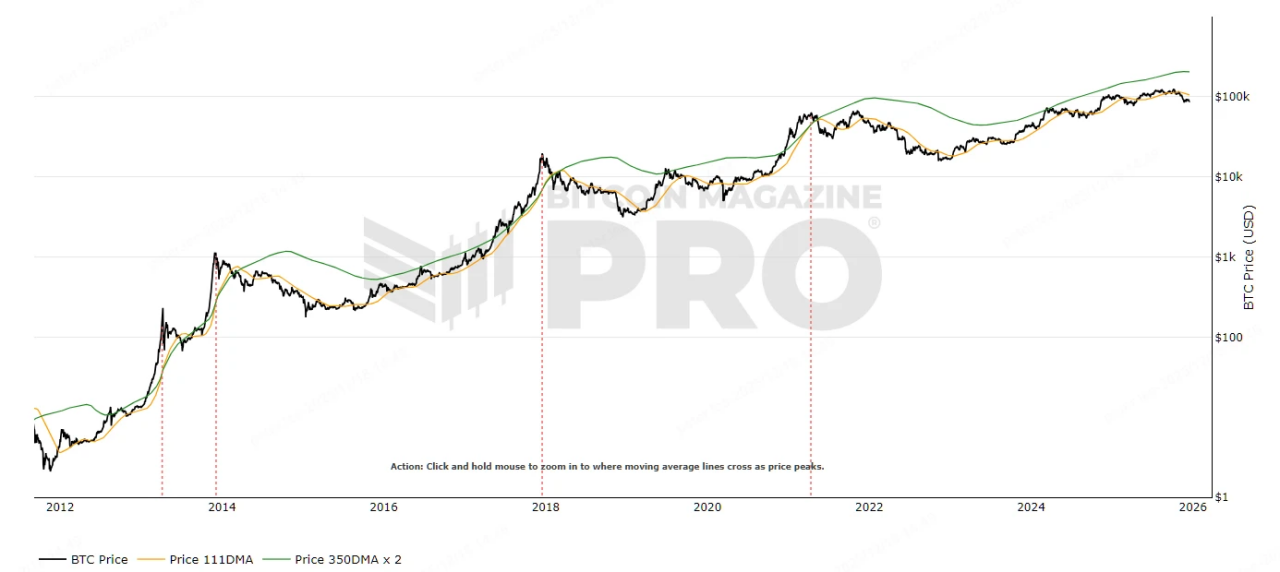
The Pi Cycle indicator is a classic tool for identifying Bitcoin price tops using the 111-day moving average (111DMA) and twice the 350-day moving average (350DMA x 2).

Typically, when the short-term line crosses above the long-term line, it often signals a market top, as it indicates that prices are rising too rapidly, detached from fundamental support.

Historically, the Pi Cycle Top Indicator has shown crossover behavior before each bull market peak:

2017 peak: 111DMA crossed above 350DMA x 2, marking the subsequent bubble burst;

2021 double top: A similar crossover occurred before the first top, followed by a rapid market correction;

Currently (Q4 2025), as shown in the chart below, the two lines have not yet crossed.
Source: https://www.bitcoinmagazinepro.com/charts/pi-cycle-top-indicator

2. Puell Multiple: Are Miner Profits Excessive?

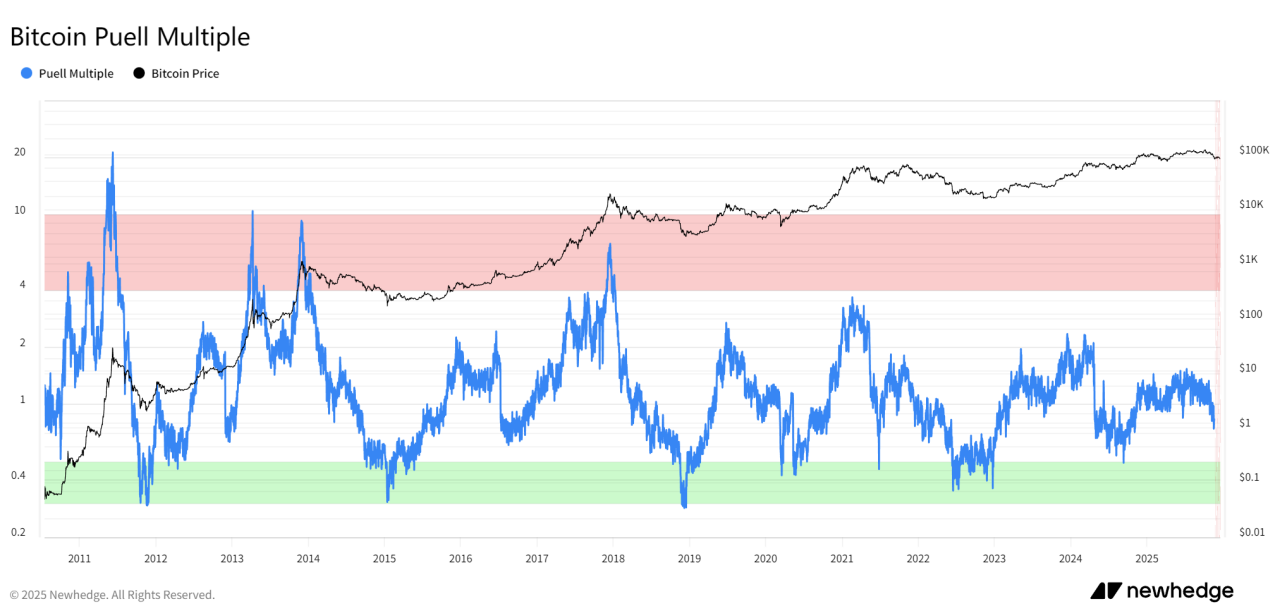
The Puell Multiple measures the ratio of miners' daily revenue to its 365-day moving average, used to assess miner profitability and market cycles.

Its principle is based on miner behavior: when the ratio is too high, miners are highly profitable and may increase selling pressure, forming a top; when too low, it indicates miner capitulation, signaling a bottom. In other words, a high Puell Multiple reflects that "miners are making too much money," accumulating supply pressure.

Historically, the Puell Multiple has shown extreme spikes before each bull market peak:

2017 peak: Exceeded 7, a historical high;

2021 double top: Exceeded 3, followed by a crash;

Currently (Q4 2025), the Puell Multiple is in the 1~2 range, indicating moderate miner pressure.
Source: https://newhedge.io/bitcoin/puell-multiple

3. Bitcoin Rainbow Chart: Has the Price Entered the "Sell" Zone?

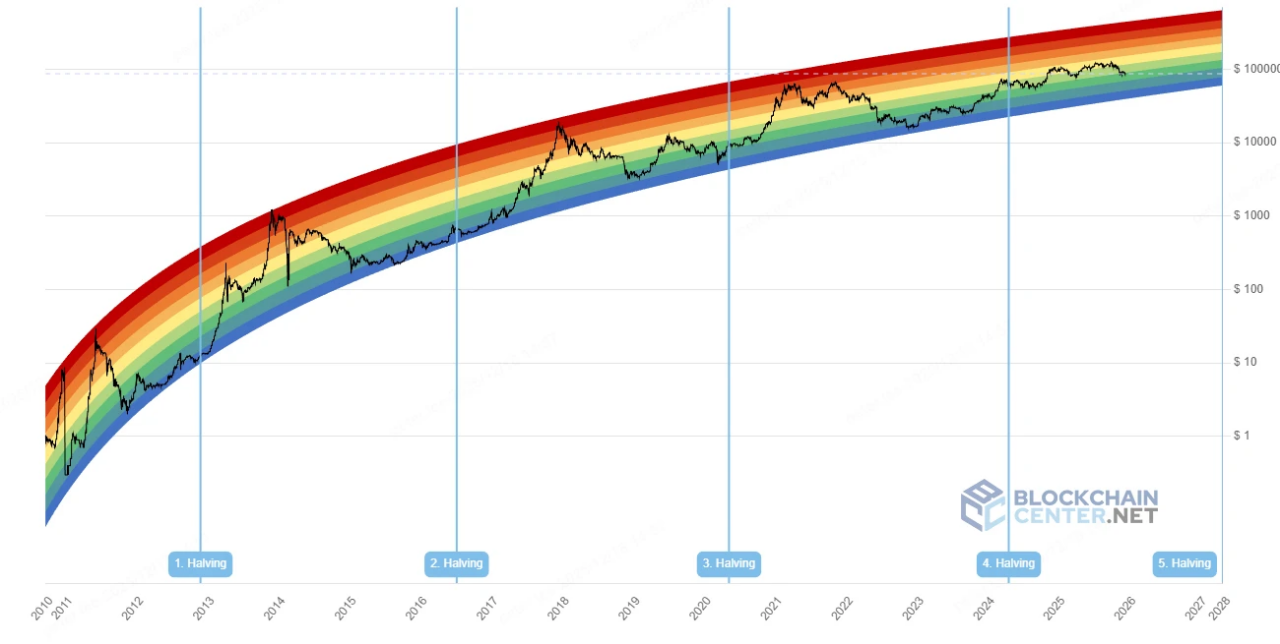
The Bitcoin Rainbow Chart uses logarithmic growth curves overlaid with rainbow-colored bands to assess Bitcoin's long-term valuation levels.

Its principle maps prices to color bands: blue zones indicate undervaluation (buy), red zones indicate overvaluation (sell). The bands are based on historical growth curves, helping to identify extreme market sentiment.

Historically, the Bitcoin Rainbow Chart has entered the red zone before each bull market peak:

2017 peak: Deep red zone, bubble peak;

2021 double top: Orange-red zone, followed by a correction;

Currently (Q4 2025), the price is in the yellow to orange range, not yet reaching the red bubble zone. We have also seen many analysts adjust this indicator, but regardless of adjustments, the price has indeed not reached the red bubble zone based on past historical experience.
Source: https://www.blockchaincenter.net/en/bitcoin-rainbow-chart/

4. 2-Year MA Multiplier: Has the Multiple Peaked?

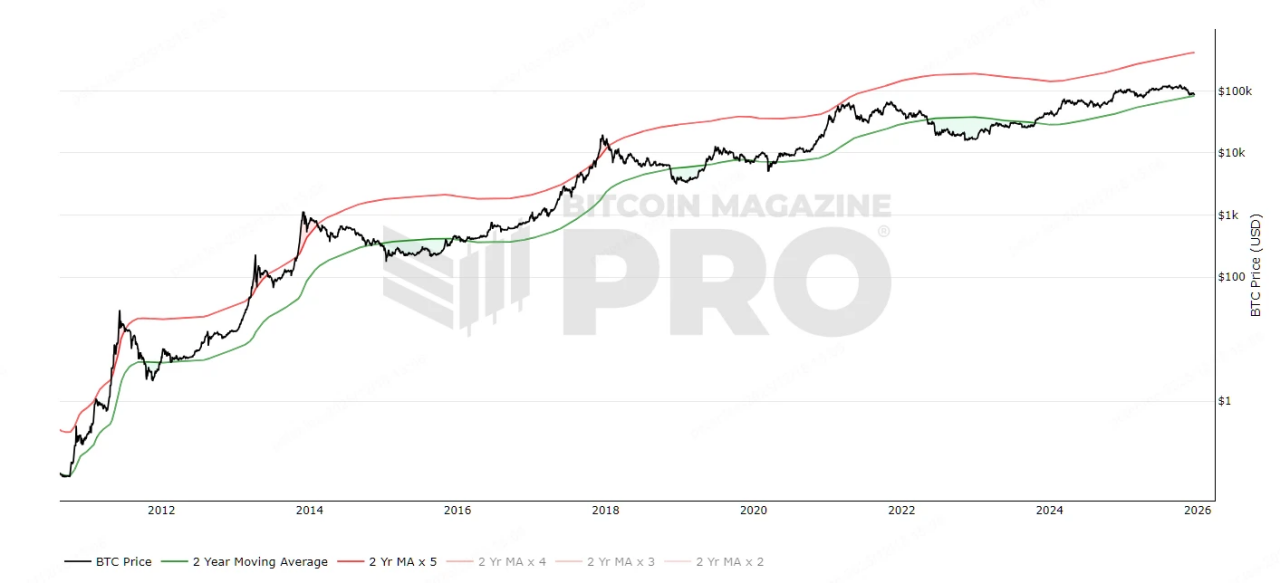
The 2-Year MA Multiplier (also known as the Golden Ratio Multiplier) uses the 2-year moving average multiplied by Fibonacci ratios to identify price zones of resistance.

Its principle combines the golden ratio (1.6) and Fibonacci sequences to assess the multiple of price relative to the long-term average: high multiples indicate overheating, signaling a correction. In other words, high multiples mean the price has "deviated too far from the long-term trend," accumulating risk.

Historically, the 2-Year MA Multiplier has shown extreme multiples before each bull market peak:

2017 peak: The indicator differed from the price by up to 10 times, with the top occurring one month after the price crossed above 2 Yr MA *5;

2021 double top: Exceeded 5 times, with the price just touching 2 Yr MA *5 before the first top;

Currently (Q4 2025), the multiple is in the 2~3 range, not yet entering the high multiple zone.
Source: https://www.bitcoinmagazinepro.com/charts/bitcoin-investor-tool/

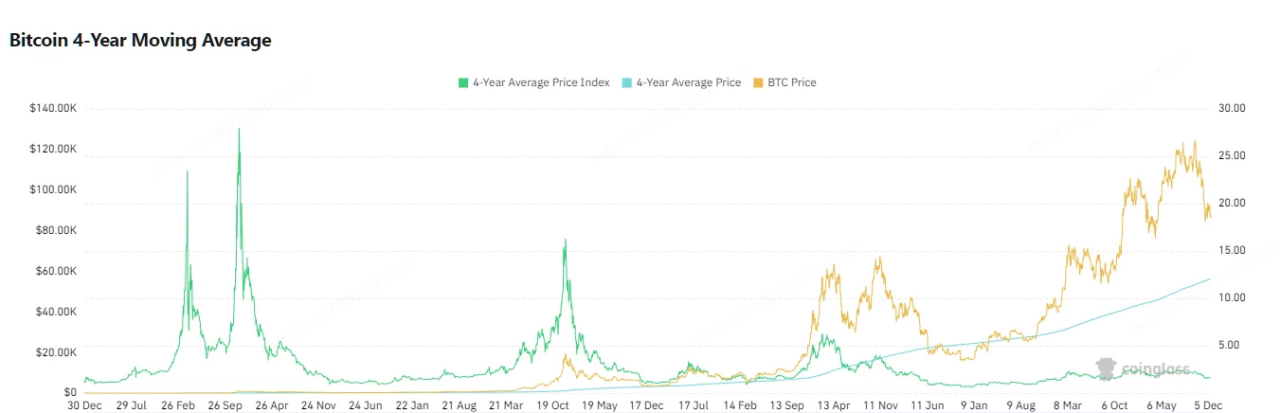
5. Bitcoin 4-Year Moving Average: Is the Price Far Above the Long-Term Average?

The Bitcoin 4-Year Moving Average calculates the 4-year price average to assess Bitcoin's macro trend.

Its principle smooths out cyclical fluctuations: prices far above the average indicate overheating; prices near the average indicate equilibrium. In other words, excessive deviation implies a "cyclical bubble," accumulating risk.

Historically, the Bitcoin 4-Year Moving Average has shown extreme price deviations before each bull market peak:

2017 peak: The indicator reached 16;

2021 double top: Reached 6 at the first top, followed by a crash;

Currently (Q4 2025), the price peaked at 2.3, showing a decreasing peak trend.
Source: https://www.coinglass.com/pro/i/four-year-moving-average

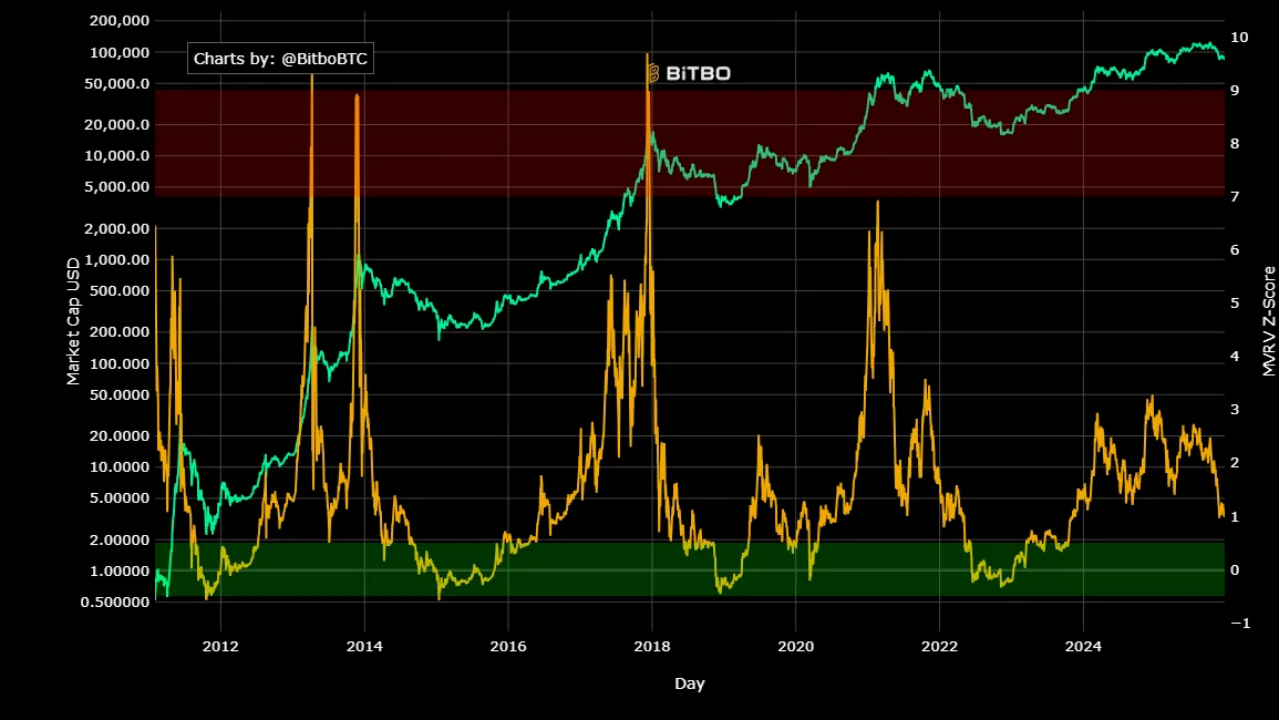
6. Bitcoin MVRV Z-Score: Has Valuation Entered the Risk Zone?

The MVRV Z-Score is a classic on-chain indicator for assessing whether Bitcoin's valuation has "deviated from its true value."

Its principle compares Bitcoin's current market cap to its "realized cap" (the total cost basis of all coins) and calculates the standard deviation of this difference. In other words: a higher Z-Score means most holders are in profit, the market is "making too much money," and risk is accumulating.

Historically, the MVRV Z-Score has shown extreme spikes before each bull market peak:

2017 peak: Approached 10, a historical extreme;

2021 double top: Exceeded 7 at the first top, followed by a market crash;

Currently (Q4 2025), the Z-Score is in the 2~4 range, indicating neutral valuation.
Source: https://charts.bitbo.io/mvrv-z-score

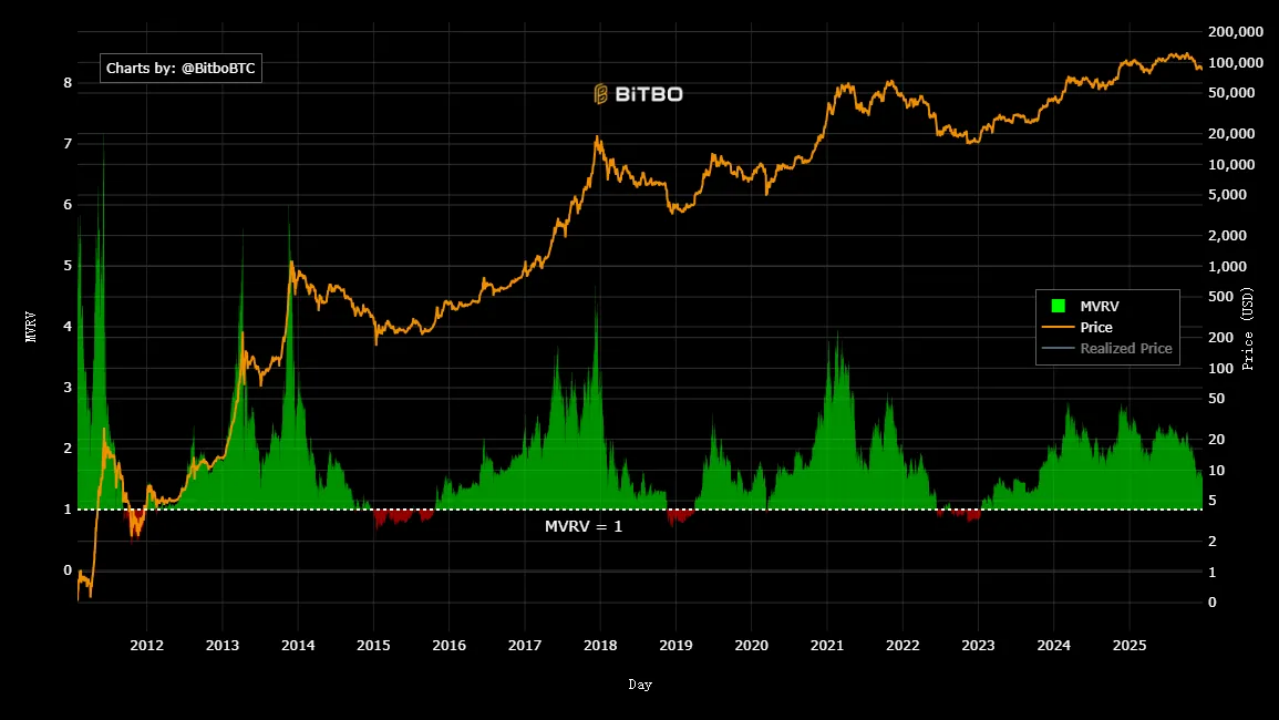
It is worth mentioning that the MVRV Rate adds statistical analysis to MVRV, measuring the standard deviation between the current MVRV and its historical average. This standardization helps identify when Bitcoin is trading above or below "fair value." However, as shown below, the peak values of this metric at each bull market top have shown a decreasing trend, and even diverged from the price peaks, greatly increasing the difficulty of using this indicator to predict tops.
Source: https://charts.bitbo.io/mvrv

7. Altcoin Season Index: Has Altcoin Season Started?

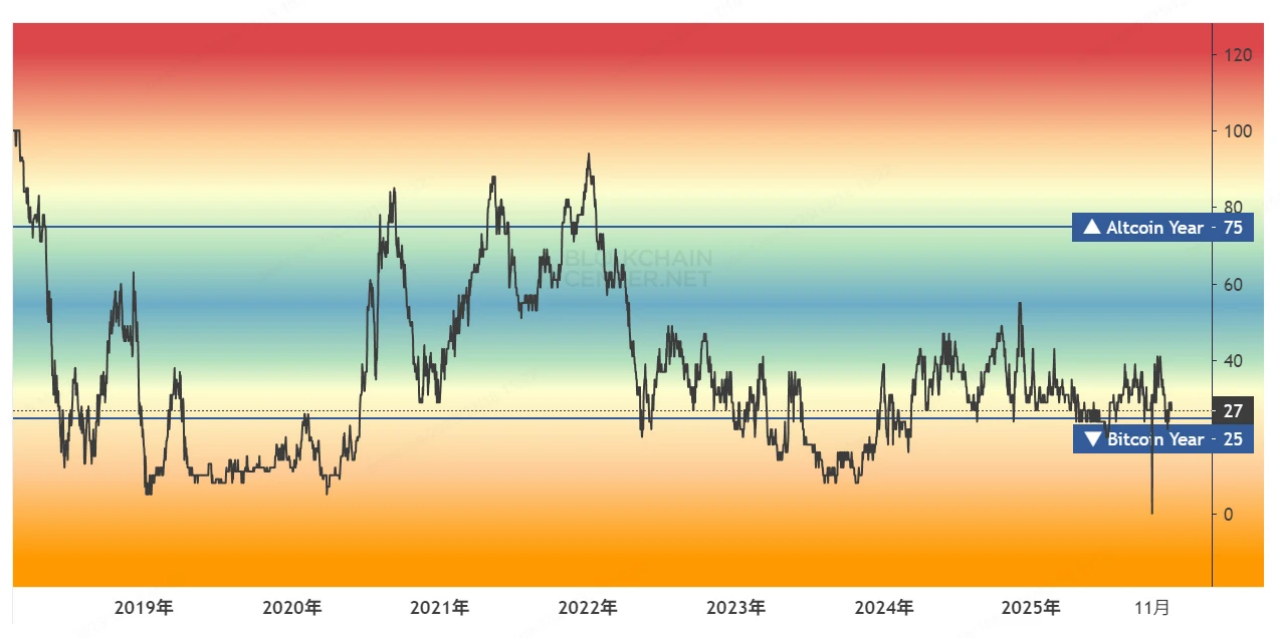
The Altcoin Season Index tracks the performance of the top 100 altcoins relative to Bitcoin to assess whether an "alt season" has begun.

Its principle is based on relative performance: an index above 75 indicates the start of alt season, often occurring after a BTC top, as funds flow from BTC to alts. In other words, a high index means BTC dominance is weakening, and market risk is diversifying.

Historically, each bull market peak has ended with an alt season狂欢 as a closing signal:

2017 peak: Exceeded 90, alt season爆发;

2021 double top: Exceeded 80, followed by BTC correction;

Currently (Q4 2025), the index is in the 30~40 range, with the altcoin sector performing poorly. In fact, since the start of this BTC bull run, the index has not even reached 60, possibly due to insufficient liquidity and an oversupply of new coins.
Source: https://www.blockchaincenter.net/en/altcoin-season-index

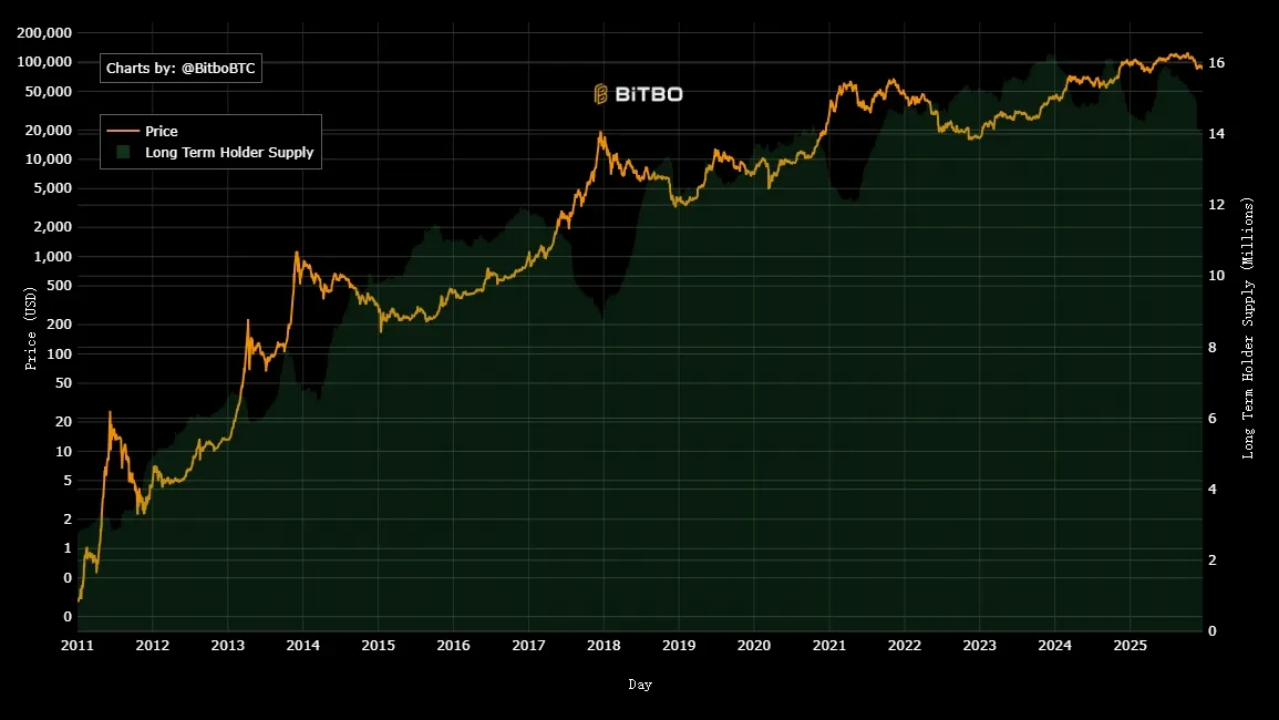
8. Bitcoin Long Term Holder Supply (LTH): Is Long-Term Holder Supply Decreasing?

Bitcoin Long Term Holder Supply (LTH) tracks the supply of Bitcoin held for more than 155 days, reflecting HODLer behavior.

Its principle observes supply changes: at tops, LTHs often sell to realize profits; at bottoms, they accumulate. In other words, a decrease in LTH supply means "smart money" is exiting, indicating high risk.

Historically, LTH has shown significant decreases before each bull market peak:

2017 peak: The selling period lasted a year, peaking at the top;

2021 double top: The first top followed a sustained selling trend for half a year, but the accumulation at the second top reached a historical high;

Currently (Q4 2025), slow selling has been ongoing for half a year, but the October top does not align with historical patterns.
Source: https://charts.bitbo.io/long-term-holder-supply

9. Bitcoin Short Term Holder Supply (STH): Is Short-Term Holder Supply Surging?

Bitcoin Short Term Holder Supply (STH) tracks the proportion of Bitcoin held for less than 155 days, assessing novice speculation.

Its principle captures new capital inflows: a high proportion indicates rampant speculation, often预示 a top; a low proportion indicates market maturity. In other words, high STH means "too many newcomers," making bubbles prone to burst.

Historically, STH has shown surges before each bull market peak:

2017 peak: Nearly 8M BTC, speculation peak;

2021 double top: Nearly 6.5M BTC at the first top, with the absolute peak selling at the second top not reaching the highest level;

Currently, STH is steadily climbing接近 5.5M BTC, but the price peak was on October 6,不像 past bull markets where STH peaks and price tops were closely aligned.

<极速 style="color: rgb(143, 149, 158);">Source: https://newhedge.io/bitcoin/short-term-holder-supply

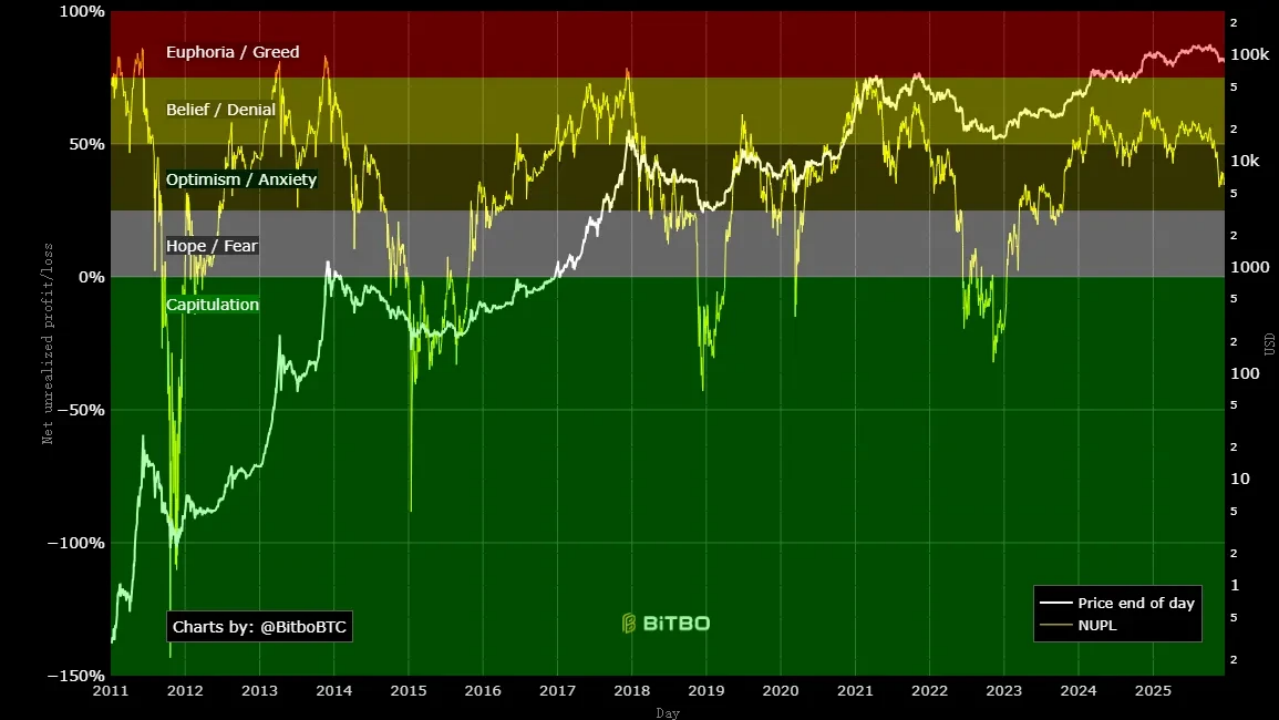
10. Bitcoin Net Unrealized Profit/Loss (NUPL): Has Unrealized Profit/Loss Entered the Greed Zone?

Bitcoin NUPL measures the network's overall unrealized profit/loss ratio, assessing market sentiment.

Its principle is: calculate market cap minus realized cap, then divide by market cap: above 0.75 indicates greed (top signal); below 0 indicates fear (bottom signal). In other words, high NUPL means "everyone is in profit," indicating high selling risk.

Historically, Bitcoin NUPL has shown extremely high values before each bull market peak:

2017 peak: Exceeded 0.8, a historical extreme;

2021 double top: Exceeded 0.7, followed by a crash;

Currently (Q4 2025), NUPL reached a high of 0.64 in early March 2024, has been fluctuating since, and has now fallen to 0.34.
Source: https://charts.bitbo.io/net-unrealized-profit-loss

Conclusion: Structural Changes in the Current Bitcoin Bull Market

Based on the above indicators, the current Bitcoin market trend does not highly align with the extreme performances seen at past bull market tops. Historical tops were often accompanied by multiple indicators overheating simultaneously, such as high Z-Score, high Puell Multiple, NUPL entering the greed zone, accompanied by LTH selling and STH surges, but now these indicators are performing very moderately.

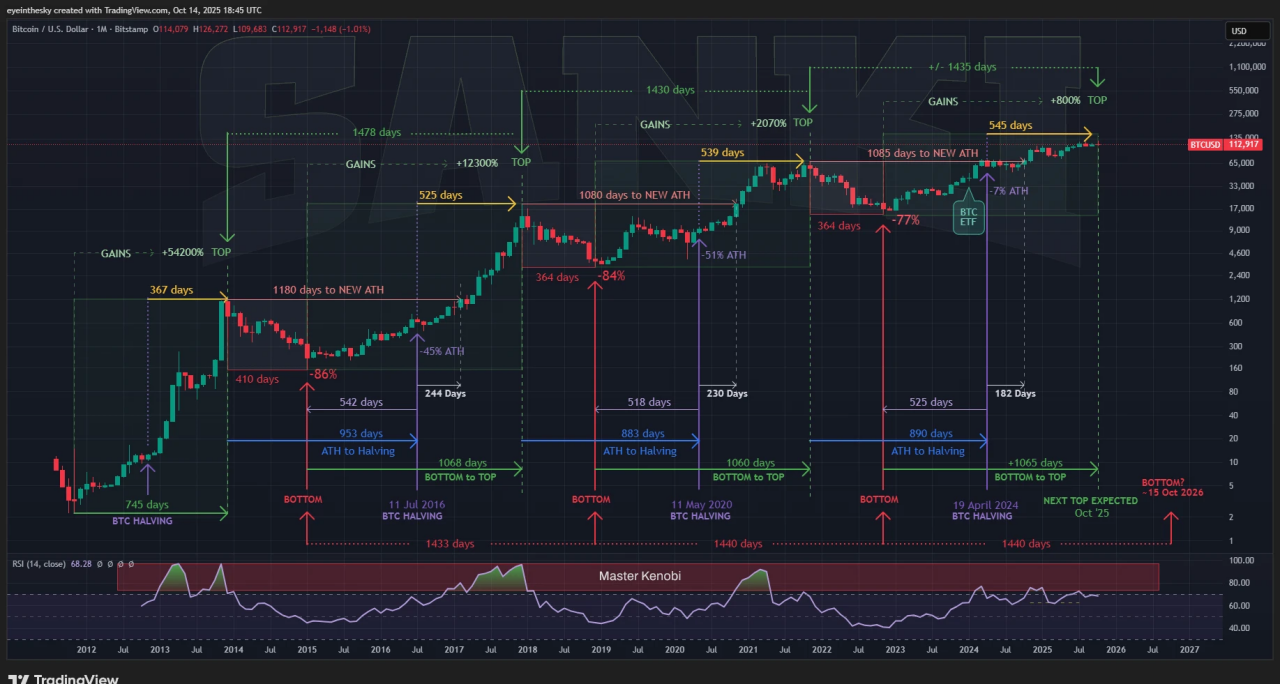
This does not mean that the current Bitcoin price has not yet peaked; these indicators are all based on spatial judgment, and the following chart, which predicts price tops based on a 3-year time cycle,似乎 suggests that Bitcoin has already peaked.
Source: https://x.com/btc_MasterPlan/status/1978180632410042828/photo/1

Of course, in analyzing the above indicators, we also found that these tools, based on linear price predictions, have already shown signs of decay in predicting top regions, exhibiting diminishing marginal effects. For example, the peak MVRV values during the 2017, 2021, and 2025 bull market tops were 10, 7, and 3 respectively. We显然 cannot expect the MVRV to reach 7 in this bull run, nor is it easy to predict a reliable value corresponding to this bull market top from MVRV.

In other words, while these indicators suggest the market is in a neutral or moderate range, they do not confirm that the bull market continues or that a bear market has arrived. Instead, they indicate that Bitcoin market growth has become more gradual rather than explosive, which may be attributed to:

First, the introduction of Bitcoin ETFs has attracted substantial long-term capital, stabilizing supply dynamics, which contrasts with past retail-driven bubbles and slows the pace of overheating.

Second, changes in global liquidity in 2025 (Fed rate cuts vs. BOJ rate hikes) and geopolitical shifts have repeatedly impacted BTC's price, and the平稳 changes in various indicators恰恰 show a more mature market.

In summary, whether the current high on October 6 is the peak of this bull market or not, we must acknowledge that Bitcoin price volatility may have broken through past historical frameworks and experiences. It seems to be undergoing a structural transformation from a "cyclical asset" to a "mainstream reserve." It is worth reminding investors that these indicators may need adjusted thresholds or combined use to be better applied to investment decisions.

About Us

WEEX Labs is the research department of WEEX Exchange, dedicated to tracking and analyzing cryptocurrencies, blockchain technology, and emerging market trends, providing professional assessments.

The team adheres to the principles of objective, independent, and comprehensive analysis, aiming to explore cutting-edge trends and investment opportunities through rigorous research methods and前沿 data analysis, outputting comprehensive, rigorous, and clear insights for the industry, and providing全方位 construction and investment guidance for Web3 startups and investors.

Disclaimer

The views expressed in this article are for reference only and do not constitute an endorsement of any products or services discussed, nor do they constitute any investment, financial, or trading advice. Readers should consult qualified professionals before making financial decisions. Please note that WEEX Labs may restrict or prohibit all or part of its services from restricted areas.


Related Questions

QWhat is the Pi Cycle Top Indicator and what does it currently indicate about the Bitcoin market?

AThe Pi Cycle Top Indicator uses the 111-day moving average (111DMA) and the 350-day moving average multiplied by 2 (350DMA x 2) to identify market tops. Historically, a crossover occurs before a top. As of Q4 2025, the lines have not yet crossed, suggesting the market may not have reached a classic top signal according to this indicator.

QHow does the Puell Multiple gauge market cycles and what is its current reading?

AThe Puell Multiple measures the ratio of miners' revenue to its 365-day moving average, indicating miner profitability and potential selling pressure. A high value suggests a top. Currently, in Q4 2025, it is in the 1-2 range, indicating moderate miner pressure, not the extreme levels seen at past tops.

QAccording to the article, what is a key structural reason why this bull market might be different from previous ones?

AA key structural reason is the introduction of Bitcoin ETFs, which have attracted significant long-term institutional capital. This has stabilized supply dynamics and created a more gradual, mature market, contrasting with the retail-driven, rapid bubble formations of the past.

QWhat trend does the MVRV Z-Score show across the last three bull market peaks (2017, 2021, 2025)?

AThe MVRV Z-Score has shown a clear trend of diminishing peaks across the last three bull markets. It reached nearly 10 in 2017, over 7 at the first peak in 2021, and was only around 3 in the current cycle (Q4 2025), indicating its predictive power for identifying absolute tops may be weakening.

QWhat does the Altcoin Season Index measure and what does its current low value suggest?

AThe Altcoin Season Index tracks the performance of the top 100 altcoins relative to Bitcoin. A value above 75 indicates an 'altcoin season' where capital flows from BTC to alts, often near a market top. Its current low value (30-40 range in Q4 2025) suggests altcoins are underperforming and a classic speculative top has not been reached.

Related Reads

$292 Million KelpDAO Cross-Chain Bridge Hack: Who Should Foot the Bill?

On April 18, 2026, an attacker stole 116,500 rsETH (worth ~$292M) from KelpDAO’s cross-chain bridge in 46 minutes—the largest DeFi exploit of 2026. The stolen assets were deposited into Aave V3 as collateral, causing $177–200M in bad debt and triggering a cascade of losses across nine DeFi protocols. Aave’s TVL dropped by ~$6B overnight. This legal analysis argues that KelpDAO and LayerZero Labs share concurrent liability, with fault apportioned 60%/40%. KelpDAO negligently configured its bridge with a 1-of-1 decentralized verifier network (DVN)—a single point of failure—despite LayerZero’s explicit recommendation of a 2-of-3 setup. LayerZero, which operated the compromised DVN, failed to secure its RPC infrastructure against a known poisoning attack vector. Both protocols’ terms of service cap liability at $200 (KelpDAO) or $50 (LayerZero), but these limits are likely unenforceable due to unconscionability, gross negligence exceptions, and potential securities law invalidation (if rsETH is deemed a security under the Howey test). Aave’s governance also faces fiduciary duty claims for raising rsETH’s loan-to-value ratio to 93%—far above competitors’ 72–75%—without adequately assessing bridge risks, amplifying the systemic fallout. Practical recovery targets include LayerZero Labs (a registered Canadian entity), KelpDAO’s founders, auditors, and identifiable Aave governance delegates. The incident underscores escalating legal risks for DeFi protocols, infrastructure providers, and governance participants.

marsbit56m ago

$292 Million KelpDAO Cross-Chain Bridge Hack: Who Should Foot the Bill?

marsbit56m ago

Insider Trading in War: 5 People Involved, the Highest Earner Was Arrested

On April 24, the U.S. Department of Justice arrested U.S. Army Special Forces Staff Sergeant Gannon Ken Van Dyke for insider trading related to the capture of Venezuelan President Nicolás Maduro on January 3. Van Dyke allegedly profited over $400,000 by placing bets on a prediction market, Polymarket, using insider knowledge of the covert operation. According to the indictment, Van Dyke registered an account (0x31a5) on December 26 and made a series of bets predicting Maduro’s capture and U.S. military involvement in Venezuela. He withdrew most of his funds on the day of the operation and attempted to obscure his tracks by transferring assets through crypto and brokerage accounts. This case marks the first time the DOJ has prosecuted insider trading on Polymarket. PolyBeats had previously identified five suspicious accounts, including Van Dyke’s—the highest earner—in January. The other accounts, with profits ranging from $34,000 to $145,000, remain under unofficial scrutiny but have not been charged. Their lower profits, indirect access to information, and unclear legal boundaries may complicate prosecution. Polymarket has since strengthened its market integrity rules, explicitly prohibiting trading based on confidential or insider information. Van Dyke’s arrest, nearly four months after his trades, signals increased regulatory attention and the persistent traceability of blockchain-based transactions.

marsbit58m ago

Insider Trading in War: 5 People Involved, the Highest Earner Was Arrested

marsbit58m ago

Bitwise: Bullish on Bitcoin's Performance in the Second Half of the Year, AI and Regulation Will Spark a New Altcoin Season

Bitwise CIO Matt Hougan and Research Lead Ryan Rasmussen express strong bullish sentiment on Bitcoin's long-term prospects, suggesting that its $1 million price target may be too conservative. They argue Bitcoin serves a dual role: as digital gold and a potential global settlement asset, especially amid declining trust in traditional monetary systems. Despite a weak Q1 2026 where nearly all crypto assets and prices saw double-digit declines, the analysts remain optimistic due to strong forward-looking catalysts, including institutional adoption via Bitcoin ETFs from major firms like Morgan Stanley and Goldman Sachs. Geopolitical instability, such as Iran’s mention of using Bitcoin for international payments, increases the value of Bitcoin’s “out-of-the-money call option” as a non-political, global settlement currency. This enhances its appeal beyond a mere store of value. . Additionally, Hougan highlights that a clearer regulatory token framework under current SEC leadership, combined with AI efficiency gains and high-performance blockchains, could fuel a new “altseason” by late 2026. This may lead to a wave of legitimate, value-capturing token projects, unlike the earlier ICO boom. . Bitwise also announced an Avalanche ETF, citing its unique architecture and rapid growth in real-world asset (RWA) tokenization, which has surged 10x to nearly $30 billion in two years. The firm believes Layer 1 blockchains are still early in their growth cycle, with significant potential ahead.

marsbit1h ago

Bitwise: Bullish on Bitcoin's Performance in the Second Half of the Year, AI and Regulation Will Spark a New Altcoin Season

marsbit1h ago

Trading

Spot
Futures

Hot Articles

What is $BITCOIN

DIGITAL GOLD ($BITCOIN): A Comprehensive Analysis Introduction to DIGITAL GOLD ($BITCOIN) DIGITAL GOLD ($BITCOIN) is a blockchain-based project operating on the Solana network, which aims to combine the characteristics of traditional precious metals with the innovation of decentralized technologies. While it shares a name with Bitcoin, often referred to as “digital gold” due to its perception as a store of value, DIGITAL GOLD is a separate token designed to create a unique ecosystem within the Web3 landscape. Its goal is to position itself as a viable alternative digital asset, although specifics regarding its applications and functionalities are still developing. What is DIGITAL GOLD ($BITCOIN)? DIGITAL GOLD ($BITCOIN) is a cryptocurrency token explicitly designed for use on the Solana blockchain. In contrast to Bitcoin, which provides a widely recognized value storage role, this token appears to focus on broader applications and characteristics. Notable aspects include: Blockchain Infrastructure: The token is built on the Solana blockchain, known for its capacity to handle high-speed and low-cost transactions. Supply Dynamics: DIGITAL GOLD has a maximum supply capped at 100 quadrillion tokens (100P $BITCOIN), although details regarding its circulating supply are currently undisclosed. Utility: While precise functionalities are not explicitly outlined, there are indications that the token could be utilized for various applications, potentially involving decentralized applications (dApps) or asset tokenization strategies. Who is the Creator of DIGITAL GOLD ($BITCOIN)? At present, the identity of the creators and development team behind DIGITAL GOLD ($BITCOIN) remains unknown. This situation is typical among many innovative projects within the blockchain space, particularly those aligning with decentralized finance and meme coin phenomena. While such anonymity may foster a community-driven culture, it intensifies concerns about governance and accountability. Who are the Investors of DIGITAL GOLD ($BITCOIN)? The available information indicates that DIGITAL GOLD ($BITCOIN) does not have any known institutional backers or prominent venture capital investments. The project seems to operate on a peer-to-peer model focused on community support and adoption rather than traditional funding routes. Its activity and liquidity are primarily situated on decentralized exchanges (DEXs), such as PumpSwap, rather than established centralized trading platforms, further highlighting its grassroots approach. How DIGITAL GOLD ($BITCOIN) Works The operational mechanics of DIGITAL GOLD ($BITCOIN) can be elaborated on based on its blockchain design and network attributes: Consensus Mechanism: By leveraging Solana’s unique proof-of-history (PoH) combined with a proof-of-stake (PoS) model, the project ensures efficient transaction validation contributing to the network's high performance. Tokenomics: While specific deflationary mechanisms have not been extensively detailed, the vast maximum token supply implies that it may cater to microtransactions or niche use cases that are still to be defined. Interoperability: There exists the potential for integration with Solana’s broader ecosystem, including various decentralized finance (DeFi) platforms. However, the details regarding specific integrations remain unspecified. Timeline of Key Events Here is a timeline that highlights significant milestones concerning DIGITAL GOLD ($BITCOIN): 2023: The initial deployment of the token occurs on the Solana blockchain, marked by its contract address. 2024: DIGITAL GOLD gains visibility as it becomes available for trading on decentralized exchanges like PumpSwap, allowing users to trade it against SOL. 2025: The project witnesses sporadic trading activity and potential interest in community-led engagements, although no noteworthy partnerships or technical advancements have been documented as of yet. Critical Analysis Strengths Scalability: The underlying Solana infrastructure supports high transaction volumes, which could enhance the utility of $BITCOIN in various transaction scenarios. Accessibility: The potential low trading price per token could attract retail investors, facilitating wider participation due to fractional ownership opportunities. Risks Lack of Transparency: The absence of publicly known backers, developers, or an audit process may yield skepticism regarding the project's sustainability and trustworthiness. Market Volatility: The trading activity is heavily reliant on speculative behavior, which can result in significant price volatility and uncertainty for investors. Conclusion DIGITAL GOLD ($BITCOIN) emerges as an intriguing yet ambiguous project within the rapidly evolving Solana ecosystem. While it attempts to leverage the “digital gold” narrative, its departure from Bitcoin's established role as a store of value underscores the need for a clearer differentiation of its intended utility and governance structure. Future acceptance and adoption will likely depend on addressing the current opacity and defining its operational and economic strategies more explicitly. Note: This report encompasses synthesised information available as of October 2023, and developments may have transpired beyond the research period.

363 Total ViewsPublished 2025.05.13Updated 2025.05.13

What is $BITCOIN

Discussions

Welcome to the HTX Community. Here, you can stay informed about the latest platform developments and gain access to professional market insights. Users' opinions on the price of BTC (BTC) are presented below.

活动图片