Analyst warns of $10K Bitcoin scenario — but charts show a different story

ambcryptoPublished on 2026-04-07Last updated on 2026-04-07

Abstract

Bloomberg analyst Mike McGlone warns of a potential Bitcoin decline to $10,000 amid a broader risk-asset downturn, drawing parallels to the 2008 financial crisis. He predicts a 50% S&P 500 drop, gold rising to $4,000, and oil falling to $40 per barrel, arguing Bitcoin remains vulnerable to tightening liquidity. However, current market data tells a different story. Bitcoin is consolidating between $64,000 and $72,000 after a recent correction, showing stabilization rather than breakdown. Key support levels hold, and the RSI indicates neutral momentum without sustained bearish pressure. Broader market volatility, while elevated, lacks the persistent instability of past crises. The analysis concludes that while a macro risk-off event could pressure Bitcoin, the current market structure does not support an imminent drop to $10,000, suggesting a more complex dynamic than direct correlation with traditional risk assets.

A bearish macro outlook from Bloomberg analyst Mike McGlone is drawing renewed attention to Bitcoin’s downside risks. The analyst is suggesting a potential path to $10,000 amid a broader unwind in global risk assets.

McGlone pointed to parallels with past market cycles, arguing that elevated risk across equities, commodities, and crypto could eventually give way to a sharp correction.

He also highlighted unusually low stock market volatility alongside rising pressures in assets like gold and crude oil. He warns that similar conditions preceded the 2008 financial crisis.

However, while the macro narrative is clear, Bitcoin’s current market structure tells a more nuanced story.

Macro warning: A broader risk-off scenario

McGlone’s outlook is not limited to crypto. His projection outlines a full risk reset across markets, including:

  • A potential 50% drawdown in the S&P 500
  • Gold rising toward $4,000
  • Oil reverting to $40 per barrel
  • Bitcoin falling sharply as liquidity tightens

The argument hinges on the idea that Bitcoin remains a risk asset, meaning it could decline alongside equities if global liquidity conditions deteriorate.

Bitcoin consolidates after sharp correction

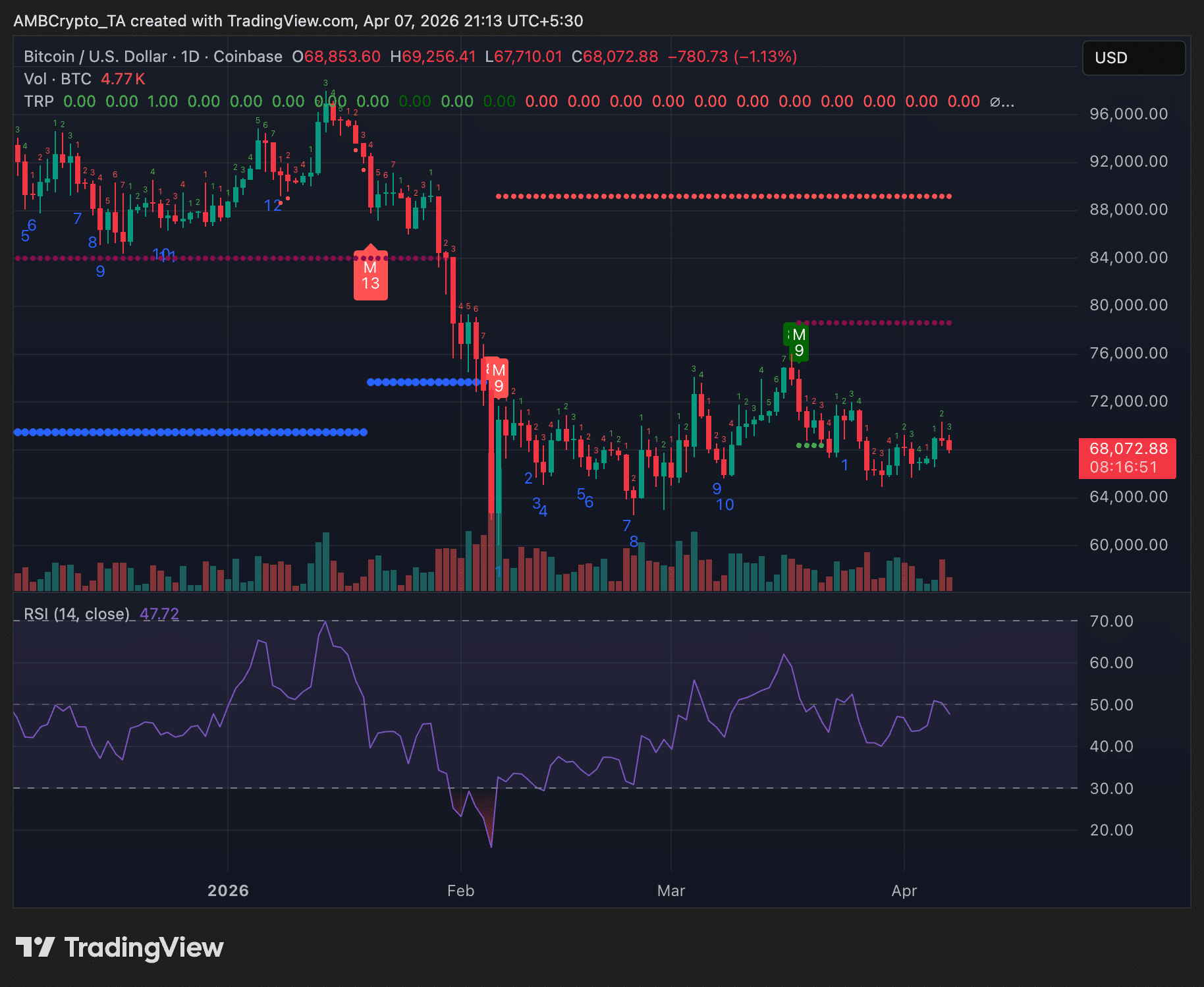
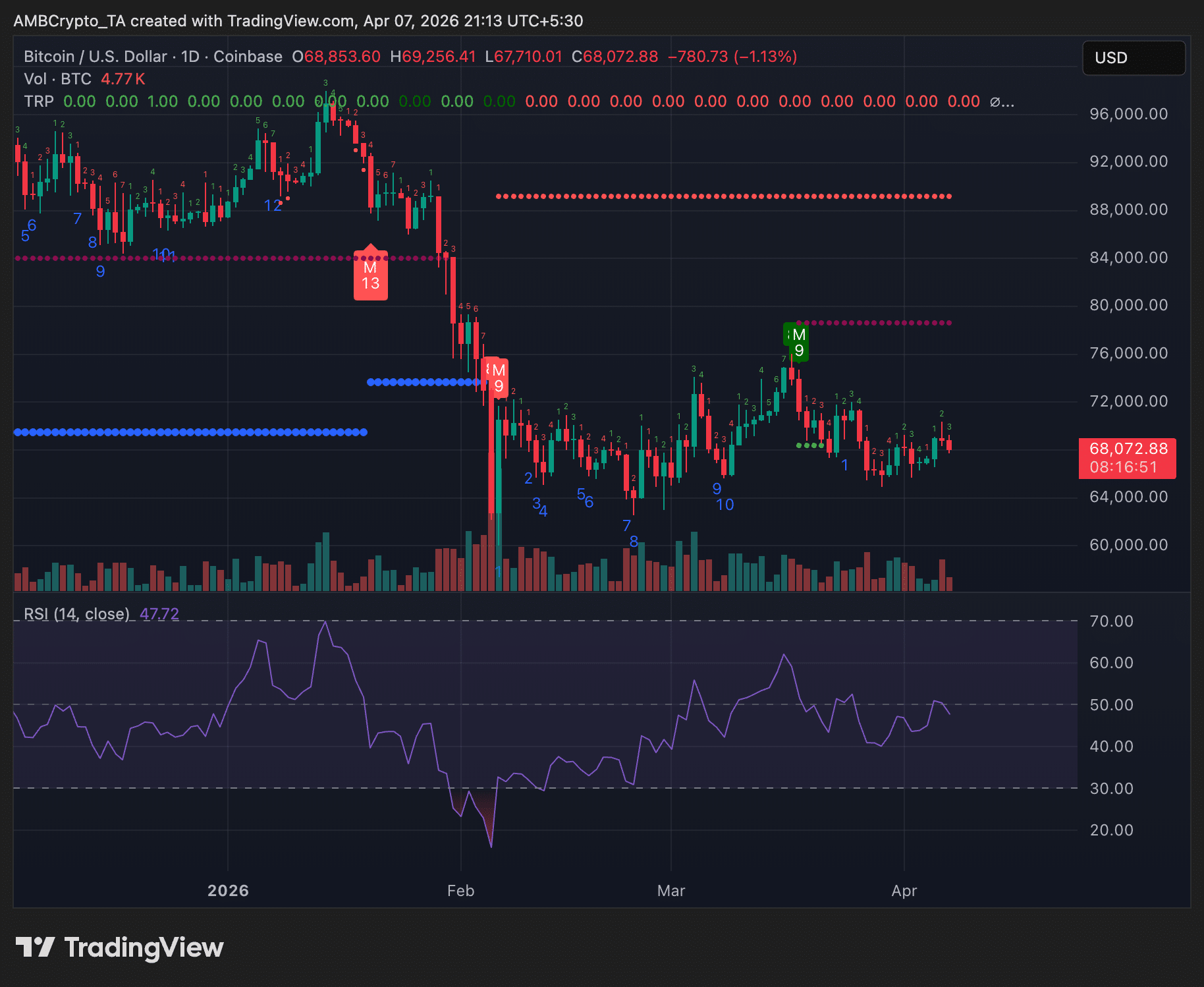
Bitcoin’s recent price action suggests the market has already undergone a significant adjustment. As of this writing, it was trading around $68,000, down almost 1%.
Source: TradingView

After a sharp drop earlier in the year, BTC has settled into a consolidation range between roughly $64,000 and $72,000. This range-bound behavior reflects a period of indecision rather than outright weakness.

The Relative Strength Index [RSI], currently hovering around neutral levels, further supports this view. Momentum has cooled from earlier highs, but there is no clear signal of sustained bearish pressure.

Importantly, Bitcoin has not broken below key structural support levels despite the earlier sell-off. This indicates that, for now, the market is stabilizing rather than entering a new leg down.

Volatility remains contained across markets

Broader market data also challenge parts of the bearish thesis.

Recent intraday movements across macro indicators show short-term volatility spikes, but not the sustained instability typically associated with systemic downturns. Instead, markets appear to be absorbing shocks while maintaining overall structure.

This contrasts with McGlone’s comparison to 2008, where volatility and liquidity conditions deteriorated rapidly and persistently.

Is Bitcoin still tied to macro risk?

The key question remains whether Bitcoin will follow traditional risk assets in a downturn.

Historically, BTC has shown periods of high correlation with equities, particularly during liquidity-driven cycles. However, its behavior during recent consolidations suggests a more complex dynamic.

Rather than tracking macro moves directly, Bitcoin is currently reacting to its own internal structure—balancing reduced momentum with stable support.

This divergence weakens the immediate case for an aggressive downside scenario like $10,000, at least in the near term.


Final Summary

  • While a macro-driven risk-off scenario could pressure Bitcoin, current price action shows consolidation rather than breakdown.
  • The $10K thesis remains a long-term bearish scenario. Still, the existing market structure does not yet support an imminent move in that direction.


Related Questions

QWhat is Bloomberg analyst Mike McGlone's bearish prediction for Bitcoin's price?

AMike McGlone suggests a potential downside scenario where Bitcoin could fall to $10,000 amid a broader unwind in global risk assets.

QAccording to the article, what are the key predictions in McGlone's broader risk-off scenario for other markets?

AMcGlone's projections include a potential 50% drawdown in the S&P 500, gold rising toward $4,000, oil reverting to $40 per barrel, and Bitcoin falling sharply as liquidity tightens.

QWhat does Bitcoin's current price action and RSI indicate, as mentioned in the article?

ABitcoin's price action shows it has settled into a consolidation range between roughly $64,000 and $72,000, with the RSI hovering around neutral levels. This reflects a period of indecision and stabilization rather than outright weakness or sustained bearish pressure.

QHow does the current market volatility contrast with McGlone's comparison to the 2008 financial crisis?

ACurrent markets show short-term volatility spikes but are absorbing shocks while maintaining overall structure. This contrasts with 2008, where volatility and liquidity conditions deteriorated rapidly and persistently.

QWhat is the article's conclusion regarding the immediate likelihood of Bitcoin falling to $10,000?

AThe article concludes that while a macro-driven risk-off scenario could pressure Bitcoin, the existing market structure shows consolidation rather than a breakdown, and does not yet support an imminent move toward $10,000 in the near term.

Related Reads

Polymarket's "2028 Presidential Election" Volume King Is... LeBron James???

An article from Odaily Planet Daily, authored by Azuma, discusses a peculiar phenomenon observed on the prediction market platform Polymarket regarding the "2028 US Presidential Election" event. Despite having a real-time probability of less than 1%, unlikely candidates such as NBA star LeBron James (with $48.41 million in trading volume), celebrity Kim Kardashian ($33.84 million), and even ineligible figures like Elon Musk ($23.14 million) and New York City Mayor Zohran Mamdani ($18.39 million) account for approximately 70% of the total trading volume. In contrast, high-probability candidates like Vice President JD Vance ($10.58 million), California Governor Gavin Newsom ($15.71 million), and Secretary of State Marco Rubio ($9.32 million) have significantly lower trading activity. The article explains that this counterintuitive trend is not driven by irrational speculation but by rational strategies. Polymarket offers a 4% annualized holding reward for certain markets, including the 2028 election, to maintain long-term pricing accuracy. This yield exceeds the current 5-year US Treasury rate (3.98%), attracting large investors ("whales") to hold "NO" shares on low-probability candidates for risk-free returns. Additionally, some users utilize a platform feature that allows converting a set of "NO" shares into corresponding "YES" shares for better liquidity or pricing efficiency, rather than directly buying "YES" shares for their preferred candidates. Thus, the seemingly absurd trading activity is strategically motivated.

marsbit48m ago

Polymarket's "2028 Presidential Election" Volume King Is... LeBron James???

marsbit48m ago

Dialogue with ViaBTC CEO Yang Haipo: Is the Essence of Blockchain a Libertarian Experiment?

"ViaBTC CEO Yang Haipo: Blockchain as a Hardcore Libertarian Experiment" In a deep-dive interview, ViaBTC CEO Yang Haipo reframes the essence of blockchain, arguing it is not merely a new technology or infrastructure but a hardcore libertarian experiment. This experiment, born from the 2008 financial crisis and decades of cypherpunk ideology, tests a fundamental question: to what extent can freedom and self-organization exist without centralized trust? The discussion highlights the experiment's verified outcomes. On one hand, it has proven its core value of censorship resistance, providing critical financial lifelines for entities like WikiLeaks and individuals in hyperinflationary or sanctioned countries via tools like stablecoins. However, Yang points out a key paradox: the most successful product, USDT, is itself a centralized compromise, showing users prioritize a less-controlled pipeline over pure decentralization. On the other hand, the experiment has exposed the severe costs of this freedom—a "dark forest" without safeguards. Events like the collapses of LUNA, Celsius, and FTX, resulting in massive wealth destruction and prison sentences for founders, underscore the system's fragility and the inherent risks of an unregulated environment. Yang observes that despite decentralized protocols, human nature inevitably recreates centralized power structures, speculative frenzies, and narrative-driven cycles (from ICOs to Meme coins), where emotion and belonging often trump technological substance. Looking forward, he believes blockchain's future is significant but niche. Its real value lies in serving specific, real-world needs for financial sovereignty and bypassing traditional controls, not as a universal infrastructure replacing all centralized systems. For the average participant, Yang's crucial advice is to cultivate independent judgment. True freedom is not holding a crypto wallet, but possessing a mind resilient to groupthink and narrative hype in a high-risk, often irrational market.

marsbit1h ago

Dialogue with ViaBTC CEO Yang Haipo: Is the Essence of Blockchain a Libertarian Experiment?

marsbit1h ago

Trading

Spot
Futures

Hot Articles

What is $BITCOIN

DIGITAL GOLD ($BITCOIN): A Comprehensive Analysis Introduction to DIGITAL GOLD ($BITCOIN) DIGITAL GOLD ($BITCOIN) is a blockchain-based project operating on the Solana network, which aims to combine the characteristics of traditional precious metals with the innovation of decentralized technologies. While it shares a name with Bitcoin, often referred to as “digital gold” due to its perception as a store of value, DIGITAL GOLD is a separate token designed to create a unique ecosystem within the Web3 landscape. Its goal is to position itself as a viable alternative digital asset, although specifics regarding its applications and functionalities are still developing. What is DIGITAL GOLD ($BITCOIN)? DIGITAL GOLD ($BITCOIN) is a cryptocurrency token explicitly designed for use on the Solana blockchain. In contrast to Bitcoin, which provides a widely recognized value storage role, this token appears to focus on broader applications and characteristics. Notable aspects include: Blockchain Infrastructure: The token is built on the Solana blockchain, known for its capacity to handle high-speed and low-cost transactions. Supply Dynamics: DIGITAL GOLD has a maximum supply capped at 100 quadrillion tokens (100P $BITCOIN), although details regarding its circulating supply are currently undisclosed. Utility: While precise functionalities are not explicitly outlined, there are indications that the token could be utilized for various applications, potentially involving decentralized applications (dApps) or asset tokenization strategies. Who is the Creator of DIGITAL GOLD ($BITCOIN)? At present, the identity of the creators and development team behind DIGITAL GOLD ($BITCOIN) remains unknown. This situation is typical among many innovative projects within the blockchain space, particularly those aligning with decentralized finance and meme coin phenomena. While such anonymity may foster a community-driven culture, it intensifies concerns about governance and accountability. Who are the Investors of DIGITAL GOLD ($BITCOIN)? The available information indicates that DIGITAL GOLD ($BITCOIN) does not have any known institutional backers or prominent venture capital investments. The project seems to operate on a peer-to-peer model focused on community support and adoption rather than traditional funding routes. Its activity and liquidity are primarily situated on decentralized exchanges (DEXs), such as PumpSwap, rather than established centralized trading platforms, further highlighting its grassroots approach. How DIGITAL GOLD ($BITCOIN) Works The operational mechanics of DIGITAL GOLD ($BITCOIN) can be elaborated on based on its blockchain design and network attributes: Consensus Mechanism: By leveraging Solana’s unique proof-of-history (PoH) combined with a proof-of-stake (PoS) model, the project ensures efficient transaction validation contributing to the network's high performance. Tokenomics: While specific deflationary mechanisms have not been extensively detailed, the vast maximum token supply implies that it may cater to microtransactions or niche use cases that are still to be defined. Interoperability: There exists the potential for integration with Solana’s broader ecosystem, including various decentralized finance (DeFi) platforms. However, the details regarding specific integrations remain unspecified. Timeline of Key Events Here is a timeline that highlights significant milestones concerning DIGITAL GOLD ($BITCOIN): 2023: The initial deployment of the token occurs on the Solana blockchain, marked by its contract address. 2024: DIGITAL GOLD gains visibility as it becomes available for trading on decentralized exchanges like PumpSwap, allowing users to trade it against SOL. 2025: The project witnesses sporadic trading activity and potential interest in community-led engagements, although no noteworthy partnerships or technical advancements have been documented as of yet. Critical Analysis Strengths Scalability: The underlying Solana infrastructure supports high transaction volumes, which could enhance the utility of $BITCOIN in various transaction scenarios. Accessibility: The potential low trading price per token could attract retail investors, facilitating wider participation due to fractional ownership opportunities. Risks Lack of Transparency: The absence of publicly known backers, developers, or an audit process may yield skepticism regarding the project's sustainability and trustworthiness. Market Volatility: The trading activity is heavily reliant on speculative behavior, which can result in significant price volatility and uncertainty for investors. Conclusion DIGITAL GOLD ($BITCOIN) emerges as an intriguing yet ambiguous project within the rapidly evolving Solana ecosystem. While it attempts to leverage the “digital gold” narrative, its departure from Bitcoin's established role as a store of value underscores the need for a clearer differentiation of its intended utility and governance structure. Future acceptance and adoption will likely depend on addressing the current opacity and defining its operational and economic strategies more explicitly. Note: This report encompasses synthesised information available as of October 2023, and developments may have transpired beyond the research period.

363 Total ViewsPublished 2025.05.13Updated 2025.05.13

What is $BITCOIN

Discussions

Welcome to the HTX Community. Here, you can stay informed about the latest platform developments and gain access to professional market insights. Users' opinions on the price of BTC (BTC) are presented below.

活动图片