Analyst Predicts Bitcoin And Ethereum Price For The Rest Of 2026, What To Expect

bitcoinistPublished on 2026-05-18Last updated on 2026-05-18

Abstract

A crypto analyst predicts Bitcoin and Ethereum prices for the remainder of 2026. For Q2 2026, he forecasts Bitcoin could drop to $58,000 and Ethereum to $1,700, potentially accompanied by panic selling and a broader S&P 500 decline. In Q3, Bitcoin may hit its cycle bottom, with whales accumulating ahead of a new trend, amid market distrust and a potential Fed leadership change. By Q4, the analyst expects Bitcoin to enter a bullish uptrend towards $90,000-$109,000+, driven by AI integrations in crypto and the potential start of Quantitative Easing.

A crypto market analyst has shared his Bitcoin and Ethereum price forecasts for the rest of 2026 quarters. The predictions come at a key moment in the currently volatile market, with investors looking for clear signals heading into the second half of the year. While the analyst’s ETH forecast covers Q2 this year, he focuses more on Bitcoin in the months ahead. He also outlined several market reactions and macroeconomic factors traders should watch for as the year progresses. The forecast gives investors a clearer sense of what to expect as 2026 draws to a close.

Bitcoin And Ethereum Price Forecast For Q2 And Q3

On May 16, Aralez, a crypto expert and trader, released a comprehensive 2026 price prediction covering Ethereum and Bitcoin. For the second quarter of this year, specifically covering May and June, the analyst predicts that the BTC price could crash toward $58,000 while ETH could plunge to $1,700.

At the time of writing, both cryptocurrencies are sitting well above those bearish targets. Bitcoin is currently trading above $76,900, which means a decline to $58,000 would represent a staggering drop of more than 24%. Meanwhile, Ethereum’s price is sitting above $2,100, so a slide to $1,700 would reflect a drop of about 19%.

During this period, Aralez expects panic selling to peak across markets, suggesting that fear and uncertainty could grip investors as prices fall into bearish territory. He also predicts that the S&P 500 will decline below $6,800 around the same time, pointing to a broader market sell-off that goes beyond crypto. This suggests that weakness in traditional markets could add more pressure on digital assets and increase risk-off behavior.
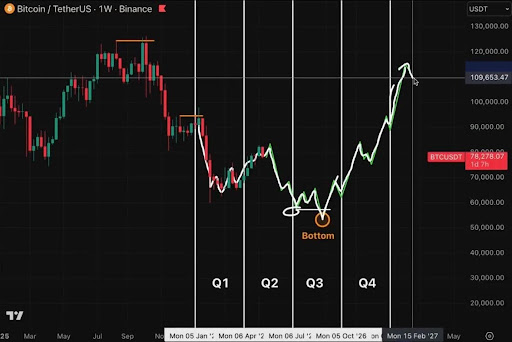
Source: Chart from Aralez on X

For his Q3 projection, Aralez boldly projects that the Bitcoin price will hit its final cycle bottom during this period. He noted that whales could also begin reentering the market, quietly accumulating more BTC ahead of a potential new bull trend.

The analyst also points to the upcoming Fed leadership change as a key trigger for a major market shakeout, with the current Chair Jerome Powell set to step down and Kevin Warsh expected to take over. Finally, he warns that peak distrust toward cryptocurrencies could spread across the market, with sentiment turning largely negative even as the market quietly resets and lays the groundwork for a fresh run higher.

Bitcoin Begins Fresh Upward Rally In Q4 2026

In his post on X, Aralez also laid out his Bitcoin outlook for Q4 2026. At this stage, the analyst predicts that the BTC price will flip back into bullish territory and begin a fresh uptrend toward $90,000 and above $109,000.

He expects the crypto market to be flooded with mass artificial intelligence (AI) integrations, fueling a fresh wave of excitement and adoption across the space. According to Aralez, momentum could also return to the market as new narratives bring in millions of participants and investors. Furthermore, he anticipates the beginning of Quantitative Easing (QE) amid global crisis conditions.

BTC trading at $76,930 on the 1D chart | Source: BTCUSDT on Tradingview.com

Related Questions

QWhat are the analyst's specific Bitcoin and Ethereum price predictions for Q2 2026?

AFor Q2 2026 (specifically May and June), the analyst predicts that Bitcoin could crash to around $58,000 and Ethereum could plunge to $1,700.

QWhat key event does the analyst believe will act as a major market trigger in Q3 2026?

AThe analyst points to the upcoming change in Federal Reserve leadership, with Jerome Powell stepping down and Kevin Warsh expected to take over, as a key trigger for a major market shakeout in Q3.

QWhat does the analyst predict for Bitcoin's price action in Q4 2026?

AIn Q4 2026, the analyst predicts Bitcoin will flip back into bullish territory and begin a fresh uptrend, targeting prices toward $90,000 and above $109,000.

QWhat are two driving factors the analyst expects to fuel market momentum in Q4 2026?

AThe analyst expects mass artificial intelligence (AI) integrations in the crypto market and the beginning of Quantitative Easing (QE) amid global crisis conditions to fuel a fresh wave of excitement and market momentum in Q4.

QWhat is the analyst's view on broader market behavior in Q2 2026 alongside the crypto predictions?

AThe analyst expects a broader market sell-off, predicting that the S&P 500 will also decline below $6,800 around the same time as the crypto price crashes, suggesting interconnected weakness and peak panic selling across markets.

Related Reads

Why Did Zhipu Surge Nearly 30% in a Single Day?

"Global AI Model Unicorn" Zhipu's stock surged nearly 30% in a single day, reaching a new market cap high. The catalyst was the launch of its GLM-5.1-highspeed API, boasting a generation speed of **400 tokens per second**, setting a new global benchmark. This speed, roughly 3-5 times faster than industry leaders like OpenAI's GPT-4o and Anthropic's Claude, is achieved **without compromising the full-scale model's capabilities**. In the era of AI Agents requiring dozens of self-calls, such latency reduction is critical, transforming speed from a system metric into a determinant of intelligence limits. The breakthrough stems from a three-layer technical overhaul: 1. **TileRT Inference Engine**: Compiles the entire model into a continuous, always-on computation pipeline using "Warp Specialization," minimizing GPU idle time by having different processor groups handle data loading, computation, and communication in parallel. 2. **Heterogeneous Parallelism for MLA**: To efficiently run the GLM-5.1 model using the MLA attention mechanism, TileRT employs a heterogeneous strategy. One GPU handles sparse indexing/routing, while the others perform dense computation, optimizing for MLA's unique workflow. 3. **ZCube Network Architecture**: Replaces the standard Spine-Leaf (ROFT) network topology with a flat, dual-group interconnect. This design creates a single optimal path between any two GPUs, eliminating network congestion at scale and reducing latency. The business impact is significant: a 15% increase in cluster throughput (free extra capacity), a 40.6% reduction in tail latency (improved stability), and a one-third cut in networking hardware costs. Long-term, this innovation challenges the dominance of NVIDIA's integrated hardware-software stack (GPU+NVLink+InfiniBand), potentially benefiting manufacturers of high-density Leaf switches and optical modules while lowering the software barrier for domestic AI chips like Huawei's Ascend. The innovation proves that more can be achieved with the same compute, reshaping the infrastructure beyond just GPUs.

marsbit1h ago

Why Did Zhipu Surge Nearly 30% in a Single Day?

marsbit1h ago

Bidding Farewell to the 'Gray Gambling Game'! Polymarket Charges into the Compliance Track—How Will This Impact the Entire Crypto Industry?

From Gray to Regulated: How Polymarket’s Compliance Journey Reshapes Crypto The evolution of Polymarket, a decentralized prediction market platform, illustrates a critical trend in crypto: innovative, high-value sectors ultimately integrate into regulatory frameworks. Founded in 2020, Polymarket quickly gained traction by leveraging low-cost Layer 2 blockchain technology for event-based trading, notably during the 2024 US presidential election where its markets outperformed traditional polls. However, its "build first, comply later" approach led to a 2022 CFTC enforcement action, resulting in a $1.4 million fine and a ban from the US market. A pivotal shift occurred in 2025 under a new US administration. Polymarket strategically acquired CFTC-licensed derivatives exchange QCX for $112 million, securing a regulated pathway back into the US. This move coincided with a regulatory reversal, as the CFTC withdrew a prior proposal to ban political event contracts. The platform’s successful "regulatory acquisition" strategy, avoiding a lengthy independent licensing process, highlights a viable compliance path for crypto-native projects. Its journey from regulatory target to a CFTC-recognized entity—bolstered by a major data partnership and investment from Intercontinental Exchange (ICE)—signals the maturation of prediction markets from a "crypto novelty" into acknowledged financial infrastructure. The story underscores that genuine utility provides negotiating power with regulators and that embracing compliance does not necessarily mean sacrificing core technological advantages.

marsbit1h ago

Bidding Farewell to the 'Gray Gambling Game'! Polymarket Charges into the Compliance Track—How Will This Impact the Entire Crypto Industry?

marsbit1h ago

Trading

Spot
Futures

Hot Articles

What is $BITCOIN

DIGITAL GOLD ($BITCOIN): A Comprehensive Analysis Introduction to DIGITAL GOLD ($BITCOIN) DIGITAL GOLD ($BITCOIN) is a blockchain-based project operating on the Solana network, which aims to combine the characteristics of traditional precious metals with the innovation of decentralized technologies. While it shares a name with Bitcoin, often referred to as “digital gold” due to its perception as a store of value, DIGITAL GOLD is a separate token designed to create a unique ecosystem within the Web3 landscape. Its goal is to position itself as a viable alternative digital asset, although specifics regarding its applications and functionalities are still developing. What is DIGITAL GOLD ($BITCOIN)? DIGITAL GOLD ($BITCOIN) is a cryptocurrency token explicitly designed for use on the Solana blockchain. In contrast to Bitcoin, which provides a widely recognized value storage role, this token appears to focus on broader applications and characteristics. Notable aspects include: Blockchain Infrastructure: The token is built on the Solana blockchain, known for its capacity to handle high-speed and low-cost transactions. Supply Dynamics: DIGITAL GOLD has a maximum supply capped at 100 quadrillion tokens (100P $BITCOIN), although details regarding its circulating supply are currently undisclosed. Utility: While precise functionalities are not explicitly outlined, there are indications that the token could be utilized for various applications, potentially involving decentralized applications (dApps) or asset tokenization strategies. Who is the Creator of DIGITAL GOLD ($BITCOIN)? At present, the identity of the creators and development team behind DIGITAL GOLD ($BITCOIN) remains unknown. This situation is typical among many innovative projects within the blockchain space, particularly those aligning with decentralized finance and meme coin phenomena. While such anonymity may foster a community-driven culture, it intensifies concerns about governance and accountability. Who are the Investors of DIGITAL GOLD ($BITCOIN)? The available information indicates that DIGITAL GOLD ($BITCOIN) does not have any known institutional backers or prominent venture capital investments. The project seems to operate on a peer-to-peer model focused on community support and adoption rather than traditional funding routes. Its activity and liquidity are primarily situated on decentralized exchanges (DEXs), such as PumpSwap, rather than established centralized trading platforms, further highlighting its grassroots approach. How DIGITAL GOLD ($BITCOIN) Works The operational mechanics of DIGITAL GOLD ($BITCOIN) can be elaborated on based on its blockchain design and network attributes: Consensus Mechanism: By leveraging Solana’s unique proof-of-history (PoH) combined with a proof-of-stake (PoS) model, the project ensures efficient transaction validation contributing to the network's high performance. Tokenomics: While specific deflationary mechanisms have not been extensively detailed, the vast maximum token supply implies that it may cater to microtransactions or niche use cases that are still to be defined. Interoperability: There exists the potential for integration with Solana’s broader ecosystem, including various decentralized finance (DeFi) platforms. However, the details regarding specific integrations remain unspecified. Timeline of Key Events Here is a timeline that highlights significant milestones concerning DIGITAL GOLD ($BITCOIN): 2023: The initial deployment of the token occurs on the Solana blockchain, marked by its contract address. 2024: DIGITAL GOLD gains visibility as it becomes available for trading on decentralized exchanges like PumpSwap, allowing users to trade it against SOL. 2025: The project witnesses sporadic trading activity and potential interest in community-led engagements, although no noteworthy partnerships or technical advancements have been documented as of yet. Critical Analysis Strengths Scalability: The underlying Solana infrastructure supports high transaction volumes, which could enhance the utility of $BITCOIN in various transaction scenarios. Accessibility: The potential low trading price per token could attract retail investors, facilitating wider participation due to fractional ownership opportunities. Risks Lack of Transparency: The absence of publicly known backers, developers, or an audit process may yield skepticism regarding the project's sustainability and trustworthiness. Market Volatility: The trading activity is heavily reliant on speculative behavior, which can result in significant price volatility and uncertainty for investors. Conclusion DIGITAL GOLD ($BITCOIN) emerges as an intriguing yet ambiguous project within the rapidly evolving Solana ecosystem. While it attempts to leverage the “digital gold” narrative, its departure from Bitcoin's established role as a store of value underscores the need for a clearer differentiation of its intended utility and governance structure. Future acceptance and adoption will likely depend on addressing the current opacity and defining its operational and economic strategies more explicitly. Note: This report encompasses synthesised information available as of October 2023, and developments may have transpired beyond the research period.

363 Total ViewsPublished 2025.05.13Updated 2025.05.13

What is $BITCOIN

Discussions

Welcome to the HTX Community. Here, you can stay informed about the latest platform developments and gain access to professional market insights. Users' opinions on the price of BTC (BTC) are presented below.

活动图片