Alert Across the Internet! Claude Code Source Code Leak Triggers "Secondary Disaster": Hackers Set GitHub Phishing Traps

marsbitPublished on 2026-04-03Last updated on 2026-04-03

Abstract

A major security alert is circulating online following the accidental leak of Claude Code's source code by Anthropic. Hackers are exploiting the incident by creating fake GitHub repositories that distribute the information-stealing malware known as **Vidar**. Posing as a user named `idbzoomh`, the threat actor set up multiple repositories claiming to offer "unlocked enterprise features" from the leaked source code. These repositories are optimized for search engines to appear at the top of results for queries like “Claude Code leak,” increasing their reach. If a user downloads and executes the provided files, the Vidar malware is deployed. It is a sophisticated stealer designed to harvest sensitive data such as browser credentials, cryptocurrency wallets, and personal information. The attack also installs **GhostSocks**, a proxy tool that establishes hidden communication channels for remote control and data exfiltration. Security firm Zscaler notes that these malicious repositories update frequently, making it easier to bypass basic security scans. At least two similar repositories have been identified, suggesting the same attacker is testing different distribution methods. This incident highlights the compound risks in the AI era, where initial human error leads to secondary threats like social engineering. Developers are urged to obtain software only through official channels and avoid executing untrusted binaries.

According to an April 2nd report, the Claude Code source code leak incident caused by an Anthropic human error continues to escalate. Currently, hackers have exploited this hot topic to spread information-stealing malware named Vidar via fake repositories on GitHub.

Upgraded Bait: Claiming to "Unlock Enterprise-Level Features"

Monitoring reports from security company Zscaler show that a user named idbzoomh has created multiple fake repositories on GitHub.

  • Precision Phishing: The hacker claims in the repository description to provide leaked source code that "unlocks enterprise features," luring eager developers to download it.

  • SEO Optimization: To maximize the impact, the attackers optimized for search engine keywords, causing these malicious repositories to often rank at the top when users search for terms like "Claude Code leak".
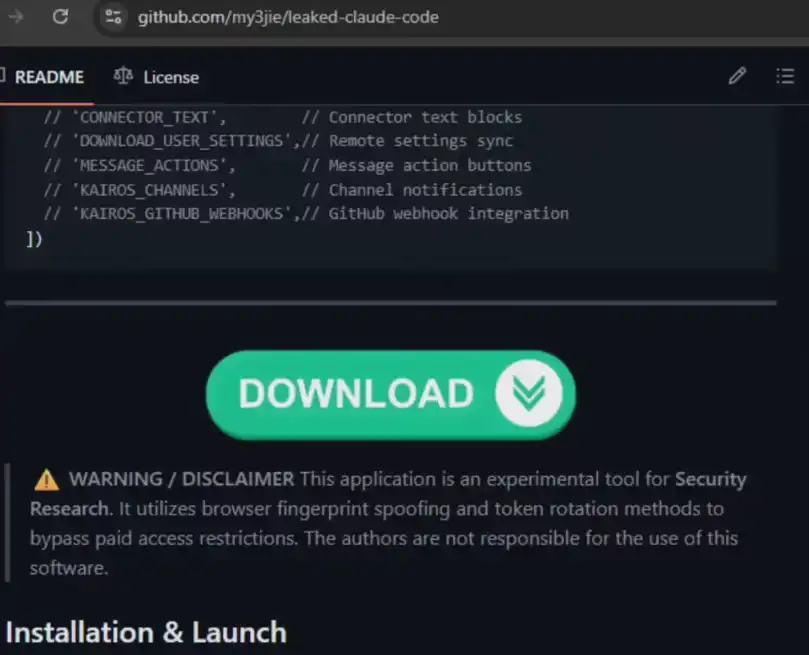
Virus Profile: Vidar Infiltrates, Data "Relocated"

Once users are deceived into downloading and executing the contained executable files, the system is quickly compromised:

  • Information Theft: The implanted Vidar is a highly mature malware on the dark web, specifically designed to harvest browser account passwords, cryptocurrency wallets, and various types of sensitive personal information.

  • Persistent Latency: The virus also simultaneously deploys the GhostSocks proxy tool, setting up a secret channel for subsequent remote control and data exfiltration.

Risk Warning: Beware of "Free Lunches" from Unofficial Channels

Security researchers point out that the malicious compressed files in these fake repositories are updated at an extremely high frequency, making them easy to bypass basic security detection. At least two repositories with similar tactics have been discovered so far, suspected to be tests of different propagation strategies by the same attacker.

Industry Observation: The "Chain Set" of AI Security

From Anthropic's source code packaging mistake to hackers secondarily exploiting the hot topic for phishing, this incident reflects the complexity of security risks in the AI era. When the developer community becomes the target of attacks, basic digital literacy—not running binaries from unknown sources—remains the last line of defense.

Editors remind all developers: Please be sure to obtain tools through official Anthropic channels. Do not fall into the traps carefully designed by hackers out of curiosity or the pursuit of "cracked features."


Related Questions

QWhat is the primary malware being distributed through the fake GitHub repositories related to the Claude Code leak?

AThe primary malware being distributed is called Vidar, which is a sophisticated information-stealing malware known for harvesting browser credentials, cryptocurrency wallets, and other sensitive personal data.

QHow are the attackers making their fake GitHub repositories more visible to potential victims?

AThe attackers are using Search Engine Optimization (SEO) techniques by including popular keywords like 'Claude Code leak' in the repository descriptions, causing these malicious repositories to appear at the top of search results.

QWhat additional tool does the Vidar malware deploy on an infected system to maintain persistence and enable data exfiltration?

AThe Vidar malware also deploys a tool called GhostSocks, which is a proxy utility that creates a secret channel for remote control and ongoing data exfiltration from the compromised system.

QWhat human error at Anthropic initially led to the situation that hackers are exploiting?

AThe initial event was a source code leak of Claude Code caused by a human error at Anthropic, where the code was mistakenly made available, creating the opportunity for hackers to use it as a lure.

QWhat is the main advice from security researchers to developers to avoid falling victim to these traps?

AThe main advice is to only obtain tools through official Anthropic channels and to avoid downloading or running binary files from unverified sources, emphasizing that basic digital hygiene is the last line of defense.

Related Reads

Coinbase Vice President: The Wars Over Cryptocurrency Regulation Are Over

Coinbase's new Vice President, Ryan VanGrak, declared that regulatory wars in the cryptocurrency sector are over. Since taking office on July 9, 2026, he has shifted the company's approach from litigation and sanctions to focusing on growth and innovation. The industry can now concentrate on development rather than fighting for its right to exist. He highlighted that the Digital Asset Market Clarity Act (CLARITY Act), which aims to establish a clear federal regulatory framework dividing oversight between the SEC and CFTC, has gained significant momentum. This framework is intended to provide proper supervision, investor protection, and maintain U.S. leadership in digital assets. VanGrak's appointment marks a strategic shift from a "wartime" to a "peacetime" advisor, replacing former Chief Legal Officer Paul Grewal, who oversaw major litigation, including a dismissed 2023 SEC lawsuit. With his background at Citadel Securities and the SEC, VanGrak brings deep regulatory and institutional finance expertise as Coinbase expands beyond a simple exchange into a broader financial services provider, offering stocks, futures, prediction markets, and AI tools. For investors, bipartisan support for crypto legislation like the CLARITY Act represents a major shift from the enforcement-focused environment of 2023-2024. Lawmakers are now focused on *how* to regulate crypto, not *if* it should exist. However, risks remain, as the bill's passage is not yet guaranteed.

cryptonews.ru2m ago

Coinbase Vice President: The Wars Over Cryptocurrency Regulation Are Over

cryptonews.ru2m ago

Deep Dive into FWA: An Intriguing Experiment Turning NFTs into "On-Chain Gachapon"

A Deep Dive into FWA: The “On-Chain Gacha” Experiment for NFTs Fake World Assets (FWA), created by TokenWorks, introduces an innovative “NFT gacha machine” fully operating on-chain. Users can deposit eligible NFTs paired with ETH (called Backing) to create a Position, acting as a prize pool. Others can then pay a uniform Acquisition Price for a chance to win a random NFT from the pool. The core mechanism features a reverse probability system: Positions with lower Backing have a higher chance of being selected, serving as common prizes, while high-Backing Positions are rare “jackpots.” The acquisition price is calculated based on the harmonic mean of all Backings, keeping entry costs low. When a Position is won, the purchaser must choose: keep the NFT or accept the Standing Bid (85% of the Backing, claimable in ETH or $FWA tokens), returning the NFT to the original depositor. The protocol involves two main roles. Depositors provide liquidity (NFT + ETH), earning a share of fees from each draw, distributed equally per active Position, plus potential $FWA rewards. Purchasers pay to spin the gacha, receiving $FWA rewards for participation. A special “Crown” reward goes to the Position with the highest Backing. The $FWA token has a fixed supply and is initially obtainable only through protocol participation (depositing or purchasing), with external buying disabled early on to reduce sell pressure. Its value is supported by a built-in buy pressure: when purchasers opt for the $FWA settlement on a Standing Bid, the protocol uses the backing ETH to buy $FWA from the market. Revenue for the protocol comes from a 1% fee on each draw, a 1% settlement fee when an NFT is kept, and the 15% discount from Standing Bid settlements (currently allocated to the protocol). The design cleverly blends Uniswap-style liquidity provision, gacha mechanics, and tokenomics to create a novel, self-regulating marketplace for NFT liquidity and engagement.

marsbit17m ago

Deep Dive into FWA: An Intriguing Experiment Turning NFTs into "On-Chain Gachapon"

marsbit17m ago

10,000 Scientists Get 1 Year of Free Access: OpenAI Brings the Scientific Research Pipeline into ChatGPT

OpenAI has launched the "ChatGPT for Academic Researchers" program, offering free one-year access to its flagship models for 100,000 university researchers globally, with 10,000 spots available this summer. Selected institutions include prestigious centers like ENS Paris and the IAS at Princeton. The initiative provides an integrated research workspace within ChatGPT, bundling tools like ChatGPT, ChatGPT Work, and Codex, along with expanded Deep Research capabilities, higher usage limits, and specialized tools for life sciences. The suite connects to platforms like Zotero and GitHub, aiming to streamline the entire research workflow from literature review and coding to data analysis and manuscript drafting. OpenAI notes that about 1.3 million people already use ChatGPT weekly for advanced science and math. The program targets building long-term user dependency by embedding these tools into daily research habits. However, access comes with limitations: it does not include API credits or model weights, and eligibility is restricted to verified academic researchers from supported countries. This approach contrasts with Anthropic's "AI for Science" program, which offers API credits but not an integrated workspace. Both companies emphasize preventing misuse by withholding model weights, a point of contention for AI researchers seeking transparency. The core strategy remains clear: provide a powerful, integrated environment to foster user reliance ahead of the post-free period.

marsbit22m ago

10,000 Scientists Get 1 Year of Free Access: OpenAI Brings the Scientific Research Pipeline into ChatGPT

marsbit22m ago

What's Going On with Gigadevice? Major Shareholder Cashes Out 44 Billion, Then Announces 20 Billion Buyback

Gigadevice Innovation, a leading Chinese memory chip company, has executed a controversial financial maneuver. The company's controlling shareholder and chairman, Zhu Yiming, sold approximately 44 billion RMB worth of his shares between early May and mid-June 2026, capitalizing on a soaring stock price that peaked at 846.66 RMB on June 29th. Following a subsequent stock crash—plummeting to around 350 RMB in 22 trading days and erasing over 330 billion RMB in market value—Zhu announced a combined "market rescue" plan on July 29th. This plan includes his personal commitment to buy back at least 1 billion RMB in shares and a company proposal to repurchase 1 to 2 billion RMB worth of stock. This sequence of high-selling followed by a low-buying plan has confused and unsettled many of the company's 240,000 retail investors. The stock's dramatic decline was attributed to several factors: the successful IPO of its sister company, Changxin Technologies, which ended Gigadevice's status as a primary investment proxy for the domestic memory sector; a Morgan Stanley report warning of a potential peak in the memory chip cycle; and a severe loss of market confidence triggered by the chairman's massive sell-off. While the sell-off was procedurally compliant, its timing has been criticized. The company's fundamentals appear strong, with preliminary H1 2026 results showing revenue up 177% year-on-year to 11.5 billion RMB and net profit skyrocketing 1099% to 6.9 billion RMB, driven by a boom in memory chips and MCU demand. However, a significant portion (2.05 billion RMB) of this profit came from non-recurring gains like securities investment, and the memory industry is notoriously cyclical. Analysts highlight the company's role in the domestic substitution of niche DRAM and NOR Flash memory, with some maintaining bullish price targets. Yet, the recent events underscore key risks: its fabless model creates dependency on foundries like Changxin, and the chairman's actions have raised serious questions about management's alignment with minority shareholders. The promised buybacks cannot commence until December 13th due to a mandatory six-month cooling-off period following an insider sale, leaving the stock vulnerable in the interim.

marsbit22m ago

What's Going On with Gigadevice? Major Shareholder Cashes Out 44 Billion, Then Announces 20 Billion Buyback

marsbit22m ago

Trading

Spot
活动图片