Written by: YQ
Compiled by: Chopper, Foresight News
A current point of debate on Crypto Twitter is: 'Should I stay, or should I go?' The question itself is wrong; it assumes there is a safe place to go, but in reality, there is none.
Goldman Sachs states that 300 million jobs globally will be impacted by AI. The CEO of Anthropic claims that 50% of junior white-collar jobs will disappear within five years. Just in Q1 2026, 45,000 tech workers were laid off.
This is not a problem unique to the crypto industry; it is the Fourth Industrial Revolution arriving at everyone's doorstep.
The panic you feel is real and widespread. And those who find the next direction to build will define the next thirty years.
What I see is this: the crypto industry hasn't made you fragile; it has forged you into the fastest-learning, most cross-domain capable, and most adaptable builders on the planet. The real question is: will you use this ability, or will you discard it to chase a sense of security that simply doesn't exist.
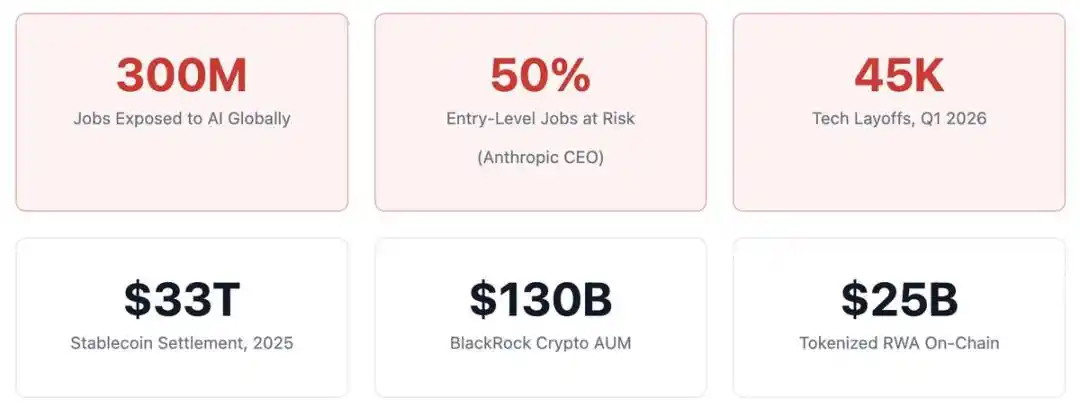
Confronting the Real Problem
The statement 'Crypto is dead for builders' had some merit in 2022. It described a market that no longer exists today.
Behind the same anxiety lies a more brutal, yet more universal truth: AI is commoditizing all work based on existing knowledge and pattern matching.
This is the real fear, not 'crypto has no use cases.' What is truly unsettling is that Claude Code, Codex, Gemini Code Assist are already so powerful that most junior software development roles are being replaced.
Stanford University research confirms: since the launch of ChatGPT, the employment rate for developers aged 22-25 has fallen by 20%. 60% of companies plan to replace employees with AI in 2026. The marginal cost of a competent code agent is approaching zero.
This is not a cryptocurrency problem. This is a problem facing all of human civilization, and it is impacting every industry simultaneously.
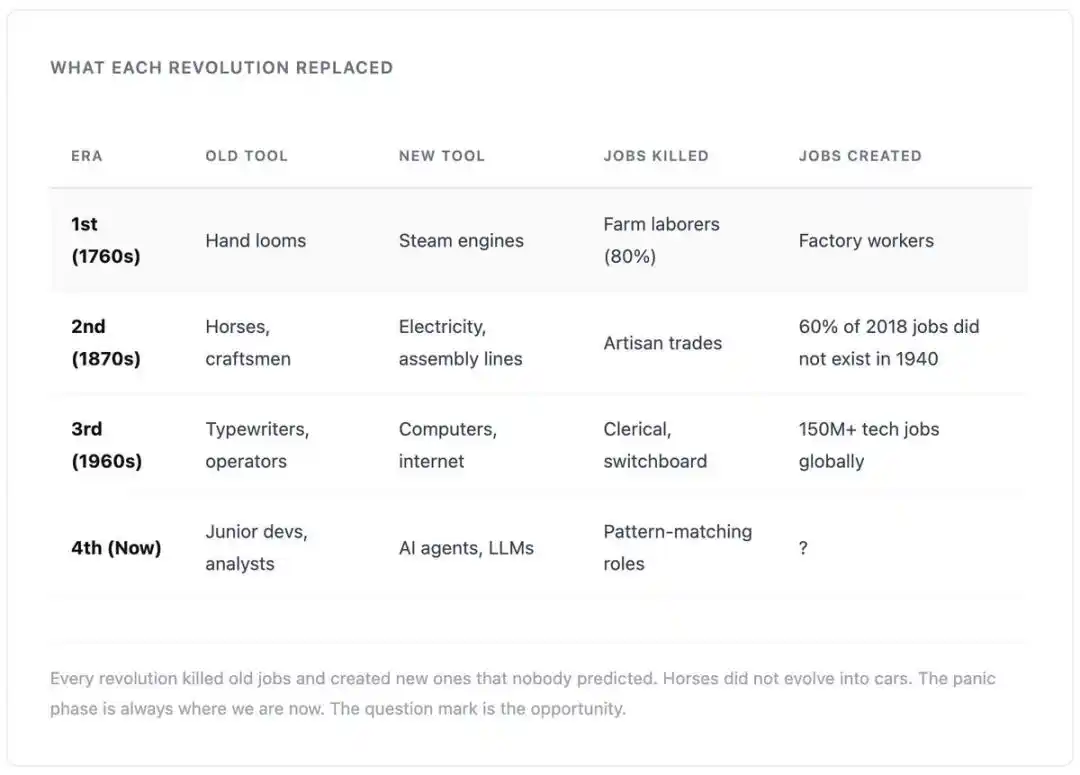
Three Types of People Make Money, The Rest Panic
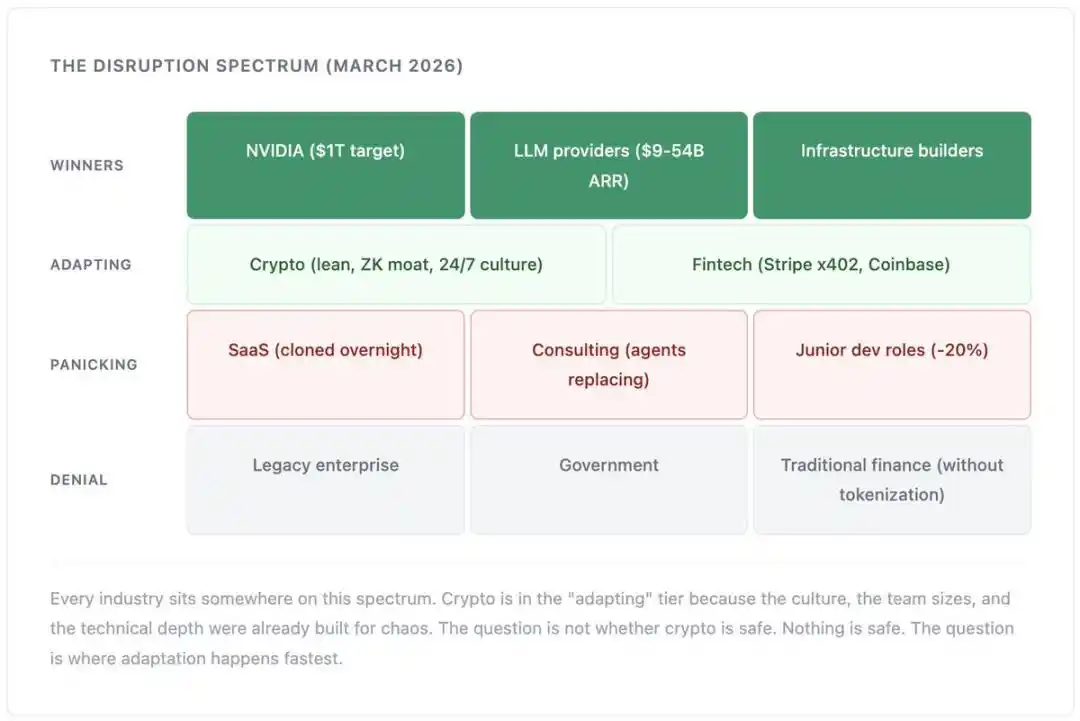
Stripping away the hype, who is *really* making money from AI right now?
First Layer: NVIDIA. NVIDIA's annual revenue is $216 billion; Jensen Huang aims for $1 trillion in annual AI chip revenue by 2027. This is the classic 'selling shovels' logic, proven effective time and again in every transformation.
Second Layer: Major model vendors. OpenAI's annualized revenue is $12.7 billion, targeting $54 billion by 2027. Anthropic's annual recurring revenue is approaching $9 billion, targeting $20-26 billion in 2026. They sell API calls, have recurring revenue, and real profits.
Third Layer: Fearmongers. Short video creators, course sellers, make money by telling you 'AI will replace you.' The content is fear, the product is a $99 course, with extremely high profit margins.
Everyone else is searching for a moat, but finding none. A good idea gets copied by hundreds of companies within days of launch. If the profits are attractive enough, OpenAI, Anthropic, or Google will step in and launch their own version.
Manus was the first general AI agent, then Claude launched Cowork, followed by OpenClaw open-sourcing the entire concept, garnering 219k stars on GitHub. The window from 'innovation' to 'commoditization' is now measured in weeks.
A dangerous signal: if your moat is just 'a nice interface wrapped around a large model,' then you have no moat. The marginal cost of wrapping models is approaching zero. The real barrier in the AI field lies in controlling the infrastructure that large models rely on, not piling features on top of them.
Why Crypto Builders Actually Have a Unique Advantage
Set aside shallow narratives like 'crypto is dead' and ask: how much better off is any other field?
Compared to SaaS? All features will be copied by AI overnight. Compared to consulting? Agents are replacing analysts. Compared to junior dev roles? Employment has fallen 20% in two years.
Crypto builders possess structural advantages that other tech fields lack.
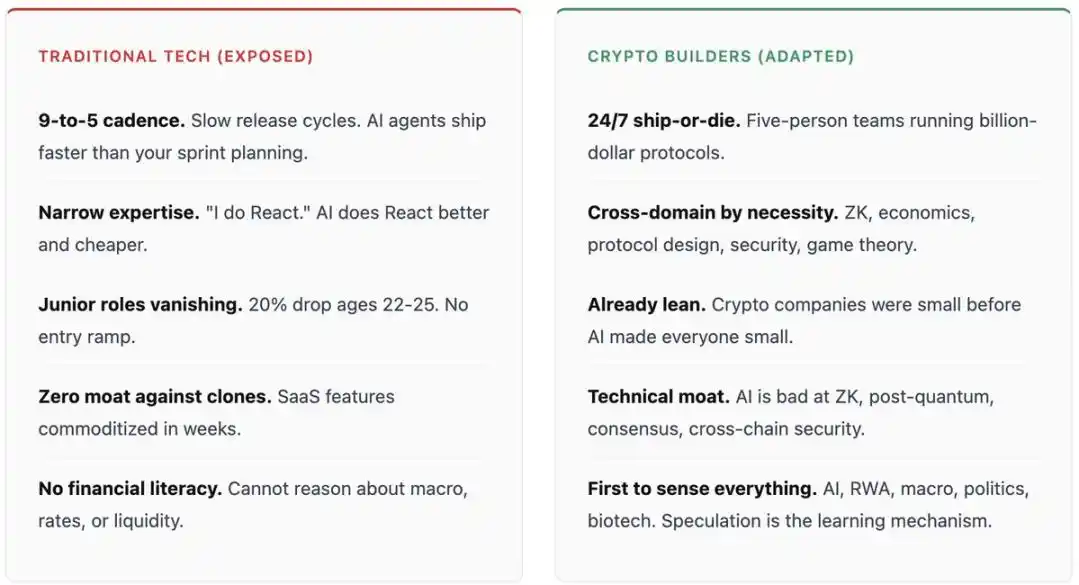
One point is particularly important: the crypto crowd has the highest information density in the tech circle. They track cryptography, distributed systems, macroeconomics, geopolitics, oil, gold, AI, biotech, longevity tech, SpaceX, and all cultural hotspots.
Why? Because they are betting on it. Meme coins, prediction markets, new token offerings... Speculation is not a flaw; it is the fastest learning mechanism humans have invented. By the time traditional industries catch on to a trend, crypto builders have already built the infrastructure for it and moved on to the next big thing.
And technical barriers aren't just talk; they are measurable. The Ethereum Foundation has elevated post-quantum cryptographic security to its highest strategic priority. Vitalik's 'Ethereum Simplification' roadmap places 'full quantum resistance' at its core. Zero-knowledge proof systems, Poseidon hash functions, lattice-based cryptography...
Claude Code can easily crush CRUD apps, but it's far less effective when writing recursive SNARK circuits or designing validator penalty mechanisms with game-theoretic guarantees.
The Fact Everyone is Ignoring
Watch actions, not sentiment. Those actually doing things are giving an answer completely opposite to the doomsayers on Crypto Twitter with their actions.
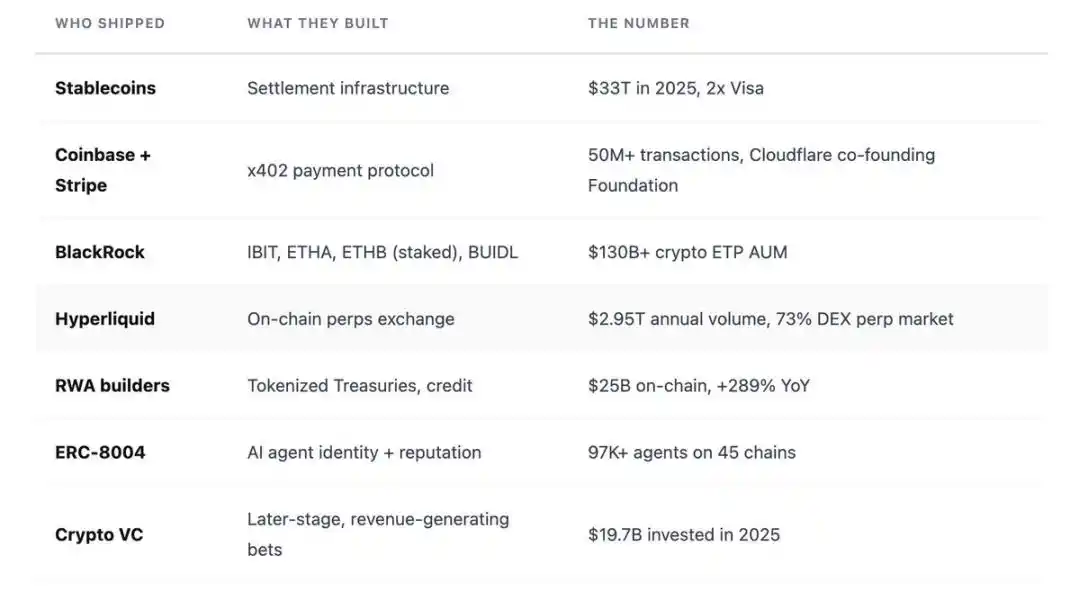
Stripe won't integrate a dying protocol. BlackRock won't issue a staked ETH ETF in a dead market. Cloudflare won't co-found a payments foundation for an industry with no future.
Hype is not demand; adoption is demand. These giants are voting with their feet.
Pandora's Box is Open
Sam Altman cannot predict what GPT-6 will bring. Dario Amodei built a lab focused on safety yet still admits half of junior jobs will disappear. Sundar Pichai reorganized all of Google to pivot entirely to AI.
The people building these technologies don't know what the future holds. No one knows.
Only three things are certain:
- The box won't close. AI will get stronger, code agents will get better, white-collar automation will accelerate. We are not going back to an era of all hand-written code. The question is not how to escape, but how you position yourself.
- New tools create new professions. In 1995, no one foresaw 'social media manager.' In 2005, no one foresaw 'cloud architect.' Today, no one can predict the AI-native professions of 2030. But every industrial revolution has created more jobs than it destroyed, without exception.
- Builders during the panic will dominate the next era. Amazon was born amidst the skepticism of the dot-com bubble; Stripe was founded when payments were 'already solved'; Coinbase started when Bitcoin was a joke.
When everyone feels 'now is not the time to build,' it is precisely the signal that it is the best time to build.
Your Choice
For doing old things, this is the worst of times. For trying new things, this is the best of times.
Don't leave the industry just because Crypto Twitter is full of anxiety. *Everyone* is anxious. Financial analysts are anxious. SaaS founders are anxious. Junior engineers at Google are anxious.
The difference is: the crypto industry has endowed you with a set of capabilities most builders don't have: all-weather cross-domain pattern recognition, a permissionless innovation sandbox, lean teams that can launch quickly without approval, and the community that absorbs new technologies the fastest globally.
Follow your genuine interest. Not because it's a comforting platitude, but because in a world where no one knows the future, the only reliable signal is whether you genuinely care about this thing, whether you are willing to persevere through difficult times.
And difficult times will come for everyone, for every industry.
Pandora's box is open; it cannot be closed. Pick up the new tools and move to the frontier. Those who persist in building amidst the panic will ultimately define the next era.






