AI Sweeps Everything, Why Are Crypto Builders the Most Secure?

marsbitPublished on 2026-03-20Last updated on 2026-03-20

Abstract

In an era where AI is disrupting industries and causing widespread job displacement, crypto builders are uniquely positioned to thrive. While AI threatens to automate many white-collar and coding jobs, the crypto sector has forged individuals with exceptional adaptability, cross-domain expertise, and rapid learning capabilities. The real issue isn’t that crypto is dying—it’s that AI is commoditizing knowledge-based work globally. True value in AI is captured by infrastructure players like NVIDIA and OpenAI, not by those simply wrapping AI models. In contrast, crypto offers structural advantages: its community operates at high information density, tracks multiple innovation frontiers, and builds non-commoditizable tech like zero-knowledge proofs and quantum-resistant cryptography. Major players like Stripe, BlackRock, and Cloudflare are investing heavily in crypto infrastructure, signaling real-world demand. The future remains uncertain, but those who build through uncertainty—as seen in past technological revolutions—will define the next era. Crypto builders, equipped with a unique skill set and mindset, are among the best prepared to navigate and lead in the age of AI.

Written by: YQ

Compiled by: Chopper, Foresight News

A current point of debate on Crypto Twitter is: 'Should I stay, or should I go?' The question itself is wrong; it assumes there is a safe place to go, but in reality, there is none.

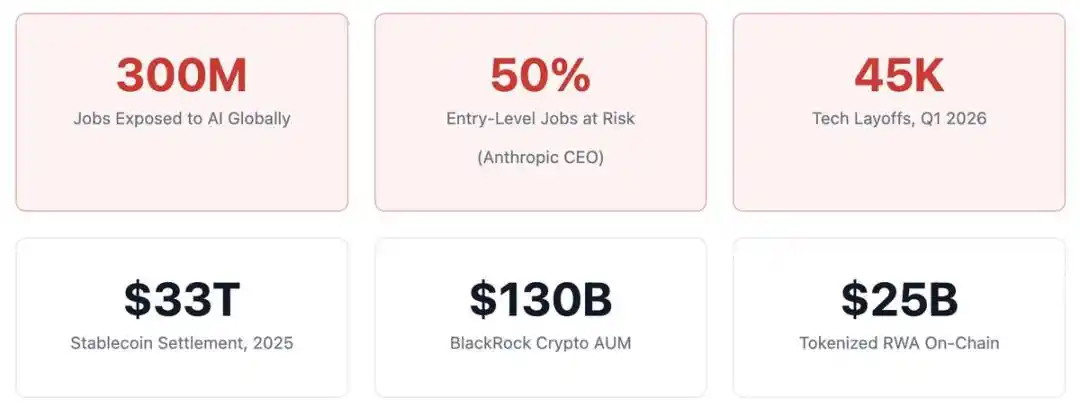
Goldman Sachs states that 300 million jobs globally will be impacted by AI. The CEO of Anthropic claims that 50% of junior white-collar jobs will disappear within five years. Just in Q1 2026, 45,000 tech workers were laid off.

This is not a problem unique to the crypto industry; it is the Fourth Industrial Revolution arriving at everyone's doorstep.

The panic you feel is real and widespread. And those who find the next direction to build will define the next thirty years.

What I see is this: the crypto industry hasn't made you fragile; it has forged you into the fastest-learning, most cross-domain capable, and most adaptable builders on the planet. The real question is: will you use this ability, or will you discard it to chase a sense of security that simply doesn't exist.
Confronting the Real Problem

The statement 'Crypto is dead for builders' had some merit in 2022. It described a market that no longer exists today.

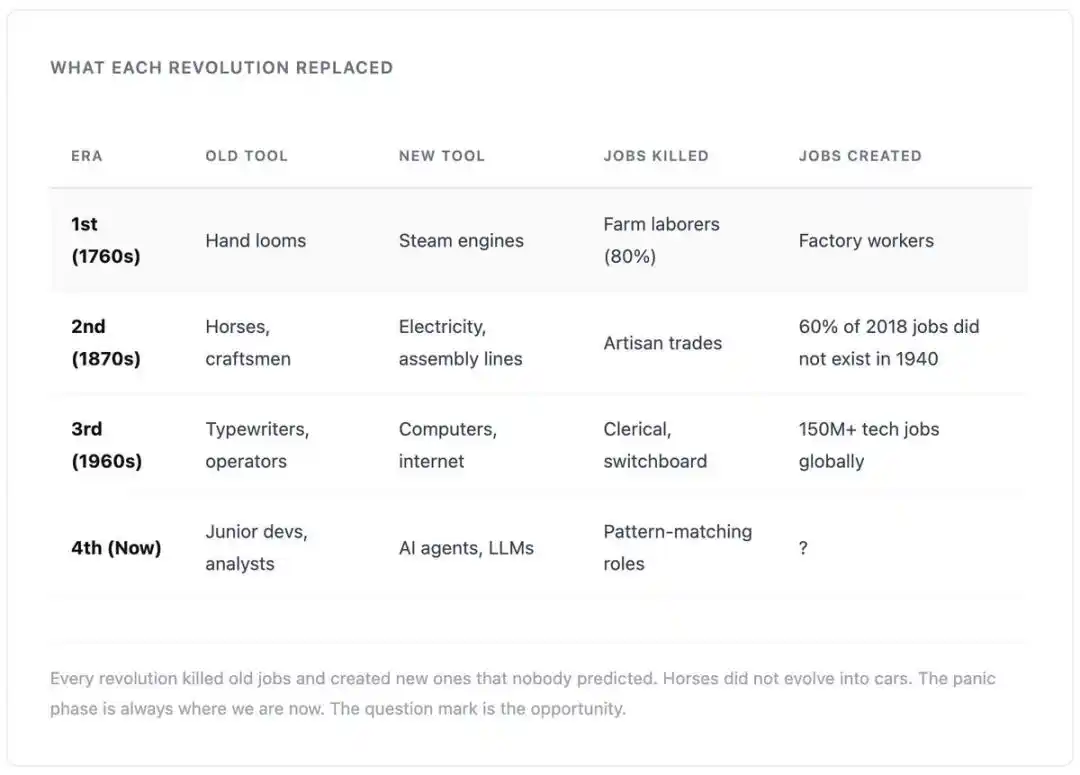
Behind the same anxiety lies a more brutal, yet more universal truth: AI is commoditizing all work based on existing knowledge and pattern matching.

This is the real fear, not 'crypto has no use cases.' What is truly unsettling is that Claude Code, Codex, Gemini Code Assist are already so powerful that most junior software development roles are being replaced.

Stanford University research confirms: since the launch of ChatGPT, the employment rate for developers aged 22-25 has fallen by 20%. 60% of companies plan to replace employees with AI in 2026. The marginal cost of a competent code agent is approaching zero.

This is not a cryptocurrency problem. This is a problem facing all of human civilization, and it is impacting every industry simultaneously.
Three Types of People Make Money, The Rest Panic

Stripping away the hype, who is *really* making money from AI right now?

First Layer: NVIDIA. NVIDIA's annual revenue is $216 billion; Jensen Huang aims for $1 trillion in annual AI chip revenue by 2027. This is the classic 'selling shovels' logic, proven effective time and again in every transformation.

Second Layer: Major model vendors. OpenAI's annualized revenue is $12.7 billion, targeting $54 billion by 2027. Anthropic's annual recurring revenue is approaching $9 billion, targeting $20-26 billion in 2026. They sell API calls, have recurring revenue, and real profits.

Third Layer: Fearmongers. Short video creators, course sellers, make money by telling you 'AI will replace you.' The content is fear, the product is a $99 course, with extremely high profit margins.

Everyone else is searching for a moat, but finding none. A good idea gets copied by hundreds of companies within days of launch. If the profits are attractive enough, OpenAI, Anthropic, or Google will step in and launch their own version.

Manus was the first general AI agent, then Claude launched Cowork, followed by OpenClaw open-sourcing the entire concept, garnering 219k stars on GitHub. The window from 'innovation' to 'commoditization' is now measured in weeks.

A dangerous signal: if your moat is just 'a nice interface wrapped around a large model,' then you have no moat. The marginal cost of wrapping models is approaching zero. The real barrier in the AI field lies in controlling the infrastructure that large models rely on, not piling features on top of them.

Why Crypto Builders Actually Have a Unique Advantage

Set aside shallow narratives like 'crypto is dead' and ask: how much better off is any other field?

Compared to SaaS? All features will be copied by AI overnight. Compared to consulting? Agents are replacing analysts. Compared to junior dev roles? Employment has fallen 20% in two years.

Crypto builders possess structural advantages that other tech fields lack.
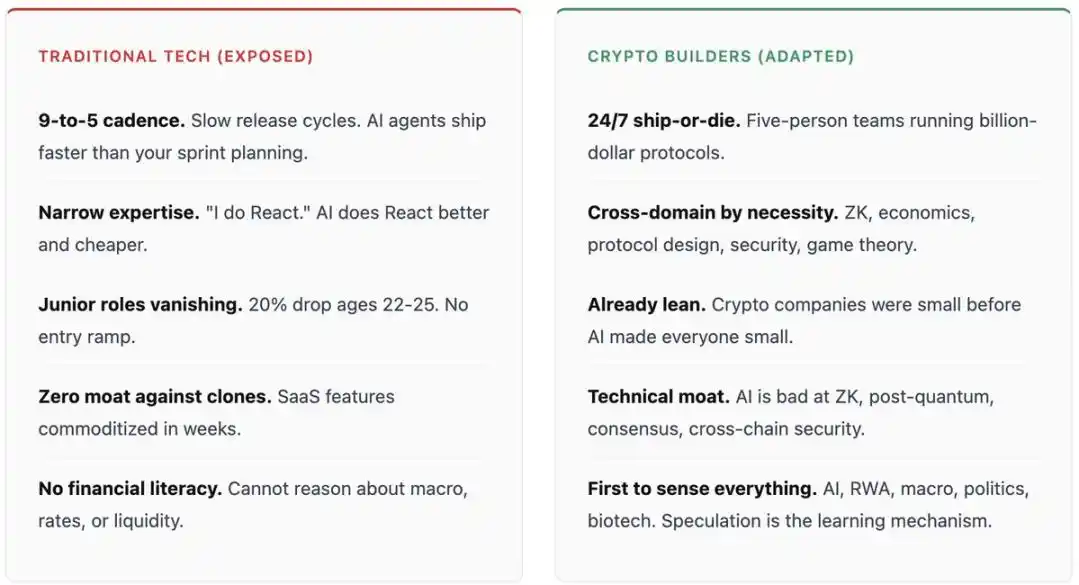
One point is particularly important: the crypto crowd has the highest information density in the tech circle. They track cryptography, distributed systems, macroeconomics, geopolitics, oil, gold, AI, biotech, longevity tech, SpaceX, and all cultural hotspots.

Why? Because they are betting on it. Meme coins, prediction markets, new token offerings... Speculation is not a flaw; it is the fastest learning mechanism humans have invented. By the time traditional industries catch on to a trend, crypto builders have already built the infrastructure for it and moved on to the next big thing.

And technical barriers aren't just talk; they are measurable. The Ethereum Foundation has elevated post-quantum cryptographic security to its highest strategic priority. Vitalik's 'Ethereum Simplification' roadmap places 'full quantum resistance' at its core. Zero-knowledge proof systems, Poseidon hash functions, lattice-based cryptography...

Claude Code can easily crush CRUD apps, but it's far less effective when writing recursive SNARK circuits or designing validator penalty mechanisms with game-theoretic guarantees.

The Fact Everyone is Ignoring

Watch actions, not sentiment. Those actually doing things are giving an answer completely opposite to the doomsayers on Crypto Twitter with their actions.
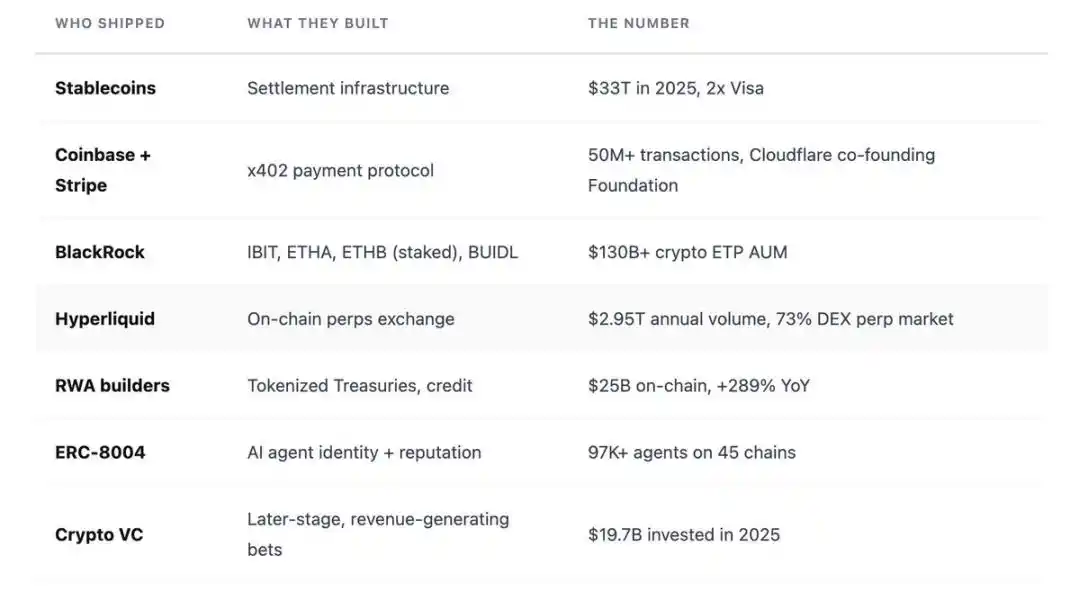
Stripe won't integrate a dying protocol. BlackRock won't issue a staked ETH ETF in a dead market. Cloudflare won't co-found a payments foundation for an industry with no future.

Hype is not demand; adoption is demand. These giants are voting with their feet.

Pandora's Box is Open

Sam Altman cannot predict what GPT-6 will bring. Dario Amodei built a lab focused on safety yet still admits half of junior jobs will disappear. Sundar Pichai reorganized all of Google to pivot entirely to AI.

The people building these technologies don't know what the future holds. No one knows.

Only three things are certain:

  • The box won't close. AI will get stronger, code agents will get better, white-collar automation will accelerate. We are not going back to an era of all hand-written code. The question is not how to escape, but how you position yourself.
  • New tools create new professions. In 1995, no one foresaw 'social media manager.' In 2005, no one foresaw 'cloud architect.' Today, no one can predict the AI-native professions of 2030. But every industrial revolution has created more jobs than it destroyed, without exception.
  • Builders during the panic will dominate the next era. Amazon was born amidst the skepticism of the dot-com bubble; Stripe was founded when payments were 'already solved'; Coinbase started when Bitcoin was a joke.

When everyone feels 'now is not the time to build,' it is precisely the signal that it is the best time to build.
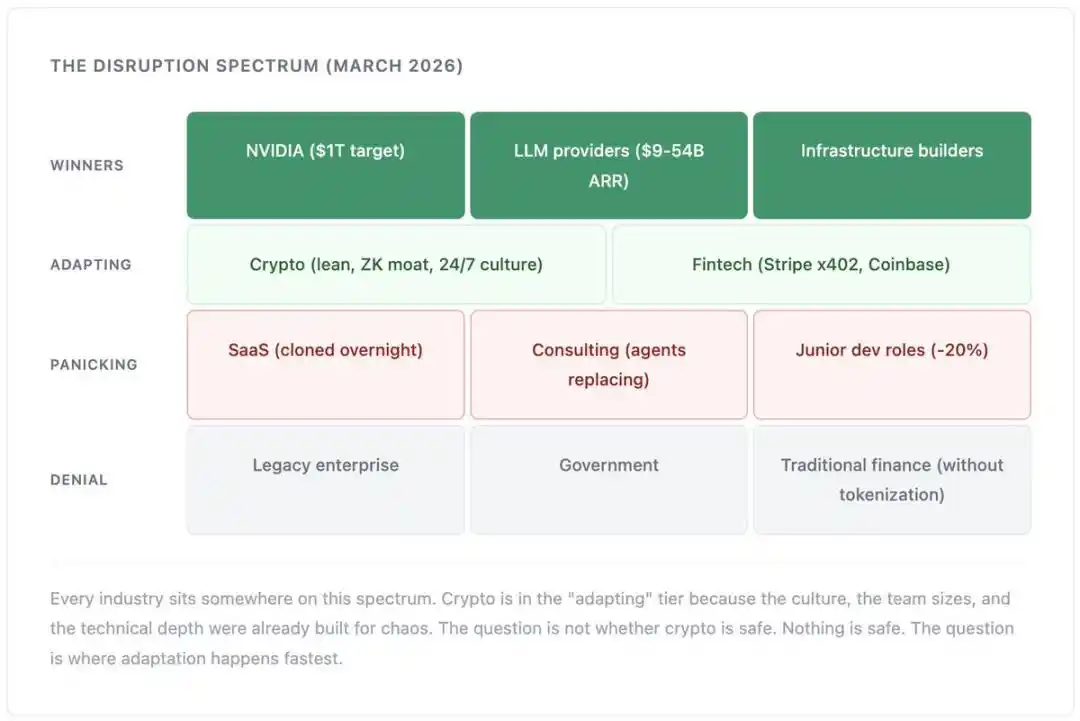
Your Choice

For doing old things, this is the worst of times. For trying new things, this is the best of times.

Don't leave the industry just because Crypto Twitter is full of anxiety. *Everyone* is anxious. Financial analysts are anxious. SaaS founders are anxious. Junior engineers at Google are anxious.

The difference is: the crypto industry has endowed you with a set of capabilities most builders don't have: all-weather cross-domain pattern recognition, a permissionless innovation sandbox, lean teams that can launch quickly without approval, and the community that absorbs new technologies the fastest globally.

Follow your genuine interest. Not because it's a comforting platitude, but because in a world where no one knows the future, the only reliable signal is whether you genuinely care about this thing, whether you are willing to persevere through difficult times.

And difficult times will come for everyone, for every industry.

Pandora's box is open; it cannot be closed. Pick up the new tools and move to the frontier. Those who persist in building amidst the panic will ultimately define the next era.


Related Questions

QWhy does the article argue that crypto builders are uniquely positioned during the AI revolution?

AThe article argues that crypto builders possess structural advantages such as high information density, cross-domain adaptability, and experience in fast-paced, permissionless innovation. They are skilled in complex areas like cryptography and distributed systems, which are less easily automated by AI compared to routine coding tasks.

QAccording to the article, what are the three groups currently profiting from AI?

AThe three groups profiting from AI are: 1) Nvidia (selling AI chips), 2) Major model manufacturers like OpenAI and Anthropic (selling API calls with recurring revenue), and 3) Those selling fear, such as influencers and course sellers capitalizing on AI anxiety.

QWhat is the core fear that the article identifies, beyond the crypto-specific concerns?

AThe core fear identified is that AI is commoditizing all work based on existing knowledge and pattern matching, threatening to replace a vast number of white-collar and junior developer positions across all industries, not just crypto.

QWhat evidence does the article provide to counter the narrative that 'crypto is dead' for builders?

AThe article points to actions from major institutions like Stripe integrating crypto protocols, Blackrock issuing a staking ETH ETF, and Cloudflare co-founding a payment foundation as evidence of real-world demand and long-term confidence, contradicting the superficial narrative.

QWhat is the article's final advice to builders feeling anxiety about the future?

AThe article advises builders to leverage the unique skills they've developed in crypto, such as rapid learning and adaptation, and to continue building new things based on genuine interest, as periods of widespread panic are historically the best times for innovation and defining the next era.

Related Reads

Snap, Unprofitable for Nine Years, and a Decade-Long AR Obsession Without Return

Snap's AR Obsession: A Decade of Betting Against the Odds On June 16, Snap CEO Evan Spiegel unveiled the new AR glasses, Specs, priced at $2,195, causing the company's stock (SNAP) to plummet nearly 10%. The launch was met with intense criticism online, with investors questioning why a consistently unprofitable company would stake its future on an expensive product its core young user base can't afford. Snapchat, known for pioneering features like ephemeral Stories and popular AR lenses (like the iconic dog filter), has a history of innovation often copied by rivals like Instagram and Meta. Despite this, it has struggled to translate first-mover advantage into commercial success. Since its 2017 IPO, Snap has reported annual net losses, with a Q1 2026 loss of $89 million. Its stock is down 94% from its 2021 peak, hampered by iOS privacy changes, competition, and a young demographic less attractive to major advertisers. In this challenging context, Spiegel is doubling down on AR. He calls 2026 a "crucible moment," having recently laid off 16% of staff while reportedly investing over $3.5 billion cumulatively in its AR glasses line over nearly a decade. The new Specs represent a significant leap from the 2016 camera-focused Spectacles, offering true AR overlays, gesture control, and standalone operation. However, at $2,195, it faces tough comparisons. While more advanced than Meta's $799 Ray-Ban smart glasses, critics point to its heavier weight, short battery life, and features largely replicable by a smartphone. Facing pressure from investors to cut losses on the Specs project, Spiegel has refused, framing it as essential to Snap's long-term vision. The company finds itself in a paradoxical position: cutting costs while heavily funding a decade-long, unproven bet. Some see Specs as an awkward but necessary step in AR's evolution, akin to early mobile phones. Whether Spiegel is a visionary outlier or a gambler destined to fail remains an open question, highlighting the tension between long-term ambition and short-term market demands.

marsbit13m ago

Snap, Unprofitable for Nine Years, and a Decade-Long AR Obsession Without Return

marsbit13m ago

Annualized Revenue Exceeds $20 Billion, Kalshi Aims to Become the First Prediction Platform IPO?

Kalshi, a leading U.S. prediction markets platform, is reportedly in early, informal discussions for an Initial Public Offering (IPO). The company's annualized revenue now exceeds $2 billion, fueled by its dominance of over 90% of the domestic prediction market activity. This growth stems from a surge in trading volume—reaching a total of $52.7 billion—and an increase in fee rates, largely driven by sports event contracts like the NBA playoffs and the 2026 FIFA World Cup. Monthly active users are approximately 2 million. Kalshi recently raised $1 billion in a funding round led by Coatue Management, valuing the company at $22 billion. It has also expanded its offerings to include Bitcoin perpetual contracts and plans to launch a dedicated trading platform, Kalshi Pro. However, Kalshi's path to an IPO faces significant regulatory hurdles. The core risk involves jurisdictional conflicts, as multiple U.S. states are challenging its operations under local gambling laws. For instance, Arizona has filed criminal charges against the platform, while states like Kentucky have filed lawsuits. Kalshi and the Commodity Futures Trading Commission (CFTC) argue that its event contracts fall under exclusive federal jurisdiction as "swaps." The outcomes of these ongoing legal battles could critically impact Kalshi's core revenue and its IPO timeline. Analysts suggest that while an IPO could theoretically occur by late 2026, a more likely timeframe is late 2027 or 2028, contingent on resolving legal issues and favorable market conditions. If successful, its fundraising could significantly exceed $1 billion, given its current valuation and revenue multiple.

Foresight News31m ago

Annualized Revenue Exceeds $20 Billion, Kalshi Aims to Become the First Prediction Platform IPO?

Foresight News31m ago

Financing Weekly Report | 11 Public Financing Events, Stablecoin Payment Infrastructure Company Trace Finance Completes $32 Million Series A Round Led by CoinFund

Financing Weekly Report | 11 public funding events recorded, with a total scale exceeding $264 million. The stablecoin payment infrastructure sector remains a hot spot. Key Deals: - Trace Finance, a stablecoin payment infrastructure firm, raised $32 million in a Series A round led by CoinFund to expand in Latin America and Asia-Pacific. - Galaxy Ventures co-led a $140 million Series A round for Karta, a US credit card provider for global travelers without requiring an SSN. - Instant payment platform Interchecks completed a $50 million Series C round. - Paradigm led a $9 million Series A for Latin American cross-border payment app El Dorado. - Range, a stablecoin compliance startup, raised $8.3 million in an oversubscribed Series A. - RWA infrastructure project Renaiss raised $1.5 million to expand its on-chain collectibles platform. Sector Breakdown: - Infrastructure & Tools: 6 deals, including the above-mentioned Trace Finance, Range, and Renaiss. - Centralized Finance (CeFi): 3 deals, led by Karta's $140 million round. - DeFi: 1 deal – reinsurance protocol Re secured strategic investment from Coinbase Ventures. - Prediction Markets: 1 deal – K25.ai completed a $10 million Pre-A round from NewGen. Other notable transactions include digital asset depository RDC raising $7 million, ad-tech startup EarnOS securing $6 million, and a $1 million strategic investment in LitVM, a ZK Layer 2 for Litecoin. The report highlights sustained investor interest in stablecoin payment infrastructure, compliant on-chain finance, and real-world asset (RWA) tokenization.

marsbit1h ago

Financing Weekly Report | 11 Public Financing Events, Stablecoin Payment Infrastructure Company Trace Finance Completes $32 Million Series A Round Led by CoinFund

marsbit1h ago

When Transfers Become Truly Frictionless: How Sui Uses 'Zero Gas' to Become the Underlying Infrastructure for Stablecoin Payments

Title: Sui Launches Zero-Gas Stablecoin Transfers to Become the Foundation for Stablecoin Payments Sui has introduced a zero-gas fee feature for peer-to-peer stablecoin transfers, eliminating the need for users or businesses to hold separate SUI tokens to pay transaction costs. This innovation, built on a new underlying account architecture called Address Balances, significantly reduces validator processing costs for eligible transactions. Currently, the feature applies to a whitelist of stablecoins for transfers meeting a minimum amount, effectively preventing spam. This development aims to unlock mainstream payment use cases for stablecoins—such as everyday purchases, remittances, and subscriptions—by removing cost and complexity barriers. It is also positioned to benefit high-frequency micro-payments for AI agents and institutional B2B payments, reducing operational friction. Major custody provider Fireblocks has already announced support. The move follows Sui processing over $1 trillion in stablecoin transfer volume since August 2025. Looking ahead, Sui plans to enhance this infrastructure with protocol-level confidential transactions later in 2026, aiming to provide scalable, free, and privacy-preserving payments. Together, these advancements strengthen Sui's goal of becoming the default settlement layer for stablecoin payments.

marsbit1h ago

When Transfers Become Truly Frictionless: How Sui Uses 'Zero Gas' to Become the Underlying Infrastructure for Stablecoin Payments

marsbit1h ago

Trading

Spot
Futures
活动图片