AI Bubble Concerns Reignite, Oracle Plunges 16%, US Stocks Mixed, Gold and Oil Under Pressure, Bitcoin Drops Over 2%

华尔街日报Published on 2025-12-11Last updated on 2025-12-11

Abstract

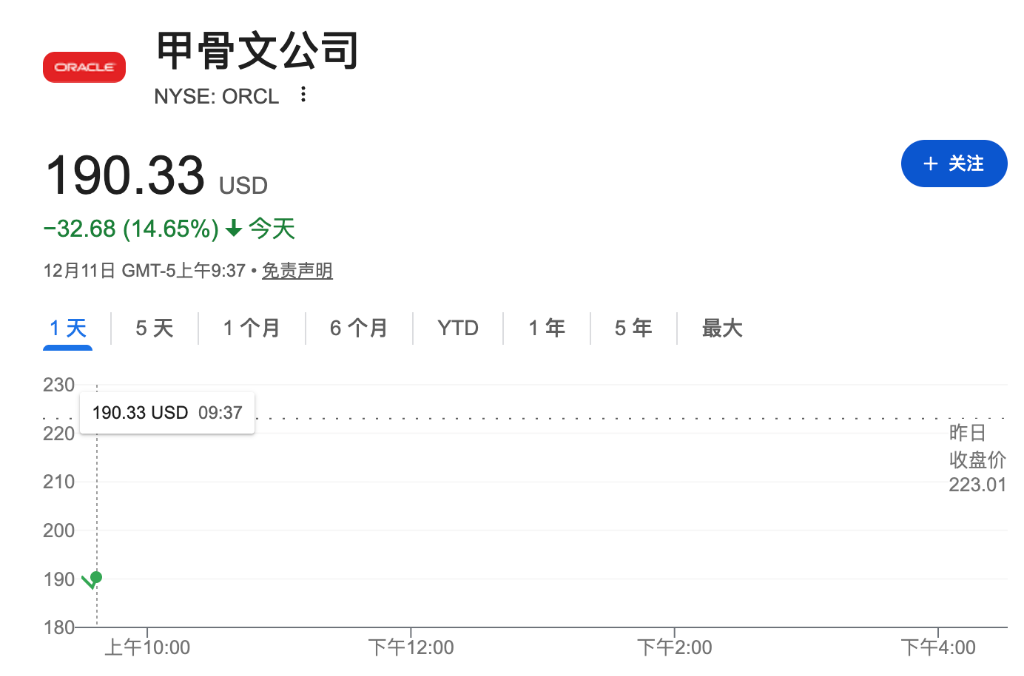
Concerns about an AI investment bubble resurfaced, triggering a broad sell-off in risk assets. Oracle's stock plummeted 16% after reporting disappointing quarterly results, with both revenue and cloud business income missing analyst expectations. The company also reported negative free cash flow and announced significantly higher-than-expected capital expenditures, largely debt-funded, for AI infrastructure. This development dampened market sentiment, particularly towards tech and AI-related stocks. Major U.S. indices were mixed, with the Nasdaq falling 0.6%. Global markets reacted similarly, with Asian and European shares mostly lower. The negative risk sentiment flowed into other asset classes. Bitcoin fell over 2%, briefly dropping below $90,000, while gold and crude oil prices also declined. In contrast, silver and copper posted gains. Analysts noted that Oracle's performance has intensified scrutiny on AI-driven spending strategies, especially those financed through debt. The market's reaction highlights growing investor caution regarding the sustainability of AI investments, marking a shift from previous excitement around capital expenditure increases in the sector.

Due to market concerns over Oracle Corporation's plans to heavily invest in artificial intelligence infrastructure, leading to a broad sell-off of risk assets, US stocks declined.

On December 11, US stocks were mixed, European stocks varied, Asian stocks gave up early gains, with most markets moving lower. US Treasury prices rose, and the US dollar saw a slight rebound. Commodities were mixed, with silver and copper rising, while gold and crude oil fell. Cryptocurrencies were under pressure, with Bitcoin briefly falling below $90,000.

Panmure Liberum strategist Susana Cruz said:

"Market caution regarding AI-related spending has significantly increased, contrasting sharply with the situation in mid-2025, when any hint of increased capital expenditure would trigger market excitement. Oracle Corporation has been the weakest link in this chain of events, primarily because a large portion of its investments are debt-financed."

Core market movements are as follows:

  • The S&P 500 opened 25.38 points lower, down 0.37%, at 6,861.30 points; the Dow Jones Industrial Average opened 25.15 points higher, up 0.05%, at 48,082.90 points; the Nasdaq Composite opened 144.94 points lower, down 0.61%, at 23,509.22 points.
  • Germany's DAX 30 index opened down 0.10%, the UK's FTSE 100 opened down 0.10%, France's CAC 40 opened up 0.21%,
    The Euro Stoxx 50 index opened down 0.03%.
  • Japan's Nikkei 225 index closed down 0.9% at 50,148.82 points, Japan's TOPIX index closed down 0.9%, South Korea's KOSPI closed down 0.66% at 4,107.77 points.
  • The 10-year US Treasury yield fell 1 basis point to 4.14%.
  • The US Dollar Index was largely flat, the euro rose 0.2% against the dollar to $1.1715.
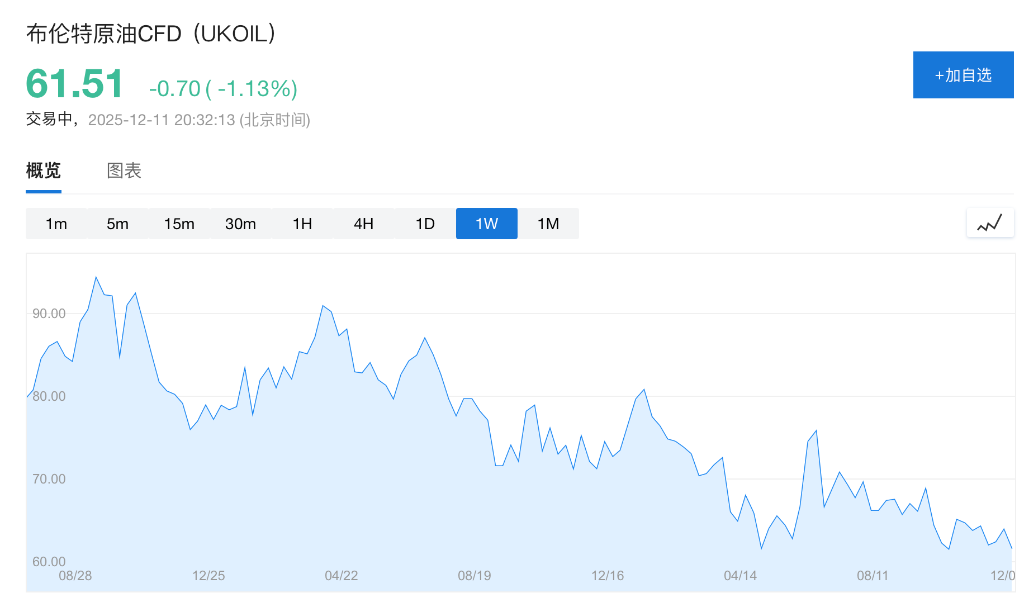
  • Spot gold fell 0.3% to $4,215.05 per ounce, spot silver extended gains to 1%, now at $62.541 per ounce, London copper futures rose over 0.5% to $11,618 per ton, Brent crude fell 0.7% to $61.51 per barrel.
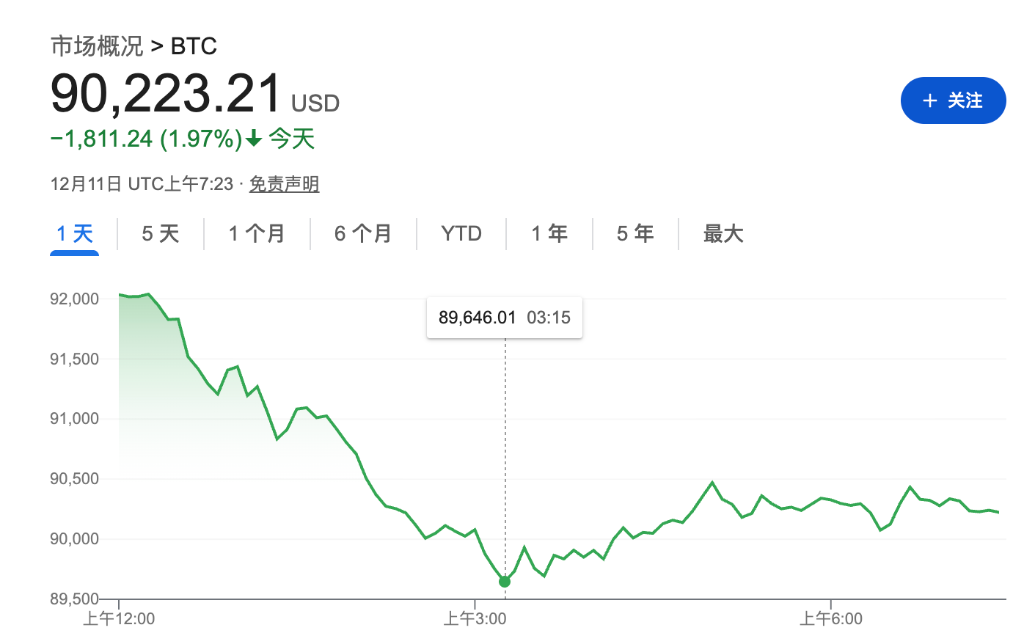
  • Bitcoin fell 2.3% to $90,224.89, Ethereum fell 4.1% to $3,204.4.

Oracle's weaker-than-expected earnings report ignited market concerns about an AI bubble, leading to a decline in tech stocks. Earlier, the optimistic market sentiment reversed after overnight gains. On one hand, positive factors such as the Fed's interest rate cut, the initiation of a $40 billion monthly Treasury purchase program (seen by the market as "stealth QE"), and dovish remarks had been fully digested. On the other hand, Oracle's sharp post-market decline due to missed revenue expectations, and the performance pressure it exposed as a key AI player, sparked worries about the return on investment in the AI sector.

According to Wall Street News, the market had expected a "hawkish rate cut" from the Fed, but the actual results showed no additional dissenters, no higher dot plot, and the anticipated strong stance from Chairman Powell did not materialize. Wall Street analysts expect the actual rate cuts next year could exceed the 25 basis points indicated by the dot plot. Leadership changes and policy uncertainty are potential drivers of market volatility in 2026.

Oracle's stock plunged 16% after hours. According to Wall Street News, the company reported its Q2 FY2026 results after the market closed on Wednesday, with both revenue and cloud business income falling short of analyst expectations. Quarterly free cash flow (FCF) was -$10 billion, and annual capital expenditures are expected to be approximately $15 billion higher than previously anticipated.

Emarketer analyst Jacob Bourne stated, Against the backdrop of ongoing uncertainty in AI spending prospects, Oracle is facing increasing scrutiny due to its debt-driven data center expansion and customer concentration risks. This revenue miss is likely to heighten concerns among already cautious investors regarding its OpenAI partnership and aggressive AI spending strategy.

Alberto Torchio, portfolio manager at Kairos Partners, said:

"Oracle's impact even surpassed the Fed's. That says it all, because we've consistently seen highly concentrated markets, with the AI theme leading the way. This doesn't mean AI is obsolete or in a bubble, but we need to look at this issue from a broader perspective."
As risk assets like global stocks fell broadly, macro risk-off sentiment dominated the market, causing oil prices to give up early gains. Previously, concerns over oil supply risks and escalating geopolitical conflicts, triggered by the US seizure of a sanctioned Venezuelan oil tanker, had pushed oil prices higher.

According to Wall Street News, the crude oil market is experiencing an unprecedented surplus. However, Brent oil prices remain stable between $61-66, primarily because the market finds it difficult to judge whether crude oil from sanctioned countries like Russia and Iran (accounting for 15% of global supply) should be counted as effective supply. Analysis suggests that sanctions make market direction unpredictable, and once floating storage moves onshore, oil prices could fall sharply.
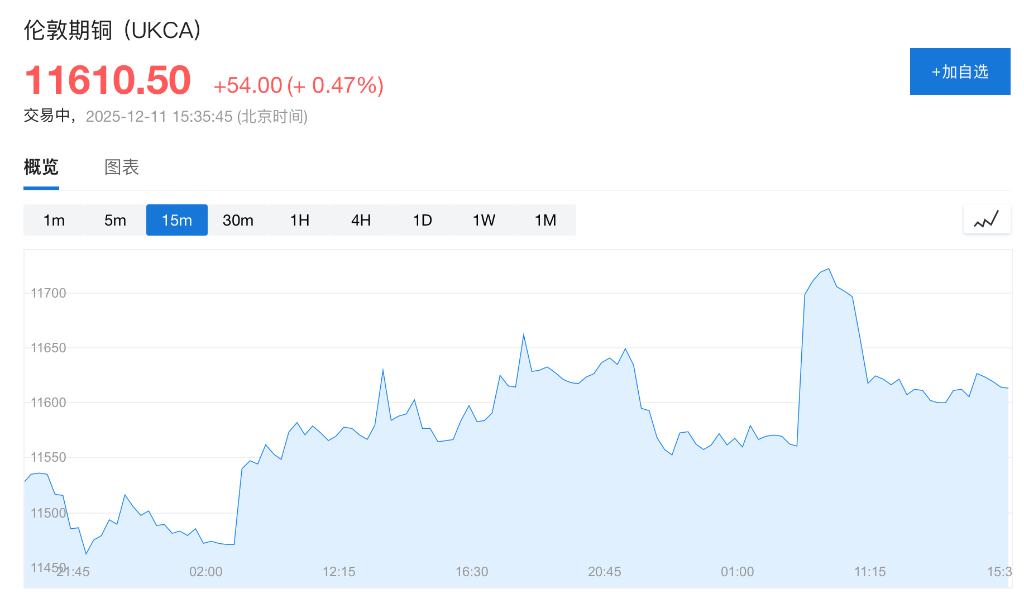
London copper futures pared some gains, now up nearly 0.5% to $11,610.5 per ton. Earlier, buoyed by the Fed's rate cut, London copper approached record highs. So far this year, copper prices have accumulated gains of over 30%. Besides liquidity expectations, a series of mine shutdowns, concerns about overseas supply shortages, and traders rushing to buy in the US market ahead of potential tariffs have all provided upward momentum for copper prices.
Oracle's disappointing earnings report dealt a blow to market sentiment, causing Bitcoin to fall sharply, once breaking below the $90,000 mark. Tony Sycamore, market analyst at IG in Sydney, said: "The cryptocurrency space really needs to see stronger evidence that the sell-off on October 10th has completely ended, but currently, such evidence does not seem to exist."

Standard Chartered significantly lowered its year-end 2025 Bitcoin forecast from $200,000 to $100,000. Geoff Kendrick, head of global digital assets research at Standard Chartered, said: "We believe the buying activity by Bitcoin digital asset fund companies may have concluded. Therefore, we now believe that future Bitcoin price increases will essentially be driven by just one factor—ETF purchases."

Related Questions

QWhat was the main reason for the decline in Oracle's stock price and the broader market's risk-off sentiment?

AOracle's stock price plummeted 16% after its Q2 FY2026 earnings report showed both revenue and cloud business income fell short of analyst expectations. The company also reported negative free cash flow of $10 billion and announced significantly higher-than-expected capital expenditures, primarily debt-funded for AI infrastructure. This sparked renewed concerns about an AI bubble and the return on investment in the AI sector, leading to a broad sell-off in risk assets.

QHow did major U.S. stock indices perform at the open on December 11th?

AThe S&P 500 opened down 25.38 points (0.37%) at 6,861.30 points. The Dow Jones Industrial Average opened up 25.15 points (0.05%) at 48,082.90 points. The Nasdaq Composite opened down 144.94 points (0.61%) at 23,509.22 points.

QWhat was the performance of key commodities like gold, oil, and copper?

ASpot gold fell 0.3% to $4,215.05 per ounce. Brent crude oil fell 0.7% to $61.51 per barrel. In contrast, London copper futures rose nearly 0.5% to $11,610.5 per ton, and spot silver gained 1% to $62.541 per ounce.

QWhat happened to Bitcoin's price and what was a key factor behind the sell-off according to analysts?

ABitcoin's price fell 2.3% to $90,224.89, briefly falling below the $90,000 level. Analysts cited the negative market sentiment from Oracle's disappointing earnings as a key factor. An IG market analyst also noted that there was a lack of strong evidence that the sell-off from October 10th had conclusively ended, contributing to the pressure on cryptocurrencies.

QHow did Standard Chartered Bank revise its Bitcoin price forecast and why?

AStandard Chartered Bank significantly lowered its Bitcoin price forecast for the end of 2025 from $200,000 to $100,000. Their global head of digital assets research, Geoff Kendrick, stated that purchasing activity from Bitcoin digital asset fund companies was likely over, and future price appreciation would now be driven solely by ETF purchases.

Related Reads

Trading

Spot
Futures

Hot Articles

What is $BITCOIN

DIGITAL GOLD ($BITCOIN): A Comprehensive Analysis Introduction to DIGITAL GOLD ($BITCOIN) DIGITAL GOLD ($BITCOIN) is a blockchain-based project operating on the Solana network, which aims to combine the characteristics of traditional precious metals with the innovation of decentralized technologies. While it shares a name with Bitcoin, often referred to as “digital gold” due to its perception as a store of value, DIGITAL GOLD is a separate token designed to create a unique ecosystem within the Web3 landscape. Its goal is to position itself as a viable alternative digital asset, although specifics regarding its applications and functionalities are still developing. What is DIGITAL GOLD ($BITCOIN)? DIGITAL GOLD ($BITCOIN) is a cryptocurrency token explicitly designed for use on the Solana blockchain. In contrast to Bitcoin, which provides a widely recognized value storage role, this token appears to focus on broader applications and characteristics. Notable aspects include: Blockchain Infrastructure: The token is built on the Solana blockchain, known for its capacity to handle high-speed and low-cost transactions. Supply Dynamics: DIGITAL GOLD has a maximum supply capped at 100 quadrillion tokens (100P $BITCOIN), although details regarding its circulating supply are currently undisclosed. Utility: While precise functionalities are not explicitly outlined, there are indications that the token could be utilized for various applications, potentially involving decentralized applications (dApps) or asset tokenization strategies. Who is the Creator of DIGITAL GOLD ($BITCOIN)? At present, the identity of the creators and development team behind DIGITAL GOLD ($BITCOIN) remains unknown. This situation is typical among many innovative projects within the blockchain space, particularly those aligning with decentralized finance and meme coin phenomena. While such anonymity may foster a community-driven culture, it intensifies concerns about governance and accountability. Who are the Investors of DIGITAL GOLD ($BITCOIN)? The available information indicates that DIGITAL GOLD ($BITCOIN) does not have any known institutional backers or prominent venture capital investments. The project seems to operate on a peer-to-peer model focused on community support and adoption rather than traditional funding routes. Its activity and liquidity are primarily situated on decentralized exchanges (DEXs), such as PumpSwap, rather than established centralized trading platforms, further highlighting its grassroots approach. How DIGITAL GOLD ($BITCOIN) Works The operational mechanics of DIGITAL GOLD ($BITCOIN) can be elaborated on based on its blockchain design and network attributes: Consensus Mechanism: By leveraging Solana’s unique proof-of-history (PoH) combined with a proof-of-stake (PoS) model, the project ensures efficient transaction validation contributing to the network's high performance. Tokenomics: While specific deflationary mechanisms have not been extensively detailed, the vast maximum token supply implies that it may cater to microtransactions or niche use cases that are still to be defined. Interoperability: There exists the potential for integration with Solana’s broader ecosystem, including various decentralized finance (DeFi) platforms. However, the details regarding specific integrations remain unspecified. Timeline of Key Events Here is a timeline that highlights significant milestones concerning DIGITAL GOLD ($BITCOIN): 2023: The initial deployment of the token occurs on the Solana blockchain, marked by its contract address. 2024: DIGITAL GOLD gains visibility as it becomes available for trading on decentralized exchanges like PumpSwap, allowing users to trade it against SOL. 2025: The project witnesses sporadic trading activity and potential interest in community-led engagements, although no noteworthy partnerships or technical advancements have been documented as of yet. Critical Analysis Strengths Scalability: The underlying Solana infrastructure supports high transaction volumes, which could enhance the utility of $BITCOIN in various transaction scenarios. Accessibility: The potential low trading price per token could attract retail investors, facilitating wider participation due to fractional ownership opportunities. Risks Lack of Transparency: The absence of publicly known backers, developers, or an audit process may yield skepticism regarding the project's sustainability and trustworthiness. Market Volatility: The trading activity is heavily reliant on speculative behavior, which can result in significant price volatility and uncertainty for investors. Conclusion DIGITAL GOLD ($BITCOIN) emerges as an intriguing yet ambiguous project within the rapidly evolving Solana ecosystem. While it attempts to leverage the “digital gold” narrative, its departure from Bitcoin's established role as a store of value underscores the need for a clearer differentiation of its intended utility and governance structure. Future acceptance and adoption will likely depend on addressing the current opacity and defining its operational and economic strategies more explicitly. Note: This report encompasses synthesised information available as of October 2023, and developments may have transpired beyond the research period.

363 Total ViewsPublished 2025.05.13Updated 2025.05.13

What is $BITCOIN

Discussions

Welcome to the HTX Community. Here, you can stay informed about the latest platform developments and gain access to professional market insights. Users' opinions on the price of BTC (BTC) are presented below.

活动图片