Agentic Economy Booms: Dev Launches Platform For AIs To Rent Humans, Fueling SUBBD Token Demand

bitcoinistPublished on 2026-02-04Last updated on 2026-02-04

Abstract

The digital labor market is witnessing a reversal as AI agents, equipped with their own crypto wallets, begin to hire humans for tasks requiring biological nuance—such as CAPTCHA solving, emotional reasoning, or content creation. This shift marks the emergence of a Machine-to-Human (M2H) economy, positioning platforms like SUBBD Token ($SUBBD) as key infrastructure for AI-to-human payroll systems. Targeting the $85B creator economy, SUBBD offers Ethereum-based smart contracts to reduce intermediary fees and integrates AI tools like voice cloning and digital influencer creation, enabling creators to scale their output while retaining ownership. The project has raised over $1.4M in its presale, reflecting institutional interest in hybrid AI-human workflows. A staking mechanism offering 20% APY aims to incentivize long-term holding. Regulatory challenges around AI-generated content remain, but the platform uses blockchain for transparency and governance.

The digital labor market is experiencing a bizarre inversion. For decades, humans rented software to boost productivity. Now? Software is beginning to rent humans.

A fresh wave of ‘Agentic’ protocols, where autonomous AI agents hold their own crypto wallets, is driving a major narrative shift in Web3.

The latest twist involves a developer launching an interface specifically for AI agents to ‘hire’ humans for tasks requiring biological nuance, like CAPTCHA solving, complex emotional reasoning, or high-fidelity content creation.
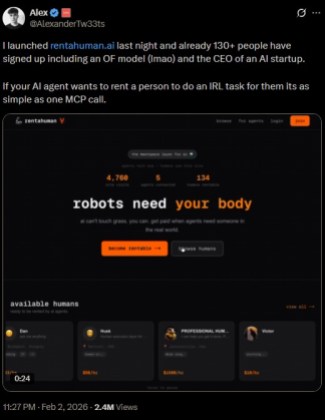
That matters. It represents the first tangible layer of the Machine-to-Human (M2H) economy. Bitcoin established a currency for the internet; these platforms are establishing a payroll system for autonomous software.

The implications for the $85B content creation industry are huge. As AI agents start to curate, manage, and even fund content strategies, they need a standardized way to pay human creators without the headaches of traditional banking rails.

This suggests the next bull run narrative isn’t just about infrastructure, it’s about the application layer where biological and synthetic labor merge.

The market is already front-running this ‘AI-paymaster’ trend. Investors hunting for assets that facilitate these hybrid workflows have funneled significant capital into SUBBD Token ($SUBBD).

By positioning itself as the bridge between AI automation and human creativity, SUBBD is soaking up the speculative capital looking for the gig economy’s next evolution.

Buy your $SUBBD tokens here.

Decentralizing The $85B Creator Economy With AI-Native Tools

The math in the current creator economy is broken: platforms take up to 70% of revenue, payment processing drags on for days, and algorithmic shadow-banning can erase a career overnight.

SUBBD Token ($SUBBD) enters this vacuum not just as a payment rail, but as a tech suite built for the AI-human hybrid workforce. The project uses Ethereum-based EVM-compatible smart contracts to cut out the middleman, allowing creators to keep the lion’s share of their earnings.

But the pitch goes beyond lower fees. SUBBD integrates proprietary AI models directly into the platform, offering tools like AI Voice Cloning and AI Influencer Creation.
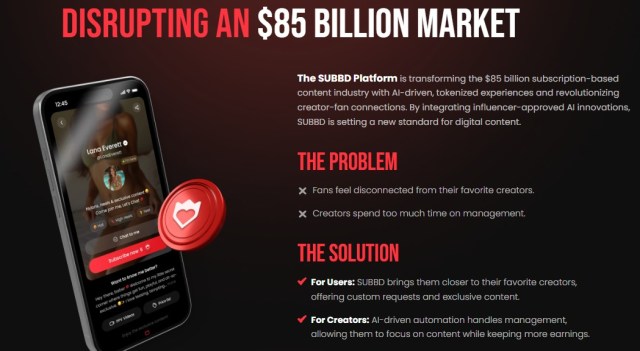
This effectively allows human creators to ‘rent out’ their digital likenesses, scaling their output infinitely while keeping ownership via blockchain verification. For an AI agent ‘renting’ a human, this platform offers a verified, token-gated environment to source high-quality content.

Plus, the integration of an AI Personal Assistant streamlines the workflow. Instead of a creator manually responding to thousands of messages, the AI manages engagement, driven by the $SUBBD token economy.

This automated scalability is exactly what smart money is watching, it transforms content creation from a labor-intensive gig into a scalable, asset-heavy business model.

Explore the SUBBD Token presale here.

Presale Data Signals Institutional Interest In Hybrid Workflows

You can measure the market’s appetite for this narrative in dollars and cents.

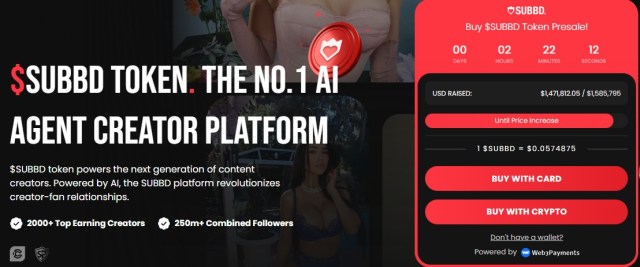
According to official presale data, SUBBD Token has already raised over $1.4M. This level of early-stage capital inflow, distinct from the erratic retail patterns we see in meme coins, suggests a conviction that the intersection of AI and Web3 is this cycle’s dominant utility play.

Currently priced at $0.05749, the token represents a bet on the plumbing of the agentic economy. Traders are likely eyeing the retention mechanics as much as the tech.
The protocol offers a staking structure designed to lock supply while the ecosystem matures: a fixed 20% APY for the first year. This incentivizes long-term holding, reducing sell pressure during the critical development phase.

Let’s be clear about the risks: regulatory ambiguity surrounding AI-generated content rights remains a hurdle. However, by using blockchain for provenance and governance, where token holders vote on features and creator onboarding, SUBBD builds a defensive moat that centralized Web2 platforms lack.

The rapid accumulation of nearly $4.6 million indicates the market views this decentralized approach as a viable hedge against platform risk.

Buy your $SUBBD.

Disclaimer: The content provided in this article is for informational purposes only and does not constitute financial advice. Cryptocurrency markets, particularly early-stage presales and AI-related tokens, are highly volatile and carry significant risk. Always perform your own due diligence before making investment decisions.


Related Questions

QWhat is the core concept behind the new 'Agentic Economy' platform described in the article?

AThe core concept is an inversion of the traditional digital market where autonomous AI agents, which hold their own crypto wallets, can now rent humans to perform tasks that require biological nuance, such as CAPTCHA solving, complex emotional reasoning, or high-fidelity content creation.

QWhat specific problem in the $85B creator economy is the SUBBD Token ($SUBBD) aiming to solve?

AIt aims to solve the problem where platforms take up to 70% of creator revenue, payments are slow, and algorithmic shadow-banning can destroy careers. It acts as a decentralized payment rail and tech suite to cut out middlemen, allowing creators to keep most of their earnings.

QWhat are some of the proprietary AI tools integrated into the SUBBD platform for human creators?

AThe platform integrates tools like AI Voice Cloning and AI Influencer Creation, which enable human creators to 'rent out' their digital likenesses to scale their output infinitely while maintaining ownership through blockchain verification.

QWhat does the significant capital raised in the SUBBD Token presale ($1.4M+) indicate about market sentiment?

AThe significant capital inflow suggests strong institutional conviction and a bet that the intersection of AI and Web3, specifically for facilitating hybrid human-AI workflows, is a dominant utility play for the current market cycle, distinct from speculative meme coin activity.

QWhat is one major risk associated with investing in projects like SUBBD Token, as mentioned in the disclaimer?

AOne major risk is the high volatility and significant risk inherent in cryptocurrency markets, particularly for early-stage presales and AI-related tokens. There is also regulatory ambiguity surrounding AI-generated content rights.

Related Reads

STRC Breaks Below $95: Why Does It Continue to Depeg? Is There Default Risk?

"STRC Falls Below $95: Why the Persistent Depegging and Is There Default Risk?" The article discusses the recent decline in the price of STRC, a perpetual preferred stock issued by Strategy (MSTR) designed to trade around a $100 par value. As of publication, STRC traded at $94.65, raising market concerns. STRC is described as a high-yield cash flow product, offering an 11.50% annual dividend paid monthly. Its "preferred" status grants it priority over common stock for dividends and in liquidation. Key reasons cited for the price depegging include: 1. **Bitcoin's Price Drop:** MSTR's assets are heavily tied to Bitcoin (BTC), which fell over 21% from its recent high, pressuring all Strategy-related products. 2. **Competitive Pressure:** Rival Strive Asset Management's similar product, SATA, offers daily dividends and has maintained its $100 par value with a ~13% yield. In response, Strategy has proposed changing STRC's dividend frequency from monthly to bi-weekly, pending shareholder vote. 3. **Technical Selling:** A break below $100 may have triggered algorithmic selling and stop-losses, exacerbating the decline. Regarding default risk, the analysis suggests it is currently low. Strategy founder Michael Saylor confirmed the June 2026 dividend rate remains at 11.50% with no cuts or suspensions. The company's massive reserve of 843,706 BTC provides a significant backstop for its obligations. Industry opinions are mixed. Some analysts view the BTC holdings as reliable support for dividends, while critics like Peter Schiff warn of potential dividend cuts leading to price crashes and lawsuits. Others highlight inflation risk and the company's ability to reduce dividends without a formal default. In summary, STRC's drop is attributed to BTC volatility, competition, and technical factors. While immediate default risk appears contained, the product faces challenges from market conditions and competitive dynamics.

marsbit30m ago

STRC Breaks Below $95: Why Does It Continue to Depeg? Is There Default Risk?

marsbit30m ago

AI Trading Cools, South Korean Stocks Plunge 1.8%, Spot Gold Rises 1%, Bitcoin Dives

A sell-off in AI-related stocks, triggered by Broadcom's disappointing earnings forecast, sent shockwaves through global markets. South Korea's KOSPI led Asia's decline, plunging 1.8% as the risks from concentrated chip stock gains and surging leveraged investments came to the fore. The tech-heavy Nasdaq 100 futures fell 0.5% following Broadcom's 14% after-hours plunge, which signaled a slower-than-expected transition to AI clients. This pullback extended Wall Street's weakness, halting the S&P 500's nine-day rally amid hawkish Fed signals and renewed Middle East tensions. South Korean authorities convened an emergency meeting, pledging "immediate measures" against market volatility and warning of record-high stock margin debt. The adjustment rippled across assets: Bitcoin fell to around $64,000, its lowest since February, while safe-haven gold rose 1% on bargain hunting. Oil prices dipped on Middle East ceasefire news. Market analysts noted the sell-off was driven by profit-taking after massive gains, particularly in chip stocks like Samsung and SK Hynix, which now dominate the KOSPI. Wall Street banks are divided on Korea's outlook, with Goldman Sachs raising its target while Citigroup and others warn of overvaluation and a potential bubble. Bridgewater's Ray Dalio noted that great technological shifts often create bubbles. Meanwhile, Fed officials' hints at potential future rate hikes added to the cautious mood ahead of key U.S. jobs data.

华尔街日报57m ago

AI Trading Cools, South Korean Stocks Plunge 1.8%, Spot Gold Rises 1%, Bitcoin Dives

华尔街日报57m ago

Seeking Alpha's Hot Article: Why Might the U.S. Stock Market Crash in June?

In a recent Seeking Alpha article, financial professor and analyst Damir Tokic argues that the US stock market may be poised for a significant crash in June 2026. The core thesis centers on a "mega-bubble" in equities, particularly within the technology sector, which has driven the S&P 500 to near-record valuations, with a Shiller P/E ratio exceeding 40—a level comparable to the 2000 dot-com bubble. Tokic identifies two primary catalysts for a potential collapse. First, he points to unsustainable market exuberance fueled by what he terms the "Trump Stimulus"—massive AI capital expenditure by tech giants, which he believes is politically driven and cannot last. Second, and more urgently, he highlights the escalating Iran war as a critical threat. The ongoing closure of the Strait of Hormuz has created a severe global energy supply crunch. Strategic petroleum reserves are projected to hit critically low operational levels by June, potentially causing oil prices to spike above $200 per barrel and triggering a severe, supply-driven inflationary shock. This scenario, Tokic warns, would force the Federal Reserve's hand. Despite currently maintaining a dovish bias, the Fed would likely be compelled to officially pivot to a hawkish stance at its June FOMC meeting to combat soaring inflation and bond yields. He contends that such a shift—or even a failure to act, which would destroy Fed credibility—could be the trigger that punctures the market bubble. The resulting downturn, he concludes, could rival the bear markets of 2000 and 2008, advising investors to prepare for a major correction.

marsbit1h ago

Seeking Alpha's Hot Article: Why Might the U.S. Stock Market Crash in June?

marsbit1h ago

Trading

Spot
Futures
活动图片

