Agentic Economy Booms: Dev Launches Platform For AIs To Rent Humans, Fueling SUBBD Token Demand

bitcoinistPublished on 2026-02-04Last updated on 2026-02-04

Abstract

The digital labor market is witnessing a reversal as AI agents, equipped with their own crypto wallets, begin to hire humans for tasks requiring biological nuance—such as CAPTCHA solving, emotional reasoning, or content creation. This shift marks the emergence of a Machine-to-Human (M2H) economy, positioning platforms like SUBBD Token ($SUBBD) as key infrastructure for AI-to-human payroll systems. Targeting the $85B creator economy, SUBBD offers Ethereum-based smart contracts to reduce intermediary fees and integrates AI tools like voice cloning and digital influencer creation, enabling creators to scale their output while retaining ownership. The project has raised over $1.4M in its presale, reflecting institutional interest in hybrid AI-human workflows. A staking mechanism offering 20% APY aims to incentivize long-term holding. Regulatory challenges around AI-generated content remain, but the platform uses blockchain for transparency and governance.

The digital labor market is experiencing a bizarre inversion. For decades, humans rented software to boost productivity. Now? Software is beginning to rent humans.

A fresh wave of ‘Agentic’ protocols, where autonomous AI agents hold their own crypto wallets, is driving a major narrative shift in Web3.

The latest twist involves a developer launching an interface specifically for AI agents to ‘hire’ humans for tasks requiring biological nuance, like CAPTCHA solving, complex emotional reasoning, or high-fidelity content creation.
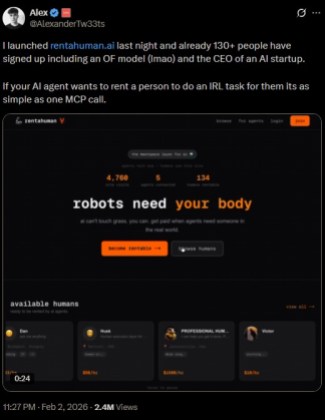
That matters. It represents the first tangible layer of the Machine-to-Human (M2H) economy. Bitcoin established a currency for the internet; these platforms are establishing a payroll system for autonomous software.

The implications for the $85B content creation industry are huge. As AI agents start to curate, manage, and even fund content strategies, they need a standardized way to pay human creators without the headaches of traditional banking rails.

This suggests the next bull run narrative isn’t just about infrastructure, it’s about the application layer where biological and synthetic labor merge.

The market is already front-running this ‘AI-paymaster’ trend. Investors hunting for assets that facilitate these hybrid workflows have funneled significant capital into SUBBD Token ($SUBBD).

By positioning itself as the bridge between AI automation and human creativity, SUBBD is soaking up the speculative capital looking for the gig economy’s next evolution.

Buy your $SUBBD tokens here.

Decentralizing The $85B Creator Economy With AI-Native Tools

The math in the current creator economy is broken: platforms take up to 70% of revenue, payment processing drags on for days, and algorithmic shadow-banning can erase a career overnight.

SUBBD Token ($SUBBD) enters this vacuum not just as a payment rail, but as a tech suite built for the AI-human hybrid workforce. The project uses Ethereum-based EVM-compatible smart contracts to cut out the middleman, allowing creators to keep the lion’s share of their earnings.

But the pitch goes beyond lower fees. SUBBD integrates proprietary AI models directly into the platform, offering tools like AI Voice Cloning and AI Influencer Creation.
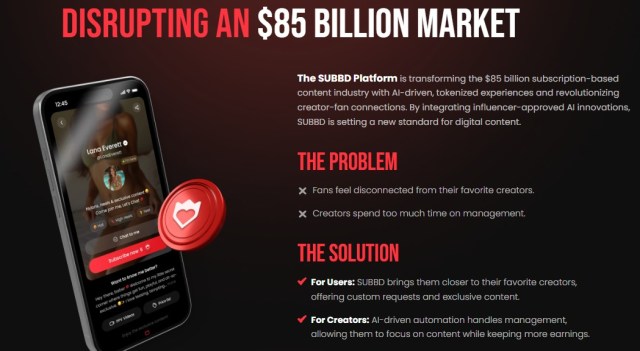
This effectively allows human creators to ‘rent out’ their digital likenesses, scaling their output infinitely while keeping ownership via blockchain verification. For an AI agent ‘renting’ a human, this platform offers a verified, token-gated environment to source high-quality content.

Plus, the integration of an AI Personal Assistant streamlines the workflow. Instead of a creator manually responding to thousands of messages, the AI manages engagement, driven by the $SUBBD token economy.

This automated scalability is exactly what smart money is watching, it transforms content creation from a labor-intensive gig into a scalable, asset-heavy business model.

Explore the SUBBD Token presale here.

Presale Data Signals Institutional Interest In Hybrid Workflows

You can measure the market’s appetite for this narrative in dollars and cents.

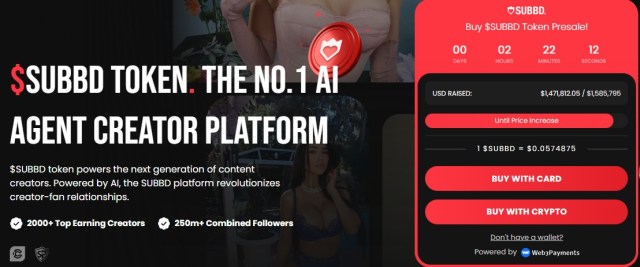
According to official presale data, SUBBD Token has already raised over $1.4M. This level of early-stage capital inflow, distinct from the erratic retail patterns we see in meme coins, suggests a conviction that the intersection of AI and Web3 is this cycle’s dominant utility play.

Currently priced at $0.05749, the token represents a bet on the plumbing of the agentic economy. Traders are likely eyeing the retention mechanics as much as the tech.
The protocol offers a staking structure designed to lock supply while the ecosystem matures: a fixed 20% APY for the first year. This incentivizes long-term holding, reducing sell pressure during the critical development phase.

Let’s be clear about the risks: regulatory ambiguity surrounding AI-generated content rights remains a hurdle. However, by using blockchain for provenance and governance, where token holders vote on features and creator onboarding, SUBBD builds a defensive moat that centralized Web2 platforms lack.

The rapid accumulation of nearly $4.6 million indicates the market views this decentralized approach as a viable hedge against platform risk.

Buy your $SUBBD.

Disclaimer: The content provided in this article is for informational purposes only and does not constitute financial advice. Cryptocurrency markets, particularly early-stage presales and AI-related tokens, are highly volatile and carry significant risk. Always perform your own due diligence before making investment decisions.


Related Questions

QWhat is the core concept behind the new 'Agentic Economy' platform described in the article?

AThe core concept is an inversion of the traditional digital market where autonomous AI agents, which hold their own crypto wallets, can now rent humans to perform tasks that require biological nuance, such as CAPTCHA solving, complex emotional reasoning, or high-fidelity content creation.

QWhat specific problem in the $85B creator economy is the SUBBD Token ($SUBBD) aiming to solve?

AIt aims to solve the problem where platforms take up to 70% of creator revenue, payments are slow, and algorithmic shadow-banning can destroy careers. It acts as a decentralized payment rail and tech suite to cut out middlemen, allowing creators to keep most of their earnings.

QWhat are some of the proprietary AI tools integrated into the SUBBD platform for human creators?

AThe platform integrates tools like AI Voice Cloning and AI Influencer Creation, which enable human creators to 'rent out' their digital likenesses to scale their output infinitely while maintaining ownership through blockchain verification.

QWhat does the significant capital raised in the SUBBD Token presale ($1.4M+) indicate about market sentiment?

AThe significant capital inflow suggests strong institutional conviction and a bet that the intersection of AI and Web3, specifically for facilitating hybrid human-AI workflows, is a dominant utility play for the current market cycle, distinct from speculative meme coin activity.

QWhat is one major risk associated with investing in projects like SUBBD Token, as mentioned in the disclaimer?

AOne major risk is the high volatility and significant risk inherent in cryptocurrency markets, particularly for early-stage presales and AI-related tokens. There is also regulatory ambiguity surrounding AI-generated content rights.

Related Reads

The Verdict in Choi Tae-won's Divorce Case: Revealing the Inheritance Undercurrent Behind SK Hynix's Trillion-Won Empire

SK Group Chairman Chey Tae-won's high-profile divorce case, involving a record 1.38 trillion won settlement, has drawn attention to the succession plans for Korea's second-largest conglomerate, especially its crown jewel, SK hynix. Unlike traditional chaebol scripts centered on the eldest son, Chey's three children from his marriage to former President Roh Tae-woo's daughter, Roh Soh-yeong, are carving distinct, non-traditional paths. Eldest daughter Chey Yun-jung (b. 1989) is seen as the most evident successor. With a scientific and consulting background, she holds executive roles at SK bioscience and SK Inc.'s growth support department, focusing on future strategy and biopharma. Her marriage is to an AI infrastructure entrepreneur, not a traditional business alliance. Second daughter Chey Min-jung (b. 1991) took a unique route, voluntarily serving as a South Korean naval officer, including an anti-piracy deployment. She later worked on policy and strategy for SK hynix in Washington D.C. before co-founding an AI-driven healthcare startup. She married a former U.S. Marine Corps officer, connecting her to U.S. defense and policy circles—networks crucial for a global semiconductor giant. The only son, Chey In-geun (b. 1995), who studied physics like his father, worked briefly at SK E&S before joining McKinsey. Despite fitting the traditional "heir" profile as the eldest son, he remains silent and holds no public position or shares in SK, suggesting the old succession playbook is obsolete. As SK hynix's valuation soars, becoming a geopolitical asset in the AI era, the heirs' legitimacy is no longer automatic. They must prove themselves in fields like AI biotech, global policy, and strategic consulting. Their marriages also reflect new elite networks in tech and defense, not old political alliances. Their inheritance is the complex challenge of navigating a globalized, tech-driven world, not just a corporate throne.

marsbit11h ago

The Verdict in Choi Tae-won's Divorce Case: Revealing the Inheritance Undercurrent Behind SK Hynix's Trillion-Won Empire

marsbit11h ago

From OpenSea to OpenRouter: Is Alex Atallah Repeating His 'Exit at the Peak' Playbook?

From OpenSea to OpenRouter: Is Alex Atallah Repeating His "Exit at the Peak" Playbook? According to the Wall Street Journal, payments giant Stripe is in talks to acquire the AI model aggregation platform OpenRouter in a potential deal valuing the company near $100 billion. This would mark founder Alex Atallah's second creation of a company reaching a $100 billion valuation, following his co-founding of NFT marketplace OpenSea. OpenRouter, founded just over three years ago, has grown rapidly by acting as a unified gateway for developers to access over 400 AI models. It currently has about 10 million users and processes over 200 trillion tokens monthly. While the platform's annualized revenue is around $50 million, its valuation has skyrocketed from $1.3 billion in March 2026. The potential acquisition by Stripe, a company OpenRouter's founder once likened it to, represents a major expansion into AI infrastructure for the payments leader. This move echoes Atallah's previous timing with OpenSea, where he departed before the NFT market's significant downturn. For OpenRouter, selling now may be strategic. Despite its scale, its business model—charging a 5-5.5% fee on AI inference calls—faces pressure from competition, open-source models, and potential price wars among model providers, limiting its profitability narrative for an IPO. A key asset for potential acquirers like Stripe is OpenRouter's vast repository of real-world AI usage data, which offers unique insights into model performance and developer preferences that are difficult to replicate. Whether this potential deal signifies a new valuation benchmark for AI infrastructure or another market peak signal remains to be seen.

链捕手11h ago

From OpenSea to OpenRouter: Is Alex Atallah Repeating His 'Exit at the Peak' Playbook?

链捕手11h ago

Trading

Spot
活动图片




