Agentic Economy Booms: Dev Launches Platform For AIs To Rent Humans, Fueling SUBBD Token Demand

bitcoinistPublished on 2026-02-04Last updated on 2026-02-04

Abstract

The digital labor market is witnessing a reversal as AI agents, equipped with their own crypto wallets, begin to hire humans for tasks requiring biological nuance—such as CAPTCHA solving, emotional reasoning, or content creation. This shift marks the emergence of a Machine-to-Human (M2H) economy, positioning platforms like SUBBD Token ($SUBBD) as key infrastructure for AI-to-human payroll systems. Targeting the $85B creator economy, SUBBD offers Ethereum-based smart contracts to reduce intermediary fees and integrates AI tools like voice cloning and digital influencer creation, enabling creators to scale their output while retaining ownership. The project has raised over $1.4M in its presale, reflecting institutional interest in hybrid AI-human workflows. A staking mechanism offering 20% APY aims to incentivize long-term holding. Regulatory challenges around AI-generated content remain, but the platform uses blockchain for transparency and governance.

The digital labor market is experiencing a bizarre inversion. For decades, humans rented software to boost productivity. Now? Software is beginning to rent humans.

A fresh wave of ‘Agentic’ protocols, where autonomous AI agents hold their own crypto wallets, is driving a major narrative shift in Web3.

The latest twist involves a developer launching an interface specifically for AI agents to ‘hire’ humans for tasks requiring biological nuance, like CAPTCHA solving, complex emotional reasoning, or high-fidelity content creation.
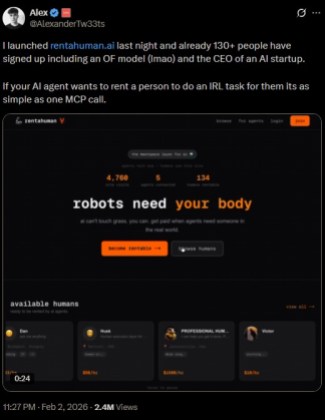
That matters. It represents the first tangible layer of the Machine-to-Human (M2H) economy. Bitcoin established a currency for the internet; these platforms are establishing a payroll system for autonomous software.

The implications for the $85B content creation industry are huge. As AI agents start to curate, manage, and even fund content strategies, they need a standardized way to pay human creators without the headaches of traditional banking rails.

This suggests the next bull run narrative isn’t just about infrastructure, it’s about the application layer where biological and synthetic labor merge.

The market is already front-running this ‘AI-paymaster’ trend. Investors hunting for assets that facilitate these hybrid workflows have funneled significant capital into SUBBD Token ($SUBBD).

By positioning itself as the bridge between AI automation and human creativity, SUBBD is soaking up the speculative capital looking for the gig economy’s next evolution.

Buy your $SUBBD tokens here.

Decentralizing The $85B Creator Economy With AI-Native Tools

The math in the current creator economy is broken: platforms take up to 70% of revenue, payment processing drags on for days, and algorithmic shadow-banning can erase a career overnight.

SUBBD Token ($SUBBD) enters this vacuum not just as a payment rail, but as a tech suite built for the AI-human hybrid workforce. The project uses Ethereum-based EVM-compatible smart contracts to cut out the middleman, allowing creators to keep the lion’s share of their earnings.

But the pitch goes beyond lower fees. SUBBD integrates proprietary AI models directly into the platform, offering tools like AI Voice Cloning and AI Influencer Creation.
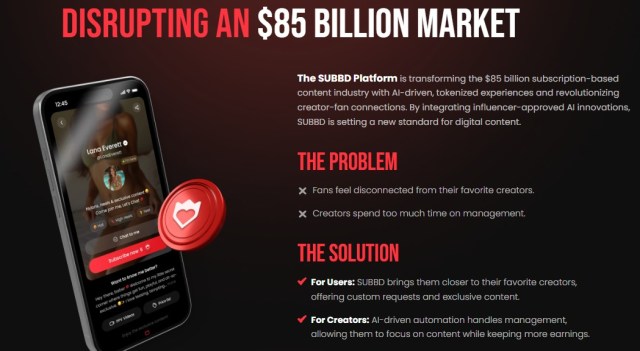
This effectively allows human creators to ‘rent out’ their digital likenesses, scaling their output infinitely while keeping ownership via blockchain verification. For an AI agent ‘renting’ a human, this platform offers a verified, token-gated environment to source high-quality content.

Plus, the integration of an AI Personal Assistant streamlines the workflow. Instead of a creator manually responding to thousands of messages, the AI manages engagement, driven by the $SUBBD token economy.

This automated scalability is exactly what smart money is watching, it transforms content creation from a labor-intensive gig into a scalable, asset-heavy business model.

Explore the SUBBD Token presale here.

Presale Data Signals Institutional Interest In Hybrid Workflows

You can measure the market’s appetite for this narrative in dollars and cents.

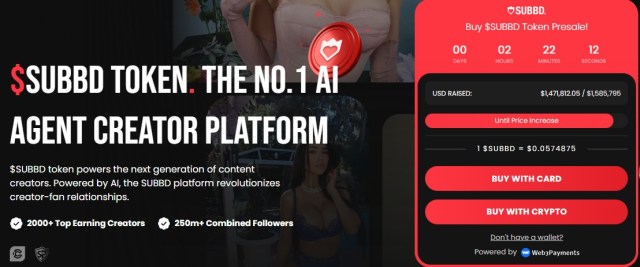
According to official presale data, SUBBD Token has already raised over $1.4M. This level of early-stage capital inflow, distinct from the erratic retail patterns we see in meme coins, suggests a conviction that the intersection of AI and Web3 is this cycle’s dominant utility play.

Currently priced at $0.05749, the token represents a bet on the plumbing of the agentic economy. Traders are likely eyeing the retention mechanics as much as the tech.
The protocol offers a staking structure designed to lock supply while the ecosystem matures: a fixed 20% APY for the first year. This incentivizes long-term holding, reducing sell pressure during the critical development phase.

Let’s be clear about the risks: regulatory ambiguity surrounding AI-generated content rights remains a hurdle. However, by using blockchain for provenance and governance, where token holders vote on features and creator onboarding, SUBBD builds a defensive moat that centralized Web2 platforms lack.

The rapid accumulation of nearly $4.6 million indicates the market views this decentralized approach as a viable hedge against platform risk.

Buy your $SUBBD.

Disclaimer: The content provided in this article is for informational purposes only and does not constitute financial advice. Cryptocurrency markets, particularly early-stage presales and AI-related tokens, are highly volatile and carry significant risk. Always perform your own due diligence before making investment decisions.


Related Questions

QWhat is the core concept behind the new 'Agentic Economy' platform described in the article?

AThe core concept is an inversion of the traditional digital market where autonomous AI agents, which hold their own crypto wallets, can now rent humans to perform tasks that require biological nuance, such as CAPTCHA solving, complex emotional reasoning, or high-fidelity content creation.

QWhat specific problem in the $85B creator economy is the SUBBD Token ($SUBBD) aiming to solve?

AIt aims to solve the problem where platforms take up to 70% of creator revenue, payments are slow, and algorithmic shadow-banning can destroy careers. It acts as a decentralized payment rail and tech suite to cut out middlemen, allowing creators to keep most of their earnings.

QWhat are some of the proprietary AI tools integrated into the SUBBD platform for human creators?

AThe platform integrates tools like AI Voice Cloning and AI Influencer Creation, which enable human creators to 'rent out' their digital likenesses to scale their output infinitely while maintaining ownership through blockchain verification.

QWhat does the significant capital raised in the SUBBD Token presale ($1.4M+) indicate about market sentiment?

AThe significant capital inflow suggests strong institutional conviction and a bet that the intersection of AI and Web3, specifically for facilitating hybrid human-AI workflows, is a dominant utility play for the current market cycle, distinct from speculative meme coin activity.

QWhat is one major risk associated with investing in projects like SUBBD Token, as mentioned in the disclaimer?

AOne major risk is the high volatility and significant risk inherent in cryptocurrency markets, particularly for early-stage presales and AI-related tokens. There is also regulatory ambiguity surrounding AI-generated content rights.

Related Reads

Has the 'Digital Gold' Narrative for BTC Failed?

**Title: Has the "Digital Gold" Narrative for Bitcoin Failed?** The article argues that Bitcoin's "digital gold" narrative remains valid despite a recent sharp price decline (from a peak near $126k in Oct 2025 to briefly under $61k in Feb 2026). It presents a long-term investment framework based on three core points: **1. Viewing Bitcoin as an Asset:** Bitcoin is presented as a superior potential store of value compared to gold. Key arguments are its absolute scarcity (21 million cap), superior portability, and transparent auditability via its public ledger. While acknowledging its current use in early, volatile stages (~3-4% global adoption), the author draws parallels to the early, disruptive phases of the internet and e-commerce. **2. Understanding the Recent Downturn:** The current ~50% correction is framed as a predictable, consensus-driven cycle following its post-halving peak (the 2024 halving preceded the Oct 2025 high). A crucial factor is a historic "changing of hands": the influx of new institutional buyers via ETFs allowed early, low-cost holders (miners, OG believers) to take profits. The author notes that while severe, Bitcoin's historical drawdowns (e.g., 93% in 2011, 77% in 2021-22) have been progressively smaller, suggesting maturing holder structure and decreasing volatility over time. **3. The Long-Term Perspective:** The long-term thesis hinges on Bitcoin capturing a portion of gold's market value. With Bitcoin's market cap at ~$1.4 trillion (at $70k) versus gold's ~$20 trillion, significant upside potential exists if the "digital gold" narrative is partially realized. However, the author strongly cautions that short-term risks remain, the bottom is unpredictable, and high volatility is inherent. The real risk is not Bitcoin failing but poor personal position management (over-leverage, wrong capital) and a lack of deep understanding, which can force investors out during severe downturns. The conclusion uses Amazon's 95% crash post-2000 dot-com bubble and subsequent 42x recovery as an analogy. The ultimate question is not if Bitcoin's price will rise, but if an investor's strategy and conviction can withstand the volatility to see the long-term play out. The recent divergence (gold up, Bitcoin down) is posed not as a narrative failure, but as potential evidence of this ongoing, painful transition from a speculative asset to a mainstream allocation.

marsbit3h ago

Has the 'Digital Gold' Narrative for BTC Failed?

marsbit3h ago

Has BTC's 'Digital Gold' Narrative Failed?

The article discusses Bitcoin's "digital gold" narrative, its recent price drop, and long-term outlook through the perspective of "Jason". It argues the narrative is not a failure but that Bitcoin represents a superior, new asset class due to its fixed supply (21 million), portability, and auditability. The piece compares its current ~3-4% global adoption rate to early internet/e-commerce, suggesting significant growth potential. Regarding the 2025-2026 price decline (from ~$126k to briefly under $61k), the author views it as a predictable, consensus-driven sell-off within Bitcoin's ~4-year cycle post-halving, exacerbated by a major "handover" from early, low-cost holders to new institutional buyers via ETFs. A key observation is that historical peak-to-trough drawdowns have lessened over time (e.g., 93% in 2011 to ~50% in 2026), indicating maturing volatility as holder structure changes. For the long term, the author uses a simple framework: Bitcoin's total market cap (~$1.4T at $70k) is only about 7% of gold's (~$20T). Even capturing 30-50% of gold's value would imply substantial upside. However, the article strongly cautions against viewing this as investment advice, emphasizing extreme volatility and the critical importance of risk management, position sizing, and deep fundamental understanding to survive severe drawdowns. It concludes by drawing a parallel to Amazon's 95% crash in 2000 and subsequent 42x recovery, stressing that the key is surviving market cycles to realize long-term potential.

链捕手3h ago

Has BTC's 'Digital Gold' Narrative Failed?

链捕手3h ago

From Code to Cognition: A Ten-Thousand-Word Guide to the Evolution of the Robot Brain

"From Code to Cognition: The Evolution of Robot Brains" The journey of robotic intelligence has shifted dramatically from manually coded systems to AI-driven brains. For decades, robots relied on layered software stacks—perception, state estimation, planning, control—each handcrafted. While predictable, they lacked adaptability. The 2010s saw deep learning revolutionize perception (e.g., object detection) and control (via reinforcement learning), but learned skills remained narrow. The arrival of Large Language Models (LLMs) marked a turning point. LLMs acted as high-level planners, interpreting natural language instructions and generating sequences of actions for traditional robotic systems to execute. However, true integration came with Visual-Language-Action (VLA) models, which fused vision, language, and motion prediction into a single network. Pioneered by models like RT-2 and open-source projects like OpenVLA, VLAs enable robots to reason and act directly from visual input and commands. The most advanced humanoid robots now employ a "dual-brain" architecture: a slow-thinking, large VLA (System 2) for reasoning and planning, and a fast-reacting, small network (System 1) for high-frequency motion control, sometimes with an even lower-level System 0 for balance. This split balances cognition with the physics of real-time movement. Computation is split between onboard hardware (e.g., NVIDIA Jetson) for safety-critical control loops and cloud/edge servers for non-critical tasks like learning and interfaces. A crucial driver is the open-source ecosystem—models like GR00T and OpenVLA allow startups to build upon pre-trained brains and fine-tune them with their own data, accelerating development. Despite progress, current systems struggle with recovery from errors, sample inefficiency, and long-horizon tasks. This has spurred the rise of **World Models**—neural networks that predict the consequences of actions. By simulating possible futures before acting (like NVIDIA Cosmos or Meta V-JEPA), robots can plan, recover, and generalize better. This represents the next frontier: shifting intelligence from learned reactions to an internal model of physics and cause-and-effect. The field is rapidly evolving. While not yet at its "ChatGPT moment," the convergence of cheaper hardware, scalable simulation, and world models points toward robots that are increasingly capable, adaptive, and useful. The question is shifting from "what can robots do?" to "what *should* they do?"

marsbit3h ago

From Code to Cognition: A Ten-Thousand-Word Guide to the Evolution of the Robot Brain

marsbit3h ago

AI Bubble Is Bursting

The AI Bubble is Bursting: A Necessary Purge on the Path to Ubiquitous Intelligence Market volatility has reignited debates about an AI bubble, with figures like Ray Dalio pointing to high valuations. However, this parallels the dot-com bubble, which, despite its crash, laid the physical infrastructure for today's internet era. The current AI investment frenzy, with tech giants planning trillions in infrastructure spending far outstripping current AI application revenues, appears similarly imbalanced. This 'bubble' is seen as an inevitable phase for a disruptive technology, paying the "innovation tax." Critically, AI inference costs have plummeted over 99.7% since 2023, making intelligence nearly free at the margin. This hasn't reduced spending but has instead unlocked massive new demand, as seen in enterprise AI cloud expenditure tripling. This follows the Jevons Paradox: efficiency gains lead to greater total consumption. The market is now entering a cleansing phase, weeding out speculative ventures lacking real moats. The deeper shift is a move from capital expenditure (CapEx) on hardware to value creation in operational expenditure (OpEx) through AI applications that solve real industry problems. While infrastructure valuations are high, rapid earnings growth from widespread AI adoption across sectors—from manufacturing and finance to law and healthcare—may digest these valuations over time. Ultimately, this creative destruction will leave behind robust infrastructure and optimized models, cheaply powering an AI-augmented future for all industries, much as the internet became indispensable after its own bubble burst. The core productive potential remains undiminished.

链捕手4h ago

AI Bubble Is Bursting

链捕手4h ago

Trading

Spot
Futures
活动图片




