Author:Yacht (TATAYA)
As a veteran in the crypto space, you must be familiar with this meme-style Q&A:
How did you first get into crypto?
A: Introduced by a friend B: Learned online C: Learned from financial institutions D: Sabotaged by an enemy.
But as we approach 2026, we increasingly face a more bitter question:
How did the project you used fade from the crypto scene?
A: Official announcement to cease operations, services stopped as planned B: One ordinary day, the website, frontend, and API went offline
C: Suddenly learned from governance proposals, court documents, or news reports D: Only realized it had been inactive for a long time after reading this article
Data analysis reveals a clear dividing line in the list of 2026 exits: after a project ceases operations, its functions often migrate within the industry. Product paradigms such as perpetual contracts, ZK scaling, asset aggregation, on-chain credit, and non-custodial ownership did not leave with the original teams; many of these capabilities have become default configurations in exchanges, wallets, protocols, and data platforms. For investors, a project's status only records the organizational outcome, while the flow of functions explains what an innovation ultimately left behind.
The closure of BitMEX pushes this dividing line to its sharpest point. Founded in 2014 and launching XBTUSD in May 2016, it pioneered the Bitcoin perpetual contract. The funding rate and non-expiring design fit the 24/7 crypto market, making perpetual contracts a core product in global crypto derivatives. On July 23, 2026, BitMEX again announced plans to shut down the exchange: entering reduce-only mode on August 26, ceasing trading and closing remaining positions on September 23, followed by continued processing of withdrawals.
How can the same company score highly in product history yet head towards an end in business history? Historical evaluation cares about what it defined, how many users it educated, and which competitors it changed; investment evaluation continues to ask where liquidity remains, who controls user access, how trading fees accrue, and what migration costs remain after technology diffusion. Overlaying these two frameworks, a pioneer's contribution can easily be erased by its business outcome, while business risks can be obscured by its pioneering halo, making assessments of merit more complex.
Respecting pioneers doesn't mean abandoning judgment on sustainability. This article selects 110 samples based on public data. Spanning seven primary sectors, these samples vary greatly in project recognition and capital size: Decentralized Exchange & Finance (31), Consumer, Social & Entertainment (28), Infrastructure & Developer Services (14), Centralized Exchange & Financial Services (13), with the rest distributed across Organization & Fundraising, Wallets & Data, Asset Issuance & RWA, etc. 45 projects disclosed funding amounts, totaling $516.52 million; 65 did not disclose amounts. Top-funded projects include Loopring ($45M), ICON ($43M), Goldfinch ($37M), and several companies backed by a16z, Pantera, Coinbase Ventures, Polychain, and others.
The sample covers projects with high industry recognition like BitMEX, Loopring, Zapper, Foundation, and Goldfinch, as well as numerous long-tail teams with limited public discussion and insufficient existing material to confirm specific exit statuses. Related news ranges from BitMEX and BitMart announcing phased shutdowns, Loopring and Zapper taking products offline, to Goldfinch governance unwinding, Foundation's failed sale, Poolin entering Chapter 11, AscendEX ceasing operations, and conflicting statuses after the Ionic security incident. This material preserves product history, capital history, and crisis management records, providing common background for later analysis of function migration and value transfer.
The most valuable information we hope to obtain lies in the chain of "project exit — function diffusion — value transfer." It separates innovation launch, industry adoption, and commercial capture into three independent outcomes, also allowing investors to see earlier: when a function achieves widespread adoption, the original project's commercialization clock may already be counting down.
Four Core Conclusions:
- After projects exit, functions continue to migrate. 82/110 projects have had their main functions widely inherited or partially diffused, accounting for 74.5%. The organizational lifespan of Web3 projects is often shorter than their product paradigm's lifespan.
- Replication speed is compressing the commercialization window. Among 47 projects founded between 2023–2025, 39 have had their functions inherited or diffused (83.0%); the corresponding ratio for projects from 2019–2022 is 72.7%.
- Capital is highly concentrated, yet outcomes remain divergent. 45 projects disclosing funding amounts raised a cumulative $516.52 million, with the top ten absorbing 60.1%. Products like Loopring, Goldfinch, and Zapper respectively headed towards product shutdown, governance maintenance, and orderly shutdown.
- The most common public form of project exit is operational layer disconnection first. Among 31 projects with confirmed exit methods, 17 manifested as product or network shutdowns. Many projects were only identified by the market after their frontend, API, or team activity stopped, indicating investment monitoring needs to move earlier to maintenance, activity, revenue, and team signals.
I. Where Did the Functions Go After the Projects Vanished
Exits did not take all product legacies. Among the 110 projects, 42 have had their main functions widely inherited or commoditized, and 40 have seen partial inheritance or adjacent diffusion, totaling 82 projects (74.5%). This statistic does not involve patent ownership; it focuses on whether similar capabilities can continue to fulfill user tasks after the original product leaves the market.
By sector, function migration shows three paths. Decentralized Exchange & Finance has 31 projects, with 25 experiencing inheritance/diffusion, 21 achieving widespread inheritance; Wallets, Data & Tools has 9 projects, 8 leaving identifiable legacies; all 6 samples in Asset Issuance, RWA & Payments achieved widespread inheritance. Modules like trade routing, asset aggregation, stablecoin settlement, and on-chain credit are easily embedded into larger capital and account systems, continuing to create trading and data value after absorption.
Among 28 Consumer, Social & Entertainment projects, 27 (96.4%) experienced inheritance/diffusion, with 26 being partial diffusion. This structure is key: consumer products often leave behind interaction design, incentive mechanisms, content mechanics, or community gameplay, which morph in adjacent products and are less likely to be preserved as complete industry standards. Centralized Exchange & Financial Services has 13 projects, with only 4 qualifying as widely inherited. Exchange platform capabilities like matching, custody, risk control, and licensing are highly coupled; individual functions can be replicated, but the entire institutional capability migrates more slowly.
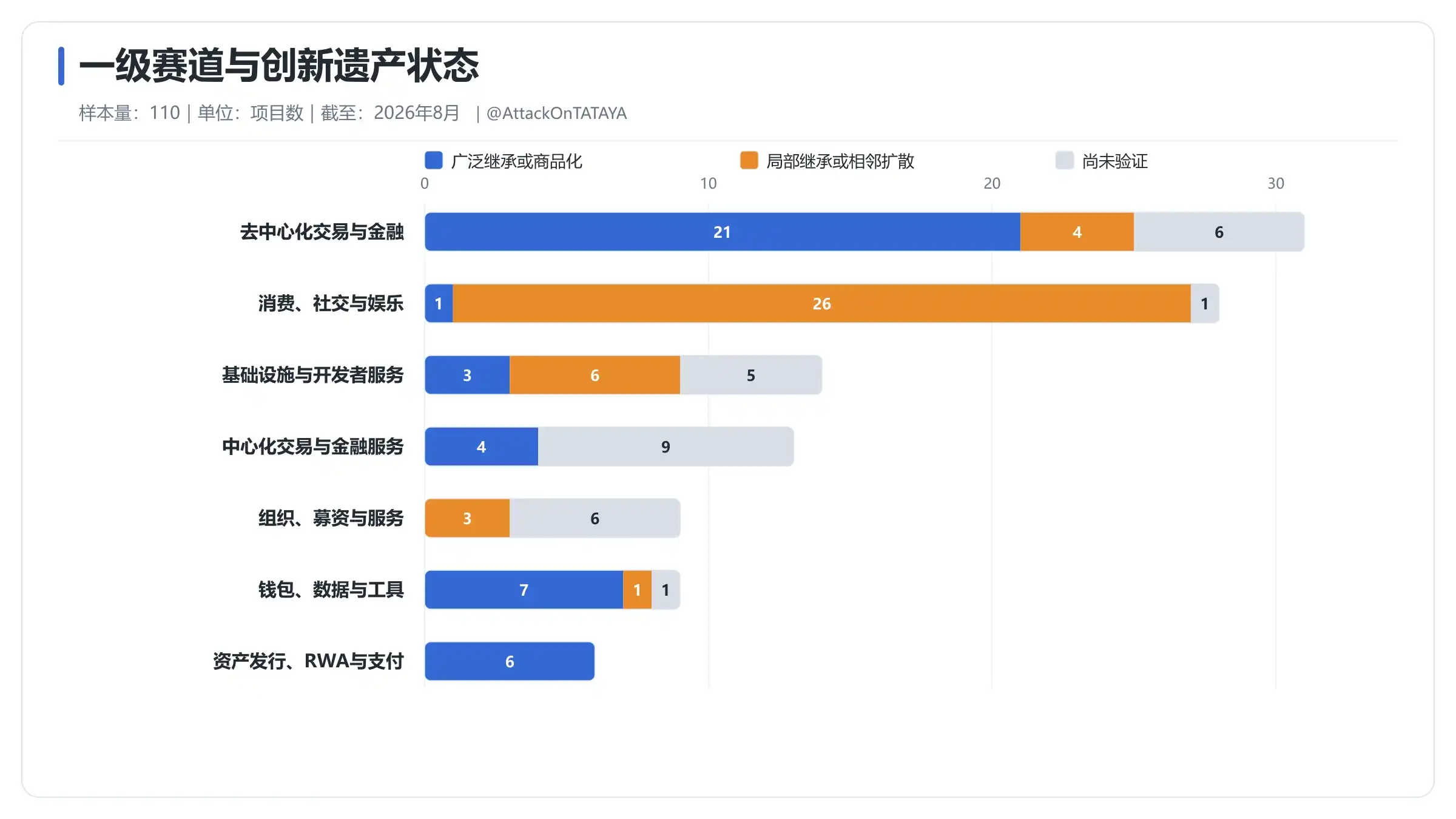
This cross-chart offers a more useful insight than sector counts: the modularity of functions affects diffusion speed, and whether the original project can connect modules to distribution, account, liquidity, and fee systems determines value attribution post-diffusion. A dashboard quickly integrable into a wallet may have significant historical impact but see its independent monetization space rapidly narrow; a product requiring underwriting, compliance, and balance sheet support replicates more slowly and carries heavier long-term operational costs.
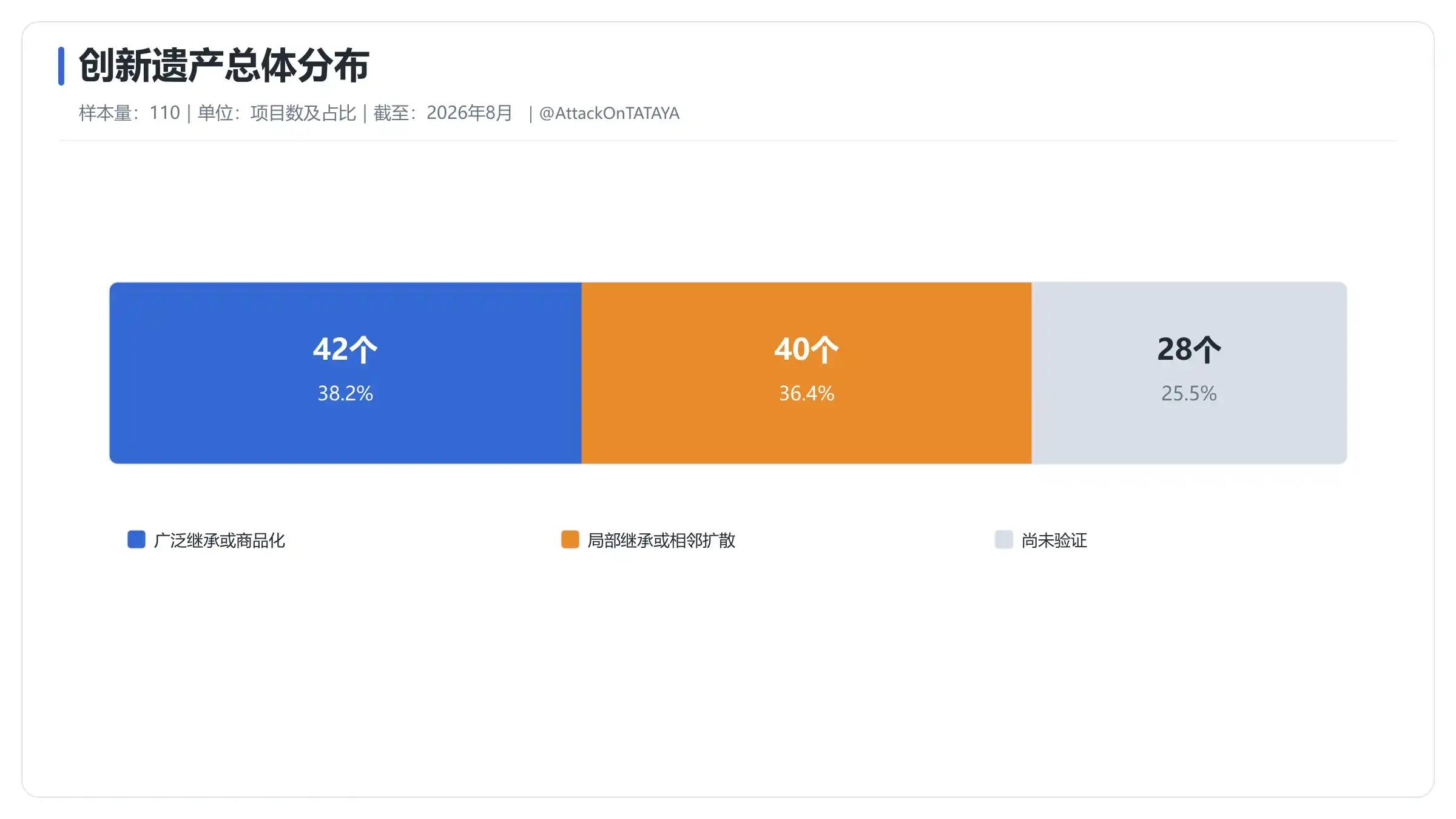
The 42 widely inherited projects indicate user education is complete, while the 28 unvalidated projects highlight another risk: the market may never have formed a clear task, or existing material is insufficient to identify its legacy. They offer different lessons: the former focuses on checking what scarce resources remain after competitor replication, the latter on checking if the problem itself has a stable budget. The more successful the innovation diffusion, the more investors should track data, brand, liquidity, protocol revenue, and channel control, rather than staying on the feature list.
II. Replication Is Now Faster Than Commercialization
There are 98 projects with valid founding years. Among 7 projects founded in 2018 or earlier, 4 (57.1%) experienced function inheritance/diffusion; for 2019–2022 it's 32/44 (72.7%); for 2023–2025 it rises to 39/47 (83.0%). Manual coding cannot prove competitors individually copied these projects, and newer startups may also choose highly homogenous product directions from the start. But regardless of whether the source is direct imitation, open-source combination, or concurrent problem-solving, the commercial consequence is similar: the period of functional scarcity is shortening.
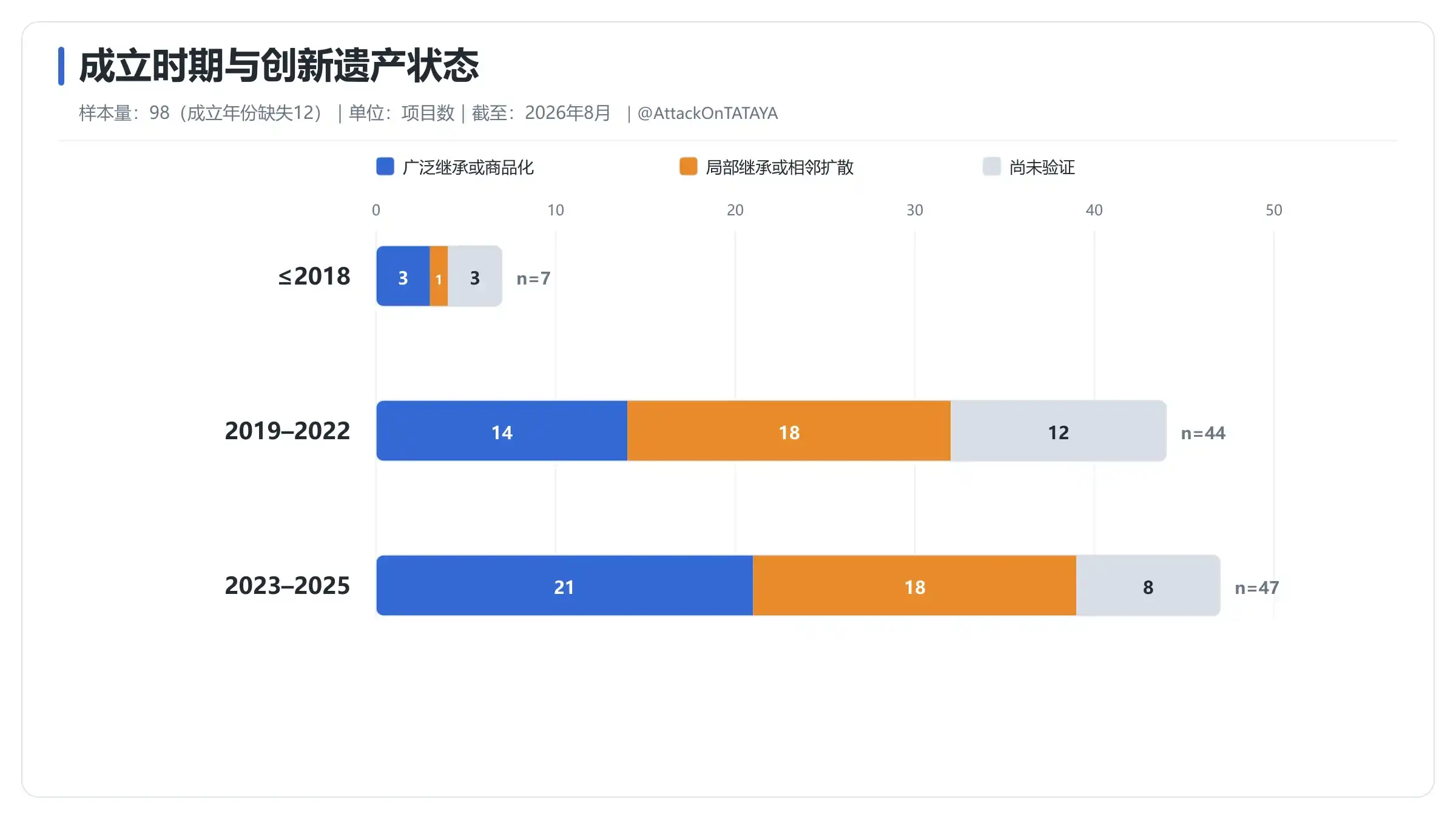
This period difference requires cautious interpretation, but the investment implication remains clear: in an environment of open-source code, modular infrastructure, mature liquidity providers, and standardized SDKs, similar products can emerge faster. Technology valuation thus needs to incorporate a "lead half-life": how long competitors need to rebuild core features, how long platforms need to integrate them, and what costs users incur to migrate. First-mover value still exists, but it acts more like a limited-duration option.
The contrast between BitMEX and Hyperliquid illustrates the difference between first-mover and systematic capture. BitMEX defined the Bitcoin perpetual contract, completing the most expensive user education. Hyperliquid inherited a mature category, placing order book, margin, liquidity, developer distribution, and fee flows into a unified system. On Hyperliquid, trading fees flow to HLP, the Aid Fund, and deployers, with the Aid Fund automatically converting fees to HYPE for burning; Builder Codes allow apps to charge on-chain fees for orders sent on behalf of users; HIP-3 lets deployers create perpetual markets on the shared HyperCore order book and margin stack, taking on oracle, leverage, and settlement responsibilities.
Through complete quarterly data, we can see the scale of this closed loop. DefiLlama records Hyperliquid Perps' Gross Protocol Revenue at $193.65 million for Q2 2026, with Perp Fees at $177.27 million, Builder Code Fees at $16.38 million, and Earnings at $143.12 million. These numbers illustrate how fees flow through the DEX product stack and form allocation relationships among developers, liquidity, and the protocol.
Later platforms can start from mature demand, shifting the competitive focus to systemic capabilities: unified liquidity lowers market cold-start costs, developer fees turn external gateways into distribution partners, market deployment mechanisms expand categories, and fee burning establishes value flowback. BitMEX's historical contribution stands, but Hyperliquid shows a longer game post-first-mover—locking product, distribution, liquidity, and economic systems into a positive feedback loop.
III. Technological Lead Did Not Translate Into Survival Rights
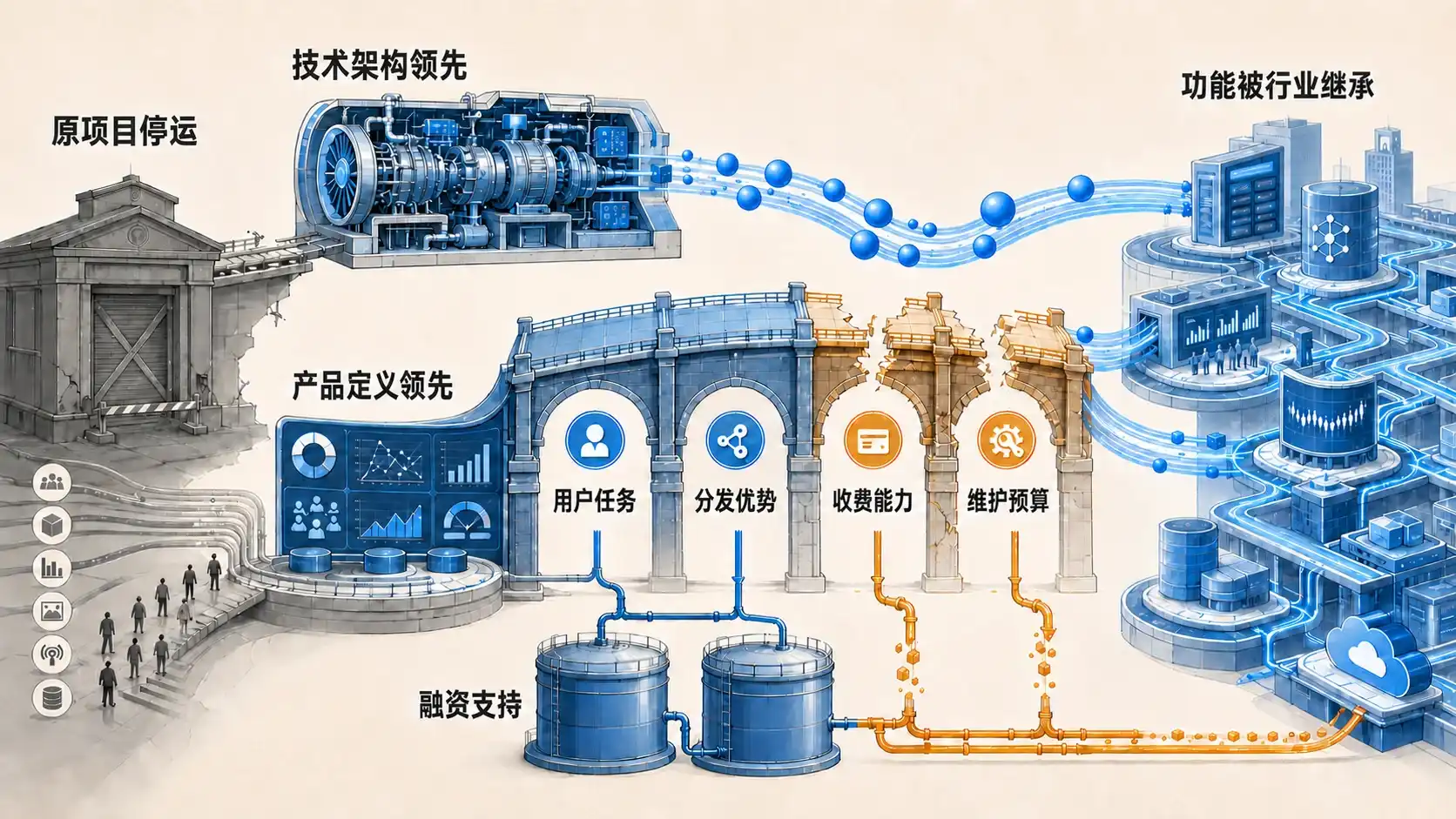
For technological advantage to translate into survival, it needs to sequentially form user tasks, distribution advantage, monetization capability, and long-term maintenance budget. If any layer breaks, the technology may be inherited by the industry, but the original project cannot sustain operations. Loopring and Zapper started from technical architecture and product definition respectively, ultimately encountering the same problem: first-mover advantage did not solidify into a sufficiently stable ecological position and cash flow.
Loopring was an early Layer 2 project combining ZK-Rollup, dedicated trading architecture, non-custodial wallets, and DEX. It helped the industry understand the value of off-chain execution, on-chain verification, and self-custody trading, disclosing ~$45M in funding from investors including Fundamental Labs, Eden Block, and Zero Age Ventures. As general-purpose Rollups, EVM-compatible environments, and larger developer ecosystems matured, competition shifted from single execution performance to tool compatibility, application composability, liquidity, and user access.
Dedicated architecture can improve efficiency for specific trading tasks but requires the team to continuously attract applications, market-making resources, and business partnerships. Loopring failed to convert its technical first-mover advantage into a large enough ecosystem and adoption scale. On June 28, 2026, its website switched to a "Loopring Has Shut Down" farewell page, the core DEX went offline, the project arranged for user asset returns via contract upgrades, and LRC lost its primary product utility. The shutdown fact was confirmed directly by the website; reasons like insufficient adoption, architectural constraints, and business development limitations are supported by team statements preserved by reliable media.
Zapper's lead was closer to product definition. Starting in 2019, it aggregated positions, yields, and claimable rewards from multiple DeFi protocols into a unified interface, later expanding to trade aggregation, NFTs, mobile, and APIs, presenting complex on-chain combinations as understandable asset accounts for ordinary users for the first time. Zapper disclosed cumulative funding of ~$16.5M, including a $1.5M seed round and a $15M Series A led by Framework Ventures.
The user task of an asset dashboard was validated, but sustained operations still required covering multi-chain indexing, protocol adaptation, data updates, and API service costs. Meanwhile, wallets, exchanges, and data platforms could set similar interfaces as default features, narrowing the distribution and monetization space for standalone products. DeBank and Rabby provide a mechanism reference: DeBank extends address and protocol data into volume-based APIs and address reach, while Rabby embeds data capabilities into a high-frequency wallet entry. This comparison only explains Zapper's missing monetization and distribution layers and does not constitute judgment on the security or investment value of active projects.
On July 8, 2026, a founder statement preserved by media announced Zapper's orderly exit; the website, mobile apps, and API ended service on August 3. This material supports shutdown timing and service scope. The team did not disclose revenue, cash burn, or deal negotiation details, so "functions absorbed by platforms, independent monetization space compressed" remains a business mechanism inference.
Placing these two cases back into the funding table of 110 projects reveals notable capital concentration. 45 projects disclosed funding amounts, totaling ~$516.52M, with a median of ~$5.28M; the top ten absorbed 60.1%, while the other 65 projects did not disclose amounts. Undisclosed amounts remain null, not counted as zero.
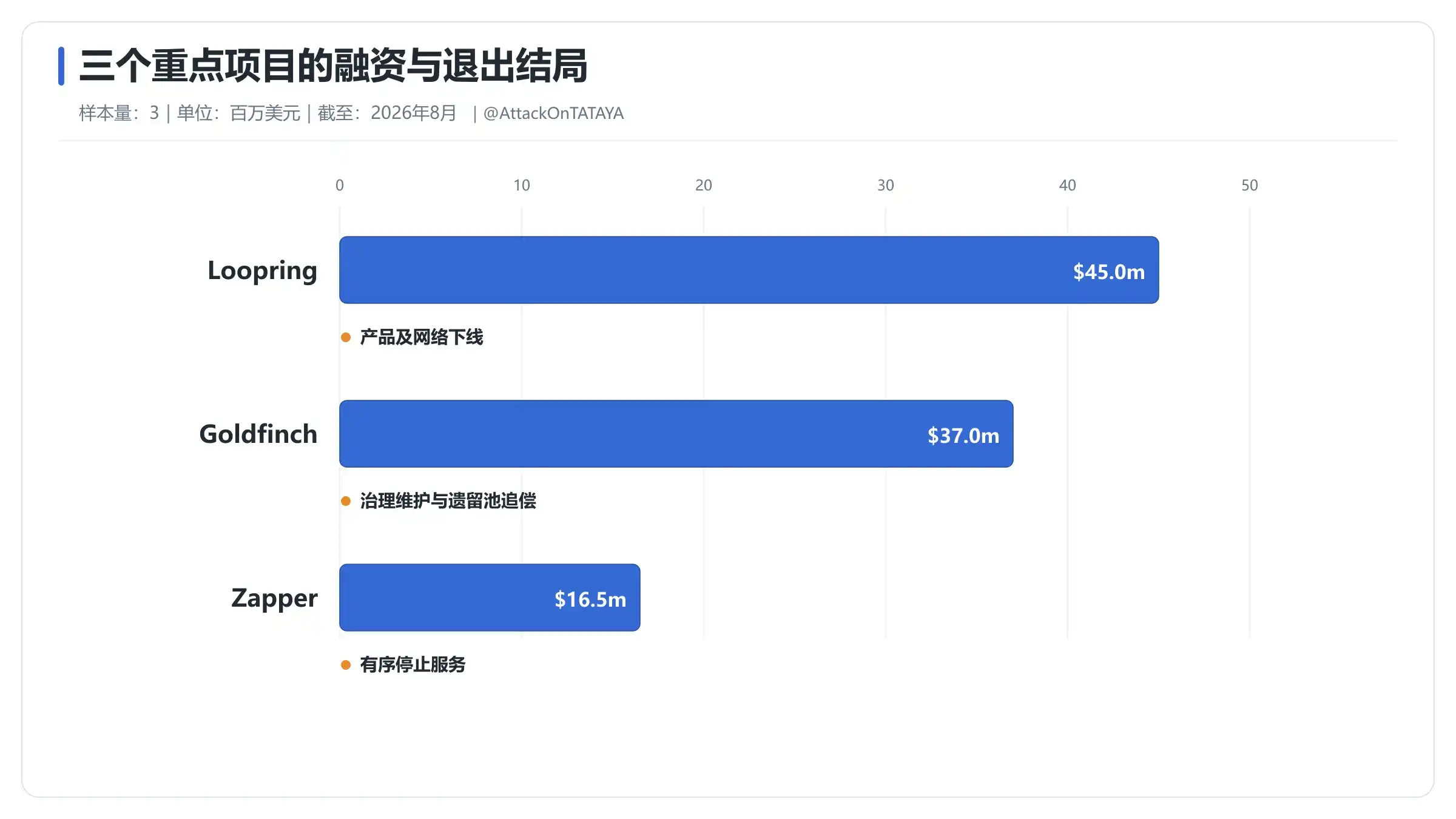
Three high-profile cases show different endgames: Loopring raised $45M then headed to product shutdown; Goldfinch raised $37M then entered governance maintenance, with Prime redeemed and legacy pools continuing recovery; Zapper raised $16.5M then executed an orderly shutdown. Thus, neither technological lead nor fundraising ability can substitute for a commercial closed loop; capital can extend the validation window, but long-term position still depends on whether adoption, distribution, monetization, and maintenance budgets connect.
IV. Responsibility-Intensive Innovation, Survival Costs Land Off-Chain
Some Web3 products bear far more than software maintenance. Underwriting, custody, asset segregation, legal recovery, licensing, customer service, and crisis handling all require a continuously existing organization and budget. This article terms this set of obligations "responsibility density": the closer a product is to credit, custody, real-world assets, and centralized exchange, the more off-chain obligations exist, and the interface between the technical system and operational system becomes a potential risk source. Goldfinch, Foundation, Poolin, and AscendEX expose this responsibility in credit execution, service continuity, corporate liabilities, and customer exit, respectively.
Goldfinch, founded in 2020, was an early DeFi protocol advancing on-chain credit to real-world borrowers without crypto collateral. The project disclosed ~$37M in funding from investors like a16z, Alliance, and SV Angel. It expanded DeFi's asset boundaries but also brought borrower screening, financial information verification, default handling, legal execution, and cross-border recovery into the protocol's long-term costs.
In June 2026, GIP-87 proposed halting new product development and growth investment, shifting the protocol to maintenance mode, and winding down Goldfinch Prime. Governance materials showed the original protocol facilitated ~$100M in loans over two-plus years, with several borrowing pools experiencing severe performance issues; Prime's adoption scale was also insufficient to justify continued investment. The proposal allocated a $150K fixed budget for transition, maintenance, and legacy asset recovery, planning to transfer recovery rights and resources to a US trust. A July 7 update confirmed Prime investors were redeemed at full principal plus one month's interest, while legacy lending pools awaited repayment or recovery.
Goldfinch's responsibility breakpoint lies in credit execution. On-chain records improve visibility of cash flows, but borrowers' balance sheets, collateral disposal, litigation priority, and jurisdiction are determined by off-chain facts. Prime redemption and legacy pool recovery correspond to two asset processes; merging narratives would overestimate settlement progress. RWA yield also needs deduction of default losses, legal costs, governance budgets, and capital lockup to approximate actual investor returns.
Shifting from credit execution to digital asset display, Foundation exposes a different responsibility. Founded in 2020, it was an early NFT marketplace emphasizing creator ownership and non-custodial trading, backed by a16z, Variant Fund, Standard Crypto, etc. (public materials do not disclose a confirmable cumulative funding amount). The platform previously attempted a sale to a third party, which ultimately didn't complete; the team lacked the financial and operational conditions to restore and maintain the platform long-term, with the website confirming permanent offline status in April 2026.
Foundation's responsibility breakpoint lies in the service layer surrounding digital assets. NFTs and smart contracts remain on-chain, users still control assets in wallets; NFTs in listing contracts need manual delisting, media long-term availability relies on additional redundancy, and discovery, indexing, and social relationships require new frontends to take over. The official commitment to maintain the IPFS gateway until April 27, 2027, allows community migration time. Non-custody protects ownership, but frontend, metadata, customer support, and migration support still consume real budgets.
Poolin pushes responsibility further into the corporate balance sheet. Founded in 2017 as a crypto mining pool, it later expanded to wallets, wealth management, and mining farm investments. Mining pool hashrate, block production, and on-chain revenue are highly observable, but custodial wallet liabilities, related-party transactions, mining farm collateral, and high fixed costs are distributed across off-chain contracts and legal entities. More products mean user asset ownership, creditor priority, and guarantee arrangements need separate verification.
On July 22, 2026, Poolin Technology PTE. LTD, Lonestar Taproot LLC, and Lonestar Dream, Inc. filed for Chapter 11 in the US, with cases jointly administered by the New Jersey Bankruptcy Court. This legal proceeding confirms three debtor entities entered restructuring but cannot be used to write all pool services as ending the same day. Recovery for customers and other creditors depends on asset sales and restructuring, with equity value subordinate to debt. Poolin's responsibility breakpoint lies between product accounts and the corporate balance sheet: public hashrate cannot substitute for transparency into custodial liabilities and related-party transactions.
AscendEX concentrates technology, licensing, and customer exit onto one platform, offering spot trading, swaps, staking, lending, and other crypto asset services. An official user letter confirmed the platform ceased operations on July 1, 2026, citing MiCA authorization gaps, broader financial/operational factors, and a strategic counterparty failing to complete arrangements. Withdrawals shifted to manual review, with uncertain processing times and amounts.
AscendEX's responsibility breakpoint lies between platform promises and user asset exit. Trading volume only describes matching activity; license validity, asset segregation, withdrawal delays, related-party exposure, and crisis communication determine asset availability during stress periods. These four cases collectively show that smart contracts can automatically execute predetermined rules, but identity, assets, legal processes, and remaining users still require an organization to bear responsibility. When revenue cannot cover these fixed obligations, technological adoption cannot support long-term service either.
V. Projects Often Choose to Exit Silently
The evidence distribution across the 110 samples is highly skewed. Regarding exit status, only 7 projects could be directly confirmed via official websites, governance, or legal documents; 24 projects received cross-support from reliable sources or had official statements fully preserved by media; the remaining 79 projects (71.8% of the sample) still lack sufficient material to confirm specific exit status. The primary reason is even harder to trace: 4 projects were directly explained by official/governance/legal documents, 8 supported by reliable sources, 1 inferred from event chains and operational signals, and the other 97 reasons unknown (88.2% unknown rate). Thus, only 31 projects have a confirmed specific exit method, and only 13 have a confirmed primary reason.
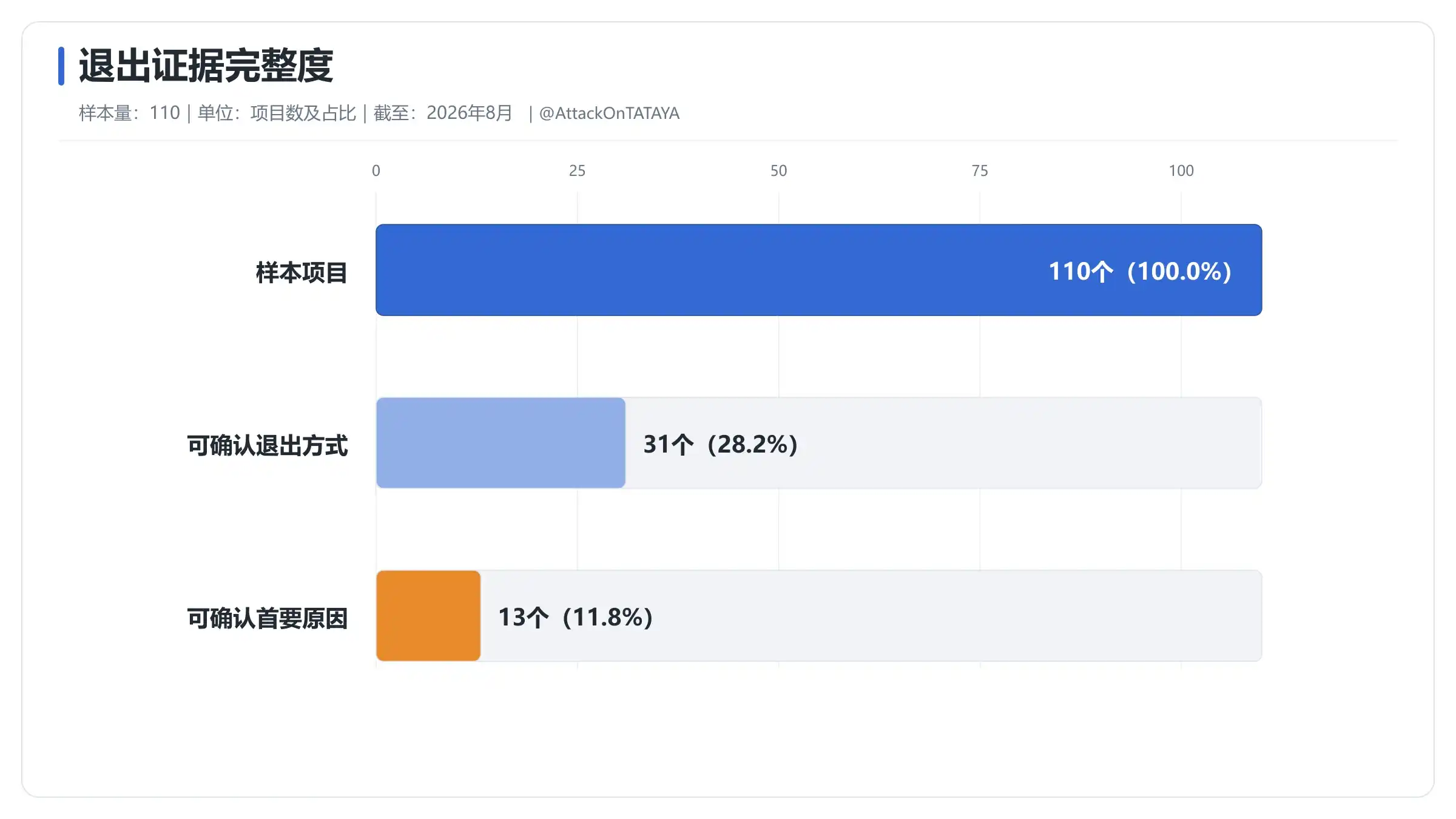
Among the 31 confirmed projects, 17 (54.8%) manifested as product or network shutdowns; 7 (22.6%) as orderly shutdowns; 4 (12.9%) entered bankruptcy/liquidation; and governance resolution, sudden halt, and failed sale each account for 1. Product or network shutdown becoming the most common public endpoint indicates many exits first appear as frontend, API, network, or team maintenance stopping, with formal reasons often appearing later.
Evidence gaps also vary by sector. Among 14 Infrastructure & Developer Services projects, 12 (85.7%) lack sufficient material to confirm specific exit status; this group has no confirmable primary reason. This result describes public disclosure completeness, not that infrastructure projects fail more easily. Teams targeting backend, developers, or protocol layers often lack broad user attention and can exit with low visibility after maintenance stops.
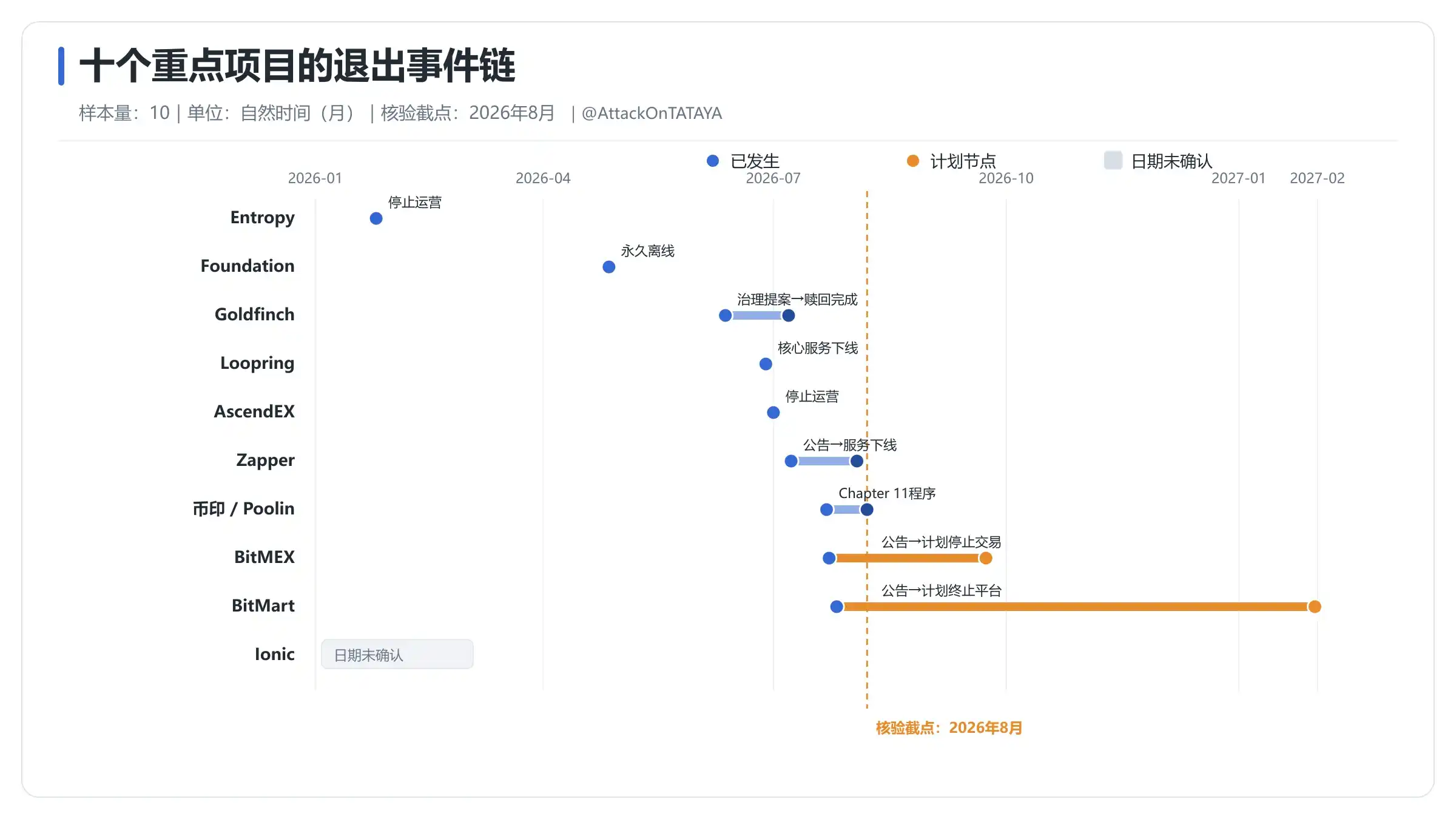
The timeline further shows "exit" is a sequence of events: announcement, stopping new business, service shutdown, asset return, and legal disposal can be weeks or even years apart. Loopring and Zapper's core services have ended; Goldfinch is in maintenance and legacy recovery; Poolin is in legal proceedings; some nodes for BitMEX and BitMart are after the report cutoff; Ionic is not forced into a specific date. For data teams, an event table preserving timing, business scope, and unknown states is more suitable for continuous updates than a single shutdown label.
VI. Surviving Cycles Requires a Composite System
The 110 exit cases collectively show that single technological advantages struggle to independently support long-term valuation. More robust projects typically connect six types of capabilities: real demand provides the budget, distribution lowers acquisition costs, the product stack extends user relationships, revenue covers operational & risk expenses, the balance sheet absorbs volatility, and a responsible entity handles off-chain obligations. If any ring relies long-term on subsidies, the system transmits pressure to other rings.
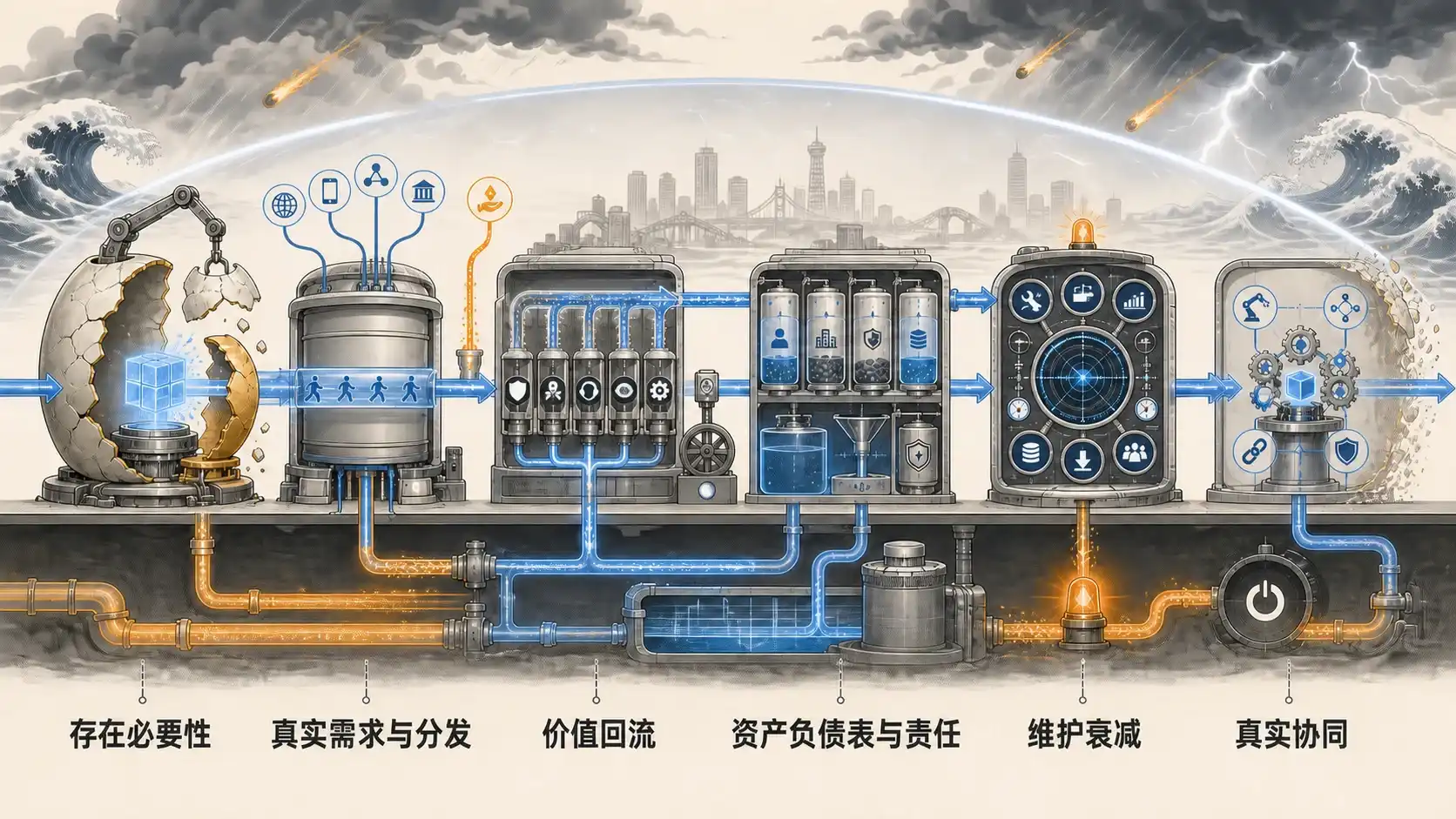
The first check is necessity. The project must clearly explain the user task, usage frequency, alternatives, and the net benefit brought by the on-chain architecture. If removing the token or governance layer significantly diminishes product value, then the Web3 components are fulfilling necessary functions. Whitepapers, actual business, and token economics need mutual verification, avoiding separation between technical narrative and revenue sources.
The second check is real demand and distribution. User growth should be split into organic retention, subsidized retention, paid conversion, and channel costs; developer products should track active keys, paid calls, client concentration, and renewal rates; trading products should distinguish passive volume from market trends versus stable market share. The Zapper vs. DeBank/Rabby comparison shows that high-frequency entry points and multi-layered monetization points increase commercial options, while a single free tool is more easily absorbed by platforms.
The third check is value flowback. A protocol generating trading volume, TVL, or yield doesn't guarantee the operating entity receives a budget. One must chart the fee path from users to market makers, deployers, treasury, token, and team, then verify security, compliance, customer service, and development expenses. The BitMEX–Hyperliquid comparison shows that after a product gains industry acceptance, distributor incentives, shared liquidity, and fee rules determine where value resides.
The fourth check is the balance sheet and responsibility density. RWA, exchange platforms, custody, and leveraged businesses require simultaneous transparency into legal entities, collateral, asset segregation, liquidation priority, withdrawal capability, and jurisdiction. On-chain transparency must combine with underwriting, collateral management, liquidity arrangements, and responsible entities to enter institutionalized risk assessment.
The fifth check is maintenance decay. Establish weekly or monthly signal tables placing release cadence, code contributors, API availability rate, organic activity, fees, withdrawal times, and team changes on the same timeline. Initiate manual verification when operational signals deteriorate for two consecutive observation periods; increase risk weight when they deteriorate for three consecutive periods without official explanation. This framework is earlier than waiting for database updates and more suitable for data team replication.
The sixth check is genuine Web3+ synergy. Combining AI, RWA, social, and gaming with on-chain systems must bring verifiable attribution, programmable settlement, open distribution, or new risk pricing capabilities. Keyword stacking cannot form a moat. Compliant projects need more compliance; innovative ones need more innovation. Products for institutions require stronger asset segregation, disclosure, and risk control; frontier products can maintain experimental speed while clarifying security budgets, permissions, data migration, and responsibility boundaries.
These six checks point to a shift in the valuation object. When code, SDKs, and liquidity infrastructure make replication faster, the premium for functional first-mover advantage begins to have a clear shelf life. Investors need to keep asking: which segment of distribution does the project control, which long-term expenses does its revenue cover, through what balance sheet are risks absorbed, and who performs maintenance and handling after the team leaves. Only when demand, distribution, revenue, maintenance, and responsibility form a closed loop can technological leadership have a chance to solidify into organizational advantage.
Industry scarcity is also migrating. Inventing a new function remains difficult, but making a set of already-validated functions work together long-term is even scarcer. Security, assets, compliance, and user responsibility cannot be forked as quickly as code; they require stable budgets, continuous decision-making, and traceable entities. The competitive advantage of the next wave of projects will likely come from this low-visibility yet high-intensity organizational capability.
Thus, historical contribution and investment outcome require two sets of metrics. The former measures what a project validated and disseminated, the latter measures how much distribution, revenue, and responsibility capacity the project retains. BitMEX, Loopring, Zapper, and Goldfinch have written perpetual contracts, ZK scaling, asset aggregation, and on-chain credit into industry product history; their business outcomes remind capital that innovation diffusion may expand societal value while shortening the original project's exclusive value period.
After the stars fall, what remains are product paradigms inherited by the industry, exposed commercial gaps, and a stricter set of system requirements. The truly scarce projects of the next wave will be those that make users return continuously, keep value within the system, assign risks to bearers, and secure long-term maintenance budgets. Neither technological lead nor fundraising ability can substitute for a commercial closed loop. The best legacy left by pioneers is letting successors see earlier: for an innovation to become infrastructure, a complete system is needed to catch its success.