After the Collapse of the Believe Flywheel Myth, the 26-Year-Old Prodigy Founder Stands as Defendant in Federal Court

marsbitPublished on 2026-04-16Last updated on 2026-04-16

Abstract

In March 2026, 26-year-old Australian entrepreneur Ben Pasternak and his entities B24, Inc. and Believe Foundation were sued in a New York federal court. Investors accused Pasternak of deceptive practices and false advertising through three consecutive token offerings and a forced token migration, causing hundreds of millions in losses. The case centers on Believe (formerly Clout.me), a Solana-based social token launch platform Pasternak founded. Users could create tokens via tweets, with the platform token LAUNCHCOIN reaching a peak market cap of $370 million in May 2025. Pasternak initially claimed he had "zero ownership" of his self-named token, PASTERNAK, which crashed over 95% within a week. In October 2025, Believe forced a migration from LAUNCHCOIN to a new token, BELIEVE, increasing total supply by 33.3%. New tokens were allocated to team members, investors, and the foundation, diluting existing holders. Pasternak falsely claimed no tokens were allocated to insiders for a year, while the foundation received 40 million tokens with no lock-up. The platform generated an estimated $54 million in fees from $6 billion in trading volume. Pasternak earned creator fees throughout. After the migration, significant selling occurred from top wallets. BELIEVE’s value plummeted from its peak to around $1.2 million. Pasternak, a former teen prodigy who dropped out of school at 15, had previously founded apps like Monkey and the food-tech startup NUGGS. His personal life also dre...

On March 23, 2026, a lawsuit was filed in the Southern District of New York Federal Court, officially naming 26-year-old Australian entrepreneur Ben Pasternak and his entities B24, Inc. and Believe Foundation as defendants.

This class action lawsuit, initiated by investors Joshua Lee and Pierre Montmeas, accuses Pasternak of engaging in deceptive business practices and false advertising through three consecutive token offerings and one forced migration, resulting in hundreds of millions of dollars in losses for consumers. By this time, nearly half a year had passed since his last original social media post.

The core of this lawsuit points to a Solana ecosystem application named Believe. Believe (formerly Clout.me) was a Solana social token launch platform launched in 2025, founded by Pasternak. Users could create tokens without code simply by posting a tweet on platform X with "@launchcoin + token name". It utilized a bonding curve mechanism, automatically upgrading to a Meteora liquidity pool once the market cap reached $100,000. The platform was positioned as an "idea crowdfunding platform," and its platform token LAUNCHCOIN reached a peak market cap of $370 million in May 2025.

According to the complaint, Pasternak launched a token named after himself, PASTERNAK, in January 2025, publicly stating on the same day that he had "zero ownership" of the token. This statement successfully built a trust narrative of "no insider allocation," and the token's market cap briefly touched $80 million on its first day. However, within a week, the price plummeted over 95%, and by March 2025, its market cap was only about $190,000.

On April 28, 2025, the platform was renamed from Clout to Believe; on May 2, the on-chain metadata for PASTERNAK was changed to LAUNCHCOIN, though the token contract itself was not redeployed. The complaint points out that in mid-May, the LAUNCHCOIN market cap once exceeded $240 million, reaching an all-time high of $0.3647. The price continued to decline afterwards, while Pasternak and the official Believe account publicly promised at least twelve times during this period to initiate a "flywheel" buyback mechanism, using platform fee revenue to purchase tokens on the open market to support the price.

On October 15, 2025, the Believe team announced the forced migration of LAUNCHCOIN to a new token, BELIEVE. Holders had to complete a 1:1 exchange by October 29; tokens not migrated by the deadline would be permanently destroyed.

Simultaneously, the total supply of the new token inflated from 1 billion to approximately 1.333 billion, an increase of 33.3%. The complaint details the allocation of the new tokens: about 17% allocated to current and future contributors, subject to a four-year vesting period and a one-year lockup; about 5% allocated to early investors, locked for one year; and about 3% allocated to the foundation, with no lockup restrictions, immediately available.

Original LAUNCHCOIN holders received no additional compensation and saw their ownership directly diluted.

The complaint further states that Pasternak publicly stated on the day of the migration announcement that "no individual or entity will get tokens for at least a year," a statement clearly contradicted by the fact that the foundation's approximately 40 million tokens were immediately unlocked. Additionally, the Believe team described the supply increase as "25%," while the actual mathematical calculation was approximately 33%, a discrepancy that sparked widespread skepticism and ridicule within the crypto community.

Regarding the platform's economic model, Believe charged approximately a 2% fee on each transaction, initially split equally between the token creator and the platform, but adjusted in June 2025 to 70% for the creator and 30% for the platform. The platform also designed a "scout" mechanism, where the first user to trigger a token launch would receive 0.1% of subsequent transaction fees. The complaint estimates that Believe processed approximately $6 billion in trading volume, with total platform fee revenue around $54 million.

As the creator of PASTERNAK, LAUNCHCOIN, and BELIEVE, Pasternak himself continuously received a share of the creator fees. The complaint also notes that in the week the migration was announced, on-chain data showed significant selling activity from top wallet addresses.

Pasternak's last original tweet was posted on October 16, 2025. In this lengthy post, he admitted for the first time that he had never purchased any Solana token before launching his first one, reiterated that the team received no token allocation in the initial offering, clarified the misstatement regarding the supply increase, promised that the foundation's holdings would not be sold, and committed to initiating the buyback flywheel after the migration was complete.
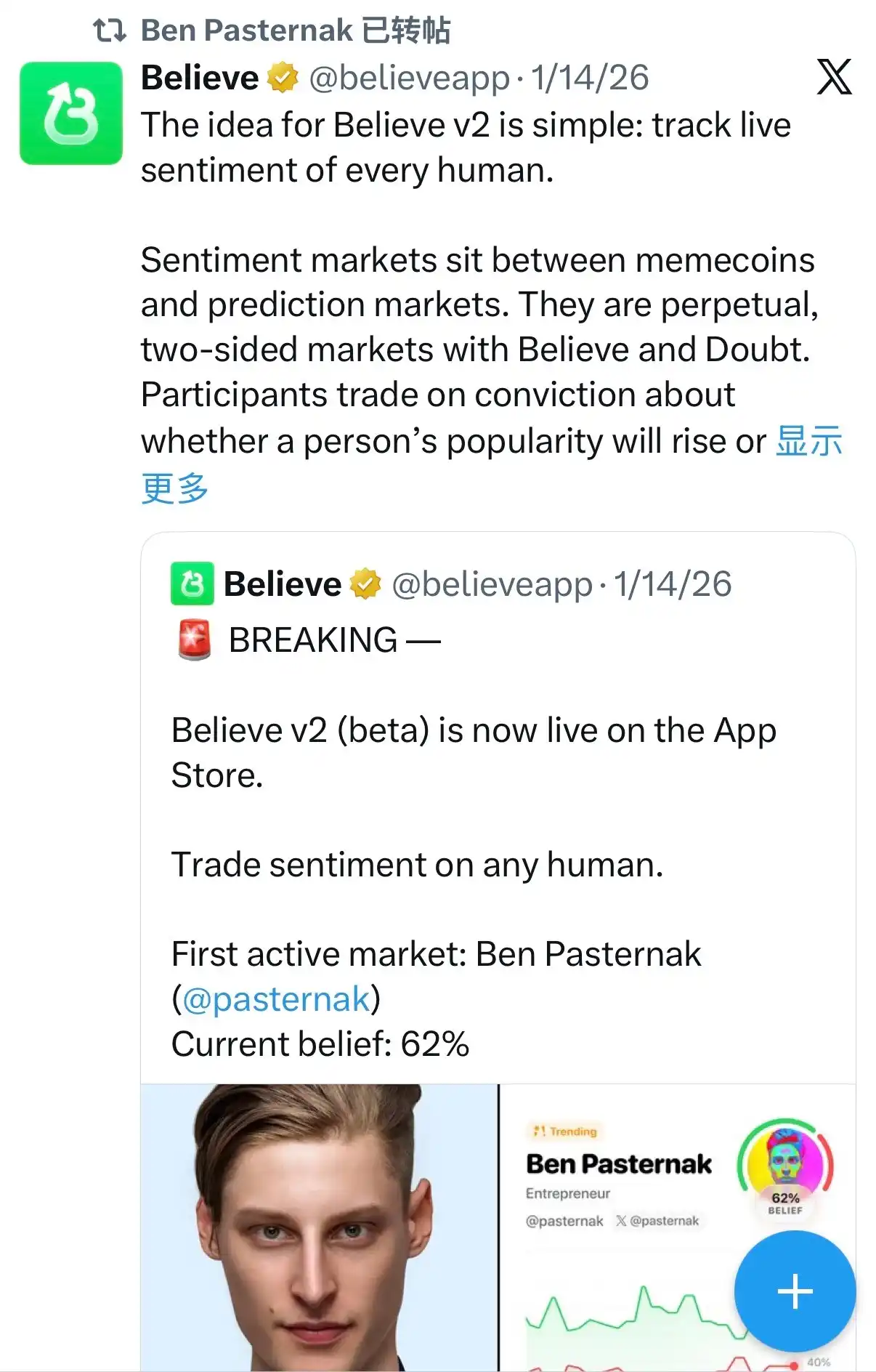
On January 14, 2026, he retweeted a post from the official Believe account, which read: "The idea behind Believe v2 is simple: track everyone's real-time sentiment."
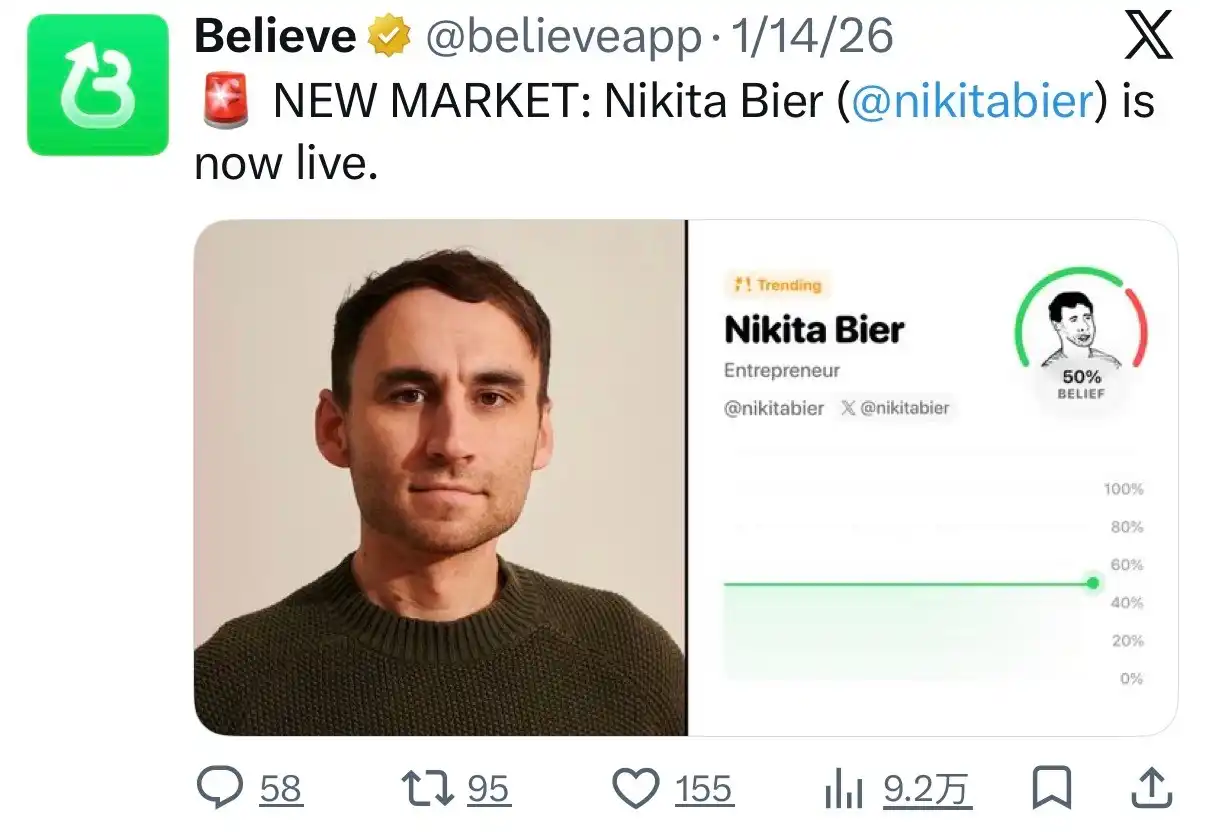
Updates from the official Believe account also stopped on that day, with its last tweet announcing: "New market listing: Nikita Bier (@nikitabier) is now open for trading." Thereafter, both Pasternak's personal and the project's official social media fell completely silent.

Believe v2, launched in January 2026, attempted to pivot to a "sentiment market," allowing users to bet on the real-time popularity of public figures through a perpetual bilateral market, but failed to regain market attention. As of the filing date, the BELIEVE token's market cap was approximately $1.2 million, having evaporated from its historical high.

This lawsuit invokes New York General Business Law Sections 349 and 350, California's Unfair Competition Law and False Advertising Law, alongside common law claims such as negligent misrepresentation and unjust enrichment. The plaintiffs request the court to order the defendants to compensate for actual losses, return platform and creator fees, and, where necessary, impose constructive trusts and injunctive relief on traceable digital assets.

Documents show Pasternak resides in Manhattan, New York, and his controlled entity B24, Inc. is also registered in New York, with platform operations and development pointing to this jurisdiction. As of the time of writing, he has not publicly responded to the lawsuit nor disclosed the specific amount of profit he gained from the Believe project.

A Legendary Teenage Era

Prior to this legal storm, Pasternak's life resume was legendary. Born on September 6, 1999, in Sydney, Australia, into a Jewish family, he grew up in the Vaucluse suburb. He taught himself programming at age 13. In 2014, at 14 years old, he collaborated with an engineer from Chicago during a school science class and completed the iOS game "Impossible Rush" in a few hours, which garnered millions of downloads and briefly reached No. 16 on the US App Store overall chart. Media quickly picked up the story, dubbing him "the next Zuckerberg."

In January 2015, the 15-year-old Pasternak rejected internship offers from Facebook and Google, dropped out of high school, and flew alone to New York to seek venture capital. In April of the same year, he founded Flogg, a social shopping app for teenagers, raising about $2 million from firms like Binary Capital and Greylock Partners.

Flogg's performance fell short of expectations and it shut down by the end of 2016. He promptly redirected resources to a new project, Monkey, a video chat app for teenagers.

Monkey accumulated over 20 million users and was acquired by the Chinese company Holla in 2018, becoming his first successfully sold startup from his teenage years.

Starting in 2018, Pasternak shifted to the food tech sector, co-founding Simulate and launching the plant-based chicken nugget NUGGS. The project attracted support from notable investors like Alexis Ohanian, Jay-Z, and McCain Foods, raising over $50 million in 2021, with the company's valuation once exceeding $250 million. That same year, he was named to the Forbes "30 Under 30" list.

From mobile apps to food tech, and then to Web3, Pasternak's every pivot landed on trending sectors, accompanied by significant controversy and risk. And as he finds himself deep in legal troubles, his personal life has also taken a dramatic turn.

Since the second half of 2024, Pasternak was publicly dating TikTok influencer Evelyn Ha. Evelyn is from the influential Korean-American Ha family of three sisters, and Pasternak frequently shared their luxurious interactions on social platforms.

However, in early April 2026, netizens noticed that the Ha sisters had simultaneously unfollowed him on Instagram, and Evelyn was later revealed to be in a close relationship with a Twitch streamer. The outside world widely interpreted this series of actions as signals of the relationship's end, with some in the crypto community joking that "the Hermès budget can finally be reinvested into the flywheel."

From the teenager writing apps in a Sydney high school classroom to the entrepreneur standing as a defendant in a New York federal court, Ben Pasternak's 26th year has brought both legal and emotional storms. He was once the media's "next Zuckerberg," but now his name is more often associated with "fraud," "collapse," and "unfollow."


Related Questions

QWhat are the main allegations against Ben Pasternak and his entities in the federal lawsuit?

AThe lawsuit alleges that Ben Pasternak, B24, Inc., and Believe Foundation engaged in deceptive business practices and false advertising through three consecutive token offerings and a forced migration, causing consumers to suffer hundreds of millions of dollars in losses.

QWhat was the core mechanism and initial promise of the Believe (formerly Clout.me) platform?

ABelieve was a Solana-based social token launch platform where users could create tokens by posting a specific tweet. It used a bonding curve mechanism and promised an automatic 'flywheel' buyback mechanism, using platform fee revenue to purchase tokens on the open market to support their price.

QWhat controversial action did the Believe team take with the LAUNCHCOIN token in October 2025?

AThe Believe team announced a forced migration from the LAUNCHCOIN token to a new token called BELIEVE. The total supply was inflated by approximately 33.3%, diluting original holders, and the new tokens were allocated to team members, investors, and a foundation, contrary to Pasternak's earlier public statements.

QWhat was the significant contradiction between Pasternak's public statements and the token migration plan?

APasternak publicly stated that 'no individual or entity would receive tokens for at least a year' on the day the migration was announced. However, the foundation's allocation of approximately 40 million BELIEVE tokens was immediately unlocked and usable, directly contradicting his claim.

QWhat was Ben Pasternak's background and public persona before the Believe controversy?

ABefore the Believe controversy, Ben Pasternak was celebrated as a teenage prodigy who created popular apps, sold a company, and founded a successful food-tech startup, NUGGS. He was featured on the Forbes '30 Under 30' list and was often referred to as 'the next Zuckerberg' by the media.

Related Reads

STAR 50 Soars 10.73%, Why Did A-Shares Stage a "V-Shaped Reversal"?

After a prolonged decline, the Chinese A-share market staged a strong rally on July 21. The STAR 50 index surged 10.73%, its largest single-day gain in nearly a year, leading a broad-based "V-shaped" reversal. The Shanghai Composite Index rose 1.79%, the Shenzhen Component Index gained 4.81%, and the ChiNext Index jumped 7.05%. Total market turnover reached 2.97 trillion yuan, an increase of 256.1 billion yuan from the previous session, with over 3,100 stocks advancing. The semiconductor sector spearheaded the rebound, with related ETFs posting significant gains. Analysts attribute the surge to three converging factors. First, coordinated capital inflows from "national team" institutions, insurance funds, listed company buybacks, and fund house self-purchases have bolstered market liquidity and confidence. Second, supportive policy signals, including commitments from regulators to ensure stable market operations, provided a favorable backdrop. Third, a stabilization and recovery in overseas markets, notably South Korea, created a positive external environment. Institutions suggest the most severe panic selling phase for the tech sector has likely passed, following a significant digestion of crowded positions and leveraged funds. While short-term volatility may persist, the medium to long-term outlook remains underpinned by enduring trends like AI computing demand expansion and semiconductor localization. The market's focus now shifts to the sustainability of supportive fund flows, earnings reports, and upcoming catalysts from the global AI industry chain.

marsbit39m ago

STAR 50 Soars 10.73%, Why Did A-Shares Stage a "V-Shaped Reversal"?

marsbit39m ago

U.S. Tech Momentum Stocks Post Largest Single-Day Gain Ever, But Is the Plunge Over?

US tech momentum stocks staged a sharp rebound on Tuesday (July 21st). Morgan Stanley's TMT Momentum Factor surged over 12%, marking its largest single-day gain on record, exceeding even peaks from the 2000 dot-com bubble. Key momentum indices from Goldman Sachs also posted their strongest daily performances in years. The rally was led by semiconductors, with the Philadelphia Semiconductor Index jumping 4.6%. This rebound followed three consecutive down days and a cumulative 33% plunge in momentum stocks, one of the steepest drawdowns since the dot-com era. Analysts attribute the surge largely to a short squeeze. Heavy selling had pushed high-beta momentum stocks into deeply oversold territory, forcing many short sellers, particularly in Asia, to cover their positions, creating a self-reinforcing buying spiral. However, the rebound's internals appear weak. Trading volume was notably low, and advancing stocks still lagged decliners on the S&P 500, indicating a narrow, concentrated rally rather than broad market participation. Diverging views emerge on the outlook. BTIG warns the bounce has hit key resistance and recommends selling into strength, citing extreme volatility and historical parallels to past market tops. Conversely, Goldman Sachs and UBS believe the momentum unwind is nearing its end, suggesting it may be time to gradually add exposure, as positioning has been significantly reduced. They caution, however, that high volatility warrants a measured approach, potentially using defined-risk strategies. The upcoming earnings season, particularly reports from major tech firms like Alphabet, is seen as a critical test for the rally's sustainability. Simultaneously, bond markets flashed a warning, with yields rising partly due to spiking oil prices. Analysts note that if long-term Treasury yields break decisively higher, it could pose a significant headwind for equities, especially growth stocks.

marsbit46m ago

U.S. Tech Momentum Stocks Post Largest Single-Day Gain Ever, But Is the Plunge Over?

marsbit46m ago

U.S. Tech Momentum Stocks Record Largest Single-Day Gain Ever, but Has the Rout Ended?

U.S. tech momentum stocks staged a dramatic rebound on Tuesday, July 21st. Key momentum indices like the Morgan Stanley TMT Momentum Factor and Goldman Sachs' High Beta Momentum Long Index posted historic or near-historic single-day gains, fueled largely by semiconductor stocks. This sharp rally followed a severe three-day sell-off that saw momentum stocks plunge 33%, marking one of the steepest pullbacks since the dot-com bubble. Analysts attribute the bounce primarily to a short squeeze, as forced covering from over-leveraged traders, particularly in Asia, created a buying spiral. However, the rally's health is questioned due to weak market breadth—overall trading volume was low, and decliners outnumbered advancers in the S&P 500 despite the index's gain—suggesting a narrow, concentrated surge rather than broad recovery. Opinions on the sustainability diverge. BTIG strategists warn the rebound has hit key resistance levels, citing extreme volatility and historic stock dispersion as signs of an ongoing broader correction, and recommend selling into strength. Conversely, Goldman Sachs and UBS view the aggressive momentum unwinding as nearing its end, noting reduced positioning and a lack of new fundamental catalysts. They suggest the sell-off presents a selective opportunity to add exposure, albeit cautiously and gradually using defined-risk strategies. The immediate trajectory hinges on the ongoing earnings season, with market focus on Alphabet's capital expenditure guidance for AI investment clarity. Meanwhile, bond markets present a risk, with rising Treasury yields—potentially heading toward 5.5%—and widening credit spreads for mega-cap tech companies posing a threat to equity valuations. The combination of technical factors, earnings results, and macro conditions leaves the durability of the rebound in doubt.

链捕手49m ago

U.S. Tech Momentum Stocks Record Largest Single-Day Gain Ever, but Has the Rout Ended?

链捕手49m ago

Long-Divided Must Unite, Long-United Must Divide: When L1 Becomes Its Own Rollup, What Is Ethereum's Endgame?

"The Inevitable Cycle: When L1 Becomes Its Own Rollup – What is Ethereum's Endgame?" For years, the Ethereum community grappled with concerns that L2s were fragmenting the ecosystem and eroding L1's value. While L2s provided cheaper execution, they also splintered liquidity and the unified user experience of a single chain. This has prompted a fundamental reassessment of the relationship between L1 and L2. Ethereum's roadmap is evolving. The "Scale" initiative merges L1 and L2 expansion into a holistic framework. L1 itself is advancing with higher gas limits, statelessness, and zkEVM verification, no longer content to be just a low-throughput settlement layer. Consequently, the primary value proposition of L2s is shifting from merely providing cheap blockspace to offering L1 cannot easily provide: application-specific optimizations, privacy features, and flexible governance models. L2s are becoming a spectrum of execution environments with varying degrees of security inheritance from Ethereum. A critical challenge in this multi-chain future is interoperability. The vision is to make Ethereum "feel like one chain again." This relies on advancements in native account abstraction (like EIP-7702) and intent-based architectures (Open Intents Framework), where users declare desired outcomes, and solvers handle the complex cross-chain execution. Furthermore, shortening Ethereum's finality time from minutes to seconds is crucial, as it underpins trust between chains for bridges, stablecoins, and cross-chain applications. Perhaps the most provocative idea is that Ethereum L1 itself could become a form of "its own Rollup." As zkEVM and proof systems mature, high-performance nodes could execute transactions and generate validity proofs. Regular validators would then verify these proofs instead of re-executing all transactions. This blurs the traditional L1/L2 hierarchy, making "Rollup" more of a general execution-verification architecture. Native Rollup aims to integrate L2 validation more directly into the Ethereum protocol, allowing L2s to inherit L1's security more fully and move away from reliance on security councils. In the end, L2s are not destined to replace L1 or be made obsolete by it. The likely future is a unified system where diverse execution environments—each optimized for specific use cases like DeFi, gaming, or privacy—coexist. They will share a common foundation of security, liquidity, and verifiable state, seamlessly connected to restore a cohesive user experience. The next phase for Ethereum is not just about scaling through separation, but about intelligently reintegrating what was separated back into a coherent whole.

链捕手1h ago

Long-Divided Must Unite, Long-United Must Divide: When L1 Becomes Its Own Rollup, What Is Ethereum's Endgame?

链捕手1h ago

Trading

Spot
活动图片




