After Riemann Hypothesis, Claude Shatters Another Century-Old Conjecture

marsbitPublished on 2026-08-20Last updated on 2026-08-20

Abstract

After decades of steadfast belief in classical geometric conjectures, a significant breakthrough has arrived via artificial intelligence. In a collaborative effort, mathematician Levent Alpöge and Anthropic's Claude have constructed a counterexample that falsifies the century-old Carathéodory conjecture in differential geometry, while simultaneously disproving the related Loewner index conjecture. The Carathéodory conjecture, first formulated in 1924, posited that any sufficiently smooth, closed, and convex surface in three-dimensional Euclidean space must possess at least two umbilical points—points where the surface's curvature is the same in all directions, making it locally spherical. This assertion, intuitively supported by examples like spheres (with infinitely many) and ellipsoids (with two), had remained unproven and unchallenged for over 100 years. The parallel Loewner conjecture imposed a theoretical limit of 1 on the index of any isolated umbilical point. The pivotal counterexample is an explicit, mathematically rigorous construction of a convex body that is infinitely smooth (C∞) yet contains only a single umbilical point, directly contradicting Carathéodory's requirement of at least two. Furthermore, this solitary umbilical point possesses an index of 2, violating the Loewner conjecture's stipulated upper bound of 1. This achievement follows Alpöge's earlier use of Claude to propose a counterexample for the three-dimensional Jacobian conjecture, signaling a pa...

A century-old conjecture has fallen yet again.

Anthropic/Harvard mathematician Levent Alpöge, in collaboration with Claude, has directly disproven the Carathéodory conjecture, which had perplexed the mathematical world for over 100 years, and in doing so, also shattered the Loewner index conjecture.

A PDF circulated within mathematical circles for a full week. Now, it has been officially made public.
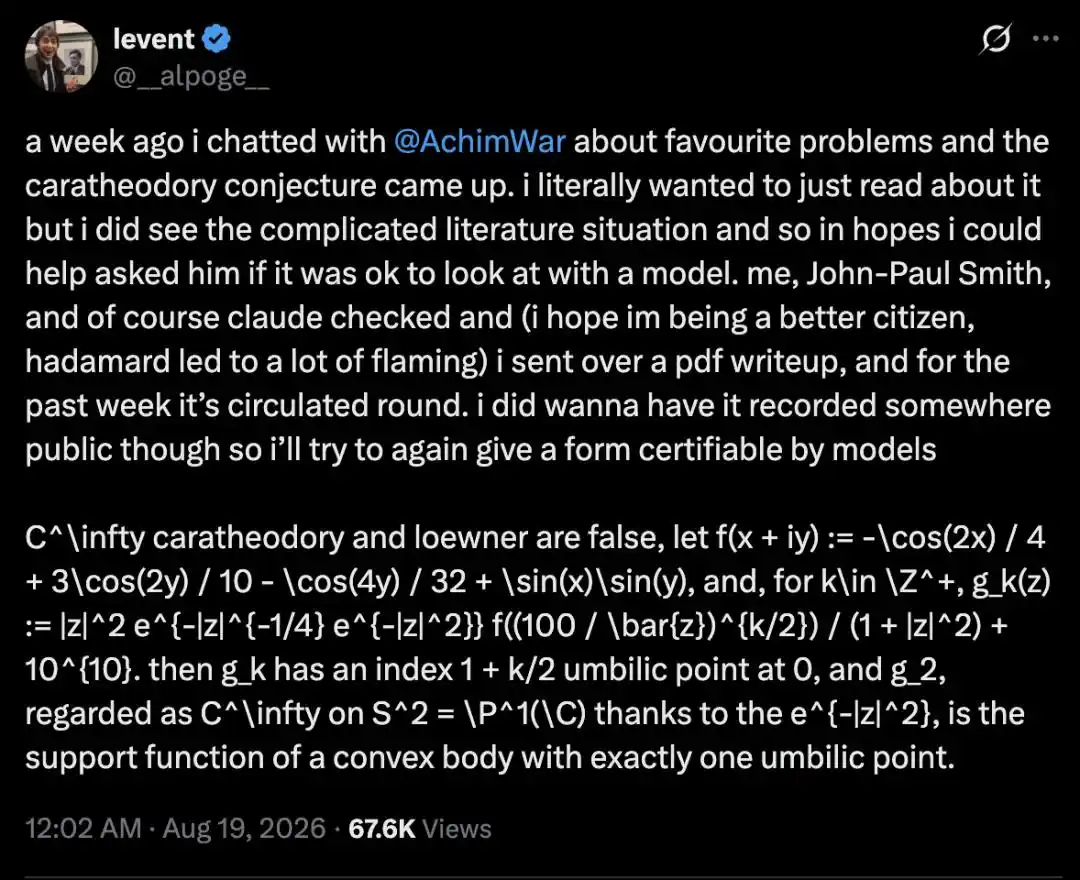
This is not the first time Alpöge has teamed up with Claude to shake things up. During the World Cup this year, he proposed a counterexample to the 3-dimensional Jacobian conjecture, sending shockwaves through the mathematical community.

What Exactly is This Century-Old Conjecture About?

First, let's talk about the Carathéodory conjecture itself.

In 1924, German mathematician Hans Ludwig Hamburger proposed the Carathéodory conjecture in differential geometry, naming it after his doctoral advisor, the Greek mathematician Constantin Carathéodory.

The conjecture states that any convex, closed, and sufficiently smooth surface in three-dimensional Euclidean space must have at least two umbilic points.
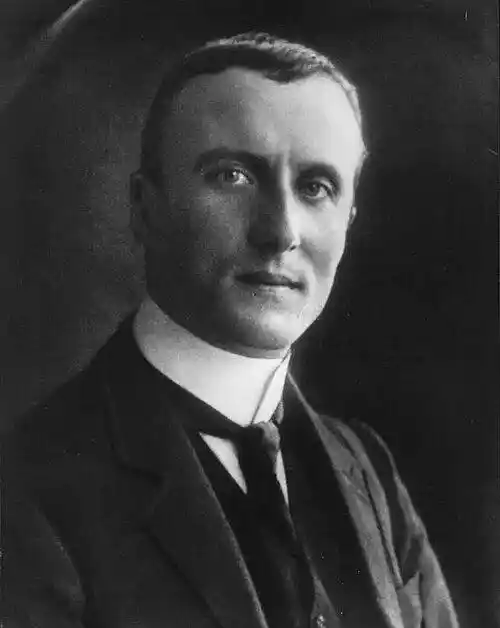
Constantin Carathéodory

The conjecture is extremely concise but notoriously difficult to prove: any sufficiently smooth closed convex surface must have at least two 'umbilic points'.

Umbilic points can be understood, in simple terms, as points on a surface where the 'curvature is exactly the same in all directions'.

In the differential geometry of surfaces in three-dimensional space, an umbilic point is a point on a surface where it locally resembles a sphere; all normal curvatures are equal at that point, meaning the two principal curvatures are equal, and every tangent vector is a principal direction.

Every point on a sphere is an umbilic point—no matter which direction you move, the curvature feels the same.

Carathéodory asserted: no matter how you shape or deform it, as long as this convex surface is sufficiently smooth, you cannot reduce the umbilic points to just one. At least two must remain.

This conjecture seems intuitively 'correct'.

A sphere has infinitely many umbilic points, an ellipsoid has two.
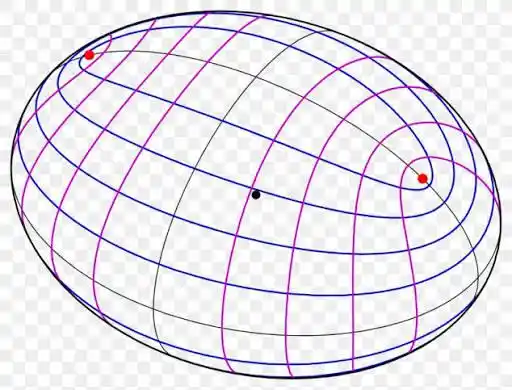
For a hundred years, countless mathematicians tried, but no one could construct a smooth convex body with only one umbilic point.

Parallel to this was the Loewner conjecture—that the index of an isolated umbilic point does not exceed 1. The two conjectures supported each other, for a century locking away an entire domain of differential geometry like a pair of iron locks.

Now, the lock has been pried open. This discovery shows that if a convex surface is too smooth (mathematically called C∞, infinitely differentiable), Levent Alpöge found a convex surface with only one umbilic point.

One Counterexample, Two Conjectures Fall Simultaneously

Alpöge and John-Paul Smith provided an extremely specific construction.

They defined a family of functions g_k, where for k=2, the function g2 serves as the support function for a sphere-like surface, producing a convex body with an umbilic point of index 2 at the origin.
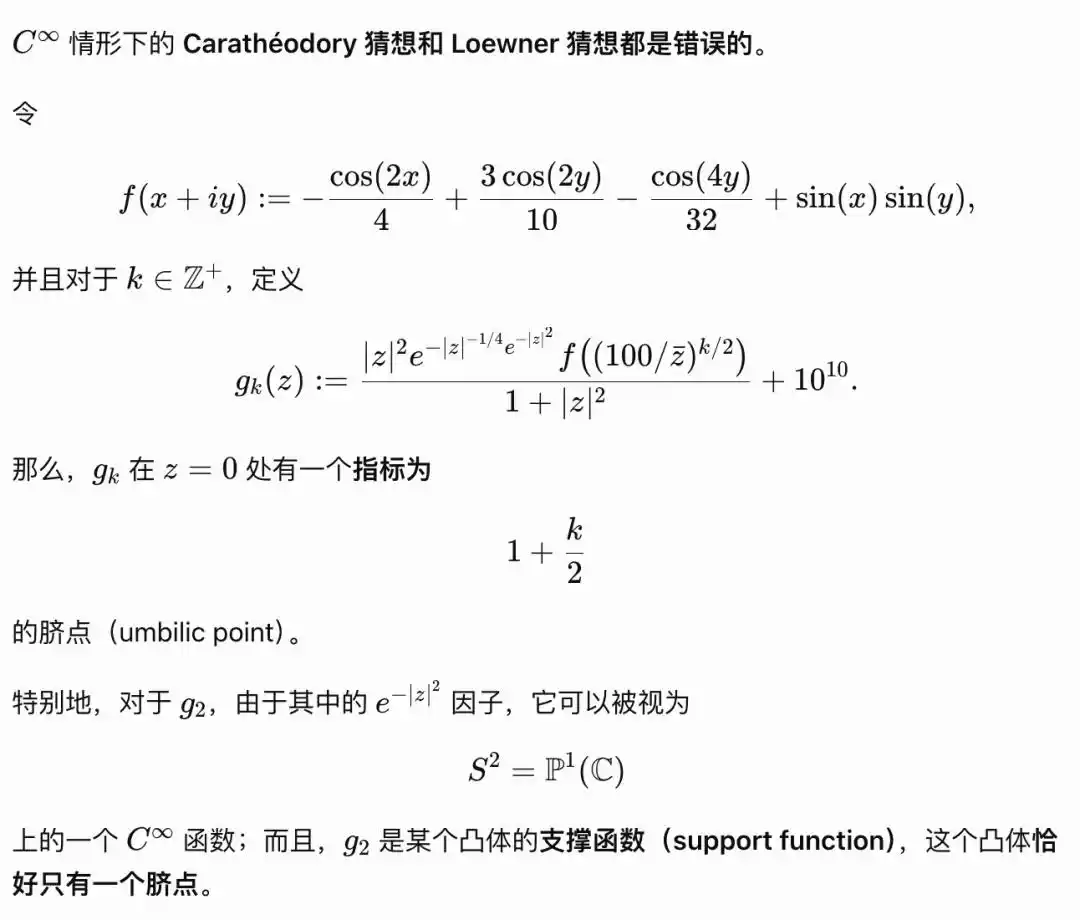
Note that an index of 2 already directly violates the Loewner conjecture's upper bound of 1.
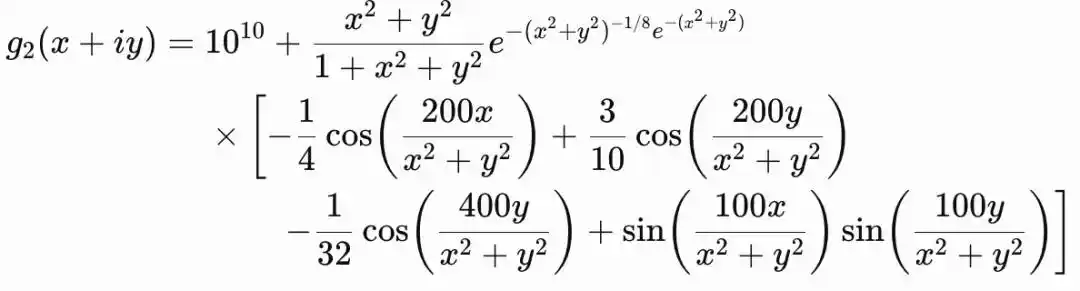
More crucially, due to the presence of an exponential decay term, g2 is mathematically guaranteed to be C∞ smooth—meaning this convex body satisfies all the smoothness conditions required by the Carathéodory conjecture.

But it has only one umbilic point.
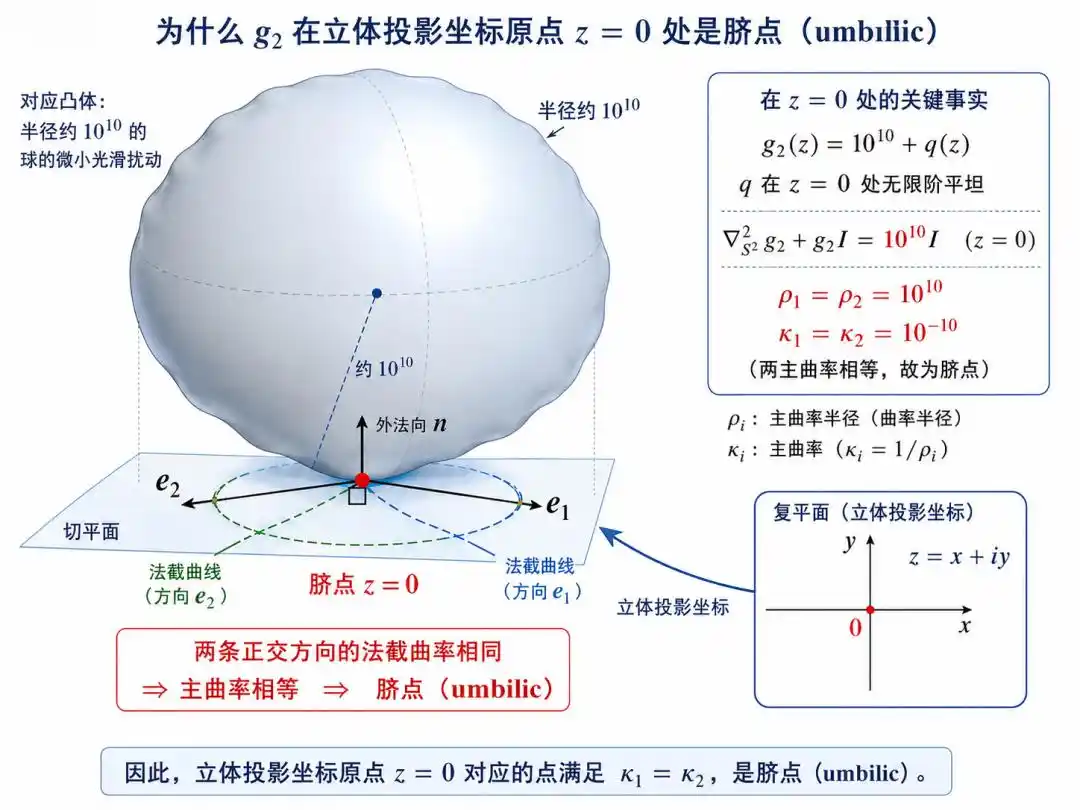
The Carathéodory conjecture requires at least two umbilic points, but the counterexample has one, thus disproving the conjecture.
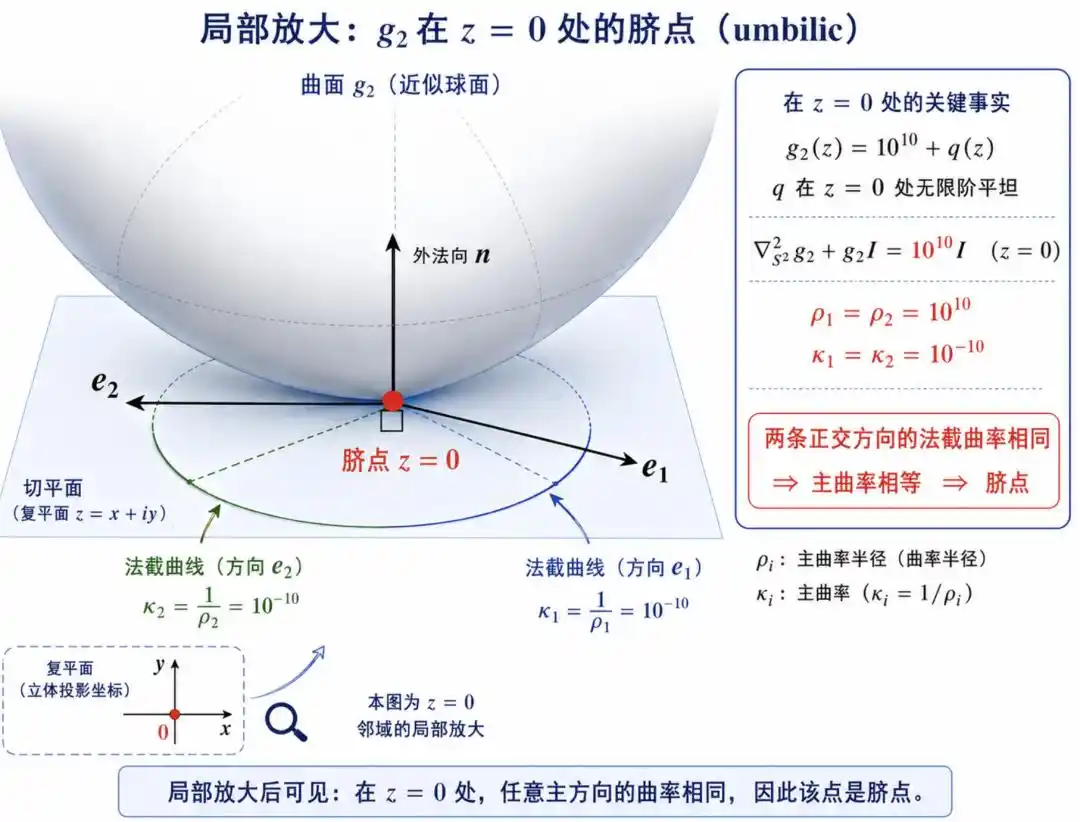
The Loewner index conjecture requires the index of an umbilic point to be 1, but this one is 2, disproving it as well.

An explicit, verifiable counterexample has taken down two conjectures that survived for over a century.

In mathematics, disproving a conjecture requires only one counterexample. But finding that counterexample can be harder than proving the conjecture itself.

The New Normal in Mathematics

Looking back over the past few months:

Claude's new record on the Riemann Hypothesis—raising the lower bound for the proportion of zeros from 41.6% to 67.2%, whereas humans had only advanced it by 0.8% in 37 years.

OpenAI's concentrated release of 10 advancements in mathematics and theoretical computer science.

Alpöge continuously using Claude to disprove several classic conjectures.

A newly crowned Fields Medalist announcing they are joining OpenAI.

A new trend is emerging.

AI is no longer just a mathematician's calculator. It is becoming a mathematician's 'intuition amplifier'—opening new pathways with its exhaustive search and construction capabilities in areas where human intuition fails.

A century-old conjecture was not shattered by superior human intellect. It was shattered by a brand new paradigm of human-machine collaboration.

This paradigm will continue to shatter more conjectures. The only question is: which one will fall next?

References:

https://x.com/haider1/status/2090034966717677902

https://x.com/alpoge/status/2089971359921156203

https://en.wikipedia.org/wiki/Carath%C3%A9odory_conjecture

This article is from the WeChat public account "New Zhiyuan", author: ASI Revelation

Related Questions

QWhat was the main mathematical discovery announced in the article?

AThe main discovery is the explicit construction, by Levent Alpöge and John-Paul Smith with assistance from Claude, of a counterexample that disproves two long-standing mathematical conjectures: the Carathéodory conjecture and the Loewner index conjecture.

QWhat does the Carathéodory conjecture state about umbilical points on convex surfaces?

AThe Carathéodory conjecture, proposed in 1924, states that any smooth, closed, convex surface in three-dimensional Euclidean space must have at least two umbilical points. An umbilical point is a point where the surface is locally spherical, meaning all directional curvatures are equal.

QHow does the constructed counterexample specifically contradict the Carathéodory and Loewner conjectures?

AThe constructed counterexample is a convex body defined by the function g₂. It is C∞ smooth (infinitely differentiable), satisfying the conditions of Carathéodory's conjecture, yet it has only one umbilical point instead of the required two. Furthermore, this single umbilical point has an index of 2, which directly violates the Loewner conjecture's claim that the index of an isolated umbilical point cannot exceed 1.

QWhat role did Claude (the AI) play in this mathematical breakthrough according to the article?

AAccording to the article, Claude acted as an 'intuition supplementer' for mathematician Levent Alpöge. It helped by providing brute-force search and construction capabilities, opening new paths in areas where human intuition had previously failed, which was instrumental in finding the counterexample.

QBeyond this recent discovery, what other significant mathematical achievement involving AI does the article mention?

AThe article mentions that Claude was also involved in a new record for the Riemann Hypothesis, improving the lower bound for the proportion of zeros on the critical line from 41.6% to 67.2%. It also notes a series of recent advances, including OpenAI releasing 10 developments in mathematics and theoretical computer science, and a newly crowned Fields Medalist announcing they would join OpenAI.

Related Reads

Musk Awaits $50 Trillion: Is There a Limit to the U.S. National Debt and What Comes Next?

Elon Musk reacted to a projection of US national debt reaching $50 trillion by 2030, labeling it a "precise timeline" with a laughing emoji. The debt has recently passed the $40 trillion mark. Skeptics note that specific debt thresholds have been breached before without immediate collapse. However, analysts warn the focus should shift from the nominal debt amount to its affordability. A key metric is when the average interest rate on the debt exceeds the economy's growth rate, a point the US Congressional Budget Office projects for 2031. Once this "debt spiral" begins, interest costs grow self-reinforcing. Currently, interest payments have already surpassed defense spending, exceeding $1 trillion annually. Ray Dalio warns a debt crisis could occur within "three years, plus or minus two," advising portfolio diversification into gold and some Bitcoin. Potential outcomes if debt becomes unmanageable include: 1) Financial repression and monetization (the "Japanese path" of controlled yields and inflation), seen as the most likely; 2) Severe austerity (the "Greek path" of spending cuts/tax hikes), considered politically unlikely; or 3) Technical default/restructuring, which would cause global financial shock. The most probable path is a hybrid of moderate financial repression and gradual inflation, leading not to a sudden crash but to long-term economic stagnation and a declining standard of living. By 2056, debt could reach 175% of GDP. Ultimately, the limit for US debt is not a fixed number but a function of market confidence in the dollar.

cryptonews.ru1h ago

Musk Awaits $50 Trillion: Is There a Limit to the U.S. National Debt and What Comes Next?

cryptonews.ru1h ago

Solana Developer Mert Mumtaz Highly Praises Altcoin!

In the world of cryptocurrencies and finance, where privacy is a major focus, significant developments are underway. Valor Group founder Dev and notable crypto ecosystem figure Mert Mumtaz participated in a program on The Rollup crypto broadcasting platform, discussing the latest developments for the Zcash (ZEC) network and its important future roadmap. The conversation covered network scalability, security updates, and measures taken against quantum threats. The recent Ironwood update implemented in the Zcash network is considered a crucial milestone for the project. During the event, Mert highlighted that internal security audits using 'red team' methods and AI identified a potential vulnerability in the Orchard pool that could have allowed the creation of counterfeit notes. Extensive work and formal verification proved the code mathematically perfect according to specifications. The seamless migration of funds from the Orchard pool to the new Ironwood pool has completely eliminated the risk of counterfeit coin creation in the network. Dev shared important technical details about Zcash's future vision, emphasizing that Valor Group's main goal is for Zcash to achieve transaction volumes comparable to credit cards. He stated they aim to process over 50,000 transactions per second with sub-second latency while maintaining the full proof-of-work mechanism. The main scaling bottleneck was identified not as the nodes themselves, but wallet scanning processes. A new wallet architecture and synchronization delay optimization are expected to resolve this issue. The upcoming Tachion update promises to provide complete protection for Zcash against quantum computing threats. This update will integrate recursive zero-knowledge proofs into the network. It is reported to reduce transaction sizes by more than five times, eliminate node data processing overhead, and address state growth issues. With Tachion, the network is claimed to achieve not just 'quantum-resilient' but a truly 'quantum-secure' privacy structure.

cryptonews.ru1h ago

Solana Developer Mert Mumtaz Highly Praises Altcoin!

cryptonews.ru1h ago

Trading

Spot
活动图片