After Falsifying Revenue, Why Did This CEO Choose a 'No Pants' Response?

比推Published on 2026-03-11Last updated on 2026-03-11

Abstract

CEO Roy Lee, founder of AI startup Cluely, responded to accusations of inflating revenue figures not with a traditional apology, but with a deliberately absurd video performance. After being accused of falsely claiming $7M in annual recurring revenue in a TechCrunch interview, Lee first admitted to casually providing the number, then released a video where he appeared professionally dressed from the waist up—only to stand up and reveal he was not wearing pants. The company, which began by creating an AI-powered interview cheating tool and was co-founded after Lee was expelled from Columbia University, has consistently leveraged controversy as a core growth strategy. Rather than mitigating the scandal, Lee turned it into a viral moment, echoing a broader trend in tech and crypto where attention itself is monetized. Major investor a16z has backed Cluely, with partners arguing that in an era of commoditized AI models, viral storytelling and public attention are the new moats. Lee’s response exemplifies how some founders now treat controversy not as risk, but as fuel for growth.

Author: DingDang

Original Title: CEO Uses Humor to Respond to Crisis, AI Entrepreneurs Steal Crypto's Marketing Playbook


In most startups, if exposed for 'falsifying revenue,' it would likely lead to a PR crisis—issuing a statement, explaining the misunderstanding, correcting data metrics, apologizing, and then steering the conversation back to product or business growth.

But Cluely's CEO Roy Lee clearly had no intention of doing that.

A Company That Started with a 'Cheating Tool'

Cluely was founded in 2025, and its initial product came from a project called Interview Coder, developed by Roy Lee and his college roommate Neel. This was a tool that used AI to help users cheat in LeetCode interviews. Due to this project, both were eventually expelled from Columbia University.

For most people, being expelled from school would be a black mark to cover up. But Roy Lee turned this incident into a marketing opportunity, even a 'turning point in life.'

Cluely's initial product slogan was: 'Cheat on Everything.' It wasn't until November 2025 that Cluely began shifting its product narrative from a 'cheating tool' to an AI note-taking assistant, such as using AI to automatically organize meeting content, optimize collaboration efficiency, and even modify attendees' expressions to hide distractions. But no matter how the product evolved, the company, or rather, its CEO, never shook off a very distinct vibe: it almost grew through controversy.

And the ensuing storm, in a way, continued down this path.

A Farce Triggered by 'Falsified Revenue'

The incident began when someone dug up a July 2025 report by TechCrunch. The article mentioned that Cluely's Annual Recurring Revenue (ARR) had doubled in a week, reaching $7 million. This data was questioned as fraudulent.
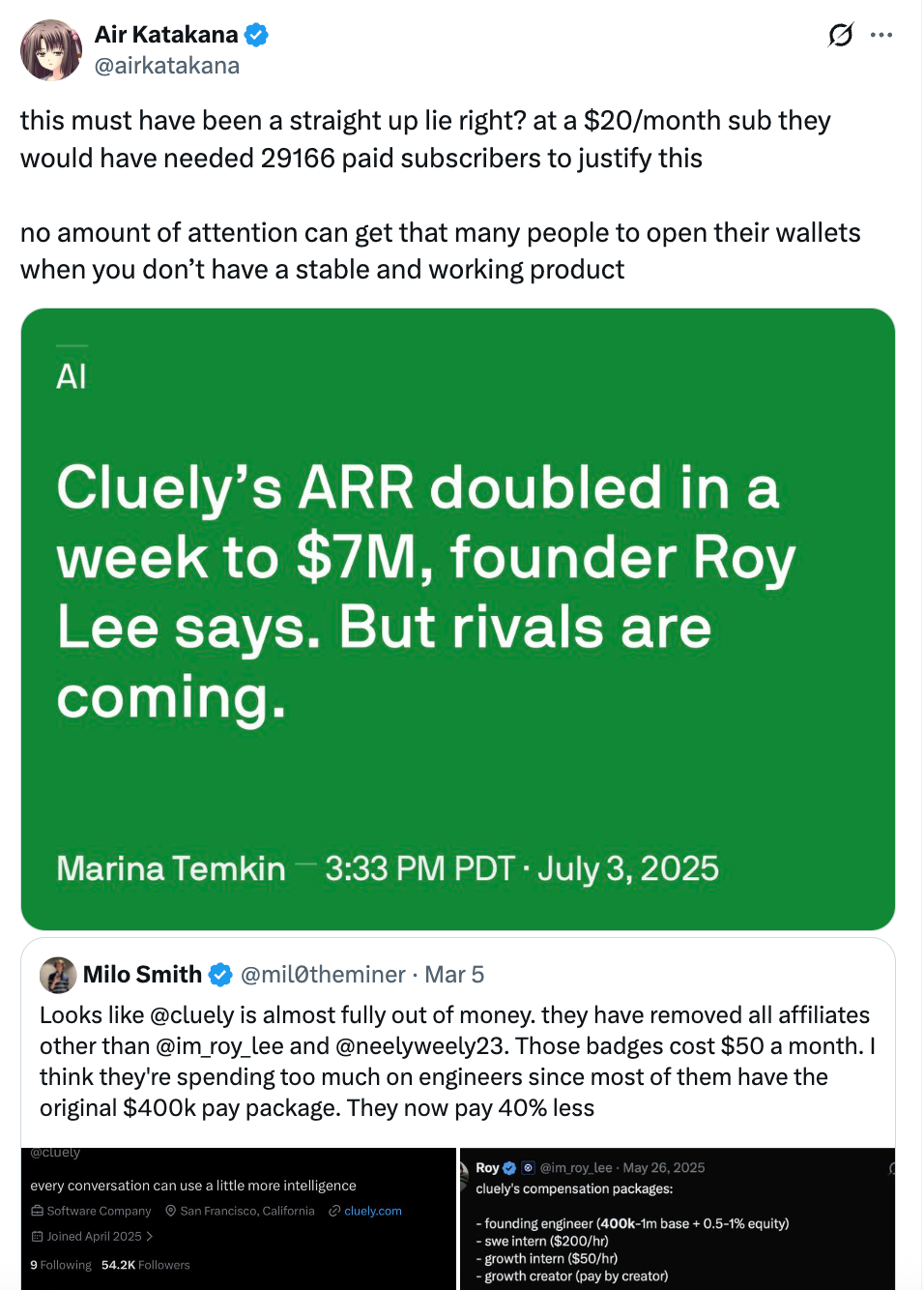
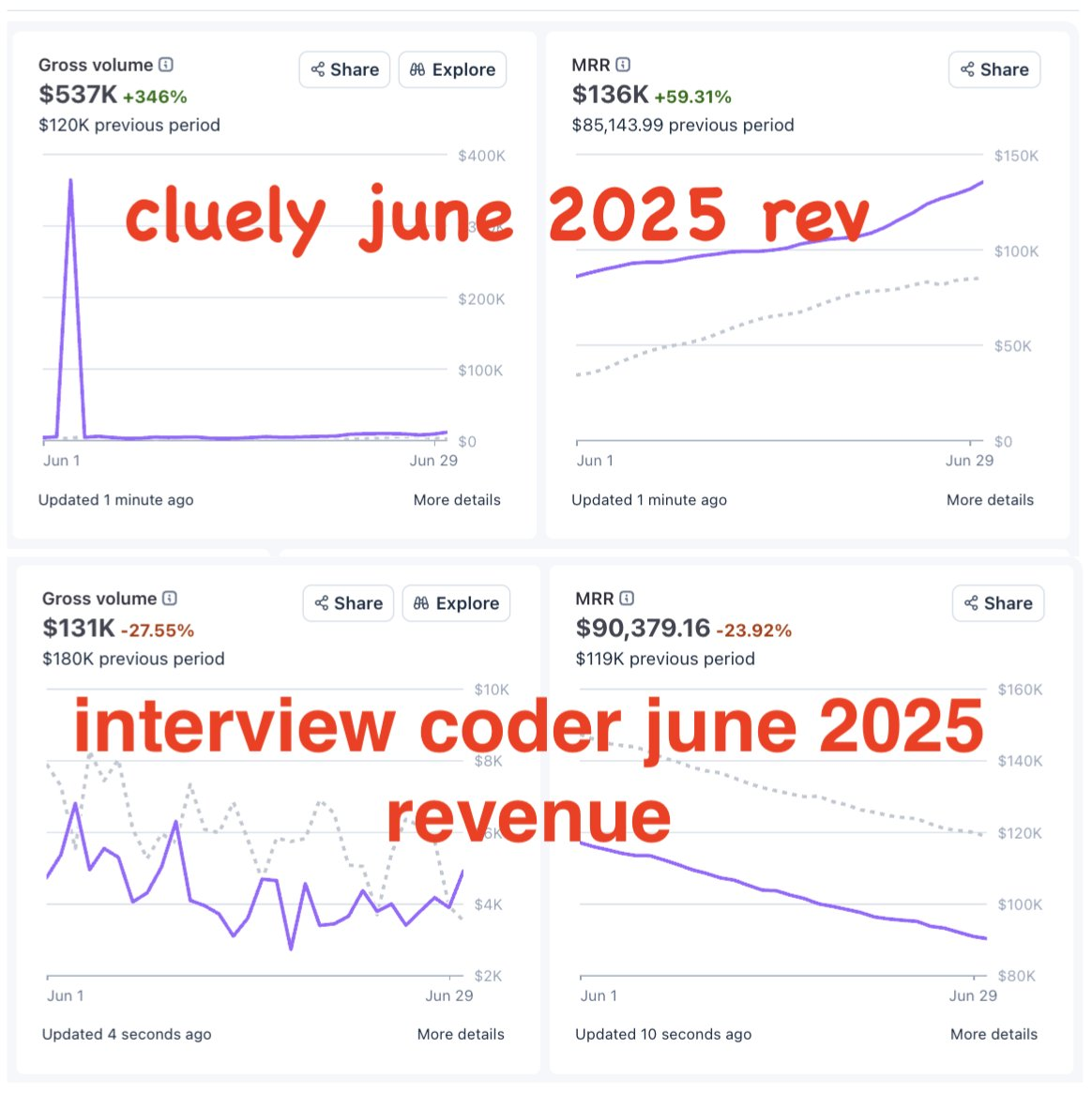
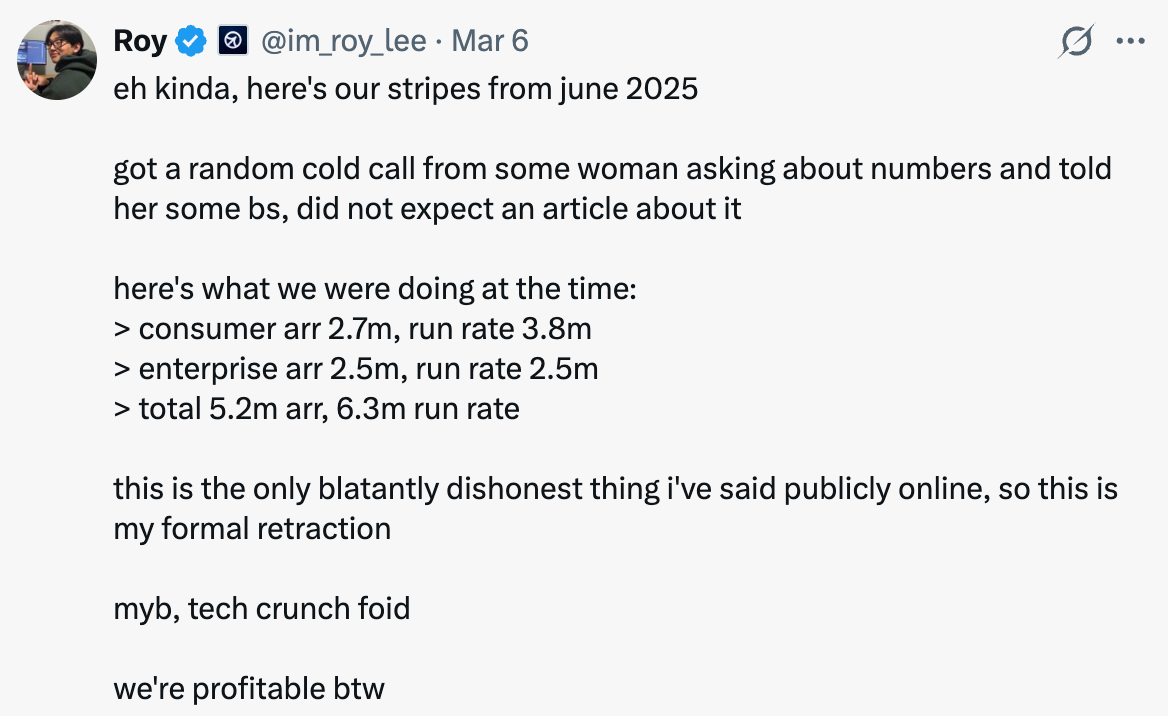
Facing the质疑, Cluely CEO Roy Lee was quite candid. He quickly posted to admit that he had casually mentioned the number when a reporter called him, not expecting it to be included in a formal article. Seemingly to prove it wasn't an intentional exaggeration, he also posted Cluely's actual data from June 2025: consumer business annual revenue of $2.7 million and enterprise business annual revenue of $2.5 million, totaling $5.2 million.

Up to this point, there was nothing sensational, and the explanation was plausible.
But on the same day, TechCrunch reporter Julie Bort published a rebuttal to Roy's claim. She stated that the interview was arranged proactively by Cluely's PR team, was documented, and was not a casual chat.

Roy Lee didn't continue with a written explanation but chose a more dramatic way to respond. He released a video with the caption, 'Breaking News: Cluely CEO Officially Responds to TechCrunch.'

In the video, he sat in front of the camera wearing sunglasses and a suit, with a microphone on the desk, looking as if he was about to make a serious statement. But the setting wasn't an office; it looked more like a living room, with an old desktop computer next to him playing Subway Surfers—a classic time-wasting game. Roy's response was also completely informal, more like a self-deprecating performance, mixed with self-mockery and bragging, his tone reminiscent of a rapper freestyling.

Even more absurdly, at the end of the video, he stood up from behind the desk, revealing that this CEO, formal from the waist up, was wearing no pants......
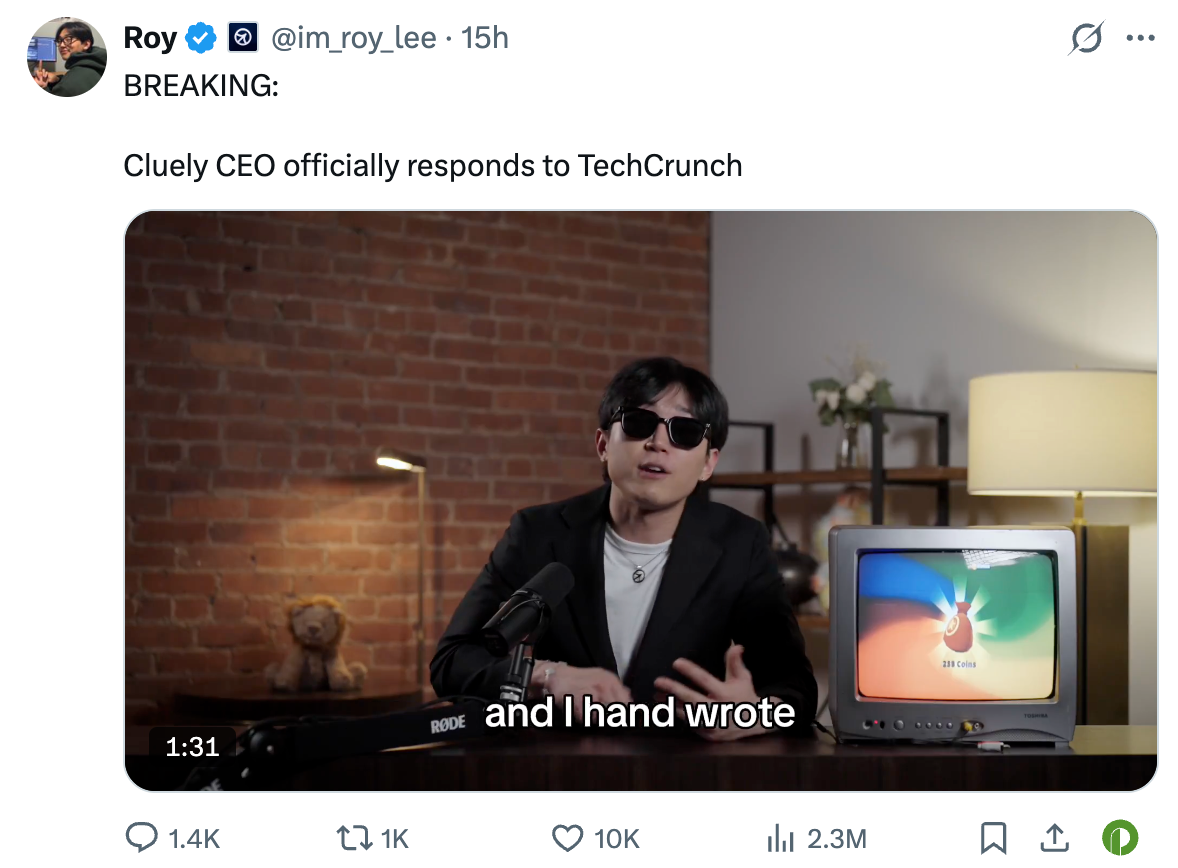
Thus, a crisis PR situation originally about 'falsified revenue' was handled as a traffic-grabbing, self-mocking performance.

What a16z Is Betting On Is Actually the Attention Economy

The capital market doesn't seem to mind this kind of performative founder personality either. In June 2025, Cluely announced the completion of a $15 million Series A funding round, with participating institutions including the renowned venture capital firm Andreessen Horowitz (a16z). Its partner Bryan Kim once mentioned on a podcast: In the AI era, the traditional 'artisan product + slow growth' model is no longer sufficient; viral spread itself is part of the product.

What he considers the 'new AI startup template' is that in an era where model capabilities are increasingly commoditized, attention itself is becoming a key resource. Whoever can capture user attention first may build a new moat.

From the 'cheating controversy' of Interview Coder, to the entrepreneurial story of being expelled from Columbia, to this absurd 'response video,' Roy Lee's entire personal brand has been built along this path: controversy itself is the content for propagation. This might also explain why a16z chose to invest in Cluely, to invest in Roy Lee.

When Controversy Becomes a Growth Strategy

In past entrepreneurial narratives, growth typically came from product capability, technological barriers, and business models. But in today's internet environment, another resource is becoming increasingly important—attention.

This logic has actually been proven in the crypto industry long ago. Many crypto projects capture user attention by creating topics, controversies, or even dramatic events, and then convert this traffic into product growth or commercial value, especially with the rise of Memes—pure propagation, no (traditional) product.

In a way, Roy Lee's response video is a classic case of this logic: when negative news emerges, rather than trying to suppress the controversy, repackage the controversy itself as传播 content.

Evidently, in the current internet environment, attention is often more valuable than explaining the truth.


Twitter:https://twitter.com/BitpushNewsCN

Bitpush TG Discussion Group:https://t.me/BitPushCommunity

Bitpush TG Subscription: https://t.me/bitpush

Original link:https://www.bitpush.news/articles/7618818

Related Questions

QWhat was the initial product developed by Cluely's CEO and co-founder, and what was the consequence of its creation?

AThe initial product was Interview Coder, an AI tool designed to help users cheat on LeetCode coding interviews. As a result, both Roy Lee and his roommate were expelled from Columbia University.

QHow did Cluely's CEO, Roy Lee, respond to the allegations of falsifying revenue reported by TechCrunch?

ARoy Lee first admitted in a post that he had casually provided the number during a call with a journalist without expecting it to be published. He then released a satirical video response where he appeared professionally dressed from the waist up but was not wearing pants, turning the crisis into a performance to attract attention.

QWhich prominent venture capital firm invested in Cluely's Series A funding round, and what was their stated reasoning for such investments in the AI era?

AAndreessen Horowitz (a16z) participated in Cluely's $15 million Series A funding round. Their partner, Bryan Kim, stated that in the AI era, viral marketing itself is part of the product, and capturing user attention is a critical resource for building a moat.

QAccording to the article, what is the 'new AI startup template' that Cluely's strategy exemplifies?

AThe 'new AI startup template' is one where, in an era of increasingly commoditized model capabilities, attention itself becomes a key resource. The strategy involves generating controversy and using viral, dramatic events to capture user attention and drive growth, rather than relying solely on traditional product capability or technological barriers.

QHow did the company's product narrative evolve from its origins to late 2025?

AOriginally promoted with the slogan 'Cheat on Everything' as a tool for cheating, the company began shifting its product narrative in November 2025 towards an AI note-taking assistant. This new focus included features like automatically organizing meeting content, improving collaboration efficiency, and even modifying attendees' expressions to hide distraction.

Related Reads

The Gold Buy-on-the-Dip Guide: Watch Interest Rates, Not Just War

"Gold Buying Guide: Focus on Interest Rates, Not Just War" Four months ago, gold buyers likely didn't anticipate buying at a peak that even a war couldn't sustain. After hitting a record high of $5,596 on January 29, gold entered a bear market just 91 days later, its fastest decline since 2008. A key trigger was the Fed's hawkish shift, highlighting that monetary policy, not geopolitics, is the primary driver. The article argues that the traditional "buy gold in turmoil" script has changed. While the US-Iran conflict initially boosted prices, the sustained rally in oil prices heightened inflation fears, forcing central banks to maintain or consider tighter policy. Since gold yields no interest, higher rates increase its opportunity cost, eroding its appeal. This dynamic was evident when gold fell sharply on May 18 despite positive peace talks, as lower oil prices eased inflation and thus rate hike pressures. The recent sell-off is also part of a broader market deleveraging. Correlations between gold, Nasdaq, and Bitcoin spiked as leveraged investors sold liquid assets to cover losses, creating a synchronized downturn. Historically, gold bottoms align with policy shifts, not conflict resolutions. The 2008 and 2022 bear markets ended with shifts to extreme easing and peak inflation expectations, respectively. For potential buyers, the author suggests monitoring three signals: 1) Peak interest rate hike expectations, 2) Reopening of the Strait of Hormuz (to ease oil/inflation pressure), and 3) A return to net inflows for Gold ETFs, indicating the end of forced selling. While predicting the exact bottom is impossible, the author's personal strategy involves scaling into a position across price levels like $4000, $3700, and $3500, committing no more than 30% of the intended total allocation initially, and adding the remainder only if key signals emerge. The core conclusion: In turbulent times, watching interest rates is more crucial than watching wars.

marsbit9m ago

The Gold Buy-on-the-Dip Guide: Watch Interest Rates, Not Just War

marsbit9m ago

Recent On-Chain Review: No Clear Narrative Under U.S. Stock Market Pressure, Just Hype

This article analyzes the current state of the Solana meme coin and community token ecosystem, highlighting a market caught between two dominant forces: attention-based PvP and a gradual return to community-centric projects. The first part explores the "Attention PvP" dynamic, where success is driven by celebrity endorsements, viral events, and speed. Examples include $JOTCHUA, which surged after its meme creator's social media activity, and $WORLDCUP, which outperformed a similar Base chain project ($PITCH) largely due to influencer support. The recent "pump.fun GO" feature, allowing bounty tasks for token promotion, is critiqued for fostering sensationalist and often negative stunts—like people getting token tickers tattooed on their bodies for rewards—reminiscent of old internet shock content. In contrast, the article points to a resurgence of organic, community-driven tokens that survive market volatility through strong holder bases and shared ideology, not just hype. Influencer Ansem is cited, arguing that durable meme coins rely on communities willing to endure losses and promote their core message daily. Examples given are older tokens like $neet (anti-work ethos), $troll, $buttcoin, and $triplet, which have maintained relative price stability. A prime example of this community-build model is the new project $KINS, the token for the browser-based MMORPG Kintara. Its success stems not from advanced graphics but from consistently delivering updates, fostering player trust, and creating genuine engagement (e.g., in-game economies, events, property auctions). It has attracted a growing player base and even notable KOLs as participants, demonstrating that sustainable growth can come from building trust rather than orchestrating pumps. The article concludes by questioning whether the market is ultimately a game of mutual trust or mutual deception, expressing hope that such reflection might lead to a healthier ecosystem.

marsbit9m ago

Recent On-Chain Review: No Clear Narrative Under U.S. Stock Market Pressure, Just Hype

marsbit9m ago

On-Chain Scene on Opening Day: $20 Billion Already Staked, How Do On-Chain Contracts Know Who Wins?

On the opening day of the 2026 World Cup, over $2 billion had already been wagered on just the "tournament winner" contracts on platforms like Polymarket and Kalshi. This article explores how these blockchain-based prediction markets actually function once the games begin. It breaks down the massive volume and explains how single-game and tournament-long contracts are priced, with values moving between 1-99 cents to reflect implied probabilities. A key mechanism highlighted is "elimination zeroing," where a team's "champion yes" contract immediately settles to zero once they are mathematically eliminated. The core technical question answered is: how does a smart contract "know" who won a real-world match? The answer lies in oracles. The article details two primary paradigms: UMA's "optimistic oracle" (used by most of Polymarket), which allows a challenge period after a proposed result, and Chainlink's multi-source data aggregation (used by FIFA partners like ADI Predictstreet), which automates settlement with minimal dispute windows. Finally, the article injects a note of caution, citing research estimating that a significant portion of historical trading volume on these platforms might be "wash trading" to inflate numbers. It concludes by contrasting the legal status of these "event contracts" under CFTC rules in the U.S. versus traditional, state-regulated sports betting. As the tournament progresses, the real-time operation of this multi-billion dollar machine—its settlements, eliminations, and underlying mechanisms—becomes a story as compelling as the football itself.

marsbit24m ago

On-Chain Scene on Opening Day: $20 Billion Already Staked, How Do On-Chain Contracts Know Who Wins?

marsbit24m ago

Sequoia Dialogue with Jensen Huang: Computing Model Undergoes a 60-Year Transformation; You Won't Be Replaced by AI, But You Will Be Dimensionality-Reduced by 'Those Who Master AI'

NVIDIA founder and CEO Jensen Huang, in a conversation with Sequoia Capital's Konstantine Buhler, argues that we are witnessing the most significant computing shift in 60 years—from retrieval-based to generative computing. Instead of just storing and retrieving data, future systems will generate highly personalized content (text, images, video) on demand, powered by massive "AI factories." Huang envisions a global "intelligence network" that will envelop the planet, following the historical patterns of energy and communication grids. He outlines a five-layer investment framework: 1) Energy, 2) Chips/Computers, 3) Infrastructure (data centers), 4) AI Models, and 5) Applications. He predicts this ecosystem will reach a scale of $20 trillion annually. Crucially, Huang pushes back against fears of AI-driven job loss. He distinguishes between specific "tasks" (e.g., typing, analyzing images) and overall "jobs" (e.g., CEO, radiologist). While AI automates tasks, it increases efficiency and demand for the higher-value problem-solving aspects of professions, thus creating more jobs and "up-leveling" careers. The real risk, he asserts, is not being replaced by AI, but being outperformed by someone who effectively leverages it. He urges everyone to embrace AI as a tool for augmented capability and innovation.

marsbit1h ago

Sequoia Dialogue with Jensen Huang: Computing Model Undergoes a 60-Year Transformation; You Won't Be Replaced by AI, But You Will Be Dimensionality-Reduced by 'Those Who Master AI'

marsbit1h ago

Trading

Spot
Futures
活动图片