After being noticed by IBM, the token of three.ws surged 50 times

foresightnews_apiPublished on 2026-06-05Last updated on 2026-06-05

Abstract

IBM's public acknowledgment and collaboration with Solana AI project three.ws sparked a massive 50x surge in its $THREE token. Three.ws is building a "3D Agent Layer" for the internet, aiming to move AI beyond chat interfaces into interactive 3D digital characters that can be embedded on websites. These agents possess bodies (3D models), brains (LLMs), memory, skills, and optional on-chain identities and wallets for payments. The platform's architecture consists of four layers: a Viewer layer for 3D rendering, an Agent layer for AI behavior and skills, an optional Identity layer for persistent profiles, and an Embedding layer for deployment. For monetization, developers can set per-use fees for agent interactions, paid in USDC via the x402 protocol. Key to its enterprise strategy are partnerships with IBM and AWS. Integration with AWS Marketplace provides enterprise billing and deployment channels, while the IBM collaboration aims to combine three.ws's 3D agents with IBM's enterprise AI, cloud services, and Granite models. The challenge remains whether businesses will adopt these embodied AI agents and what utility the $THREE token will ultimately hold within the ecosystem.


Author: KarenZ, Foresight News


A piece of news about an IBM collaboration quickly brought the Solana ecosystem project three.ws into market view, and its token three soared 50 times.


The immediate catalyst for the price surge came from IBM. On the evening of June 1 and early morning of June 2, IBM's official Twitter account responded twice to related content about the collaboration posted by three.ws.


During the news dissemination, the three.ws token three experienced rapid growth. According to GMGN data, the market cap of three rose from around $300,000 before IBM's response to a high of $16.38 million on June 4, representing a surge of up to 53 times. Currently, the market cap of three fluctuates around $13 million.
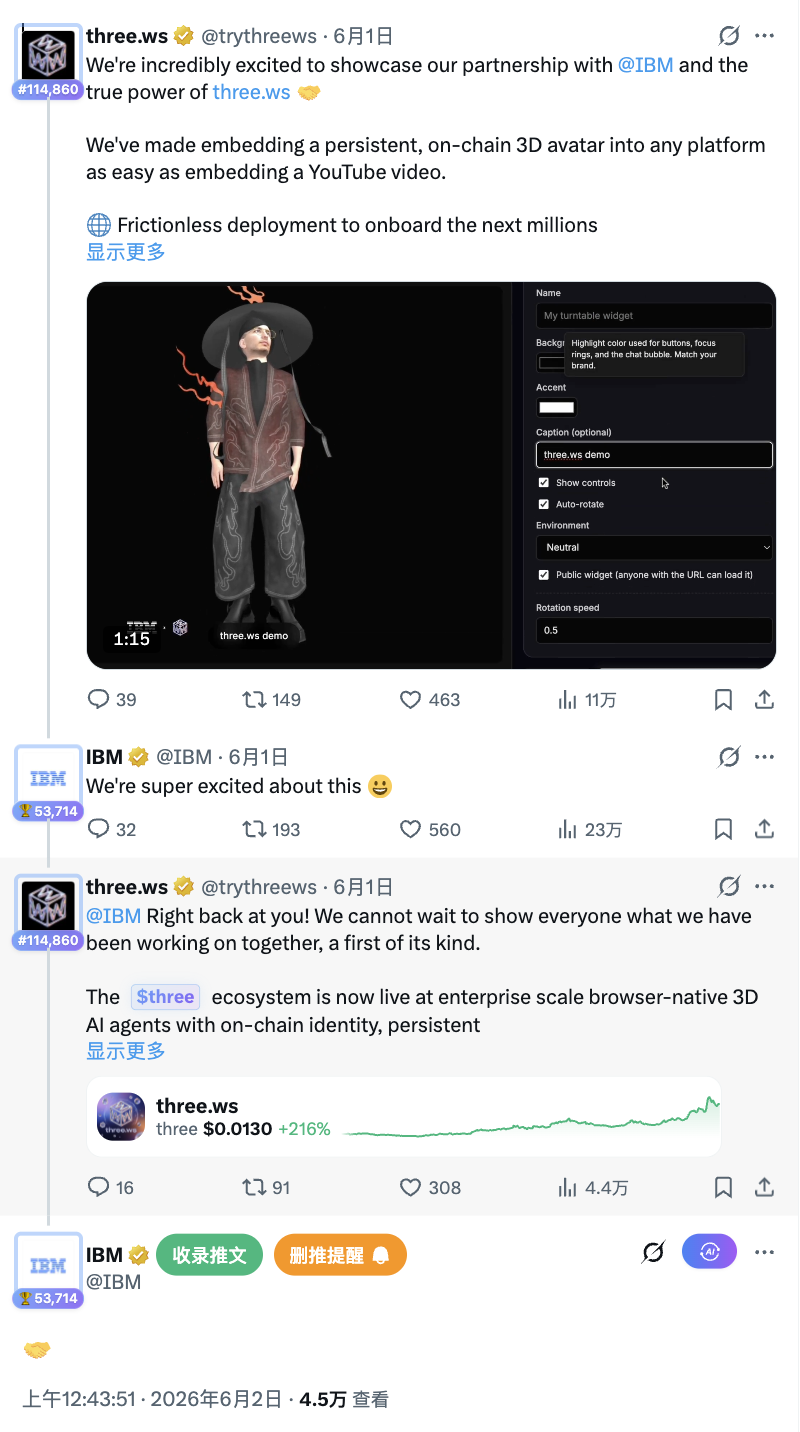


It is evident that this was not a sustained rally starting from the token's issuance. three was launched on the Solana chain as early as late April, with the main price increase concentrated around the time of IBM's public responses and the collaboration announcement.


However, understanding three.ws solely as a Solana AI project backed by an IBM collaboration overlooks the real problem it aims to solve: most AI Agents still reside within chatboxes and background programs, invisible to users and difficult to identify, own, or invoke across different websites, devices, and on-chain environments.


three.ws hopes to equip AI Agents with a body, memory, identity, wallet, and distribution channels, transforming them into 3D digital characters that can appear on web pages, perform actions, and execute transactions.


Releasing AI from the Chatbox onto the Web Page


three.ws defines itself as the "3D Agent Layer" for the internet. Its founder, @nichxbt, currently has over 20,000 followers on Twitter and holds a blue verification checkmark.


The project is currently listed on the AWS Marketplace and Alibaba Cloud International Marketplace and has joined the Google Cloud for Web3 Startups program. three.ws is also included in the Anthropic official MCP Registry, is a W3C contributor, and was a participant in the Solana Frontier Hackathon.


Based on the project's existing code and documentation, three.ws's foundational capabilities include loading, inspecting, and displaying 3D models on the web client, subsequently integrated with large language models, memory, voice, skills, on-chain identity, and payment functionalities.
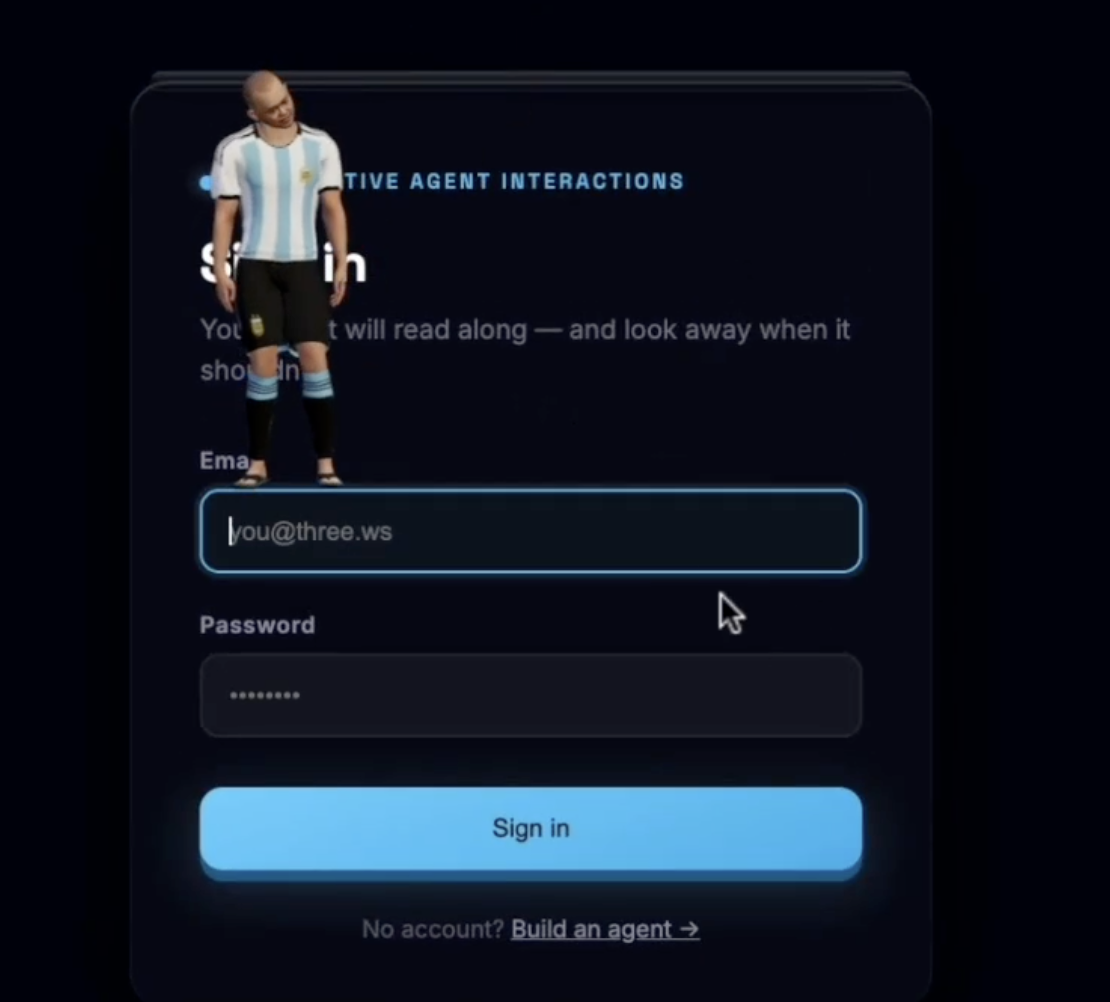

In simple terms, developers can create a 3D character on the platform, connect it to a large language model, memory system, voice, and skills, and then embed it into a website via a web component.


For example, businesses could deploy a 3D shopping guide Agent on a product page to introduce items, answer questions, and demonstrate product features through actions. Developers can also build digital customer service agents, virtual teachers, game characters, or personal AI assistants.


This process is somewhat similar to embedding a YouTube video. Developers don't need to build complex 3D pages separately; after adding the component and Agent ID, users can see and interact with the Agent in their browser.


three.ws offers multiple ways to create characters. Users can upload a selfie to generate an animatable 3D avatar in about 60 seconds; they can also generate models from text or images, upload their own GLB or glTF files, or use the character editor for creation.


Once the character is generated, developers can configure different large language models, voices, and skills for it.


three.ws also integrates on-chain capabilities for Agents. An Agent can own a Solana wallet, pay USDC for premium APIs via the x402 protocol, and register its identity as a Metaplex Core asset on Solana or via ERC-8004 on EVM chains. Here, identity and funds need to be distinguished: the on-chain identity proves who the Agent belongs to and where its profile points; the wallet is responsible for payments and executing transactions.


How Does a 3D Agent Operate?


three.ws consists of four independent technological layers that can be replaced individually. Developers can use all four layers in combination or utilize only a portion of them.
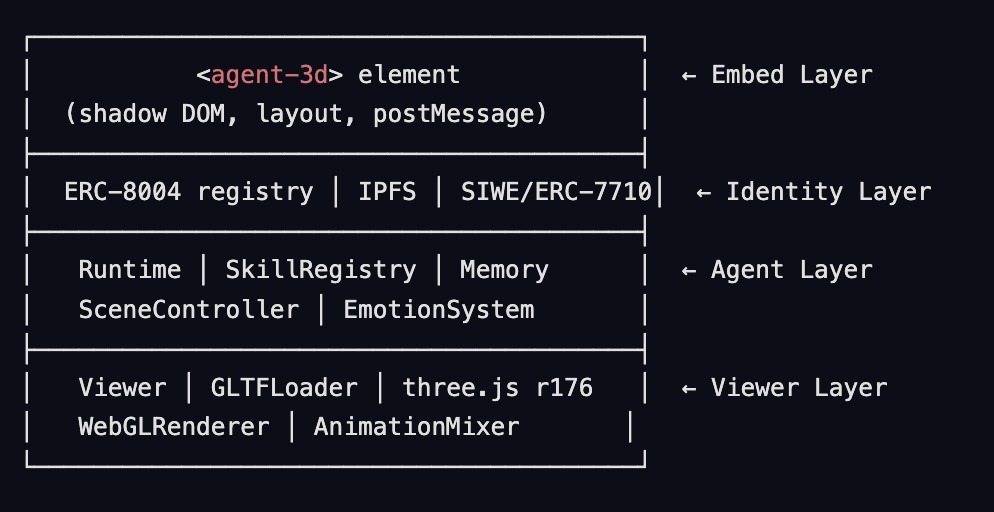


The bottom layer is the Viewer layer, also known as the rendering layer.


This layer is responsible for loading and displaying the 3D model in the browser, including lighting, camera, materials, and animations. It is built on three.js and inherently does not know if there is an AI, wallet, or on-chain identity behind the model. Therefore, even without connecting an Agent, the Viewer can function independently as a 3D model viewer.


The second layer is the Agent layer, which serves as the character's brain and behavioral system.


After receiving user input, the large language model makes judgments based on character settings, historical memory, and installed skills. If a user asks the character to wave, the model calls the corresponding tool, and the scene controller plays the waving animation; if the character needs to remember something, the memory module saves the relevant information.


This layer also includes an emotion system. The character can change expressions, gaze, and actions based on events, such as appearing happier after completing a task or showing concern when an operation fails.


The third layer is the Identity layer. This layer is an optional module.


The Identity layer ensures that the Agent maintains the same identity across different websites, devices, and sessions. The Agent's profile, memory patterns, and resource addresses can be written into a Manifest file and stored via IPFS or the platform's servers.


According to the three.ws official documentation, its Solana Agent already supports on-chain identity registration via Metaplex Core, but the ERC-8004-related on-chain reputation registration and verification registry are currently only available on the EVM side, with the verification registry still in the testnet phase.


The fourth layer is the Embedding and Distribution layer. This layer is responsible for bringing the Agent in front of users. Developers can add characters to websites, applications, and enterprise interfaces via web components, iframes, Widgets, or SDKs.


In simpler terms, the rendering layer handles the body and movements, the Agent layer provides the brain, memory, and skills, the identity layer offers an optional digital passport, and the embedding layer is responsible for deploying this character onto websites and applications.


The fee structure of three.ws should be understood from two dimensions: through which channels do users access or purchase services? And what costs are incurred after using the platform?


Regarding purchase/usage channels, one can directly subscribe, choosing a free version, Pro (US$49 per month), or an enterprise plan based on usage needs. The AWS Marketplace serves as an enterprise procurement channel.


After subscribing to three.ws, developers can use x402 to set prices for the Agent's chat, content generation, or API calls, with the caller paying per use in USDC. Platform fees are deducted from the developer's earnings: during the public beta, the platform fee for the free version is 0% (post-beta rates are not yet announced); the Pro version has a 2.9% platform fee, and enterprise plan fees are customized per agreement.


IBM Adds Enterprise Capabilities, AWS and Other Platforms Handle Distribution


For 3D AI Agent projects, creating a digital character capable of demonstrations is not difficult. The real challenge lies in integrating the product into enterprise procurement systems and meeting requirements for billing, deployment, identity verification, and AI governance.


three.ws is addressing these aspects through platforms like IBM and AWS Marketplace.


On May 27, three.ws announced becoming a member of the AWS Partner Network (APN) and subsequently launched on the AWS Marketplace. This means enterprise clients can procure three.ws services through their existing AWS accounts.


Later, three.ws published a technical article on the AWS Builder Center blog detailing its SaaS product billing solution. This solution connects AWS Marketplace's customer verification, usage metering, and subscription management with the on-chain x402 payment interface.


Regarding the IBM collaboration, three.ws plans to combine its 3D Agent technology with IBM's enterprise AI, hybrid cloud, and market channels, and integrate IBM's Granite series models for scenarios such as conversational AI, image understanding, semantic matching, market prediction, and enterprise governance.


AWS Marketplace helps three.ws enter enterprise procurement and billing systems, while IBM provides enterprise AI technology and commercial channels. Both partnerships aim towards the same goal: transforming the browser-based 3D AI Agent from an eye-catching demo into a service that enterprises can procure, deploy, and manage.


In a bear market, IBM's public response granted three.ws scarce market attention.


However, beyond the hype, the project still needs to answer more practical questions: do enterprises and developers truly need an AI Agent with a body, skills, and a digital identity, and what role will the token three ultimately play within this system.


Related Questions

QWhat was the direct catalyst for the significant price increase of the three token, and what was the reported growth?

AThe direct catalyst was IBM's official social media responses to collaboration-related content posted by three.ws. Following this, the token's market capitalization reportedly surged from around $300,000 to a high of $16.38 million, representing a growth of approximately 53 times (or 50-fold).

QAccording to the article, what is the core problem that three.ws aims to solve, beyond just being an AI project with IBM backing?

AThe core problem three.ws aims to solve is that most AI Agents are currently confined to chat windows and backend programs, making them invisible to users and difficult to identify, own, or invoke across different websites, devices, and blockchain environments. It seeks to equip AI Agents with a body, memory, identity, wallet, and distribution channels to become interactive 3D digital characters.

QHow does the three.ws platform allow developers to integrate a 3D AI Agent into a website?

ADevelopers can integrate a 3D AI Agent by creating a character on the three.ws platform, connecting it to an LLM, memory system, voice, and skills, and then embedding it into a website using a simple web component (like ``). This process is likened to embedding a YouTube video, requiring only the component and an Agent ID.

QWhat are the four independent technical layers that constitute the three.ws system, and what is the primary function of the 'Viewer' layer?

AThe four layers are: 1) Viewer Layer (rendering), 2) Agent Layer (brain/behavior), 3) Identity Layer (optional), and 4) Embedding & Distribution Layer. The primary function of the Viewer layer is to load and display 3D models in a browser, handling lighting, camera, materials, and animations. It is built on three.js and can function independently as a 3D model viewer.

QWhat strategic roles do the partnerships with IBM and AWS Marketplace play for three.ws, according to the article?

AThe partnership with AWS Marketplace helps three.ws enter the enterprise procurement and billing system, allowing business customers to purchase its services through their existing AWS accounts. The collaboration with IBM provides enterprise-grade AI technology (like IBM Granite models), hybrid cloud capabilities, and commercial market channels. Together, they aim to transform the 3D AI Agent from a demo into a service that enterprises can procure, deploy, and manage.

Related Reads

The Foundation of SpaceX's Trillion-Dollar Valuation: Who is Dividing Up Musk's Annual Tens of Billions in Capital Expenditure?

SpaceX's trillion-dollar valuation is built on its three core businesses: Starlink (profitable, 60% of revenue), rockets (driving down launch costs), and AI (a major investment area). This creates a financial cycle: Starlink funds rocket development, which enables low-cost launches for AI hardware, generating future revenue. This cycle fuels annual capital expenditures of tens of billions, flowing to a vast supply chain. Suppliers are categorized by their replaceability. The first group includes irreplaceable players like NVIDIA (GPU/CUDA ecosystem), Eutelsat (critical radio spectrum), Filtronic (specialized amplifiers), Materion (strategic beryllium), and STMicroelectronics (antenna chips). The second group consists of hard-to-replace suppliers due to high switching costs, such as Honeywell (flight control), Carpenter Technology (specialty alloys), Hexcel (carbon fiber), Broadcom (data exchange), and Linde (industrial gases). The third group comprises high-volume, cost-critical suppliers for mass-produced items like Starlink terminals. Key names include Wistron NeWeb (primary manufacturer) and several A-share companies like Shenzhen Sunway (connectors), Pies New Materials (forgings), Western Superconducting (alloys), and Yingliu (castings). Other niche players include Trimble (timing), Astronics (power distribution), and CTS (thermal management). The article argues that investing in these suppliers, rather than SpaceX stock directly, offers an alternative opportunity. The rationale is threefold: procurement is just beginning to scale, SpaceX's IPO brings new transparency to its supply chain, and the situation mirrors early stages of past "super terminal" ecosystems like Apple or Tesla. While risks exist (commodity cycles, geopolitical factors, technology shifts), the core thesis is that SpaceX's massive, ongoing procurement will translate into reliable revenue for its key suppliers, regardless of its own stock price volatility.

marsbit27m ago

The Foundation of SpaceX's Trillion-Dollar Valuation: Who is Dividing Up Musk's Annual Tens of Billions in Capital Expenditure?

marsbit27m ago

SpaceX's Trillion-Dollar Valuation Base: Who's Sharing in Musk's Annual Tens of Billions in Capital Expenditure?

**Title: The Foundation of SpaceX's Trillion-Dollar Valuation: Who Benefits from Musk's Annual $100 Billion Capital Expenditure?** This article argues that investors seeking to benefit from SpaceX's growth might find greater opportunities in its supply chain rather than directly investing in the company itself, drawing parallels to historical successes with Apple, Tesla, and NVIDIA suppliers. **SpaceX's Business Model & Cash Flow:** SpaceX generates revenue from three main areas: 1. **Starlink:** Its profitable core, earning $11.3B in 2023 (60% of revenue), funding other ventures. 2. **Rockets (Falcon/Starship):** Requires $3B+ in annual R&D but achieves the world's lowest launch costs. 3. **AI:** Currently unprofitable (-$6B+ in 2023), investing heavily in ground-based supercomputers (220,000 GPUs) and future orbital data centers. The cycle is: Starlink profits → fund cheaper rockets → low-cost launches deploy AI hardware → AI compute rentals generate future revenue. This cycle drives annual procurement spending of tens of billions of dollars. **The Supply Chain Beneficiaries:** Suppliers are categorized by their replaceability: **1. Nearly Irreplaceable (High Barriers to Entry):** * **NVIDIA:** Powers the Colossus supercomputer; its CUDA ecosystem creates immense switching costs. * **Eutelsat (SATS):** Controls critical radio spectrum for satellite communications; holds a ~3% stake in SpaceX. * **Filtronic (FTC):** Supplies millimeter-wave signal amplifiers for Starlink satellites; SpaceX constitutes 83% of its revenue. * **Materion (MTRN):** Global leader in beryllium production, a strategic material used in Starship structures. * **STMicroelectronics (STM):** Supplies phased-array antenna chips for Starlink satellites. **2. Replaceable, but Switching Cost is Prohibitively High:** * **Honeywell (HON):** Provides flight control and inertial navigation systems with decades of certification. * **Carpenter Technology (CRS):** Manufactures ultra-pure specialty steel alloys for Raptor engines. * **Hexcel (HXL):** Supplies custom carbon fiber composites developed over a decade with SpaceX. * **Broadcom (AVGO):** Manages high-speed data switching. * **Linde Group:** Supplies industrial gases (liquid oxygen/nitrogen) from facilities built near SpaceX launch sites. **3. High-Volume, Cost-Critical Manufacturing:** Focuses on mass-producing components like Starlink user terminals (target: 30 million units). * **Key Players:** Wistron NeWeb (6285, primary terminal manufacturer), several Chinese A-share companies (e.g., Sunway Communication, PAX New Materials, Western Metal Materials, Yingliu Co.), and smaller US firms like Trimble (TRMB, timing systems). **Why Now?** Three factors make the supply chain opportunity timely: 1. **Volume Ramp-Up:** SpaceX plans 100 launches in 2026, aims for 30 million Starlink terminals, and will deploy AI data centers, meaning procurement will accelerate. 2. **Increased Transparency:** The IPO provides public financial data, allowing investors to track supplier order growth. 3. **Historical Precedent:** The current phase is likened to Tesla's early mass-production stage (circa 2018), suggesting a long growth runway for suppliers. **Conclusion:** The article posits that while investing in SpaceX stock is betting on Elon Musk's ambitious vision at a high valuation, investing in its established suppliers is a bet on the tangible, recurring revenue from its massive procurement budget, which is largely decoupled from day-to-day stock price volatility.

链捕手31m ago

SpaceX's Trillion-Dollar Valuation Base: Who's Sharing in Musk's Annual Tens of Billions in Capital Expenditure?

链捕手31m ago

The U.S. Government Blocked the Anthropic Model. It Wasn't About 'Jailbreaking' at All.

Last Friday, the U.S. Commerce Department issued an enforcement letter that forced Anthropic to take its two most advanced AI models, Fable 5 and Mythos 5, offline. The stated reason was unspecified national security concerns, initially linked to potential "jailbreaks" of the models' safeguards. However, new details suggest the action stemmed more from a deteriorating relationship between the Trump administration and Anthropic, rather than a genuine technical threat. According to reports, the government cited a little-known export control regulation, compelling Anthropic to block access for all non-U.S. persons, including its own international employees. The company complied, shutting down the models without a court order or specific technical details from the government. Cybersecurity expert Katie Moussouris revealed she was privately shown a research paper detailing a potential safeguard bypass in Fable 5. She argued the described method was minor and did not warrant an export ban, stating that attempts to "fix" it would only weaken the model's defensive capabilities. Moussouris and other experts have since called for the order to be revoked, warning it dangerously removes advanced cybersecurity tools from U.S. defenders. Analysts like Justin Hendrix suggest the move appears retaliatory and sets a dangerous precedent, signaling that the U.S. government can unilaterally shut down a tech company's products. The incident has raised concerns about the reliability of American AI and the potential for political interference in the tech industry, serving as a warning to the broader sector.

marsbit34m ago

The U.S. Government Blocked the Anthropic Model. It Wasn't About 'Jailbreaking' at All.

marsbit34m ago

Ray Dalio: AI Bull Market Continues to Soar, Should Investors Go All In or Cash Out and Leave the Field?

In his latest notes, Ray Dalio addresses a critical question for investors amid the AI-driven stock market surge: how should one allocate assets during a transformative technological revolution? Dalio emphasizes that technological advancement does not automatically make related stocks attractive. Historical tech cycles—marked by excitement, crowding, volatility, and eventual shakeouts—show that even long-term winners like Microsoft and Apple experienced severe drawdowns. Today's AI sector faces similar uncertainties: overinvestment, intensifying competition, geopolitical tensions (e.g., Taiwan's chip supply), tax policy shifts, anti-AI sentiment, and potential disruption from future technologies like quantum computing. Dalio's core argument focuses on the highly concentrated market structure, where a few tech giants dominate major indices. He warns investors against unknowingly holding concentrated, correlated exposures. Instead of chasing a handful of AI leaders, he advocates for a robust, diversified portfolio of 15 or more high-quality, uncorrelated investments, risk-balanced to match an investor's volatility tolerance. Mathematically, such diversification significantly improves the risk-return ratio—for example, holding 15 uncorrelated assets can boost the ratio by over four times compared to a single concentrated bet. Dalio cautions that future equity returns appear low, with his bubble indicator suggesting real returns could be negative over the next 5-10 years. He stresses that knowing what you don't know is as important as knowing what you do. In an environment of high uncertainty and concentration, avoiding large, concentrated bets on AI stocks is prudent. The optimal strategy is disciplined diversification—the "holy grail" of investing—to navigate this technologically driven cycle with lower risk and comparable or better returns.

marsbit38m ago

Ray Dalio: AI Bull Market Continues to Soar, Should Investors Go All In or Cash Out and Leave the Field?

marsbit38m ago

Trading

Spot
Futures
活动图片