After a 30x Surge and Then a Collapse, Who Set Up the RIVER Scheme Promoted by Hayes?

marsbitPublished on 2026-02-03Last updated on 2026-02-03

Abstract

The native token RIVER of the chain-abstract stablecoin system River experienced an extreme price surge and crash in January 2026, rising over 2700% from around $2 to over $87 in four weeks, before plummeting 87% to around $11 in just six days. The volatility drew scrutiny from analysts, with Bubblemaps identifying a cluster of over 2,000 wallets linked to RIVER’s creators, which allegedly profited around $10 million through coordinated selling on Bitget. The token had gained attention after Arthur Hayes publicly endorsed it and the project raised $12 million in strategic funding. Analysis by CoinGlass highlighted how negative funding rates were exploited to manipulate leverage and liquidity, triggering cascading liquidations. The event underscores risks associated with low-float, high-volatility tokens where concentrated ownership and derivative structures can amplify both gains and losses.

In the first month of 2026, the native token RIVER of the chain-abstracted stablecoin system River experienced an extreme inverted V-shaped reversal within just four weeks. Starting from around $2 in late December 2025, it surged to a historical high of over $87, marking an increase of more than 2700%, only to plummet rapidly within six days to a low of around $11, a drop of 87%.
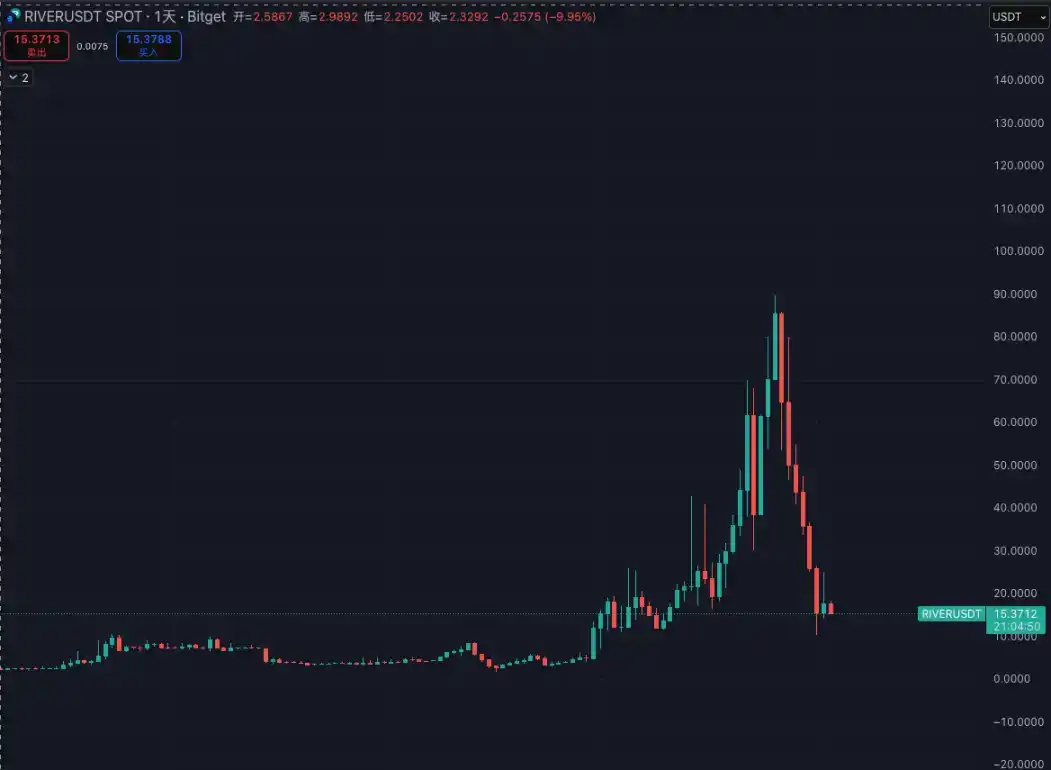
This abnormal market volatility has drawn significant attention from industry observers and on-chain data analysis institutions. As third-party data agencies like Bubblemaps disclosed key evidence on January 27, suspicions surrounding RIVER token price manipulation, highly concentrated early holdings, and profits by associated addresses are growing.

New Funding of $12 Million, Promoted by Arthur Hayes

The River project is developed by the RiverdotInc team, with its main focus on building a chain-abstracted stablecoin system for the multi-chain ecosystem. The system aims to connect assets, liquidity, and yields across different blockchains, enabling seamless cross-chain interactions without relying on traditional bridging or wrapping mechanisms.

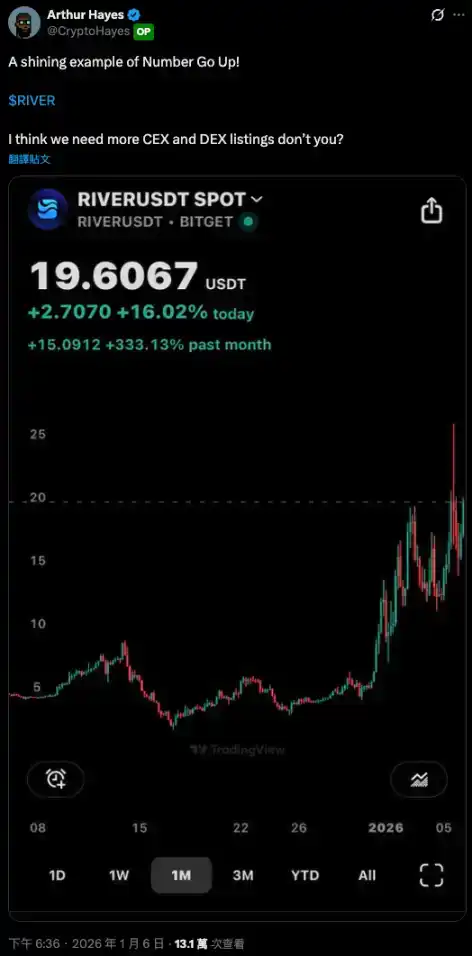
On January 6, BitMEX founder Arthur Hayes publicly called for CEXs to list the token and predicted it would explode. Hayes' endorsement provided the first boost for RIVER. Despite most mainstream crypto assets being in a downward trend at the time, RIVER began a unilateral upward trend, with its market cap more than quadrupling in just a few weeks.
On January 23, River announced the completion of a $12 million strategic funding round. In addition to previously reported participation from Justin Sun and TRON DAO, this round of investors also included Maelstrom Fund (founded by Arthur Hayes), The Spartan Group, and Nasdaq-listed companies and institutions from the United States and Europe.

Officially, the funding will be used to support River's expansion into EVM and non-EVM ecosystems (including TRON, Sui, and major EVM networks) and to continue building on-chain liquidity infrastructure. The funds will accelerate ecosystem deployment, deepen stablecoin liquidity, and promote the integration of satUSD in trading, lending, staking, and yield scenarios. Additionally, River will launch yield products Smart Vault and Prime Vault, providing a unified interface for users and institutions to access cross-ecosystem yields through protocol-native and institutional-grade strategies.

Interestingly, just a couple of days after announcing the large funding round, RIVER's price hit its peak and began to decline.

Funding Rate-Driven Price Manipulation Tactics

CoinGlass once used RIVER as an example to discuss how funding rates can be used in conjunction with leverage structures to drive price volatility, emphasizing that this pattern has appeared in multiple tokens over the past two years, with RIVER being just one case. It stressed that many traders misunderstand funding rates. Funding rates do not provide directional predictive signals; they provide information on the imbalance between long and short positions, indicating which side of the market is more crowded.

Step 1: Suppress the price while pushing the funding rate into deeply negative territory. First, keep the price low or suppressed while pushing the funding rate into a significantly negative range. The result is that short positions become increasingly concentrated, and the market begins to form a consensus expectation that a rebound is imminent due to the negative funding rate.

Step 2: Lure some traders to go long. During the phase of deeply negative funding rates, some traders will open long positions, motivated by the expectation of a rebound and the hope of receiving funding rate payments. The thread refers to this expectation as part of the trap.

Step 3: Price pushes upward can also occur during negative funding rate phases. CoinGlass's key argument is that when funding rates are extremely negative, prices do not need to enter a trend reversal. The market only needs a controlled upward push to trigger a chain reaction among shorts, including liquidations, stop-losses, and passive covering.
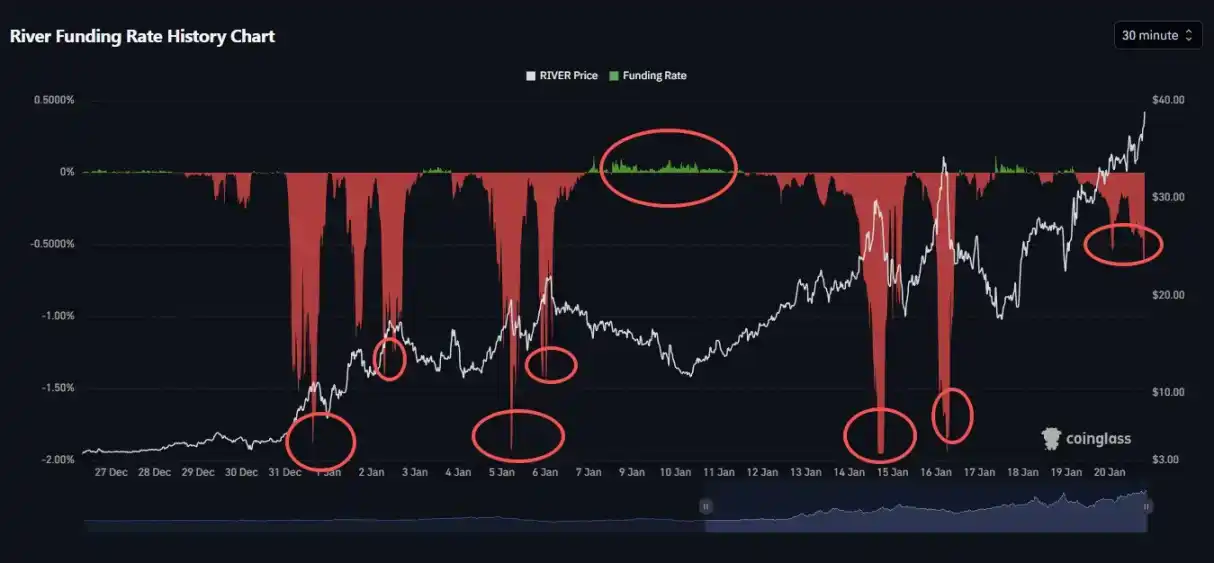
Why does the rally happen when the funding rate is still negative? Many sharp rallies start when funding rates are still negative. The driving force behind the price push comes from the unwinding of leveraged positions, and passive buying in the market amplifies the gains. After the crowded shorts are cleared, funding rates quickly return to more neutral levels. Some traders interpret the normalization of funding rates as a signal of market recovery.

CoinGlass warns that this is actually just the "reset" process of the trap, and manipulators can repeatedly execute the cycle of "creating extreme rates, attracting consistent positions, forcing liquidations, and resetting."

Analysis: RIVER Creators Suspected to Be Directly Related to a Large Cluster of Addresses, Selling RIVER for $10 Million in Profits

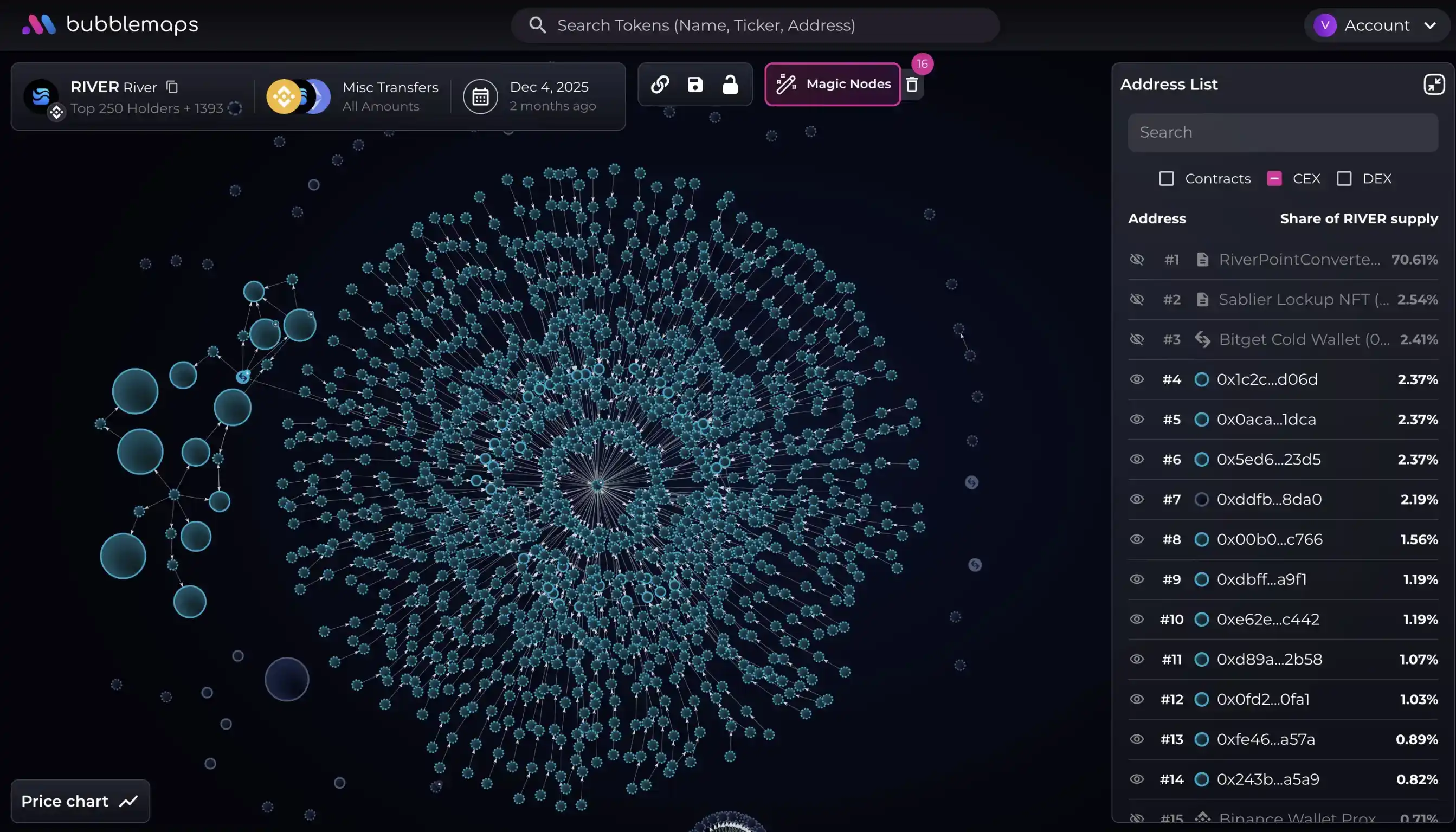
According to Bubblemaps monitoring, a large cluster containing over 2,000 wallet addresses is directly related to RIVER.
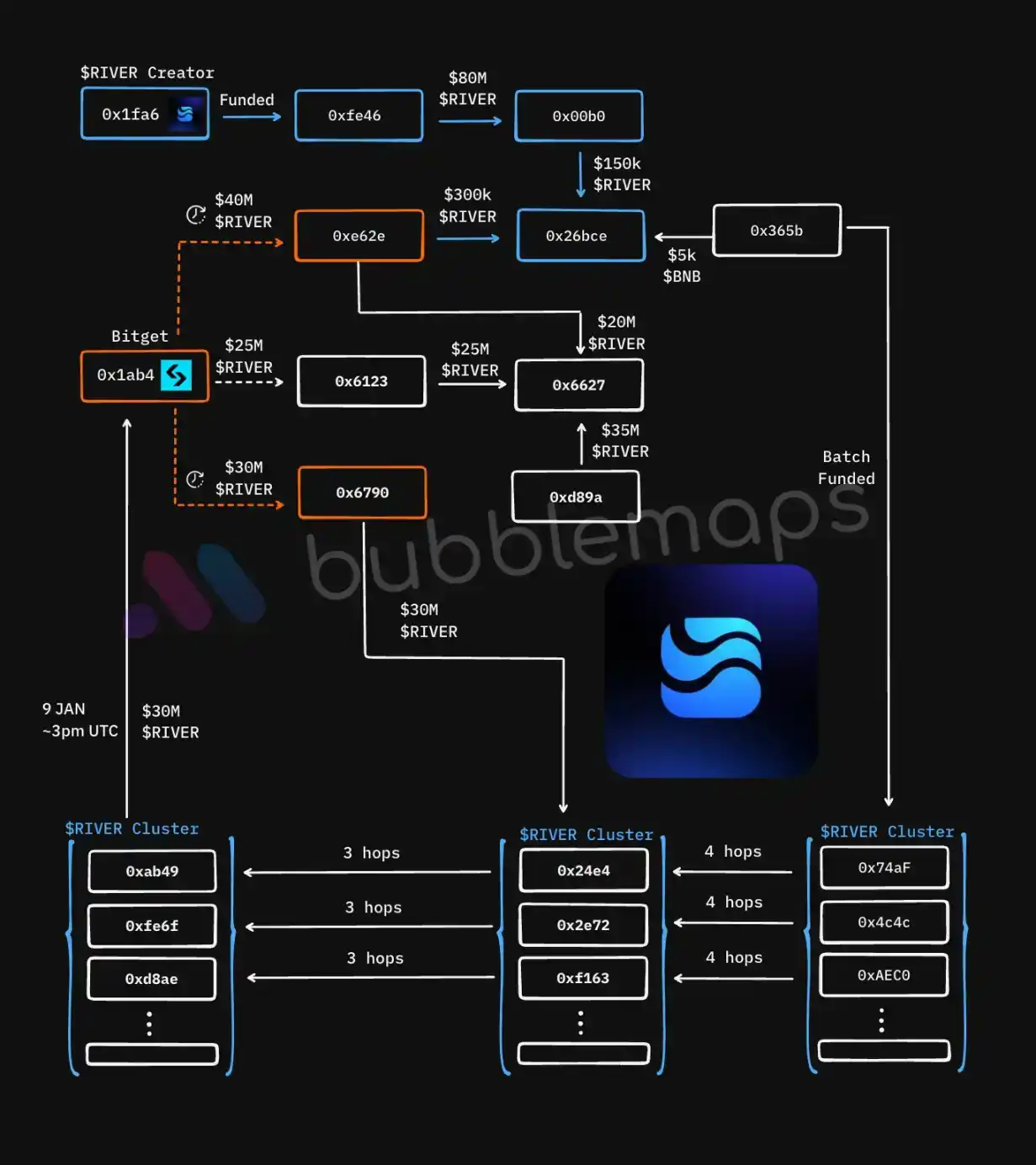
It pointed out that one month after RIVER's launch, seven addresses withdrew 230 million RIVER tokens from Bitget. These wallets had no prior activity and received the tokens within a tight time window on December 3 and 29.
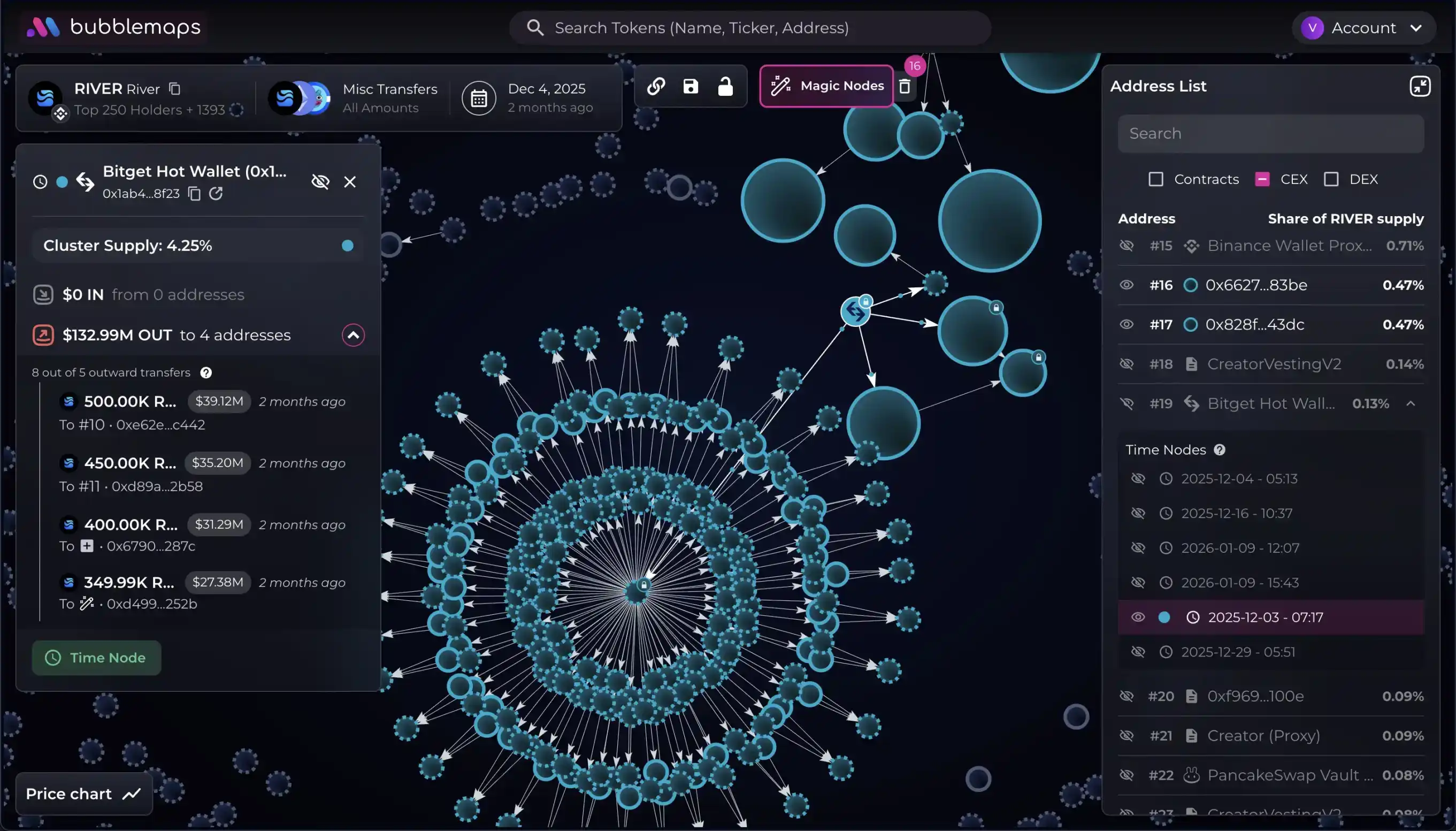
One wallet, 0x6790, distributed 400,000 RIVER across hundreds of wallets. All these receiving wallets showed similar patterns: no prior activity, receiving similar amounts of RIVER, sending tokens to Bitget on January 9 likely for sale, funded by a single source, and经过四层跳转 (after four layers of hopping).
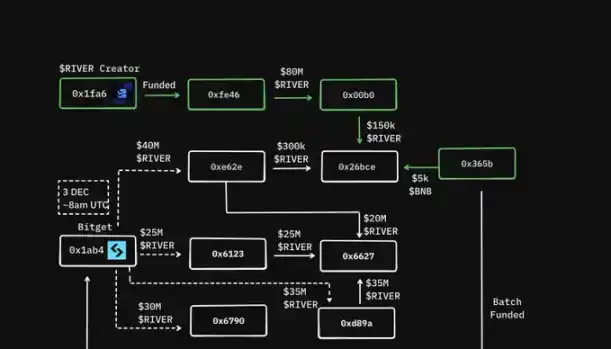
Bubblemaps noted that the wallet funding this cluster is address 0x365b, which is directly connected to the RIVER creator. Additionally, the wallet 0x6790, which distributed RIVER to the cluster, shows links pointing to the RIVER creator. It estimates the cluster's profits at $10 million.
What is certain now is that RIVER completed a drastic repricing from rapid rise to rapid retreat in an extremely short time. Market focus has shifted from narrative and growth expectations to whether there are abnormalities in token distribution and fund flows. The address cluster and associated clues raised by Bubblemaps have amplified suspicions of early concentration of holdings, profits by associated addresses, and selling through exchanges; the funding rate and position crowding mechanism mentioned by CoinGlass provide another explanatory framework, suggesting that derivative structures may have amplified the price swings.

For the market, the RIVER incident once again serves as a reminder that tokens with low circulation and high volatility are prone to extreme price movements when sentiment and structure resonate, and when negative signals emerge in holdings and trading structures, price adjustments often come faster and deeper.


Related Questions

QWhat was the extreme price movement of RIVER token in the first month of 2026?

AThe RIVER token experienced an extreme inverted V-shaped reversal, surging from around $2 in late December 2025 to a high of over $87, a gain of more than 2700%, before crashing down to around $11 in just six days, a drop of 87%.

QWho is a prominent figure that publicly endorsed the RIVER token and what was his prediction?

ABitMEX founder Arthur Hayes publicly called for CEXs to list the token and predicted it would experience a massive breakout.

QAccording to the analysis from Bubblemaps, what was the suspected link between a large cluster of wallets and the RIVER token creators?

ABubblemaps identified a cluster of over 2000 wallet addresses directly linked to RIVER's creators, with evidence showing these wallets received tokens from the creators and later sold them on Bitget, netting an estimated profit of $10 million.

QHow did CoinGlass describe the mechanism of price manipulation involving funding rates, as exemplified by RIVER?

ACoinGlass described a套路 where manipulators first suppress the price to create deeply negative funding rates, lure in long positions expecting a rebound, and then trigger a short squeeze by pushing the price up, forcing liquidations and stop-losses. This cycle of creating extreme rates, attracting one-sided positions, forcing liquidations, and resetting can be repeated.

QWhat was the purpose of the $12 million strategic funding round announced by River, and who were some of the investors?

AThe $12 million strategic funding round was intended to support River's expansion into EVM and non-EVM ecosystems (including TRON, Sui, and major EVM networks), build on-chain liquidity infrastructure, accelerate ecosystem deployment, and launch yield products like Smart Vault and Prime Vault. Investors included Maelstrom Fund (Arthur Hayes), The Spartan Group, Justin Sun, TRON DAO, and Nasdaq-listed companies from the US and Europe.

Related Reads

KOL's Perspective: Why Is SOL Set to Rise from This Point?

**Summary: Why SOL is Positioned for Growth at This Level** The article argues that SOL is poised for an upward move from its current price point, citing several key factors. Primarily, SOL has just broken out of a 4-month consolidation phase. This breakout signals a return of risk appetite to the broader crypto market, as SOL is seen as a key indicator of overall crypto health. The token's ownership has reportedly shifted from short-term traders and tourists to long-term accumulators, leading to low volume. Any meaningful increase in trading activity could thus trigger significant upward momentum. Fundamental strengths include strong institutional adoption, integration with DeFi and RWAs (Real-World Assets), and the potential benefits from the Clarity Act. Despite its high volatility—having dropped 70% from its all-time high but still up 12x from its bear market low—SOL is highlighted as one of the few tokens from the last cycle to reach new highs. It boasts a robust ecosystem of applications, users, and protocols. Future catalysts include the expected influx of AI developers following the Miami Accelerate conference, which focused on AI on Solana. Furthermore, Solana is positioned as the premier chain for memecoin activity, a trend expected to continue and drive network usage and fees. The article concludes that recent price action reflects a healthy transfer to long-term holders, setting the stage for growth.

marsbit44m ago

KOL's Perspective: Why Is SOL Set to Rise from This Point?

marsbit44m ago

Those Pre-Bitcoin PoW Protocols Have Recently Been Reimplemented

This article details a recent surge in replicating pre-Bitcoin Proof-of-Work (PoW) protocols, specifically focusing on Hal Finney's 2004 RPOW (Reusable Proofs of Work). Within five days in May 2026, multiple independent builders in the Bitcoin/cypherpunk community launched projects inspired by this early electronic cash proposal. The initiative began with Fred Krueger's `rpow2.com`, a centralized but auditable system that replaced RPOW's original IBM 4758 hardware with Ed25519 signatures. Initially a faithful replica, it later adopted Bitcoin-like features (21M supply cap, difficulty adjustment) and a controversial 5.24% founder allocation. This sparked rapid forks, including `rpow4.com` which incorporated full Bitcoin parameters, a prediction market (`rpowmarket.com`), and a DEX (`rpow2swap.com`). Concurrently, Mike In Space created a prototype of Wei Dai's 1998 b-money proposal (`b-money.replit.app`), pushing the historical exploration even further back. The article contrasts these centralized, server-dependent experiments with Bitcoin's core innovation of decentralized, trustless consensus. It also highlights a parallel development: the `HASH` project on Ethereum, which uses smart contract hooks to enable a purely fair-launch, browser-mineable PoW token with 0% allocations to team or VCs. The collective activity is framed as a meme-driven, educational exploration of cypherpunk history rather than a serious financial movement, with all projects heavily disclaiming any investment value.

marsbit49m ago

Those Pre-Bitcoin PoW Protocols Have Recently Been Reimplemented

marsbit49m ago

South Korean Exchanges 'Battle' Regulators, Challenging the Boundaries of Enforcement and Legislation

South Korea's cryptocurrency industry is engaged in a rare, direct confrontation with regulators. The Financial Intelligence Unit (FIU), the primary anti-money laundering (AML) watchdog, has recently imposed heavy penalties on major exchanges like Upbit and Bithumb for alleged violations involving unregistered overseas VASPs and AML procedures. However, exchanges are now actively challenging these actions in court and through industry associations. In a significant shift, the Seoul Administrative Court ruled in favor of Upbit's operator, Dunamu, overturning part of an FIU-ordered business suspension. The court found the FIU's penalty criteria and justification insufficiently clear. Similarly, the court suspended the enforcement of a six-month business suspension against Bithumb pending a final ruling, citing potential irreversible harm to the exchange. Beyond legal battles, the industry is contesting proposed legislative amendments. The Digital Asset eXchange Alliance (DAXA) strongly opposes a draft rule that would mandate Suspicious Transaction Reports (STRs) for all crypto transfers over 10 million KRW (~$6,800). DAXA argues this "poison pill" clause violates legal principles and would overwhelm the STR system, increasing reports from 63,000 to an estimated 5.45 million annually for major exchanges, thereby crippling effective AML monitoring. This conflict highlights a structural tension in South Korea's crypto governance: comprehensive digital asset laws are still developing, while regulators rely heavily on AML enforcement. The industry's move from passive compliance to active legal and legislative challenges signifies a new phase, pressing for clearer rules and more proportionate enforcement. While short-term disputes may intensify, this clash could ultimately lead to a more mature and sustainable regulatory framework for South Korea's vibrant crypto market.

marsbit1h ago

South Korean Exchanges 'Battle' Regulators, Challenging the Boundaries of Enforcement and Legislation

marsbit1h ago

After 50x Storage Surge, Justin Sun Always Looks to the Next Decade

Sun Yuchen, known for his controversial stunts like a $30 million lunch with Warren Buffett (canceled due to a kidney stone) and eating a $6.2 million duct-taped banana, is often overshadowed by a significant fact: his decade-long track record of spotting major investment trends. In 2016, he famously advised young people to invest in Bitcoin, Nvidia, Tesla, and Tencent instead of buying property. A hypothetical $20,000 investment in Nvidia and Tesla from that list would now be worth over 50 million RMB. His latest major call was on November 6, 2025, predicting a "50x storage opportunity" tied to the AI boom, which materialized with Sandisk's stock surging nearly 50-fold by 2026. Looking ahead, Sun now focuses on the next frontier: Physical AI. He identifies four key areas: 1. **Embodied AI/Robotics**: He sees this reaching its "iPhone moment," with companies like UBTech and Galaxy General leading in commercialization. 2. **Drones**: Viewed as the first commercially viable form of Physical AI, revolutionizing sectors from warfare (e.g., AeroVironment's Switchblade) to logistics. 3. **Spatial Computing**: Beyond VR, it's about AI understanding physical space, a foundational technology for robotics and autonomous systems, exemplified by Apple's Vision Pro. 4. **Space Exploration**: After a 2025 suborbital flight with Blue Origin, Sun advocates for space as the ultimate frontier, discussing blockchain's potential role in space asset management and data transactions. His investment philosophy involves betting on entire, inevitable trends rather than single companies. For robotics, he sees Tesla (the body/manufacturer) and Nvidia (the brain/AI platform) as complementary plays. In defense drones, he highlights companies making tanks obsolete (AeroVironment) and those augmenting fighter jets (Kratos). For space, he participated in Blue Origin's flight and anticipates SpaceX's potential IPO to redefine the sector's valuation. Sun Yuchen's vision frames the next two decades not as a revolution in information flow (like the internet), but in the fundamental operation of the physical world through AI-powered robots, autonomous systems, and spatial intelligence, ultimately extending human and AI activity into space. While many still focus on conventional assets, he continues to look toward the next technological horizon.

marsbit2h ago

After 50x Storage Surge, Justin Sun Always Looks to the Next Decade

marsbit2h ago

Trading

Spot
Futures

Hot Articles

How to Buy RIVER

Welcome to HTX.com! We've made purchasing River (RIVER) simple and convenient. Follow our step-by-step guide to embark on your crypto journey.Step 1: Create Your HTX AccountUse your email or phone number to sign up for a free account on HTX. Experience a hassle-free registration journey and unlock all features.Get My AccountStep 2: Go to Buy Crypto and Choose Your Payment MethodCredit/Debit Card: Use your Visa or Mastercard to buy River (RIVER) instantly.Balance: Use funds from your HTX account balance to trade seamlessly.Third Parties: We've added popular payment methods such as Google Pay and Apple Pay to enhance convenience.P2P: Trade directly with other users on HTX.Over-the-Counter (OTC): We offer tailor-made services and competitive exchange rates for traders.Step 3: Store Your River (RIVER)After purchasing your River (RIVER), store it in your HTX account. Alternatively, you can send it elsewhere via blockchain transfer or use it to trade other cryptocurrencies.Step 4: Trade River (RIVER)Easily trade River (RIVER) on HTX's spot market. Simply access your account, select your trading pair, execute your trades, and monitor in real-time. We offer a user-friendly experience for both beginners and seasoned traders.

5.1k Total ViewsPublished 2026.01.16Updated 2026.01.16

How to Buy RIVER

Discussions

Welcome to the HTX Community. Here, you can stay informed about the latest platform developments and gain access to professional market insights. Users' opinions on the price of RIVER (RIVER) are presented below.

活动图片










