Actually, the Crypto Winter Began in January 2025

marsbitPublished on 2026-02-03Last updated on 2026-02-03

Abstract

The crypto winter began in January 2025, though many only recently acknowledged it. Bitcoin and Ethereum have fallen 39% and 53% from their October 2025 peaks, with steeper declines for other assets. This is a full bear market, not a correction, driven by over-leverage and profit-taking. Positive developments like regulatory progress and institutional adoption have been ignored amid the downturn, typical of crypto winters where good news fails to lift prices. Historically, crypto winters last around 13 months. However, this one may be closer to ending than it appears, as it effectively started in January 2025. ETF and digital asset trust (DAT) inflows masked the reality for some assets. Bitcoin, Ethereum, and XRP saw milder declines (10–20%) due to institutional support, while assets like ADA, AVAX, SUI, and DOT fell 62–75% without such backing. Without $75 billion in ETF/DAT buying, Bitcoin’s drop would have been closer to 60%. The retail crypto market has been in winter since January 2025. Despite the gloom, fundamental strengths remain: regulatory clarity, institutional adoption, stablecoins, tokenization, and Wall Street embrace. These positive factors are stored energy that will fuel the next rally when sentiment shifts. Triggers could include strong economic growth, pro-crypto regulatory surprises, sovereign adoption of Bitcoin, or simply time. As with past winters, the end feels near—despair and frustration are common precursors to recovery. Spring is likely coming s...

Author:Matt Hougan, Chief Investment Officer of Bitwise

Compiled by: Hu Tao, ChainCatcher

We have been in a crypto winter since January 2025. It's likely that we are closer to the end of this winter than to its beginning.

We are in the midst of a full-blown crypto winter.

Crypto Twitter has only recently begun to realize this, but it is undeniable. Bitcoin is down 39% from its all-time high in October 2025, Ethereum is down 53%, and many other crypto assets have fallen even more.

This is not a "bull market correction" or a "slight dip." This is a full-blown, Leonardo DiCaprio-in-The-Revenant-(2012)-level crypto winter—caused by factors such as excessive leverage and widespread profit-taking by seasoned players.

Recognizing and accepting this is enlightening.

Why are crypto prices still falling despite positive news about adoption, regulation, and other areas? Because we are in the depths of a crypto winter.

Why is the new Fed Chair a Bitcoin supporter, yet the Crypto Fear & Greed Index is near historic highs? Because we are in a crypto winter.

Crypto investors who have lived through past winters (be it 2018 or 2022) should remember that at the deepest points of the winter, good news meant nothing. Wall Street hiring aggressively or Morgan Stanley increasing its crypto investments did not drive a crypto market rally. These factors might matter in the long run, but not now. The end of a crypto winter is not exciting; it is exhausting.

So, when will the winter end?

The good news is: We are closer to the end than you think.

The History of Crypto Winters

Crypto winters typically last about 13 months. For example, Bitcoin peaked in December 2017 and bottomed in December 2018. It peaked again in October 2021 and bottomed in November 2022.

By that measure, we are in for a tough time. After all, Bitcoin's peak was in October 2025. Are we really going to have to wait until next November to get back in?

I don't think so.

The more time I spend analyzing the current "winter," the more I realize it actually began in January 2025. It's just that ETF and Digital Asset Trust (DAT) flows masked the truth, preventing us from seeing it.

ETF and DAT Flows Masked the 2025 Winter

Take a closer look at this chart of the components of the Bitwise 10 Large Cap Crypto Index since January 1, 2025.
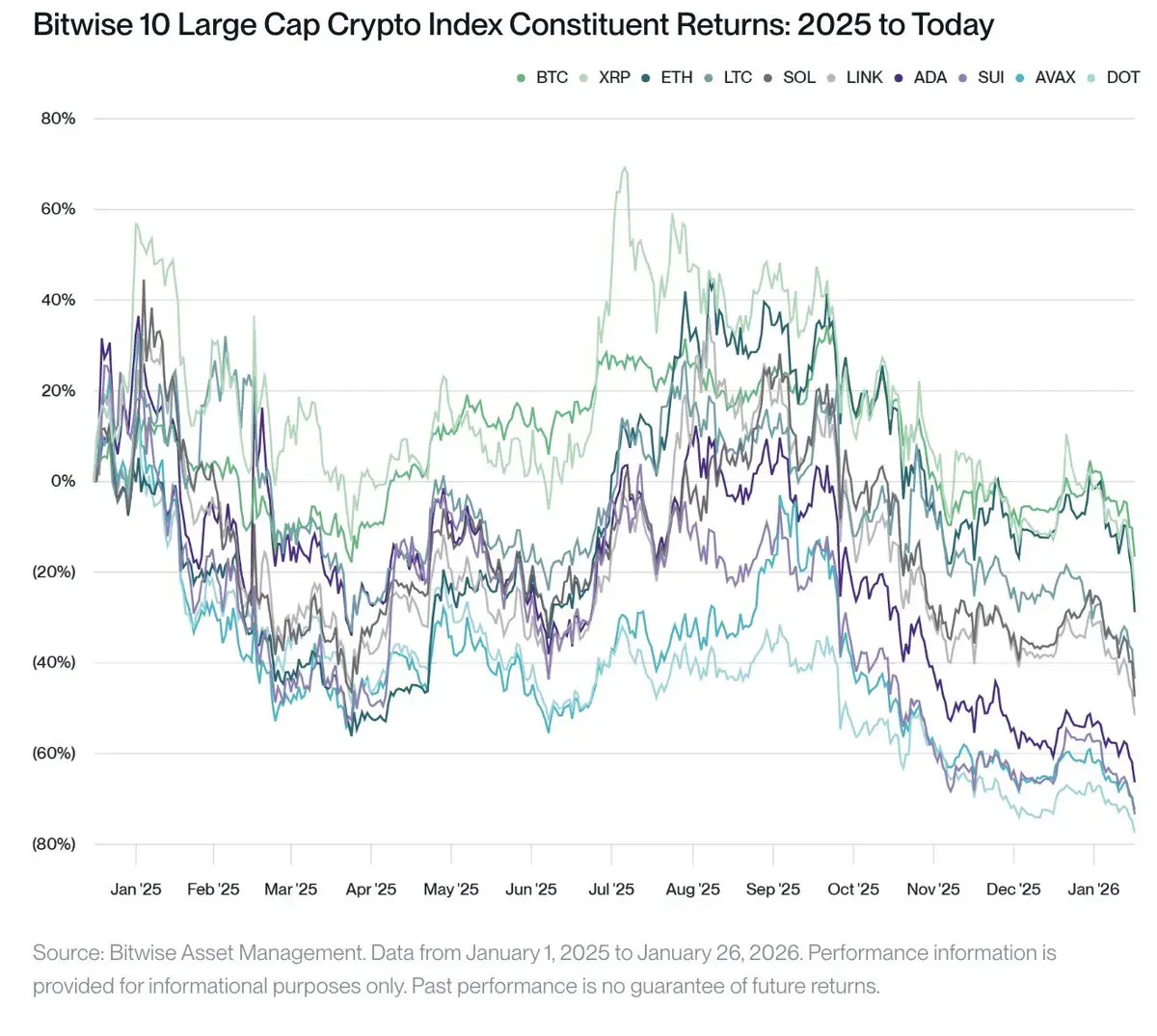
It is divided into three clear groups. The first group of assets (BTC, ETH, XRP) performed okay, down 10.3% to 19.9%. The second group (SOL, LTC, LINK) experienced a standard bear market, down 36.9% to 46.2%. But the third group (ADA, AVAX, SUI, DOT) was hit hard, with declines as high as 61.9% to 74.7%.

The fundamental difference between these three groups lies in the ability of institutional investors to invest in them. The first group benefited from strong ETF/DAT support throughout the year (or, in the case of XRP, from winning its lawsuit against the SEC); the second group had ETFs expected to be approved in 20251; and the third group never received such support.

Look at what happened to the third group, which relied solely on crypto-native channels for support!

The institutional support received by the first group was unprecedented. For example, during the period shown in the chart, ETFs and DATs bought 744,417 bitcoins, worth approximately $75 billion. Imagine where Bitcoin would be without that $75 billion in support? I estimate it would be down about 60%.

The retail crypto market has been in a severe winter since January 2025. Institutional investors merely masked this fact for certain assets.

The Darkest Hour Is Just Before the Dawn

What needs to be remembered now is that there is indeed a lot of good news in the crypto space. Regulatory progress is real. Institutional adoption is real. Stablecoins and tokenization are real. Wall Street's acceptance is real.

Good news tends to be ignored in bear markets, but it doesn't disappear. It is stored as potential energy. When the gloom lifts and market sentiment returns to normal, this stored energy will return with a vengeance.

What can lift the gloom? Strong economic growth triggering a wave of aggressive risk-on sentiment, positive surprises from the Clarity Act, signs of Bitcoin recognition by sovereign nations, or simply the passage of time.

As a veteran of multiple crypto winters, I can tell you that the feeling at the end of those winters felt very much like it does now: despair, frustration, and listlessness. But the current market correction has not fundamentally changed anything about crypto.

I believe we will bounce back strongly soon. After all, if it has felt like winter from January 2025 until now, spring must surely be just around the corner.


Related Questions

QAccording to the article, when did the crypto winter actually begin?

AThe crypto winter actually began in January 2025.

QWhat was the primary factor that masked the true start of the crypto winter in 2025?

AThe massive inflows into ETFs and Digital Asset Trusts (DATs) masked the true start of the crypto winter.

QHow are the assets in the article's 'third group' characterized, and what was their performance?

AThe third group (ADA, AVAX, SUI, DOT) consists of assets that never received institutional support like ETFs. They were hit the hardest, with declines ranging from 61.9% to 74.7%.

QWhat does the author suggest is the typical duration of a crypto winter, and why does he believe the current one might be different?

AThe typical duration is about 13 months. The author believes the current winter is different because it effectively started in January 2025, not October 2025 (the peak), meaning we are likely closer to its end than the 13-month timeline from the peak would suggest.

QWhat does the author say happens to positive news and developments during a crypto winter?

APositive news is ignored during a crypto winter, but it doesn't disappear. It gets stored as potential energy and is then released powerfully when market sentiment returns to normal.

Related Reads

Within Strategy's Framework, STRC's Dividend Yield Remains at 12% as Share Price Stays Below Par Value

Michael Saylor, Executive Chairman of Strategy (MSTR), confirmed that the dividend rate for its STRC perpetual preferred shares will remain at 12.00% through August 2026. The rate has increased from 9% at its July 2025 launch to the current high via a "ratchet" mechanism, which permanently raises the rate by 0.5% whenever the share price falls below $95. This mechanism is intended to push the price back toward its $100 par value and support Strategy's "at-the-market" (ATM) program for issuing new shares to fund Bitcoin purchases. However, the mechanism has not worked as intended. STRC shares closed at $89.46 on July 31, remaining about 10-11% below par value despite the record-high dividend. Competition from rival Strive's higher-yielding SATA securities has pressured demand. The persistent discount has forced Strategy to suspend new STRC issuances via its ATM program, limiting this funding channel for Bitcoin acquisitions. STRC's struggles reflect Bitcoin's own volatility, as the preferred shares historically move in tandem. Analysts have warned the ratchet structure carries long-term, one-way risk. A law firm is investigating Strategy's ability to maintain dividend payments if Bitcoin's price stays low. Retail investors own roughly 83% of outstanding STRC shares, a group seen as prone to panic selling during downturns. In response, Strategy has established financial reserves, including a liquidity cushion covering about 26 months of dividend/interest obligations, and a $2 billion share buyback program alongside a Bitcoin monetization framework, though the company emphasized it is not obligated to sell any Bitcoin.

cryptonews.ru40m ago

Within Strategy's Framework, STRC's Dividend Yield Remains at 12% as Share Price Stays Below Par Value

cryptonews.ru40m ago

Analyst: Bitcoin's Price Will Drop to $60k in August, Then Rebound to $70k

Financial analyst Andrey Poroshin has provided a new forecast for Bitcoin's price dynamics in August. Poroshin, an analyst at the Bitbanker exchange, expects the cryptocurrency market to experience a downturn this month, with prices retesting the $60,000 level due to a lack of supportive macroeconomic catalysts. He noted that the recent US Federal Reserve decision to hold interest rates did not significantly impact the market, while inflation remains above the 2% target. Poroshin stated that Bitcoin is ending July under pressure from moderate volatility and a lack of new macroeconomic stimuli, leading to continued market caution. According to his base scenario, Bitcoin will drop to a range of $60,000 to $62,000 before recovering to $70,000. He pointed out that even $70,000 remains below the cost of mining in the US, which has prompted some miners to shift towards AI data center operations. Poroshin cited the winding down of BitMEX's operations as a potential catalyst for a price rebound, suggesting the exit of weaker players often coincides with market reversals and reduced short-term selling pressure. He believes Bitcoin is currently less susceptible to geopolitical shocks, such as the Iran-US conflict, and does not expect significant market changes in August related to the pending CLARITY Act. Looking ahead, Poroshin forecasts that September will bring more active price fluctuations driven by potential Fed rate decisions and possible discussions or approval of the CLARITY Act.

cryptonews.ru40m ago

Analyst: Bitcoin's Price Will Drop to $60k in August, Then Rebound to $70k

cryptonews.ru40m ago

Trading

Spot
活动图片




