a16z Bets on Energy Tokenization Experiment: How Will DayFi Use DeFi to Restructure the Power Grid? Jae 2025/12/13 12:00

marsbitPublished on 2025-12-13Last updated on 2025-12-13

Abstract

a16z Backs Energy Tokenization Experiment: How DayFi Aims to Restructure the Grid with DeFi As global tech giants compete for computing power, electricity has become a critical resource. DayFi, a decentralized energy capital markets protocol under the Daylight ecosystem, is launching a $50 million pre-deposit event on December 16. Backed by a16z Crypto and Framework Ventures, DayFi tokenizes future electricity revenue into tradable crypto assets. The protocol allows users to deposit stablecoins to mint GRID—a fully collateralized stablecoin—and then stake it to receive sGRID, a yield-bearing token representing a share in energy asset revenue. This creates a flywheel effect: liquidity funds distributed energy projects, which generate tokenized returns for holders. However, DayFi faces significant regulatory challenges. sGRID may be classified as a security by the SEC, requiring strict disclosures. Additionally, FERC’s restrictions on disclosing critical energy infrastructure data conflict with DeFi’s transparency requirements. Technical solutions like zero-knowledge proofs may be needed to verify收益 without exposing sensitive data. Valuation of the underlying energy assets—solar panels, batteries—also remains uncertain, with risks of depreciation and potential manipulation. Despite these hurdles, DayFi represents an ambitious attempt to bridge DeFi with physical energy grids, transforming electricity into a dynamic, tradable asset amid growing AI-driven power demand.

As global tech giants fiercely compete for every kilowatt-hour on the computing power battlefield, electricity has become a harder currency than data. AI energy consumption is devouring grid resources like a black hole, while traditional energy infrastructure remains mired in inefficiency.

An energy tokenization experiment is attempting to walk a tightrope between regulation and valuation, carving out an asset channel connecting blockchain and the power grid. In this gap between energy and computing power, Daylight has made its move, with its decentralized energy capital market protocol DayFi announcing a $50 million pre-deposit event opening on December 16th.

DayFi carries the ambition of "restructuring the power grid with DeFi," aiming to slice future electricity revenue into tradable crypto assets. Backing the protocol are top-tier capital firms like a16z Crypto and Framework Ventures. Their investment is not just in a single project but更像是在AI能源困局中埋下一枚伏笔 (like planting a seed in the AI energy dilemma).

Transforming Energy into Yield-Generating Assets, Securing Tens of Millions from a16z and Others

Daylight is an established DePIN project, founded in 2022, focused on building a distributed energy network for generating, storing, and sharing clean power. Project founder Jason Badeaux once stated: "Electricity demand is now increasing significantly, but the traditional way of adding capacity is too slow and too cumbersome. Distributed energy will provide the fastest and most economical way to scale energy production and storage on the grid."

However, distributed energy systems also face their own challenges, including lengthy sales cycles, extensive market education, and high costs. Typically, about 60% of the cost of a residential solar installation comes from customer acquisition and other inefficient aspects.

DayFi is the capitalization pipeline Daylight built to tackle this problem. The protocol, based on Ethereum, will use DeFi to provide funding for the development of distributed energy projects.

Investors can deposit stablecoins like USDT, USDS, use DayFi to mint the protocol's stablecoin GRID, and directly inject liquidity into distributed energy projects. GRID is a stablecoin built on the M0 tech stack, fully collateralized by U.S. Treasuries and cash, and does not inherently generate yield.

After staking GRID, investors receive the yield token sGRID as a certificate, entitling them to a share of the electricity revenue generated by the underlying energy assets. Essentially, sGRID is a composite yield coupon combining Treasury interest and solar power generation income. Users typically lock this capital for two months through Upshift's vaults, and K3 decides to lend it to borrowers using energy project revenue as collateral.

In other words, DayFi allows users to deposit stablecoin assets, use these funds for energy project financing, and return the profits earned by these projects to them in tokenized form.

DayFi's model design could create a positive flywheel effect: Liquidity is introduced into DayFi → Protocol funds are used to accelerate the construction of distributed energy → Projects become operational and generate energy revenue → Revenue is tokenized and returned to holders as yield.

Before DayFi's official launch, Daylight secured further capital support. In October this year, Daylight announced the completion of a $15 million equity financing led by Framework Ventures with participation from a16z Crypto and others, plus a $60 million credit facility led by Turtle Hill Capital. Prior to this, Daylight had raised a cumulative $9 million in seed funding between 2022 and 2024 from Union Square Ventures, 1kx, Framework Ventures, 6MV, and OpenSea Ventures, among others.

The entry of VCs like a16z was predictable; they have emphasized that "access to electricity is becoming the new moat in AI competition."

According to U.S. Energy Information Administration predictions, data center electricity consumption will surge from 4.4% in 2023 to 12% by 2028. This means that whoever can lock in cheap, stable power in the future holds the confidence to train large models.

The current grid's bottleneck lies precisely in monopoly and inefficiency. Data from Berkeley Lab shows that the backlog of new energy projects in the U.S. grid interconnection queue has reached 2,600 GW, with approval cycles often taking years. Large companies can secure resources through long-term power purchase agreements, while smaller players are left to endure high electricity prices and long waiting periods. DayFi's emergence may meet market needs.

Currently, Daylight is operating in Illinois and Massachusetts, with plans to expand to California and other U.S. regional markets.


Facing Dual Regulatory Pressures, Asset Valuation Questions Remain

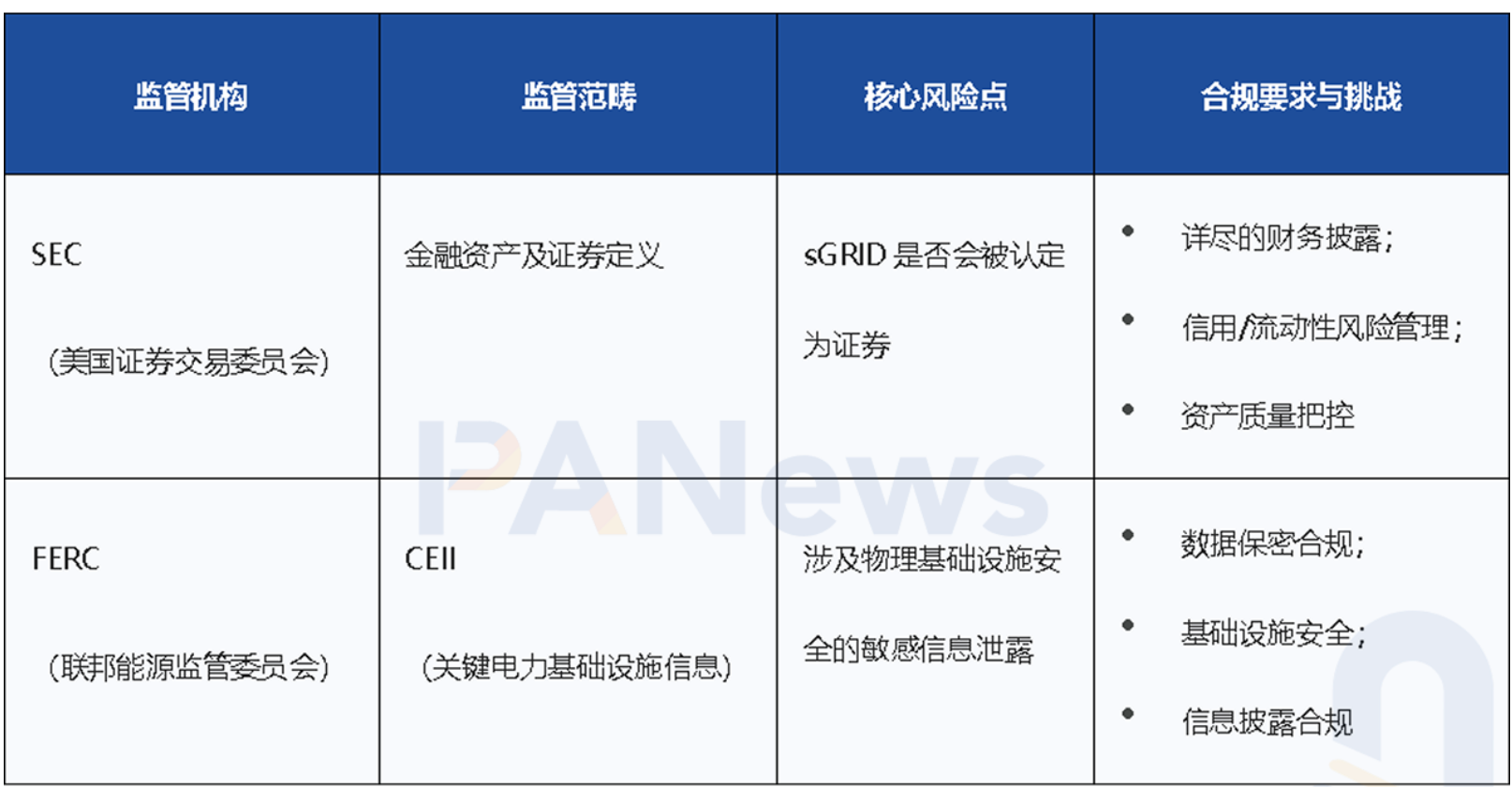
The ideal is丰满 (ambitious), but reality is布满监管荆棘 (littered with regulatory thorns). DayFi's foremost challenges come from the SEC (U.S. Securities and Exchange Commission) and FERC (Federal Energy Regulatory Commission).

sGRID represents the right to future electricity revenue, making it highly likely that the SEC will classify it as a security under the Howey Test. This means DayFi must fulfill the same disclosure obligations as traditional financial products: regularly reporting asset quality, cash flow status, risk management, and establishing investor protection mechanisms.

More complex regulatory conflicts come from FERC. Energy project information is often classified as CEII (Critical Electric Infrastructure Information), subject to strict confidentiality requirements. Disclosing details like power plant locations, design specifics, and operational data could threaten the physical security of the grid.

This directly contradicts the transparency ethos of DeFi. Blockchain requires revenue data to be verifiable on-chain; otherwise, it cannot prove the authenticity of the yield. If information is overly obscured for compliance, it risks becoming a "black box," undermining its decentralized foundation.

DayFi is essentially walking a tightrope. It must design a system that is "verifiable but not exposed," perhaps using technologies like Zero-Knowledge Proofs (ZKP) to disclose only the yield results to verifiers without leaking sensitive information like geographic coordinates of power plants.
Even if it navigates regulatory inquiries, DayFi faces another fundamental question: how much are the assets backing sGRID actually worth?

Unlike GRID, which is fully collateralized by cash equivalents, sGRID is pegged to the "net asset value" of distributed energy projects. And these assets—solar panels, storage batteries, inverters—can fluctuate wildly in value due to technological iteration and depreciation.

Crypto KOL @luyaoyuan also sharply questioned this: "The most虚 (inflated) part of the net value is the book value of deployed new energy assets, depreciated according to 2025 standards. It could easily include a bunch of废旧太阳能板 (scrap solar panels), batteries淘汰的 (discarded from) new energy vehicles, etc. The room for manipulation is too large."

Indeed, DayFi's whitepaper also repeatedly emphasizes that sGRID is not redeemable at any time and its value "fluctuates with the net value of the underlying assets." This effectively positions it as a kind of RWA (Real World Asset) net value index, but also opens up the possibility of valuation manipulation.

The problem is that power assets lack a consensus mechanism for on-chain valuation. Electricity revenue can be verified, but the residual value assessment of the power stations themselves may still rely on traditional audits, which fundamentally conflicts with the trustless principle of blockchain.

The endgame of AI is electricity. Energy is becoming the next main battlefield in AI competition. Even Musk recently emphasized that energy is the true currency and cannot be obtained through legislation. Amid surging energy demand and the popularity of the RWA concept, DayFi transforms energy from a static resource into a dynamic DeFi asset, allowing electricity traders, grid operators, and investors to utilize it efficiently on-chain. But is it a新能源DeFi协议 (new energy DeFi protocol) wrapped in green, or a pioneer destined to founder in regulatory fog or valuation bubbles? Its journey on-chain may provide the answer.


Related Questions

QWhat is DayFi and how does it aim to transform the energy sector using DeFi?

ADayFi is a decentralized energy capital markets protocol developed by Daylight. It aims to transform the energy sector by converting future electricity fee revenue into liquid crypto assets. It allows investors to deposit stablecoins to mint the protocol's stablecoin GRID, which provides liquidity for distributed energy projects. Investors then receive sGRID tokens, which represent a share in the electricity revenue generated by the underlying energy assets, effectively turning energy into yield-generating DeFi assets.

QWhich major venture capital firms have invested in Daylight and DayFi, and what is the significance of their investment?

AMajor venture capital investors include a16z Crypto and Framework Ventures. Their investment is significant because it signals a strong belief that access to electricity is becoming a new competitive moat in the AI race. They are betting on a solution to the AI energy crisis by funding infrastructure that can provide cheap, stable power more efficiently than traditional grid expansion methods.

QWhat are the primary regulatory challenges that DayFi faces from U.S. regulators?

ADayFi faces significant regulatory challenges from the SEC and FERC. The sGRID token, which represents a right to future electricity revenue, could be classified as a security under the Howey Test by the SEC, requiring extensive disclosure and investor protection measures. Furthermore, FERC regulations classify much energy project information as Critical Electric Infrastructure Information (CEII), which must be kept confidential for grid security. This conflicts with the transparency required for DeFi, forcing DayFi to find a balance using technologies like zero-knowledge proofs.

QHow does the DayFi protocol create a 'flywheel effect' for distributed energy resources?

AThe DayFi protocol is designed to create a positive flywheel effect: liquidity is brought into DayFi → the protocol's funds are used to accelerate the construction of distributed energy projects → these projects become operational and generate energy revenue → that revenue is tokenized and distributed as yield back to the sGRID token holders. This cycle encourages more investment, leading to further growth of the distributed energy network.

QWhat are the concerns regarding the valuation of the assets backing the sGRID token?

AA major concern is that the value of sGRID is tied to the net asset value of distributed energy projects (like solar panels and batteries), which can depreciate quickly and be highly volatile. Critics argue there is significant room for manipulation in valuing these physical assets, such as overvaluing depreciated equipment. Unlike the fully collateralized GRID stablecoin, sGRID acts more like a Real World Asset (RWA) index whose value fluctuates, and its valuation may still rely on traditional audits, which conflicts with the trustless nature of blockchain.

Related Reads

Qualcomm Chip Price Hike Deals a Blow to Android Phones

Qualcomm has officially announced a new round of price increases for its entire chip portfolio, effective September 1. The hikes, reaching up to 18% for the flagship Snapdragon 8 Elite Gen 6 Pro, follow similar moves by MediaTek, intensifying cost pressures on the already strained smartphone industry. CEO Cristiano Amon confirmed the plan, citing the need to offset rising industry-wide costs and restore declining profit margins. Qualcomm's Q3 FY2026 results showed a 25% drop in net profit, with mobile revenue plunging 20% year-over-year, hitting its lowest level since 2021. The surge in AI computing demand has led memory manufacturers to prioritize HBM production, creating a shortage in general-purpose DRAM and NAND Flash chips. Their prices soared by 93%-98% and 55%-60% respectively in Q1 2026, causing the memory cost share in smartphones to jump from 10%-15% to over 30%. Coupled with the soaring cost of advanced nodes like TSMC's 2nm and packaging, overall chip costs have reached historic highs. These upstream pressures are forcing downstream smartphone brands like Xiaomi, OPPO, and vivo to cut orders for mid-to-low-end models by up to 20% and use cost-saving measures like older chipsets. Reportedly, the Snapdragon 8E5 will be repurposed as a "long-lasting" chip for sub-brand phones in H2 2026. Amid this cost crisis, the Android market remains sluggish. Q2 2026 smartphone shipments in China fell 4.3% year-over-year, marking five consecutive quarters of decline. Major Android brands saw market share drop, while Huawei and Apple, with their in-house chip advantages, gained share. Qualcomm is diversifying into automotive and IoT sectors to reduce reliance on smartphones, but these new segments cannot yet fill the mobile revenue gap. Industry observers warn that the full impact of component cost hikes will hit in the second half of 2026, likely leading to higher-than-expected price increases for Android flagships and a further contraction in the Chinese smartphone market.

marsbit18m ago

Qualcomm Chip Price Hike Deals a Blow to Android Phones

marsbit18m ago

Breaking: GPT-5.6 Prices Slashed Effective Today

OpenAI has announced significant price cuts for its GPT-5.6 model API, effective immediately. The entry-level **GPT-5.6 Luna** sees the most drastic reduction, with input prices dropping 80% to $0.20 per million tokens and output prices falling to $1.20 per million tokens. The mid-tier **GPT-5.6 Terra** is reduced by 20%, now costing $2.00 (input) and $12.00 (output) per million tokens. The flagship **GPT-5.6 Sol** maintains its original price but introduces a new **Fast mode**, offering speeds up to 2.5 times faster for double the cost. The company attributes these price reductions to efficiency gains achieved through **GPT-5.6 Sol's own involvement in optimizing its production systems**. The model assisted in rewriting GPU kernels and improving speculative decoding, leading to a 20% reduction in end-to-end service costs and over 15% improvement in token generation efficiency. OpenAI emphasizes this process remained human-led. A key focus of the降价 is to lower the barrier for running **AI agent workflows**. By making the capable, tool-calling Luna model significantly cheaper, OpenAI aims to enable more frequent use in cost-sensitive, high-volume tasks like code review and monitoring. This creates a potential feedback loop: model-assisted efficiency gains lead to lower costs, which enables broader agent deployment, which in turn drives further optimization. The new pricing and features will also apply to Codex and ChatGPT Work subscriptions. The changes intensify competition in the large language model market, with OpenAI directly challenging rivals like Anthropic to respond.

marsbit47m ago

Breaking: GPT-5.6 Prices Slashed Effective Today

marsbit47m ago

Trading

Spot
活动图片