A New Paradigm in Tokenomics? When Backpack Makes VCs 'Delay Gratification'

marsbitPublished on 2026-02-10Last updated on 2026-02-10

Abstract

The article discusses Backpack's innovative tokenomics model, which challenges conventional practices in the cryptocurrency industry. Unlike typical projects where teams and venture capitalists (VCs) receive immediate token allocations, Backpack allocates 100% of liquid tokens to users at TGE. The remaining 37.5% of tokens, traditionally reserved for teams and investors, are locked in a corporate vault and tied to the company’s eventual IPO. This structure ensures that internal stakeholders can only benefit after a successful IPO, with an additional one-year lock-up period post-IPO to prevent early sell-offs. Backpack’s approach emphasizes long-term alignment with user interests and project sustainability. The token distribution prioritizes community incentives, with 25% of tokens released at TGE to reward users and NFT holders. Future unlocks are tied to product milestones, ensuring that new token releases contribute more value to the ecosystem than they dilute the token’s price. Additionally, Backpack prioritizes regulatory compliance, currently serving only 48% of global regions to adhere to legal standards. Its goal is to build a hybrid platform integrating crypto and traditional financial services. Market reactions are mixed: Backpack is reportedly seeking funding at a $1 billion valuation, but predictions about its token FDV reflect uncertainty. Ultimately, Backpack’s model represents a shift toward transparency, long-term value, and user-centric growth in Web3.

In the "Wild West" of cryptocurrency, "founders cashing out and exiting" and "project teams rug-pulling retail investors" have become blatant acts of profit plunder, turning into chronic maladies that shackle the development of Web3. Consequently, "tokenomics" is often seen as an accelerator for team wealth and a touchstone for user confidence.

However, when we turn our attention to Backpack, we see a completely different design: Backpack has chosen a thorny path that directly addresses the industry's pain points: at TGE, all liquid tokens are given to users, while the returns for the team and investors are entirely tied to the company's IPO process.

This move by Backpack abandons the rugged design of "VCs setting up the game, retail investors footing the bill." Whether it ultimately succeeds or not, this is a respectable attempt in the history of cryptocurrency.

Delayed Gratification: The Long-Term Game Between Team and Capital

In Backpack's token economic system, the most attention-grabbing aspect is the strict constraints on returns for the team and investors—no founders, executives, employees, or venture capitalists directly receive token allocations.

As Backpack founder and CEO Armani Ferrante put it, the "escape velocity" Backpack seeks is never about reaching a market cap of billions of dollars or hitting some short-term milestone in user numbers, but about the company successfully completing an IPO in the United States.

All tokens originally intended for "team incentives" and "investor returns" (37.5% of the total supply) are deposited into the company's "corporate treasury," i.e., on Backpack's balance sheet. Even after a successful IPO, these tokens are subject to a fully locked period of at least one year, further eliminating the possibility of "cashing out immediately upon listing."

This design of "delayed gratification" is the best protection for the project's long-term value. In the crypto industry, too many projects collapse due to the "short-sightedness" of teams and investors—selling tokens too early to cash out, causing token prices to crash, losing user trust, and ultimately leading to demise. Backpack's approach completely severs the path for insiders to "cash out short-term," forcing the team and investors to "sink or swim" with the project.

Of course, an IPO is no easy path. Backpack's founders admit that going public could be imminent, could be far off, or might never happen. But regardless of the outcome, they will give it their all. This "break or break through" determination makes Backpack stand out among the myriad of short-sighted crypto projects, yet it has won the trust of users who truly value long-term value.

User-First Token Distribution: Igniting the Growth Engine with Incentives

In Backpack's tokenomics, all liquid tokens are entirely allocated to users. In Backpack's view, users are the core driving force behind project growth, so tokens should serve as fuel to incentivize user participation and drive product development.
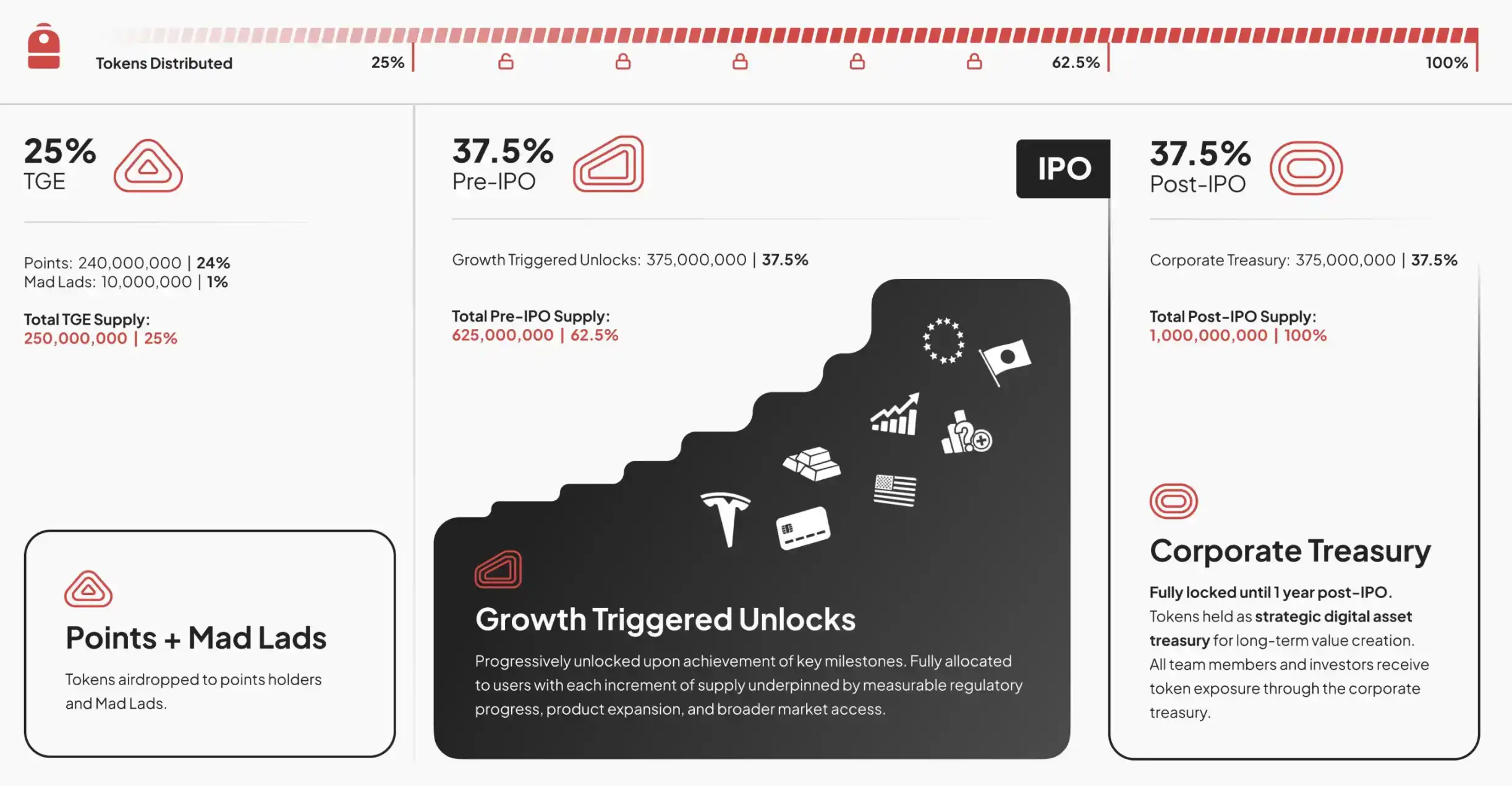
· Total supply of 1 billion tokens, 25% directly released to the community at TGE: Among these, points holders account for 24%, and Mad Lads holders account for 1%.

· Unlocked (37.5%) triggered by key product milestones before IPO. Every market expansion, every new product launch, is an opportunity to incentivize users with tokens, each triggering corresponding token unlocks. This design, through a predictable token unlock model, continuously attracts new users and expands the community scale.

More importantly, according to Armani Ferrante, Backpack has set strict constraints for token unlocks: the new ecological value brought by token unlocks must always be greater than its dilutive effect on the token price.

This design protects the core interests of users while ensuring the project's long-term value is not diluted by short-term unlocking behavior, making token incentives a true catalyst for platform growth, achieving a triple win of "user benefit, ecological value addition, and project growth."

Under Compliance: Slow is Fast

Beyond the innovation in token distribution, another distinctive feature of Backpack is its pursuit of compliance. This stands in stark contrast to the common logic in the industry of "expand first, comply later" and "prioritize scale over compliance."

As Armani Ferrante revealed, "Backpack currently serves only about 48% of regions globally. Behind this seemingly slow expansion lies a pursuit of compliance."

This strategic choice might mean missing market opportunities in the short term, but from a long-term development perspective, it is key to building a trust barrier.

Currently, Backpack's positioning is a compliant crypto exchange, offering cryptocurrency spot, derivatives, and lending services. But it is not content with being a pure cryptocurrency trading platform; it aims to build a compliant platform integrating crypto assets and traditional financial (TradFi) services. To achieve this goal, the team is laying banking rails globally and also plans to gradually launch diversified services like securities products in the future. In January, Backpack also launched a unified margin and cross-collateralization prediction product.

Market Perspective: How to View Backpack's FDV?

The market's attitude towards Backpack also reflects the controversy and potential of its model from the side.

According to Axios citing informed sources, Backpack is negotiating terms for new financing, with a pre-money valuation already reaching $1 billion.

On the prediction market Polymarket, market expectations for Backpack's token show significant volatility: the probability of Backpack's token FDV exceeding $1 billion within one day of listing is 21%, while in November 2025, this probability once reached over 80%. Of course, this volatility largely stems from the inherent uncertainty of the crypto market and also reflects the market's cautious attitude towards the "IPO-bound returns" model.

Summary

When tokens become tools for project teams to cash out, and users become targets to be harvested, the crypto industry loses its original ideals. Backpack's token distribution essentially creates a physical separation between Web2 equity incentives and Web3 token utility.

· For the team: The only way out is to make the product stronger and more compliant until the IPO. If the company fails midway or cannot go public, the equity in the team's hands will be worthless, with no possibility of cashing out.

· For the community: They are no longer the liquidity exit for VCs. Tokens are purely user rewards and ecological tools, not the team's ATM.

Backpack's choice is to redefine the value logic of crypto projects with compliance, transparency, and long-termism, showing us another possibility for the Web3 industry.

As Armani Ferrante said: "We either go big, or we go home." This statement is not only the manifesto of the Backpack team but also a mandatory question for the entire Web3 industry: Do we continue to revel in the speculative bubble,透支行业的信任与未来透支行业的信任与未来 (overdrawing the industry's trust and future原文此处为中文); or do we, like Backpack, choose the harder, slower, but more hopeful path, using long-termism to reconstruct the industry ecosystem?

Of course, an IPO is not easy, and the road is long and arduous, especially in the crypto industry, facing multiple challenges like regulation, market, and competition. Accidents and uncertainties are everywhere.


Related Questions

QWhat is the core innovation in Backpack's token economics model?

ABackpack's token economics model allocates all liquid tokens to users at TGE, while team and investor rewards are entirely tied to the company's IPO process, preventing early insider sales and aligning long-term incentives.

QHow does Backpack ensure that token unlocks benefit the ecosystem without diluting value?

ABackpack sets strict constraints for token unlocks: the new ecological value generated from unlocks must always exceed the dilutive effect on the token price, ensuring user benefits and sustainable growth.

QWhat percentage of the total token supply is allocated to the community at TGE, and how is it distributed?

AAt TGE, 25% of the total 1 billion token supply is allocated to the community: 24% to points holders and 1% to Mad Lads holders.

QWhy does Backpack prioritize compliance in its expansion strategy, and what regions does it currently serve?

ABackpack prioritizes compliance to build long-term trust and regulatory security, currently serving only about 48% of global regions to ensure adherence to local laws before expanding.

QWhat is the significance of tying team and investor rewards to Backpack's IPO instead of token sales?

ALinking rewards to the IPO ensures that team and investors are fully committed to the project's long-term success, as they cannot cash out until after a successful IPO, which may take years or never happen, aligning their interests with sustainable growth.

Related Reads

Misjudged A-Shares: Resilience, Expectations, and Confidence

China's A-share market recently faced selling pressure, especially in tech sectors, initially triggered by a global tech sell-off that began in South Korea. However, the article argues this is a case of "mistaken injury" and highlights the market's underlying resilience. This resilience stems from three main pillars: **1) Tech Sector Fundamentals:** Unlike Korea's market dominated by a few memory chip stocks, China's tech sector is diversified across computing, communications, electronics, and semiconductors, supported by dual narratives of global AI supply chains and domestic substitution. Core areas like optical modules and fiber optics continue to show strong earnings growth. **2) "National Team" Support:** State-backed institutions and large corporations have made significant market purchases and announced buybacks, providing liquidity and signaling confidence. This is seen as a stabilizing policy signal, often associated with market bottoms. **3) Broader Market Pillars:** Other major sectors are showing endogenous recovery momentum. Consumer stocks benefit from stabilizing CPI and signs of sector recovery (e.g., liquor price hikes). Cyclical sectors like aluminum have high earnings, potential price increases due to tight supply, and low valuations. The financial sector offers stable dividends and low valuations. The conclusion is that the sell-off was driven by external contagion, not a collapse in fundamentals. With strong policy support and recovering momentum across key sectors, the A-share market possesses the toughness to regain stability.

marsbit24m ago

Misjudged A-Shares: Resilience, Expectations, and Confidence

marsbit24m ago

The Clarity Act's Journey Through Congress: The Thorny Path of Bipartisan Compromise in the U.S.

The U.S. Congress is struggling to advance the crypto market structure bill known as the Clarity Act, with bipartisan compromise proving difficult. Key hurdles include unresolved disputes over "yield" products and, more critically, the inclusion of strong ethics provisions for elected officials—a non-negotiable demand for many Democrats. While a compromise on yield was reached in May, securing only limited Democratic support in committee, the separate Senate Agriculture Committee version later passed with no Democratic votes due to the ethics impasse. As Republicans push for a full Senate vote in July, demands for ethics rules have expanded, and other contentious issues like developer protections and concerns from law enforcement and large banks further complicate negotiations. Despite consensus on the need for legislation, the path forward is unclear. Recent discussions between senators and White House officials aim to find acceptable ethics language. Some lawmakers question whether a compromise text can garner enough bipartisan support, with one Democrat stating the current proposal lacks the strong ethics provisions required for their vote. Potential short-term goals for the crypto community include symbolic Senate action before the August recess, a longer-term aim for passage by 2026, or establishing a detailed framework that addresses ethics and other compromises. The process remains arduous, relying on the traditional, vote-by-vote effort to build bipartisan support.

marsbit44m ago

The Clarity Act's Journey Through Congress: The Thorny Path of Bipartisan Compromise in the U.S.

marsbit44m ago

Are Kalshi and Polymarket Founders at Odds? This Business Rivalry Is More Brutal Than You Think

"The Rivalry Between Kalshi and Polymarket Founders Turns Bitter and Litigious" The intense feud between Tarek Mansour, CEO of Kalshi, and Shayne Coplan, founder of Polymarket, has escalated far beyond typical business competition into personal animosity and regulatory battles. Both lead billion-dollar prediction market platforms, but their approaches differ sharply. Kalshi positions itself as the compliant operator, securing U.S. regulatory approval before launching. In contrast, Polymarket initially operated offshore, allowing U.S. users to access its platform via VPN, which drew regulatory scrutiny. The conflict reached a peak in November 2024 when FBI agents raided Coplan's New York apartment. While Coplan publicly blamed political motives, his team privately suspected Kalshi was involved. According to sources, Kalshi's lawyers had previously reported Polymarket's operations to federal prosecutors, highlighting its accessibility to U.S. users despite a ban. This incident fueled mutual accusations and underhanded tactics, including social media smear campaigns and attempts to sabotage each other's major business deals. Their rivalry also played out in Washington, influencing regulatory debates. Kalshi actively lobbied against Polymarket's practices, framing them as illegal and unethical. Polymarket, after facing a CFTC fine and investigation, later acquired a licensed U.S. firm to launch a domestic app, regaining a foothold. Despite the hostility, both companies have seen massive growth, with combined trading volumes soaring. However, increased regulatory scrutiny, particularly around insider trading on Polymarket's platform, continues to pose challenges. The founders' deep-seated mutual disdain ensures their battle for market dominance remains as much a personal vendetta as a commercial one.

marsbit53m ago

Are Kalshi and Polymarket Founders at Odds? This Business Rivalry Is More Brutal Than You Think

marsbit53m ago

Trading

Spot
活动图片




