A Hard-Fought Battle to Defend Par Value: STRC Drifts Further Away from $100

Foresight NewsPublished on 2026-06-25Last updated on 2026-06-25

Abstract

STRC, the dividend-paying stock issued by Michael Saylor's bitcoin reserve firm Strategy (formerly MicroStrategy), is trading far below its intended $100 par value, closing recently at $80.84. With a key dividend snapshot date approaching, Saylor aims to pull the price back to $100, as per SEC filings stating the company's goal to stabilize the stock near that level. The situation is complicated by the June volume-weighted average price (VWAP) falling below $95, triggering an internal rule that mandates the next dividend increase to be at least double the standard 0.25% per cycle, potentially pushing the annualized dividend yield to 12%. However, attracting buyers with this higher yield faces challenges: the payout is spread over 24 bi-monthly installments, the board can alter or suspend dividends at any time, and there is no guarantee against further price declines. Beyond raising dividends, Strategy has limited tools to boost the stock. These include direct share buybacks (never utilized), halting new share issuances above $100 (which currently cap the price), selling ordinary MSTR shares to build a cash buffer for dividends (with limited effect so far), or announcing special shareholder benefits. Historically, STRC has reclaimed the $100 mark, such as in October last year, driven by a combination of dividend fulfillment, a rate hike, and a pause in share sales. The core question remains how much cost and effort Strategy is willing to bear to attract the necessary buying ...


Written by: Protos

Compiled by: Chopper, Foresight News


STRC is a dividend-paying stock issued by Strategy (formerly MicroStrategy), the Bitcoin reserve company led by Michael Saylor. Its latest closing price has fallen to $80.84.


That number was supposed to be $100.
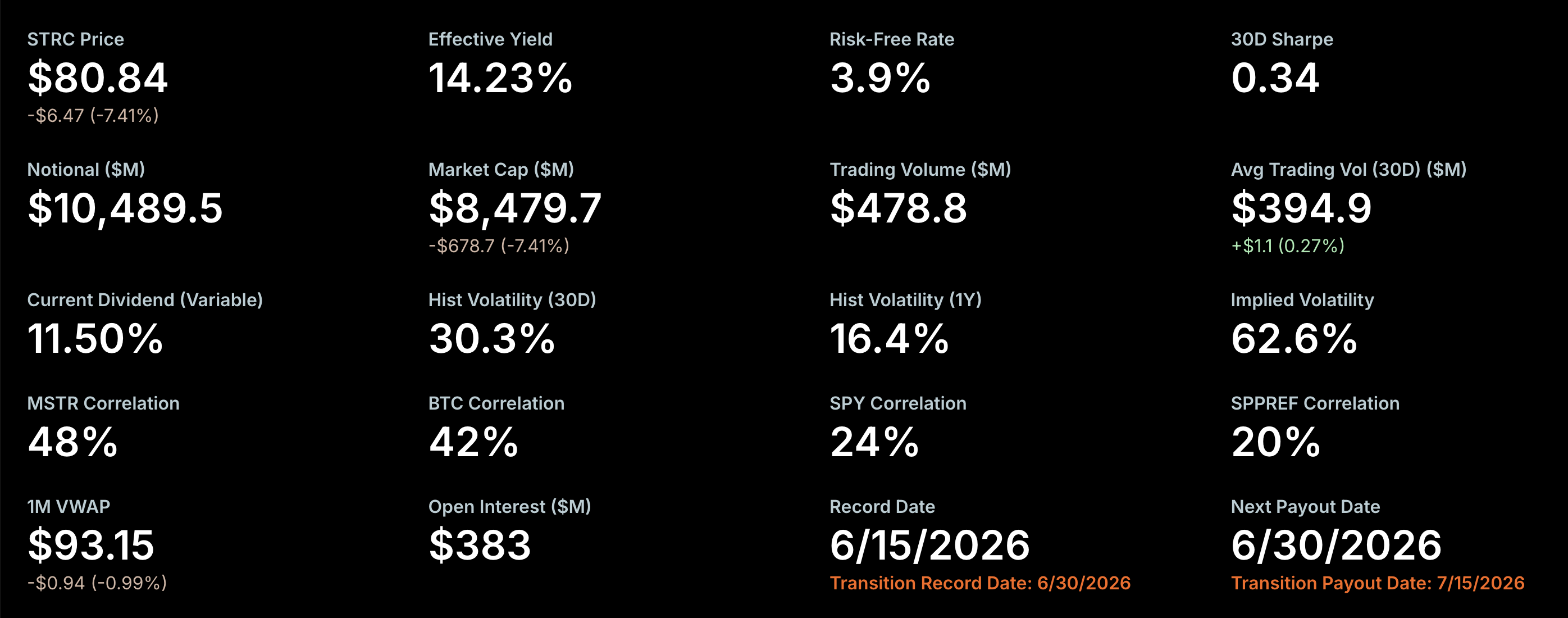

STRC Price Panel, Source: Strategy Website


Saylor places great importance on STRC maintaining a trading price at its $100 par value. With just one week left until the dividend snapshot date, he hopes to pull the stock price back to the $100 mark before then.


The company's filing with the U.S. Securities and Exchange Commission (SEC) clearly states: Strategy "aims to stabilize the trading price of STRC shares near the par value of $100 per share."


But the reality is, the current stock price is at a discount of about 20% to its par value.


More critically, the company's data panel reveals another severe crisis: As of yesterday's Nasdaq close, STRC's June monthly Volume-Weighted Average Price (VWAP) was $94.09, falling below the company's set red line of $95. According to internal rules, once this threshold is triggered, the dividend increase must be at least double the regular standard.


Based on the internal dividend mechanism, if the final June monthly VWAP closes below $95, the next STRC dividend increase cannot be lower than 0.5%. Under normal circumstances, since its listing, STRC's dividend increase per dividend registration cycle has been only 0.25%.


This means if secondary market funds do not actively enter to boost the stock price, the current 11.5% annualized dividend yield will most likely be raised to 12% in the next dividend registration cycle in mid-July. If Strategy's board wants to adopt a more aggressive strategy, their rules allow them to grant a higher increase at their discretion.



Can a 12% High Dividend Pull the Stock Price Back to $100?


Even if a 12% ultra-high dividend has the potential to attract buying interest, the current stock price of around $80 still has a huge gap to reach $100.


First, investors need to hold the stock for an entire year to receive this expected 12% dividend, and the dividend will be split into 24 bi-monthly capital return payments, each distributing only 0.5%. Second, the board can lower the dividend standard at any time during the year.


Furthermore, the STRC stock price itself still carries the risk of continued decline.


Ultimately, investing in STRC relies entirely on market expectations, with no guaranteed returns. The company's board can modify or suspend the dividend policy at any time, and this so-called "standardized dividend mechanism" has no legal binding force. The company's public disclosure documents repeatedly caution: cash dividends are not promised and there is a possibility of sudden reductions or direct suspension; meanwhile, the company provides no guarantee for the secondary market price of STRC, and the stock's current performance remains persistently weak.


Four Other Feasible Means to Boost the Stock Price


Apart from significantly raising the dividend, Strategy has four other tools to restore market confidence, but their implementation is relatively unlikely and their effectiveness limited.


First, the company could directly repurchase STRC shares in the secondary market.


Rules allow the company to buy back its own shares on the Nasdaq exchange, but it has never conducted repurchase operations, nor has it indicated any intention to do so. On the contrary, the original purpose of Strategy issuing STRC was to sell shares to raise funds and increase Bitcoin holdings, not to support the stock price through buybacks.


Second, Strategy might announce a suspension of issuing STRC at prices above $100.


Strategy's supplemental filing from last November shows plans to continuously issue new STRC in the range of $99 to $101, with the actual issuance price basically locked at $100.01. Continuous issuance dilutes the float, essentially placing a natural ceiling on the stock price, as speculative buying interest weakens significantly when the price approaches $100. If the company suddenly announced a halt to dilutive issuances around $100.01, this unexpected move might temporarily boost market sentiment.


Third, the company could signal long-term stable dividend-paying capability to the market by selling ordinary shares and continuously accumulating US dollar cash.


In recent weeks, Strategy has already used this method, selling MSTR ordinary shares and adding hundreds of millions of dollars to its cash buffer, but with little effect. Currently, the company's dollar reserves are only $1.4 billion, a scale insufficient to reassure STRC shareholders to hold on.


Fourth, Strategy might announce a benefit that surprises STRC shareholders.


A public company's board has the authority to distribute one-time special dividends or shareholder perks, creating positive surprises. For example, company CEO Phong Le purchased $1 million worth of STRC this week. Although the amount is negligible compared to his annual compensation, it still counts as a small positive signal. If the board introduced more creative shareholder benefits, it might reverse the current bearish market sentiment.


Historically, STRC has also rebounded against the trend and stabilized above $100. According to a Protos report last October, at that time, the company fully delivered dividends, raised the dividend to 10.25%, and suspended selling STRC through the ATM issuance channel since July. Multiple positive factors resonated, pushing the stock price back to $100 for the first time. Before that dividend registration date, many investors were willing to enter at $100.


Judging from its historical performance, STRC has the full potential to return to $100. The only question is: How much cost is Strategy willing to bear to attract funds to buy in?


Related Questions

QWhat is the current trading price of STRC, and how does it compare to its intended par value?

AThe current closing price of STRC is $80.84, which is approximately 20% below its intended par value of $100.

QWhat is the consequence for STRC's dividend if the June Volume Weighted Average Price (VWAP) falls below $95?

AIf the June monthly VWAP falls below $95, the next dividend increase for STRC must be at least 0.5%, which is double the standard increase of 0.25% per dividend registration cycle.

QWhat are the four potential methods mentioned for Strategy to boost confidence in STRC's price?

AThe four methods are: 1. Directly repurchasing STRC shares in the secondary market. 2. Announcing a pause in issuing new STRC shares above $100. 3. Selling common shares (MSTR) to accumulate cash and signal stable dividend capacity. 4. Announcing a special surprise benefit for STRC shareholders, like a one-time special dividend.

QWhat is a key risk associated with investing in STRC, according to the company's disclosures?

AA key risk is that the dividend policy is not guaranteed. The company's board can modify, suspend, or stop the dividend policy at any time, and there is no legal guarantee for the standardized dividend mechanism or any price support for STRC's secondary market value.

QHas STRC ever traded at its $100 par value before, and what contributed to that achievement?

AYes, STRC returned to and held the $100 price level in the past. According to a Protos report from October of last year, this was achieved by the company fully delivering on dividends, raising the dividend to 10.25%, and pausing sales of STRC shares through its ATM (At-The-Market) offering channel starting in July.

Related Reads

Tiger Research: Three Strategies for Financial Institutions to Keep Up with the Tokenization Wave

Tiger Research's in-depth report analyzes the strategic choices for financial institutions entering the rapidly growing Real-World Asset (RWA) tokenization market. With the market projected to be worth $25-36 billion and a lack of complete regulatory frameworks in many jurisdictions, institutions face three options: waiting for domestic legislation, using regulatory sandboxes for limited experiments, or moving first into established overseas markets to gain a competitive edge. Tokenization is not magic; it requires meticulous preparation. Before entry, institutions must strategically plan across six core areas: choosing a jurisdiction, obtaining necessary licenses, defining the asset type, targeting the appropriate investor base, selecting settlement currencies, and designing operational requirements like custody and governance. The report outlines two main operational paths. The first is a direct jurisdictional path, establishing a legal presence in mature markets like Hong Kong, Singapore, or the U.S., often leveraging local licensed platforms to accelerate market entry. The second is a chain-native path, using platforms like Ondo or Plume that are built with regulatory compliance embedded, allowing for faster, more flexible market access without being tied to a specific jurisdiction. Ultimately, the report advises against waiting for perfect regulation. The preparation process can take 6-12 months and requires thorough legal review. Using the example of a mid-sized securities firm, it details steps from evaluating existing entities to final execution. The core message is that accumulating real-world operational experience is paramount, as the market is moving ahead and will not wait for latecomers.

Foresight News1h ago

Tiger Research: Three Strategies for Financial Institutions to Keep Up with the Tokenization Wave

Foresight News1h ago

Unitree's IPO Frenzy: The Real Mystery is How It Will Spend the 42 Billion Raised

Unitree, a Chinese robotics company, is set for a public listing after its IPO registration was approved by regulators. The company, which started with quadruped robots and has expanded into humanoids, plans to raise approximately 4.2 billion yuan through its offering. The article traces Unitree's rapid growth from its founding in 2016 to its current status. It highlights key milestones like the 2021 CCTV Spring Festival Gala performance, the 2023 launch of its affordable Go2 robot dog and the H1 humanoid robot, and a series of subsequent product launches. By 2025, the company reported revenue of 1.71 billion yuan, profitability, and sales exceeding 5,500 humanoid robots. As the first publicly-listed humanoid robot company on China's STAR Market, Unitree's main challenges are sustaining growth and deploying its newly raised capital effectively. The humanoid robot sector in China is crowded, with over 140 companies. Competitors include UBTech (focusing on industrial and consumer markets), Fourier, and international players like Tesla Optimus and 1X NEO. The article outlines three critical challenges for Unitree: establishing a strong second product line beyond its quadruped robots, maintaining its price advantage while ensuring quality, and successfully advancing its embodied AI capabilities through partnerships like the one with NVIDIA for the H2 Plus platform. Unitree's likely strategy involves a "developer tools + industry benchmarks" approach: using low-cost models like the R1 and G1 to build developer adoption and volume, leveraging high-end platforms for AI training, and securing pilot projects in sectors like logistics and manufacturing to build case studies. The company's future success hinges on converting its current momentum in shipments and pilot programs into sustainable, large-scale commercial contracts as the broader market evolves.

marsbit2h ago

Unitree's IPO Frenzy: The Real Mystery is How It Will Spend the 42 Billion Raised

marsbit2h ago

Trading

Spot
活动图片