A Century-Long Journey of an Egg: From Wall Street to Polymarket

marsbitPublished on 2026-03-02Last updated on 2026-03-02

Abstract

The article traces the historical journey of egg futures, once one of the most active commodities traded on Wall Street. Beginning at the Chicago Butter and Egg Board (which later became the CME), egg futures were highly active in the early 20th century. However, by the 1980s, industrial farming and improved supply chains reduced price volatility, leading to the decline of egg futures trading in traditional markets. In 2013, China’s Dalian Commodity Exchange revived egg futures due to market volatility. More recently, egg price speculation has moved to Polymarket, a prediction market platform. One trader, "xcnstrategy," reportedly earned significant profits by shorting egg price intervals, likely leveraging expertise in commodity markets or agriculture. The piece highlights a broader trend: crypto and prediction markets like Polymarket and Hyperliquid are increasingly serving as 24/7 trading venues for traditional assets—including oil, gold, and forex—especially during periods when conventional markets are closed. This was evident during recent U.S.-Iran tensions when traders used these platforms to hedge and price assets amid traditional market closures. The evolution reflects an ongoing shift in price discovery power from established exchanges to decentralized, always-on crypto markets—echoing the original purpose of futures markets: to manage risk and determine prices.

"We went from eggs to yen"—this financial reminiscence from CME legend Leo Melamed bears witness to a time when eggs were once one of the world's most active futures products.

In the first half of the 20th century, egg futures were among the hottest trading instruments in Chicago. Trading volume in some years was second only to grain varieties, and there were even instances where futures trading far exceeded the volume of physical circulation.

The predecessor of the Chicago Mercantile Exchange (CME), the world's largest derivatives market, was called the "Chicago Butter and Egg Board." This was the foundation of what would later become a derivatives empire, and as the name implies, the exchange initially traded only two things: butter and eggs.

After the 1970s, the U.S. egg-laying industry rapidly industrialized, cold chains matured, and price fluctuations were gradually "smoothed out." As uncertainty began to fade, the noise in the trading pits quieted down. In 1982, egg futures officially exited the Chicago Mercantile Exchange. It didn’t collapse dramatically; rather, it was as if the times quietly turned off the lights.

In 2013, the Dalian Commodity Exchange in mainland China reignited this product. At that time, mainland China's egg-laying industry was still highly fragmented, with sharp price fluctuations, making hedging needs real and urgent.

Egg futures trading did not disappear; it merely migrated. And today, this migration has taken another step forward. The venue for trading egg prices has moved to Polymarket.
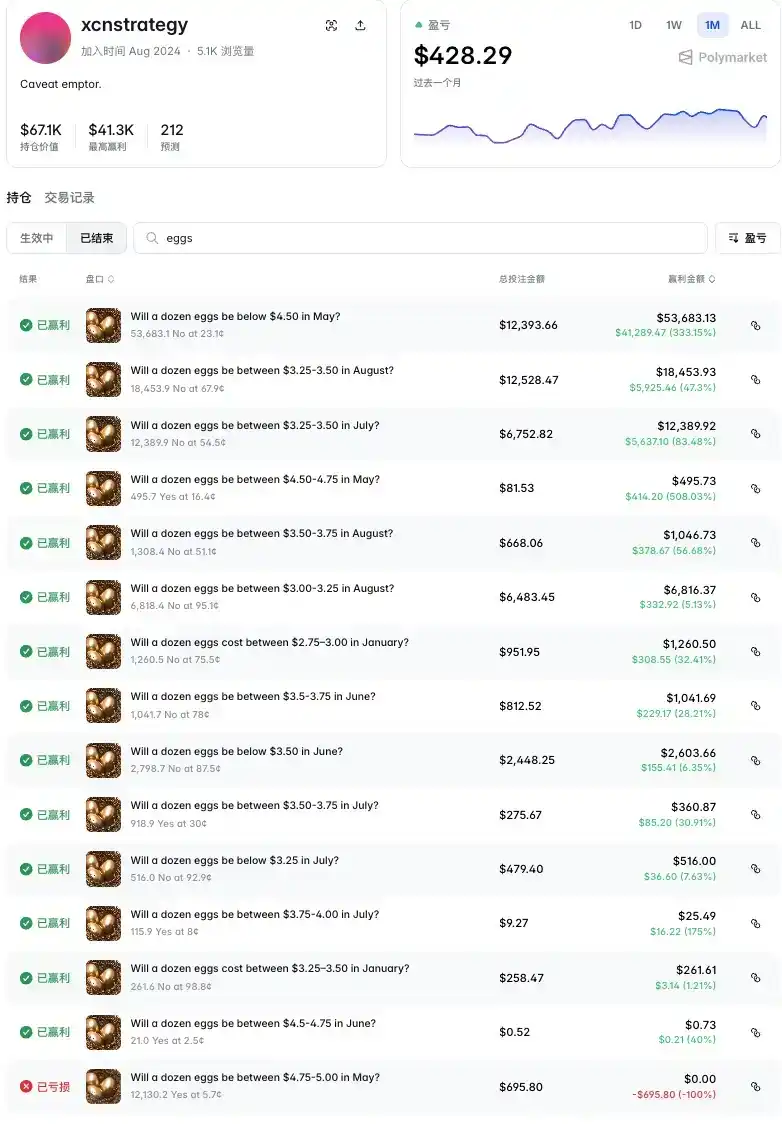
A trader with the ID "xcnstrategy" established positions in multiple expiration months—January, May, June, July, and August—for egg price predictions. The vast majority of these trades were shorting the "Yes" for certain price ranges, meaning betting that eggs would not reach certain price levels. The total betting amount was $44,800, with nearly $100,000 in profits. Out of 15 trades, all but the first were profitable.

The most recent trade was also the most profitable: a $12,393 bet on "No" for "a dozen eggs in May below $4.50," yielding a profit of $41,289 (+333%).

Speculations about xcnstrategy’s true identity, aside from possibly being an "egg enthusiast," include many who believe he is likely someone with a commodities market background or agricultural data research capabilities, analyzing that the U.S. avian flu-induced egg price surge starting in 2025 was a short-term phenomenon and that the market overestimated the probability of sustained high prices. Others think he is an industry insider in the egg supply chain, hedging against the volatility inherent in the industry.
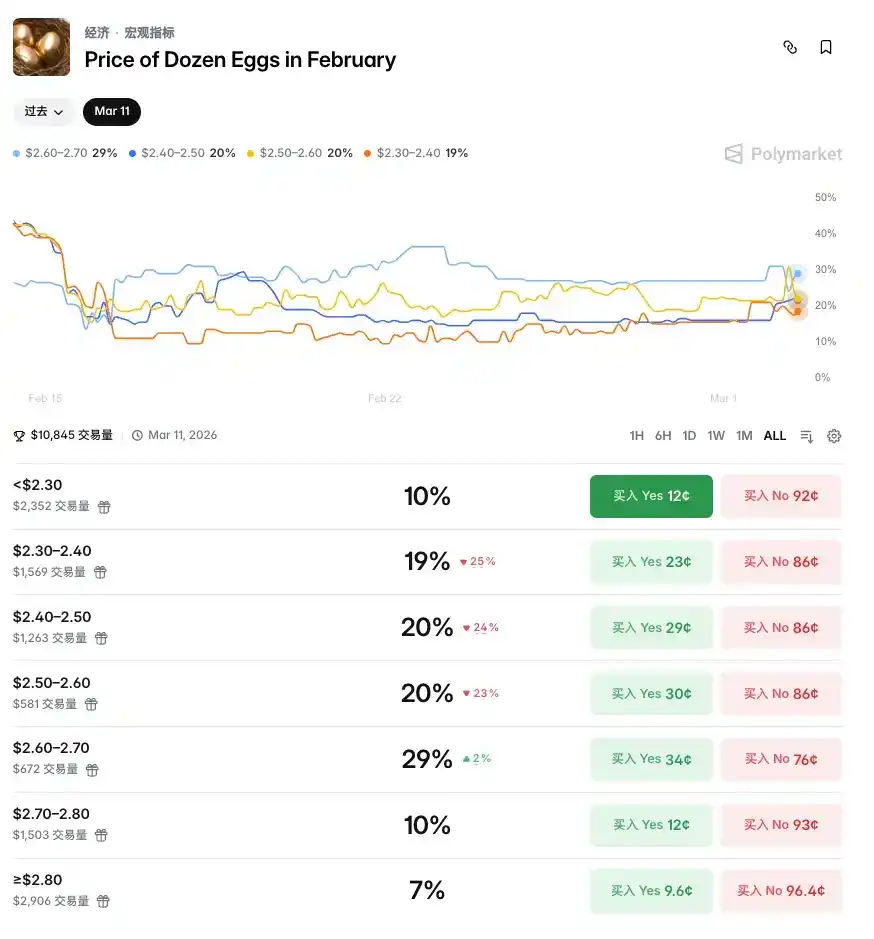
Eggs are just one example. The traditional asset标的 available for trading on Polymarket are far more diverse than one might imagine: from crude oil (CL), gold (GC), silver (SI), and other commodities to various foreign exchange rates and housing data—all can be found as markets on Polymarket.
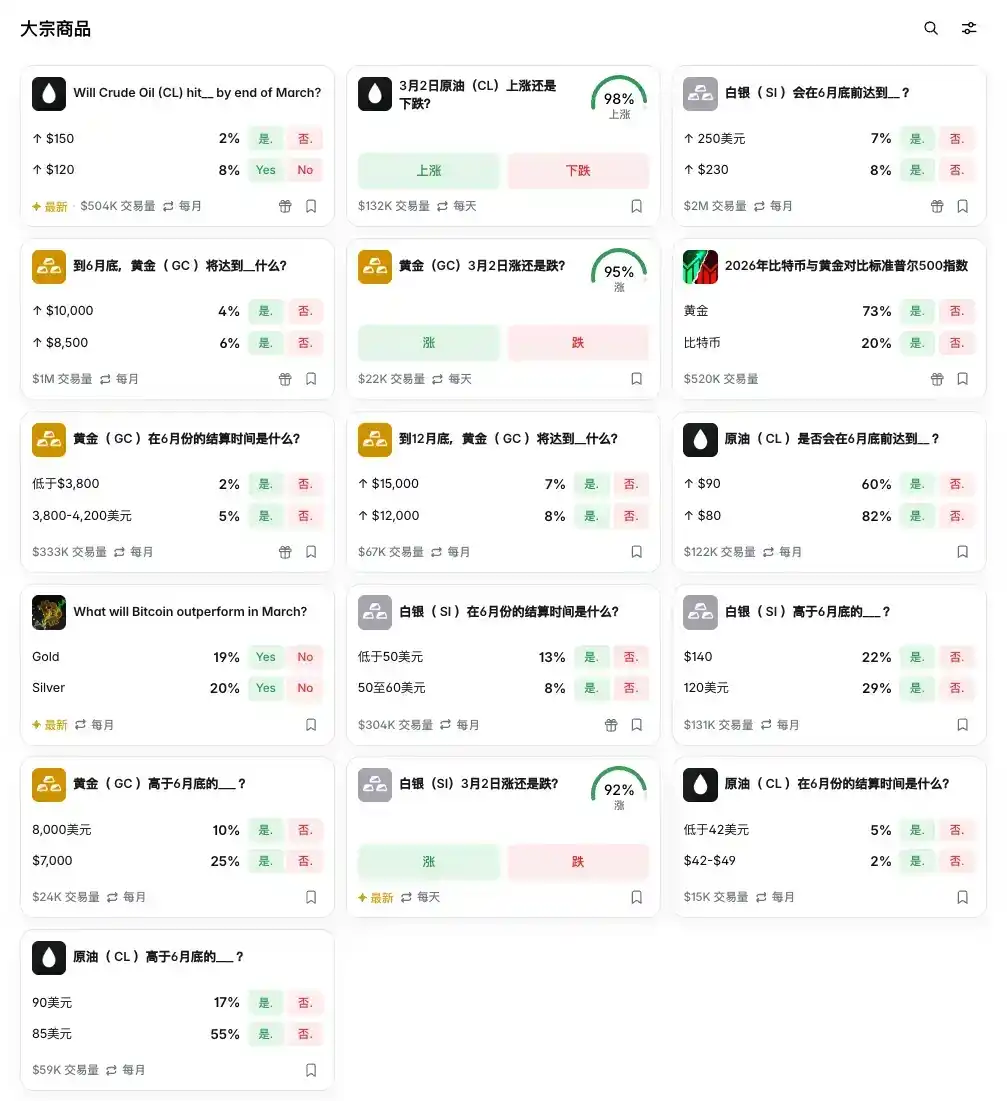
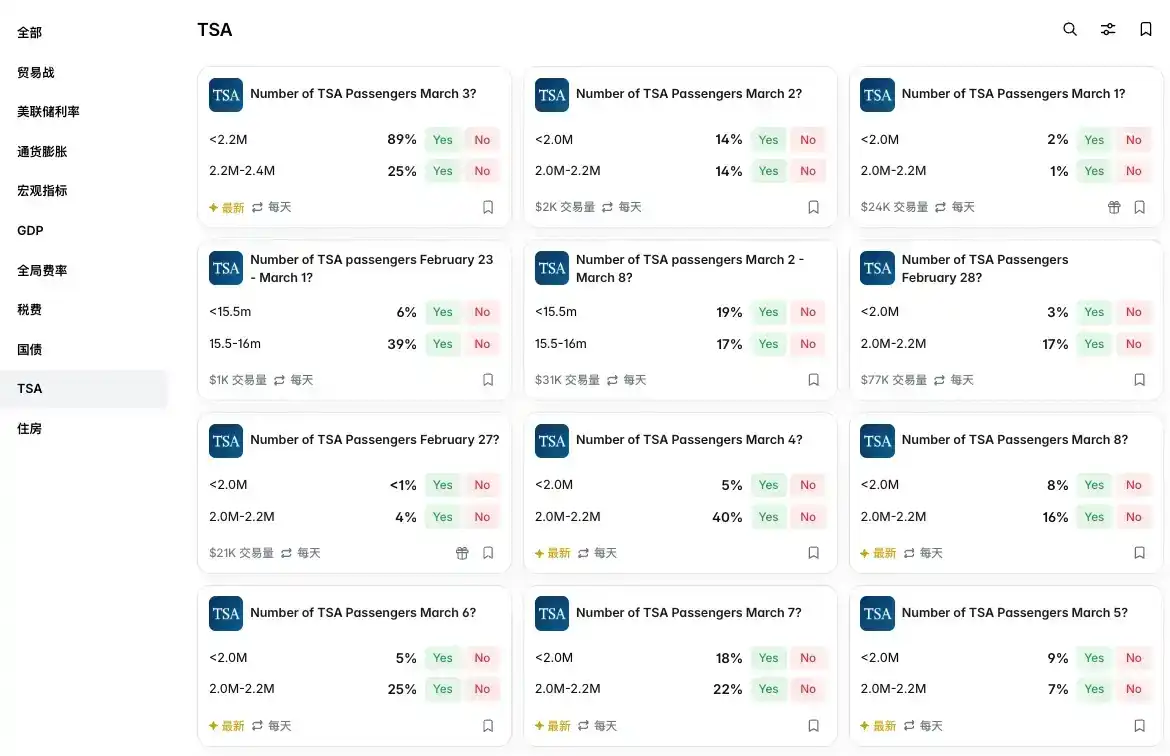
Operating 24/7 without closing is one of the biggest advantages of trading such markets on Polymarket. This advantage is particularly evident during traditional financial market closures, as seen with the U.S.-Iran conflict escalation last weekend.

In this regard, Hyperliquid shares the same advantage. The perpetual contracts on Hyperliquid, linked to crude oil and gold, have no expiration dates and run continuously, 24/7.

This leads to an increasingly hard-to-ignore phenomenon: the crypto market is quietly taking on the price discovery function of traditional financial markets, especially when the latter are closed.

Traditional futures markets have fixed trading hours; CME's crude oil and gold contracts close on weekends, and foreign exchange markets see liquidity dry up late at night. This means that when geopolitical shocks erupt after Friday's close, participants are left in the dark—unable to hedge, express views, or price assets.

Last weekend's U.S.-Iran conflict escalation is the latest validation. According to Bloomberg, around the time the conflict broke out, a large number of traders flocked to Hyperliquid to trade perpetual contracts linked to crude oil and gold to hedge against the geopolitical shock—while traditional markets were shut, crypto derivatives markets were the only place with the lights on. Investment firm executive Avi Felman had previously predicted that "Hyperliquid will become indispensable for fund managers because it’s 24/7." This judgment was concretely validated during this conflict.

At the same time, gold tokenization is accelerating another logic: when gold exists in the form of on-chain tokens and is continuously priced in decentralized markets, it no longer needs to wait for the London Metal Exchange or CME to open. To some extent, the tokenized gold market is acting as a "shadow pre-market" for traditional gold markets, pricing gold over the weekend and allowing price discovery to occur before traditional markets open.

In 2020, then the world's second-largest trading platform, FTX, launched tokenized stocks, allowing platform users to trade Tesla and NVIDIA shares with stablecoins. The idea was to capture pricing power—when U.S. stocks were closed, FTX's Tesla tokens could fill the market void, allowing users to trade Tesla stock when the company announced new models on Saturday, thereby influencing Nasdaq's Monday opening.

Unfortunately, due to liquidity issues, the pricing effect ultimately did not materialize. Six years later, tokenization has come full circle back to this vision. Today, Polymarket and Hyperliquid are viewed not merely as cryptocurrency trading platforms. Polymarket is already officially recognized as a public opinion polling agency and information exchange hub, while Hyperliquid is seen as a new type of full-asset trading platform.

Price discovery power has always been one of the core powers in financial infrastructure.

Back in the day, Chicago butter and egg merchants established the CME because they needed a venue to discover prices and transfer risks. Over a hundred years later, the same logic is replaying on-chain, only the medium has changed.

You might think the market is trading eggs, but in reality, the market is fighting for pricing power.

Related Questions

QWhat was the original name of the Chicago Mercantile Exchange (CME) and what products did it initially trade?

AThe original name was the Chicago Butter and Egg Board, and it initially traded only two products: butter and eggs.

QWhy did the trading of egg futures decline and eventually cease on the CME in 1982?

AThe decline was due to the rapid industrialization of the U.S. egg-laying industry and the maturation of the cold chain, which smoothed out price volatility, reducing the uncertainty and need for hedging, leading to its quiet discontinuation.

QWhat is the significant advantage of trading assets like eggs, oil, and gold on platforms like Polymarket and Hyperliquid compared to traditional markets?

AThe significant advantage is that they operate 24/7, allowing for continuous trading, price discovery, and risk management even when traditional financial markets are closed, such as during weekends or overnight.

QAccording to the article, how did the recent U.S.-Iran conflict demonstrate the value of crypto derivative markets like Hyperliquid?

AWhen the conflict escalated over a weekend, traditional markets were closed, but traders flocked to Hyperliquid to trade perpetual contracts linked to oil and gold, making it the only available venue to hedge risks and express market views, thus validating its role in pricing during off-hours.

QWhat broader financial function are platforms like Polymarket and Hyperliquid increasingly seen as fulfilling, beyond just trading cryptocurrencies?

AThey are increasingly seen as fulfilling the core financial function of price discovery and acting as information hubs or full-asset trading platforms, effectively competing for pricing power that was traditionally held by established exchanges like the CME.

Related Reads

The Largest IPO in History Is Approaching, Surpassing SpaceX, 28 Years of AI Self-Iteration, Countdown to Intelligence Explosion

"Anthropic Nears Trillion-Dollar IPO, Fueled by Explosive Growth and 2028 'Intelligence Explosion' Warning Anthropic is considering a deal valuing the AI company near $1 trillion, potentially leading to one of the largest IPOs ever and surpassing SpaceX. Its revenue has skyrocketed, with Annual Recurring Revenue (ARR) reaching $45 billion in May 2026—a 500% increase in just five months. This vertical growth curve is attributed to its key products, Claude Code and Cowork, dominating AI coding and enterprise collaboration. Beyond commercial success, co-founder Jack Clark issued a pivotal warning in an interview: there is a greater than 50% chance that by the end of 2028, AI systems will achieve recursive self-improvement—the ability to autonomously build a 'better version' of themselves, initiating an 'intelligence explosion.' This prophecy underpins the company's astronomical valuation, as the market prices in the potential for transformative and disruptive AI. Further signaling its ambition, Anthropic formed a $1.5 billion joint venture with Goldman Sachs and Blackstone, aiming to disrupt traditional consulting firms like McKinsey by deploying Claude AI for complex strategic work. This move tests AI's capacity to replace high-level cognitive labor, a precursor to its predicted autonomous evolution. The narrative presents a dual future: unprecedented economic opportunity alongside significant risks like economic restructuring and security threats. Anthropic's meteoric rise and Clark's 2028 prediction frame the coming years as a countdown to a potential technological singularity."

marsbit10m ago

The Largest IPO in History Is Approaching, Surpassing SpaceX, 28 Years of AI Self-Iteration, Countdown to Intelligence Explosion

marsbit10m ago

Has Hook Summer Really Arrived? sato, Lo0p, FLOOD Ignite the New Narrative of Uniswap v4

"Hook Summer" Arrives? Sato, Lo0p, FLOOD Ignite Uniswap v4 Narrative Amidst a slight market recovery, attention within the Ethereum ecosystem has shifted to Meme coins built on Uniswap v4's Hook protocol. Following ASTEROID, tokens like sato, sat1, Lo0p, and FLOOD have become market focal points, with market caps ranging from millions to tens of millions, bringing concentrated liquidity to a narrative-dry market. Uniswap v4 Hooks are "plugin smart contracts" that allow developers to inject custom logic at key points in a liquidity pool's lifecycle (initialization, adding/removing liquidity, swaps, etc.), making the AMM programmable. Recent representative projects include: * **sato**: Market cap peaked over $38M; uses a v4 curve mechanism for minting/burning, locking ETH as reserve. * **sat1**: Market cap briefly exceeded $10M, positioning as an "optimized sato," but later declined significantly. * **Lo0p**: Market cap neared $6.6M; a "lending AMM protocol" allowing users to borrow ETH against deposited LO0P tokens without immediate selling pressure. * **FLOOD**: Market cap approached $6M; channels trading reserves into Aave v3 to generate yield, which is retained in the pool. The emergence of these Hook-based tokens could drive long-term growth for the Uniswap ecosystem by attracting users and liquidity to v4 pools. Combined with Uniswap's activated fee switch (partially used to burn UNI), the long-term outlook for UNI appears positive. However, short-term UNI price appreciation is not directly guaranteed. Factors include the sustainability and lifecycle of these new tokens, their price volatility, overall market conditions, and regulatory pressures. Currently, Uniswap v4's TVL ($595M) lags behind v3 and v2, indicating Hook adoption still requires time to mature. In summary, the Hook ecosystem serves as "long-term nourishment" for UNI, but acts more as a "catalyst" than a direct "booster" in the short term. Note: These are early-stage experimental tokens and may carry unknown risks.

marsbit36m ago

Has Hook Summer Really Arrived? sato, Lo0p, FLOOD Ignite the New Narrative of Uniswap v4

marsbit36m ago

Has Hook Summer Truly Arrived? sato, Lo0p, FLOOD Ignite the New Uniswap v4 Narrative

With the broader market showing signs of recovery, a new wave of interest has emerged around Ethereum-based meme coins. Following ASTEROID, tokens like sato, sat1, Lo0p, and FLOOD, built upon the Uniswap v4 Hook protocol, are capturing market attention. Their market capitalizations range from millions to tens of millions of dollars, injecting much-needed focused liquidity into a market lacking narratives. This article explores whether this trend signifies an incoming "Hook Summer" and its potential impact on UNI's price. Hooks are essentially plug-in smart contracts for Uniswap v4 liquidity pools, allowing developers to inject custom logic at key points in a pool's lifecycle (like initialization, adding/removing liquidity, swaps). This transforms the AMM into programmable building blocks. Key highlighted projects include: * **sato**: Peaked over $38M market cap. It utilizes a v4 curve for minting/burning; buying locks ETH as reserve to mint new tokens, while selling redeems ETH from the reserve and burns tokens. * **sat1**: Market cap briefly exceeded $10M, promoted as an "optimized sato," but later declined significantly. * **Lo0p**: Reached nearly $6.6M. It's a lending AMM protocol where buying LO0P tokens locks them as collateral, allowing users to borrow ETH from the pool reserve at 40% LTV, aiming to improve capital efficiency for idle ETH in LPs. * **FLOOD**: Peaked near $6M. Its mechanism directs asset reserves from buys into Aave v3 to generate yield, with fees and interest retained in the pool to potentially influence the token's price long-term. In the long term, the development of the Hook ecosystem can attract users and liquidity to Uniswap v4, benefiting UNI's fundamentals—especially combined with the recent activation of the protocol fee switch, where a portion of fees is used to burn UNI. However, in the short term, these Hook-based tokens are unlikely to directly drive significant UNI price appreciation. Their impact is moderated by factors like token sustainability, price volatility, and broader market and regulatory conditions. Currently, Uniswap v4's TVL ($595M) still trails behind v2 and v3, indicating adoption and growth will take time. The article concludes that while the Hook ecosystem provides long-term "nourishment" for UNI, its short-term role is more of a "catalyst" than a "booster." Readers are cautioned that these are early-stage experimental tokens and may carry unknown risks.

Odaily星球日报48m ago

Has Hook Summer Truly Arrived? sato, Lo0p, FLOOD Ignite the New Uniswap v4 Narrative

Odaily星球日报48m ago

Trading

Spot
Futures
活动图片