Original Author: Eric, Foresight News
During the overall market volatility in June and July, the price movements of most major tokens were lackluster, but UNI performed unexpectedly strongly.
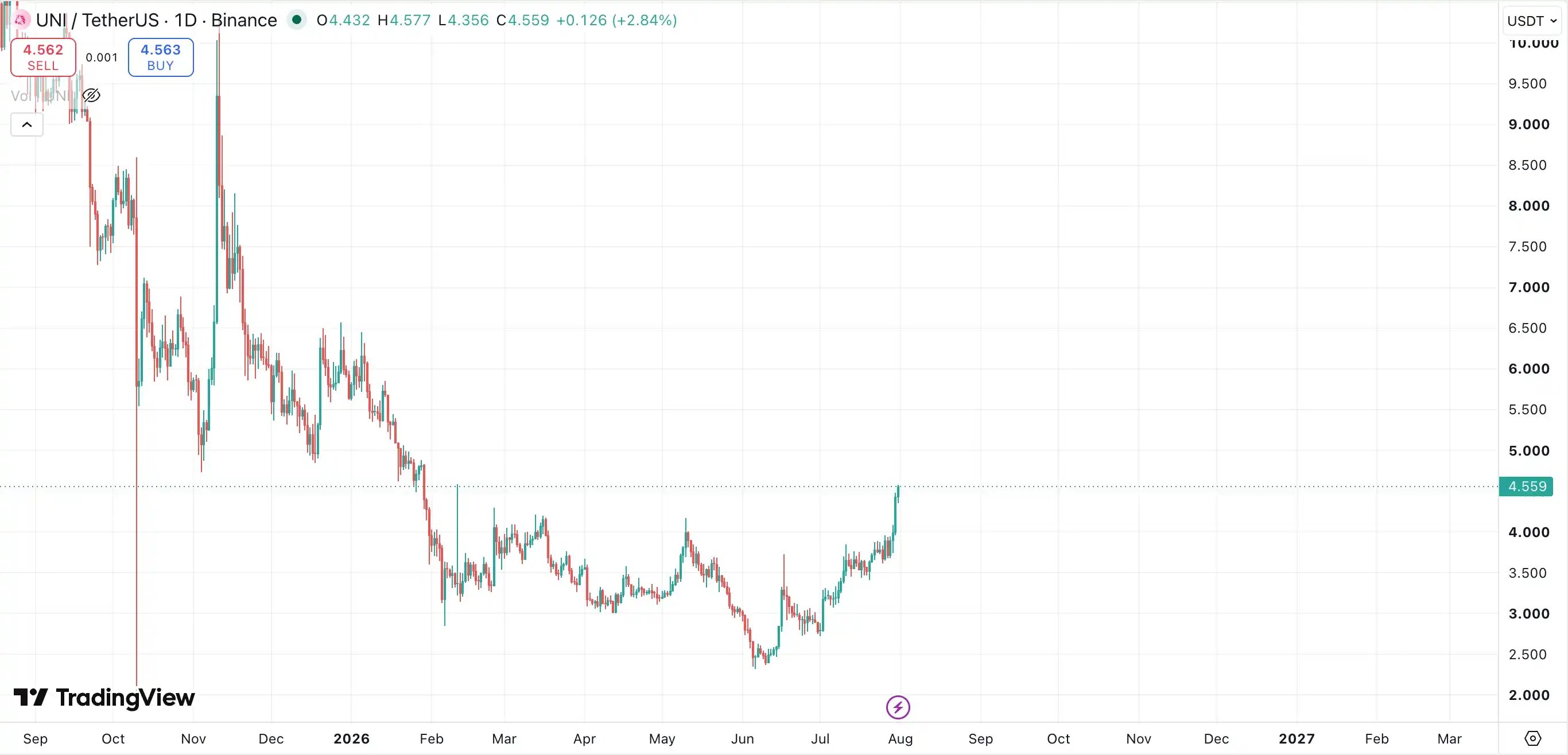
In early June, the price of UNI was hovering around $2.3. By the end of July, it had approached $4.6, nearly doubling in two months. Rewinding to last December, when Uniswap had just passed the long-debated fee switch proposal, UNI rose for only one day before falling alongside the broader market, with little market interest in the leading DEX of the DeFi world.
But the turning point had been set then, though few realized it at the time.
On December 28, 2025, the Uniswap governance proposal UNIfication was officially executed on-chain. The protocol fee switch was activated, diverting a portion of trading fees from Ethereum mainnet v2 pools and some v3 pools to the protocol; sequencer revenue from Unichain, after deducting OP shares and L1 data costs, also flowed into the same fund pool; a one-time burn of 100 million UNI tokens from the treasury served as retrospective compensation for the past years of the "free era"; Uniswap Labs reduced its fees for the frontend, wallet, and API to zero, while receiving an annual 20 million UNI growth budget. All these protocol revenues ultimately converged into a treasury contract named TokenJar, which had only one outlet: buying UNI through the Firepit contract for permanent destruction.
This is what the long-debated "fee switch" truly looked like upon implementation. Since DeFi Summer, the community had debated whether to allocate a portion of trading fees to the protocol, but each vote was stalled by concerns over profit distribution, legal risks, and LP attrition. When it finally passed, the market reaction was quite muted. When the proposal was announced, UNI surged nearly 50% in a few hours, but then declined as the broader market weakened. By March 2026, UNI had fallen below $3.8, ranging sideways around $3 in April and May, and even dropping to $2.3 in early June. The fee switch was turned on, but quietly.
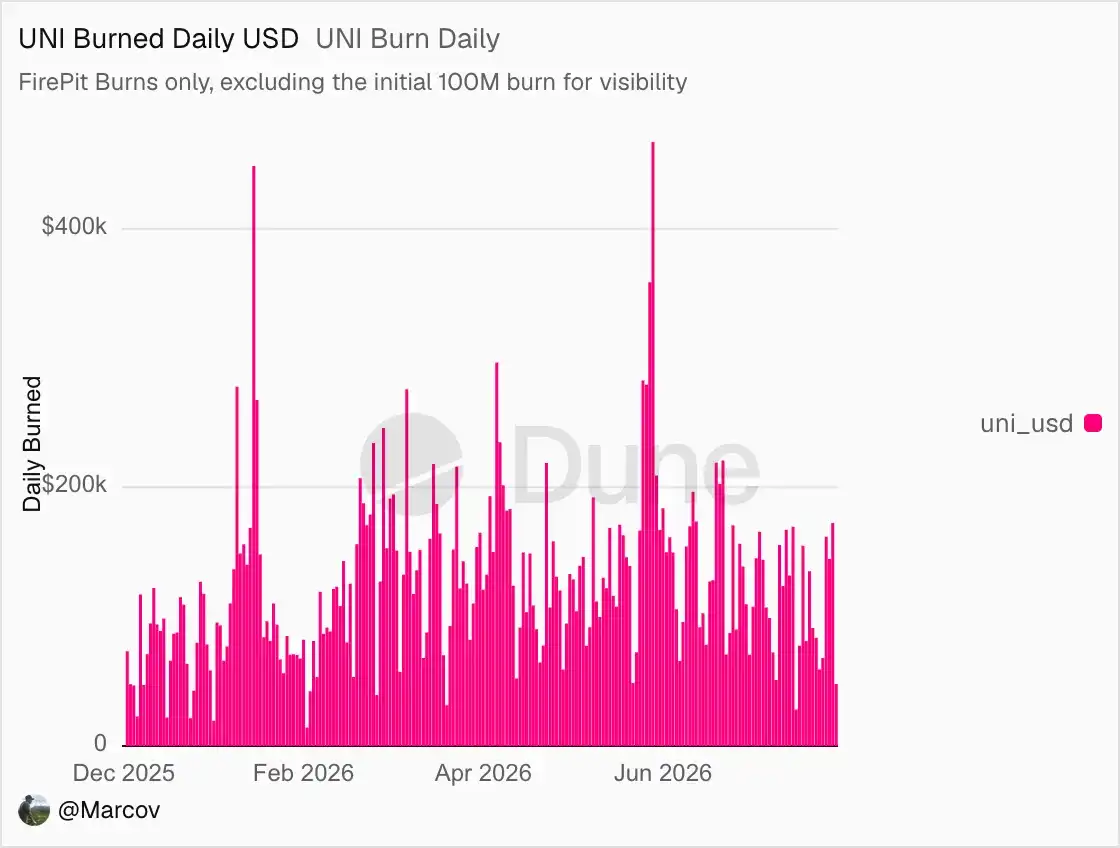
The quietness was due to underwhelming data. According to Dune statistics, in the first 12 days after the fee switch was activated, the cumulative value of burned UNI was only about $800,000, roughly $26-27 million annualized, corresponding to an annual burn of approximately 4 to 5 million UNI tokens. Considering the protocol's annual 20 million UNI growth budget expenditure, this figure held little appeal. By May 2026, cumulative protocol revenue was about $12.3 million, with daily protocol revenue around $73,000. The burn mechanism was operating, but it was more like an engine idling too quietly to be heard.
The change occurred in July. On July 1, Robinhood Chain officially launched, with Uniswap's v2, v3, v4, and UniswapX deployed on the first day. This chain, built for tokenized stocks, pushed Uniswap's daily trading volume to $5 billion within eight days, with cumulative trading volume surpassing $10 billion by July 10. In its first week, Robinhood Chain contributed nearly half of Uniswap's total weekly fees, approximately $11 million. Daily total protocol fees once reached $5.2 million, second only to the two major stablecoin issuers across the entire network. Uniswap founder Hayden Adams called it the most active chain outside of Ethereum mainnet.
Then came the votes. A Snapshot vote from July 7 to 12 decided to extend the fee mechanism to v4 pools, followed by on-chain voting the next week; a temperature check for activating protocol fees on the Robinhood Chain deployment ran from July 10 to 15. On July 27, the v4 fee switch was officially activated. The effect was immediate: according to DefiLlama data, protocol revenue nearly tripled after activation. Daily funds flowing to UNI burns rose from about $114,000 in early July to $325,000, with Robinhood Chain alone contributing $170,000, over half the total, and Ethereum mainnet contributing about $82,000. On the day the news materialized, UNI rose 12%, touching $4.4.
Looking back at this curve, the logic is quite clear. When the fee switch was turned on at the end of last year, the market priced in expectations, and when expectations weren't met, it fell back. But when the burn data climbed from a few hundred thousand dollars per month to a few hundred thousand dollars per day, and when the largest new revenue source by trading volume connected to this burn machine, the market began pricing not expectations but cash flow. For a protocol with annual trading volume in the trillions, token holders previously received nothing. Now, every transaction creates a permanent, automatic buyer for the token. This transformation from a governance token to a cash-flow asset is the core narrative behind this rally.
It's worth noting that buyback-and-burn mechanisms are no longer novel in today's crypto industry. Hyperliquid has a monthly buyback size of nearly $95 million, pump.fun has $35 million, Jupiter uses half its operating income for buybacks, and dYdX, Aave, and Lido are all advancing similar mechanisms. But whether buyback-and-burn works never depends on the mechanism itself, but on the token distribution structure.
UNI is an "old token" that completed its distribution in 2020. Six years have allowed for sufficiently dispersed holdings. There are no massive, pending unlocks in the circulating supply. Approximately $830 million worth of UNI is available for sale on exchanges. The buyback-formed buying pressure genuinely acts on the secondary market. Many new projects also sport buyback-and-burn labels, but the monthly token unlocks for teams and investors far exceed the buyback volume. The burned tokens are just a drop in the bucket against the constant influx of new supply, so prices naturally cannot hold.
This is a rare advantage for old DeFi projects. Having survived long enough, launching early enough, and having sufficiently cleaned-up token distribution allows the buyback-and-burn machine to truly start turning. For UNI, the next question to verify is also specific: Robinhood Chain's gas subsidies are set to expire roughly 90 days after launch. How much trading volume remains thereafter will determine whether this doubling is the beginning of value realization or just another illusion propped up by subsidies.